Main Points:
- In 1915, the Watch Tower still supported going to war if drafted, a policy that stayed about the same from at least as early as 1898 to as late as 1939.
- Watch Tower suggests that if drafted to serve (conscripted) the Bible Student should request non-combatant service but, if not given this option, could shoot to miss, or shoot over the head of the enemy.
- An interesting story is offered in support of God’s blessing on this “tactic.” Based on the meeting between between two “Bible Student” combatants, armed against each other with bayonets, early in 1915.
- The odds against this story actually occurring were so astronomical that the story is, in effect, a claim of a miracle – but a miracle in support of a doctrine that Jehovah never really approved.
________________________________
The 2015 Yearbook of Jehovah’s Witnesses as it appears on the jw.org site contains an article named “100 Years Ago – 1915.” http://www.jw.org/en/publications/books/2015-yearbook/jw-history-1915/
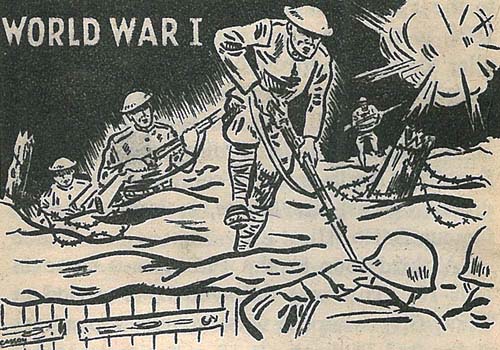
The primary topic of discussion about 1915 in that article is World War I. Note these excerpts:
During 1915, some Bible Students battled with feelings of disappointment. Much of the world, however, fought battles of a different kind. The Great War, later known as World War I, was enveloping Europe. . . . On May 7, 1915, . . . U-boats sank the British passenger ship Lusitania. More than 1,100 people died.
The following, however, is a more interesting point from the same 2015 Yearbook article:
The Bible Students wanted no part of this war. However, they did not then fully understand the Christian position of strict neutrality. While they did not voluntarily enroll in the army, some of them accepted conscription and endeavored to obtain noncombatant roles. If forced into the trenches, others felt that they could simply “shoot over the enemy’s head.”
This policy is confirmed in the July 1, 1915 and the July 15, 1915 issues of the Watch Tower. The article “A View from the Watch Tower” gives the view that this war was the prelude of Armageddon and was predicted to end in anarchy. (By this point in time, the year 1914 was described as the year running from the fall of 1914 to the fall of 1915.) Russell recognized that there would be true Christians fighting in the armies of each nation. The following are excerpts from p.495,496 of this July 1, 1915 issue:
At the same time it should not be forgotten that there are saints of God in every land, and that doubtless there are saints in every army–in these armies because of conscription–in these armies to fulfil the demands of the governments, but with fullest determination that they at the same time owe their highest allegiance to the kingdom of kindness, and fully determined that they will kill nobody. We are hearing from the front, that they are seeking to live up to the teachings of the Word of God, pointed out in the sixth volume of SCRIPTURE STUDIES, and that they are being blessed in so doing. What more could we ask?
That reference is to the sixth volume of Studies in the Scriptures, The New Creation, and is found on pages 594-595, where we read the following:
True, government may not always exempt those opposed to war from participating in it, although a very gracious provision of this kind has in the past been made for some who, like ourselves, believe war to be unrighteous; viz., the Friends or Quakers, exempted from military duty under specially generous laws. We may be required to do military service whether we vote or not, however; and if required we would be obliged to obey the powers that be, and should consider that the Lord’s providence had permitted the conscription and that he was able to overrule it to the good of ourselves or others. In such event we would consider it not amiss to make a partial explanation to the proper officers, and to request a transference to the medical or hospital department, where our services could be used with the full consent of our consciences—but even if compelled to serve in the ranks and to fire our guns we need not feel compelled to shoot a fellow-creature.
That “sixth volume” was first published in 1904, and the idea seems very little changed in the July 1, 1915 Watch Tower magazine:
Inquiries come to us respecting the advisability of enlisting in hospital corps, rather than to be conscripted for the regular service later on. Our advice would be to wait for the leadings of the Lord’s providence and to take such steps only when fully assured of their wisdom. Now is a good time to remember the words of the Lord, “Wait ye upon Me, saith the Lord.” It would be a mistake, however, for any of the Lord’s people to think themselves called upon to interfere in any manner with the world’s course in respect to enlistment. Let the worldly use their own judgment, while God’s consecrated people use theirs. To be “subject to the powers that be,” implies not merely a willingness to serve under compulsion, but implies also that we will not oppose earthly governments in any public manner.
In other words, do not volunteer for hospital service in advance of being conscripted or drafted. Allow yourself to be conscripted even if this means you may inevitably end up fighting with guns, cannon, bayonets, and other armaments in the trenches and on the front lines. Most Bible Students would be expected to request a transfer to a non-combatant role, and then hope for the best.
Note, too, how the Watch Tower is also being very careful not to speak out against either the enlistment or conscription processes in the various countries where the Bible Students followed the advice of the Watch Tower. Before this war was over, however, that advice about not speaking out against conscription or enlistment would often be ignored when J. F. Rutherford took over the reins of the Watch Tower later the following year (1916). More specifically, it was the 1917 Finished Mystery (Studies in the Scriptures, Volume VII) with anti-war sentiment –actually anti-conscription sentiment– found on a couple of pages. Rutherford had the offending pages removed, by having them torn out of already-printed volumes. However, this wasn’t enough to appease the authorities. Papers from the 1917 FBI investigation also show that there were various letters collected from Rutherford’s offices which confirmed that Rutherford was regularly being called upon to help the Watchtower’s Bible Students avoid conscription. [Future post or article is planned on this subject.]
This idea had actually appeared well before Studies in the Scriptures, Volume VI, from 1904. It had also appeared when the United States was becoming involved in its first major international conflicts since 1879, when the first Watch Tower was published. Outside of wars with Native American tribes, 1898 was the time of a war in Samoa, resulting in a new territory: American Somoa. The most prominent conflicts in 1898 were due to the Spanish-American War involving fighting by U.S. soldiers in Cuba, Philippines, Puerto Rico and Guam.
Therefore, the July 1898 Watch Tower, p.204, had stated:
CHRISTIAN DUTY IF DRAFTED.. . . If, therefore, we were drafted, and if the government refused to accept our conscientious scruples against warfare (as they have heretofore done with “Friends,” called Quakers), we should request to be assigned to the hospital service or to the Commissary department or to some other non-combatant place of usefulness; and such requests would no doubt be granted. If not, and we ever got into battle, we might help to terrify the enemy, but need not shoot anybody.
That led to the questions printed in the August 1898 issue, p. 231:
Question. I was surprised to note your advice to any who might be drafted into the army. Would not your advice seem like compromising to avoid trouble?
Answer. It is proper to avoid trouble in a proper manner. It is proper to compromise when no principle is involved, as in the case mentioned. Notice that there is no command in the Scriptures against military service. Obedience to a draft would remind us of our Lord’s words, “If any man compel thee to go a mile, go with him twain.” The government may compel marching or drilling, but cannot compel you to kill the foe. You need not be a good marksman.
Question. You suggested in a recent WATCH TOWER that, if drafted and in the army, we need not shoot to kill. Would such a course be right? Would it not be fraudulent?
Answer. No; it would be quite right to shoot, not to kill. You forget, perhaps, our provisos, which were that we explain our conscientious scruples against war, and seek to be excused; if not excused, that we seek non-combatant positions, as nurses, etc.; but if compelled to go a mile or many miles as a soldier, we still need not kill anybody.
None of these previous references from either 1898 or 1904 had specifically mentioned the idea or the term about “shooting over the enemy’s head.” Where did that come from exactly? The idea was first mentioned in the July 15, 1915, page 216, which also included the experience that is referenced in the recent 2015 Yearbook. Quoting from that Watch Tower, it states:
I have something to read to you. It is a translation of a letter. It was written in Hungarian, to a Slav brother in the United States, and was forwarded to us. A portion of the letter follows:
“A Hungarian soldier, injured on the battlefield, was returned home wounded. He was there met by some of our brethren, and later was led to diligent and earnest study of the Scriptures, and finally made his consecration to the Lord. This he symbolized last January, at the hands of our dear Brother Szabo. A few days later he was obliged to return to the front and to the trench, in Galicia. A cannon shot burned the cap from his head; earth caved in upon him. He was dug out by his comrades, and again sent to the hospital. This brought the dear brother into our midst again, but for a short time only. Presently he had to return to the firing line again.
“This time they came within 800 feet of the Russian line, and they received the command, ‘A bayonet charge!’ The Hungarian brother was at the end of the left wing. He sought only to protect himself from the enemy, hence endeavored merely to knock the bayonet from the hand of the Russian with whom he was confronted. Just then he observed that the Russian was endeavoring to do likewise; and instead of using his opportunity to pierce his opponent, the Russian let his bayonet fall to the ground; he was weeping. Our brother then looked at his ‘enemy’ closer–and he recognized a ‘Cross and Crown’ pin on his coat! The Russian, too, was a brother in the Lord! The Hungarian brother also wore a ‘Cross and Crown’ emblem–on his cap.
“The two brethren quickly clasped hands and stepped aside. Their joy was overflowing, that our Heavenly Father had permitted them to meet even on the field of the enemy! They could not understand one another’s speech, but by signs they conversed, taking out their Bibles–and the Russian had the SCRIPTURE STUDIES in his pocket with a song book, all bound in one volume, and a photo of Brother Russell. The Brother then took the bayonet of the Russian brother, and gave him over as a prisoner of war; and he still remains as such in Hungary, while the Hungarian brother has now been sent to the hospital for the third time.”
While there are not many rich or noble amongst the Lord’s brethren, yet when it comes to telling the Truth, they manage it very well!
In Germany, Great Britain, and all over Europe, our people have been conscious for years that this war was coming on. They have been writing to me and continually inquiring how they should proceed if they were drafted or went into the army. In Volume Six of SCRIPTURE STUDIES, the friends are instructed to avoid taking life. If they were ever drafted into the army they should go. If they could be sent to the Quartermaster’s Department to take care of the food, that would be desirable, or into the hospital work. They should endeavor to get such positions. They could not be expected to do service in the way of killing. If they were obliged to go on the firing line, they could shoot over the enemy’s head, if they wished.
And that is the way these brethren did; each had this same thought in mind. This letter shows the love of the brethren even on the field of battle, and in the enemy’s land, with carnal weapons. It made no difference that one was a Hungarian and the other a Russian!
I doubt that any readers were expected to question the story although the odds against it actually happening were overwhelming.
On the one hand, there were 15,000 or more active readers of the Watch Tower in 1915. The July 1, 1915 issue quoted earlier had stated:
Approximately 15,000 have already indicated to us that they have taken the Vow, and that therefore they belong to this great world-wide Prayer Circle which remembers each other and all the laborers in the Lord’s Kingdom daily at the Throne of Grace.
Other numbers provided for this time period would tell us that there could be as many as 18,000 or more associated with the Watch Tower and Bible Students in 1915. This means that with a world population of 1,800,000,000, according to the U.S. Census Bureau, there may have been one Bible Student for every 100,000 people. (Today it’s more like 1 out of every 1,000 persons.)
But most of those were in the United States. Based on the distribution of literature worldwide, 98% or more of all Watch Tower followers were in North America, Australia, United Kingdom, Germany, Spain, Italy, Greece, etc. Between 1% and 2% (max) could be expected in Hungary and Russia.
Even the 1% to 2% estimate is probably high, but also note the following number of “active” Bible Students from within just a few years during this same period. The “Jehovah’s Witnesses – Proclaimers” book says the following on page 425:
The actual number who were then sharing in that work, however, was small. Some who had fearfully held back during 1918 became active again, and a few more joined their ranks. But the records that are available show that in 1919 there were only some 5,700 who were actively witnessing, in 43 lands.
If we average the 5,700 with the 15,000 we come up with about 10,000. But about half of these were women, leaving only 5,000. That’s no more than 50 in Russia and 50 in Hungary. And we can assume that as few as 30% would have been conscripted to military service based on age and eligibility. That would leave 15 on each side. Also Russell claimed that reports from Europe showed that there had been good success in following the Watch Tower instructions that had included making a request for non-combatant roles. Assuming only one-third found re-assignment this way, we have only about 10 “cross-and-crown” wearing Bible Students on each side that might have found themselves battling each other in the front lines.
It’s fairly easy to imagine the odds of laying out two decks of cards in rows across from each other and testing whether, for example, the Ace of Spades from each deck happens to end up exactly across from each other. But still, it might happen often enough to make you think this is a fair possibility, even if not likely. But here we are looking for something more like dumping two haystacks on top of each other, each with a single needle in it, and then finding out that those two needles had fallen exactly against each other.
If you are looking for more mathematical accuracy, it seems even less likely than the haystack example. Here’s why:
Recall that the Hungarian and Russian “Cross and Crown” wearers are in a battle in Galicia just a few days after the Hungarian has converted to become a Bible Student in January 1915. A series of battles matching this description is known to have occurred between January and March 1915. Note the following from From http://www.historyplace.com/worldhistory/firstworldwar/index-1915.html :
March 22, 1915 – The Russians capture 120,000 Austrians at Przemysl in Galicia. This marks the culmination of a series of winter battles between the Austrians and Russians to secure the strategic Carpathian Mountain passes and opens the way for a Russian invasion of Hungary. Realizing this, the Germans and Austrians make plans to combine their troops and launch a major spring offensive.
That’s quite a large number of soldiers who must have been involved in this specific series of battles. But look at the size of the military population they were chosen from, based on this chart from http://spartacus-educational.com/FWWarmies1914.htm :

Those battling against each other here were chosen from armies that ranged from 6 to 12 million on the Russian side and 3 to 8 million on the Austria-Hungary side. Therefore, Bible Students are not likely to make up more than one out of every million soldiers. (1:1,000,000). So now imagine those two card decks, not of 52 cards each, but of one million cards each with only one Ace of Spades in each deck. Now try to imagine the odds of those two aces ending up exactly across from each other.
The story of the two soldiers is repeated in the “2015 Yearbook” without any question, of course, about its authenticity.
The story, therefore, describes something no less than a mathematical miracle! And it was put to use in the defense of a doctrinal position that is now considered incorrect, and which wasn’t updated to its current form until as late as 1939. Note the “Proclaimers” book again, from page 191:
Though Jehovah’s Witnesses quickly discerned some issues that involve a Christian’s relationship to the world, other matters required more time. However, as World War II gathered momentum in Europe, a significant article in The Watchtower of November 1, 1939, helped them to appreciate the meaning of Christian neutrality.
This would mean that Jehovah, in effect, produced a miracle in support of a doctrine that he never approved. Oddly, no such miracle has ever occurred that would seem to support the Watch Tower’s stance on blood transfusion, for example. And for that matter, what should have been the odds for discovering a Greek manuscript of the “New Testament” with Jehovah’s name in it? Since the Watchtower claims that this was supposedly in all the correct originals, the odds in favor of such a find should be very high. It wouldn’t have even required a a miracle, and yet the miraculous protection of the accuracy of the Biblical manuscripts is often discussed in the Watchtower. Could not even one of these “accurate” manuscript examples have survived?
If Jehovah could make a miracle happen in support of a “false” doctrine, what would have made it so difficult for Jehovah to produce a miracle in support of a “true” doctrine?