Tag Archives: Watchtower

Carl Sagan’s Remarks About Jehovah’s Witnesses False Prophecies

Alan Feuerbacher

A few years after the complete collapse of everything C. T. Russell had predicted, J. F. Rutherford began a process of replacing Russell’s unfulfilled predictions with a series of invisible and spiritual events associated with the years 1914 and 1918. By the early 1930s the process was complete.

An interesting comment on this transformation was made by Carl Sagan in his book Broca’s Brain (New York: Ballantine Books, 1979, pp. 332-333):

Doctrines that make no predictions are less compelling than those which make correct predictions; they are in turn more successful than doctrines that make false predictions.

But not always. One prominent American religion confidently predicted that the world would end in 1914. Well, 1914 has come and gone, and — while the events of that year were certainly of some importance — the world does not, at least so far as I can see, seem to have ended. There are at least three responses that an organized religion can make in the face of such a failed and fundamental prophecy. They could have said, “Oh, did we say ‘1914’? So sorry, we meant ‘2014.’ A slight error in calculation. Hope you weren’t inconvenienced in any way.” But they did not. They could have said, “Well, the world would have ended, except we prayed very hard and interceded with God so He spared the Earth.” But they did not. Instead, they did something much more ingenious.

They announced that the world had in fact ended in 1914, and if the rest of us hadn’t noticed, that was our lookout. It is astonishing in the face of such transparent evasions that this religion has any adherents at all. But religions are tough. Either they make no contentions which are subject to disproof or they quickly redesign doctrine after disproof. The fact that religions can be so shamelessly dishonest, so contemptuous of the intelligence of their adherents, and still flourish does not speak very well for the tough-mindedness of the believers. But it does indicate, if a demonstration were needed, that near the core of the religious experience is something remarkably resistant to rational inquiry.

100 Years Ago: What was Bethel like in January 1917?

Q. Where did the Watch Tower Society get the idea to call it “Bethel” in the first place?

A. The answer to this question is being saved, not for this post, but the next one. This will give a chance for readers to participate if they think they know the answer. We’ll ask this question on Facebook and Twitter, where we already have a couple thousand followers, and we’ll give credit to anyone who knows. The question is not as obvious as it sounds at first. We’re not asking  why calling it Bethel is scripturally appropriate, or what reasons we might think we have for calling it Bethel now. We are asking why it was called Bethel at the time it was first given that name.

We learn from the 1975 Yearbook that the adjacent buildings, 122 and 124 Columbia Heights, had already been owned together since 1908. It was in 1911 when a rear addition was added.

*** yb75 pp. 52-53 Part 1—United States of America ***
For a time the Society’s headquarters staff was housed largely at 124 Columbia Heights. Later, the adjoining building at 122 Columbia Heights was purchased, enlarging the Bethel home. The year 1911 saw the completion of a rear addition extending nine floors down a precipice to Furman Street. It provided much more space for living quarters and other facilities, including a new dining room.

We also gather from a 1969 Watchtower magazine that it was in 1908 when the two adjacent 4-story buildings were purchased, and that they were converted into a home for about 30 persons in 1909, and then torn down to put up a single 9-story structure, housing about 180 persons in 1927.

*** w69 6/15 p. 380 Expansion at Headquarters of Jehovah’s Witnesses ***
During the dedication program the president of the Watchtower Society, Nathan H. Knorr, described the expansion of the headquarters of Jehovah’s witnesses since its move to Brooklyn in 1909. In 1908 the old four-story brownstone parsonage of Henry Ward Beecher at 124 Columbia Heights and a similar building adjoining it had been purchased. These were converted into a home for the Society’s headquarters staff of thirty persons.
But due to rapid expansion, in 1911 spacious new housing accommodations adjoining the rear of the home on Columbia Heights were completed. Then in 1927, N. H. Knorr explained, further expansion at headquarters necessitated tearing down the buildings on Columbia Heights and putting up a new nine-story structure there, providing, in all, approximately 120 rooms. At that time there were about 180 members of the headquarters family.

So the number was 30 in 1909, and “rapidly expanded” by 1911. We also read that it was about 180 in 1927.

So how many in 1917? That would depend on how rapidly it had expanded by 1911. Another factor would be the number of persons affected when Rutherford dismissed some persons in January 1917 and a larger number left by July 1917. (For reasons many readers will already be aware of, and which we will detail in later posts.)

Based on the description of the expansion, and the number of intervening years, we should expect the number to be between 30 and 180, probably under 110, which would be the midpoint between 30 and 180.

But we can get a pretty good sense of the actual number from the 1920 Census. Here we have 83 persons listed at 122 and 124 Columbia Heights.

It was actually split up as 3 persons at 122, and 80 persons in 124. We would expect that the persons listed here in January 1920 would be a fair reflection of the persons who had remained after July 1917. The Census includes information about their age, gender, and national backgrounds, too.

Most JWs will also recognize many of these names as persons they have read about, and even met in many cases:

1920brooklyn1

1920brooklyn2

1920brooklyn3

1920brooklyn4

1920brooklyn5


One more rarely seen source of information about Bethel, 100 years ago, is the testimony of Charles Taze Russell in 1914 when he hoped to win a libel suit against a local Brooklyn newspaper.

Recall that 1914 was the culmination of a lot of growth and activity by the Watch Tower Society due to the expectations for October 1914. Naturally, when 1914 proved disappointing, many of these persons left. In addition, 1914 was a year when the Watch Tower Society was spending as if there were no tomorrow. Of course, they would never have spent so much on “moving pictures” for the “Photo-Drama of Creation” if they thought they would need this money in 1915.

Due to those expenses, a lot of persons were laid off from Bethel by the end of 1914. We would expect the numbers in the middle of 1914 to be even higher, then, than the numbers in early 1917. That’s exactly what the evidence from Russell’s testimony bears out, along with a few more hints about the activity there.

These images below may be hard to read, but they indicate about 40 persons who belong directly to the Peoples Pulpit Association who live at “Bethel” in addition to another 60 or 70 who are assistants, wives and helpers to the ministers. This would be 100 or 110 living there in early 1914, and therefore the number of 86 in the 1920 Census appears to be a reasonable reflection of the persons there in 1917.

russell-test4

russell-test3

russell-test1


Save

Save

Save

Save

Save

Who ‘wondered admiringly’ at the League of Nations [as if] to fulfill Revelation 17:8?

Summary: The Watchtower explains that the initial beast of Revelation 17:8 is the “League of Nations.”  Revelation 17:8 (NWT) says that persons whose names have not been written upon the scroll of life will “wonder admiringly” at this beast.  It’s surely just an ironic coincidence, yet, in 1919 the Watchtower not only “wondered admiringly” at the League of Nations, they went so far as to actually use sentences that contained those literal words:

  • “We cannot but admire the high principles embodied in the proposed League of Nations.”
  • “This fact makes all the more wonderful the ideals which they express.”

(Revelation 17:8)  The wild beast that you saw was, but is not, and yet is about to ascend out of the abyss, and it is to go off into destruction. And when they see how the wild beast was, but is not, and yet will be present, those who dwell on the earth will wonder admiringly, but their names have not been written upon the scroll of life from the founding of the world. [NWT Reference Edition]

The 2013 Revised NWT changes “will wonder admiringly” and instead uses the term “will be amazed.” I couldn’t help but ‘wonder in amazement’ about whether a certain post discussing this same subject had already come to the attention of the translators. It was a post I had put on beliefnet.com several years prior which made the same point made here, along with some additional information.

The Watchtower Speaks for Itself

For many decades, the Watchtower has identified the initial beast of Revelation 17:8 as the League of Nations:

*** w85 10/1 p. 15 par. 9 Peace, Security, and the ‘Image of the Beast’ ***
9 Our identification of this beast is confirmed by some further details given by the angel: “The wild beast that you saw was, but is not, and yet is about to ascend out of the abyss, and it is to go off into destruction.” (Revelation 17:8) This has already been fulfilled in part. The second world war effectively killed the League of Nations.

In various places, the Watch Tower publications have repeatedly reminded readers (over 200 different times)  that the clergy of Christendom, both Catholic and Protestant, have promoted the rejection of Christ’s kingdom and even the “worship” of this beast by hailing the League of Nations as the “political expression of God’s Kingdom on earth.” Note:

*** ka chap. 11 pp. 197-198 pars. 27-28 “Here Is the Bridegroom!” ***
27 The position taken by the “discreet” virgin class on this issue was unequivocal from the start. In evidence of this, on Sunday afternoon, September 7, 1919, at the Cedar Point convention, President Rutherford gave his public address on “The Hope for Distressed Humanity,” in which he pointed out God’s disapproval of the League of Nations. To quote from the report published in the Sandusky (Ohio) Star-Journal on Monday, September 8, 1919:
“President Rutherford . . .declared a League of Nations formed by the political and economic forces moved by a desire to better mankind by establishment of peace and plenty would accomplish great good, and then asserted that the Lord’s displeasure is certain to be visited upon the League, however, because the clergy—Catholic and Protestant—claiming to be God’s representatives, have abandoned his plan and endorse the League of Nations, hailing it as a political expression of Christ’s kingdom on earth.—The Watch Tower, under date of October 1, 1919, page 298, column 1.”

*** ka chap. 13 p. 250 par. 22 Settling Accounts with the Slaves of Today ***
22 Of course, the sectarian church members of Christendom . . . . took a compromising course with the politicians and militarists of this world. . . . They turned their interest and attention to the proposed League of Nations, which the Federal Council of the Churches of Christ in America called “the political expression of the Kingdom of God on earth.” (Isaiah 9:6, 7) They tried to increase the number of supporters and worshipers of that man-made international organization for world peace and security.

Was the Watch Tower’s position on this issue really “unequivocal from the start”? In answering this question note the words that are underlined and highlighted from the February 15, 1919 Watchtower:

“We cannot but admire the high principles embodied in the proposed League of Nations, formulated undoubtedly by those who have no knowledge of the great plan of God. This fact makes all the more wonderful the ideals which they express. For instance, it has been made plain by President Wilson and the advocates of his ideas that the proposed League of Nations is more than merely a league to enforce peace. They would not have us consider it to exclusively from the standpoint of politics or of military relations. It should be considered as fully from the economic and social points of view. The President’s idea seems to be that the League of Nations which he proposes would stand for world service rather than mere world regulation in the military sense, and that the very smallest of nations shall be participants in its every arrangement. In other words, his idea undoubtedly is that the league shall not be established merely for the purpose of promoting peace by threat or coercion; but that its purpose, when put into operation, will be to make all nations of earth one great family, working together for the common benefit in all the avenues of national life. Truly this is idealistic, and approximates in a small way that which God has foretold that he will bring about after this great time of trouble.” — Watch Tower,  February 15, 1919,  p.51 [Reprints page 6389].

In other words, this 1919 Watchtower considers the League of Nations to be, essentially, ‘the political expression of God’s kingdom on earth.’ In fact, a careful reading of the article gives at least some evidence that this particular phrase was already known to the writers of this Watchtower article, and this article was intended to show agreement with that idea.

That might sound surprising coming from the same magazine that has declared itself not to have ever compromised on that particular issue in the way that Catholic and Protestant clergy and their constituents had supposedly done. But the Watchtower took it a bit further, literally admitting their amazement at the wonderful and admirable ideals of the League of Nations.

Some Additional Details and Resources 

Additional resources will be added to this article or forthcoming follow-up articles to show that the Watch Tower publications have not been totally accurate about many other claims and details surrounding this issue. These details might include:

  1. The Watch Tower’s repeated claims about who actually promoted the idea that the League of Nations was “the political expression of God’s kingdom on earth.”
  2. The hypocrisy of the condemnation of the “political expression” claim is not only shown in the first portion of this article, but is shown to be an ongoing problem for the Watch Tower publications. For example:
    • There was a supposed “cleansing” related to the political neutrality of the “Faithful Slave” (now, Governing Body) as of 1919. Yet, we see similar wording of Joseph F. Rutherford in a letter to Adolph Hitler, which also admits an admiration for the ideals and principals of the German National Socialism (Nazi regime). Rutherford similarly tied those ideals of Hitler as a political expression of the kingdom of God.
  3. There is also a serious problem with the claim that the Watch Tower (especially through a talk by Nathan H. Knorr) actually predicted the fall of the League and its rise again as the United Nations.
  4. A problem starting with the very application of the League of Nations to Revelation 17:8.

Most of the four points above have been made by others and can be found at various places.

  1. #1 is fairly debunked here: https://www.jehovahs-witness.com/topic/17563/fccc-league-on-nations-un-watchtower-rare-article?size=20&page=1
    • The links to the actual source material may not show up any more on that site because the discussion is 15 years old, or more. The same resource pages can be found here: https://books.google.com/books?id=lEVQAQAAMAAJ
    • The book is called: Federal Council Bulletin: A Journal of Religious Co-operation and Inter-church Activities, Volumes 1-3
    • The quote(s) in question are found on page 12 of Volume 2 (1919), especially at the end of the fourth paragraph under Declarations. (The book starts out with 1918, and the page numbering starts over for 1919 and 1920.)
    • Note that similar sentiments can be found in that book as early as January 1918.
    • The most serious problem with the Watch Tower’s claim is that the WTS doesn’t seem to realize or admit that this publication of the Federal Council of Churches of Christ was speaking about what the League “should be” not what it was. They were speaking of an “ideal.” They were not promoting “worship” any more than the Watchtower itself was in the article they published the following month with similar sentiments. Also, this declaration about the proposed League only represented a small number of Protestant churches although it was presented as representing all of Christendom, Protestant and Catholic. The statement itself was evidently an invention of the executive committee of the FCCC.
  2. The problems with the lack of neutrality in the pre-1919 era of the Watch Tower are not given much attention. Russell’s fervent Zionism that survived into the late 1920’s is a case in point. On this site, a couple of other examples are mentioned. They provide some context for the thinking published in 1919. Russell wrote a letter to the President in 1915 to advise him to sell some of the Philippines to Japan because, as Russell said, Filipinos were basically lazy and Japanese were industrious. Russell also advised his readers not to try to avoid conscription in the military and not to insist on hospital work. If assigned to the front lines, they should merely shoot over the heads of the enemies. Rutherford’s attempts to avoid prison in 1918 under the Espionage Act also involved some embarrassing compromise, which was revisited but omitted, of course, during the preparation of the “Proclaimers” book. The problems of lack of neutrality after 1919 are better known. Rutherford’s Declaration and the letter to Hitler is discussed in Jim Penton’s well-researched book: “Jehovah’s Witnesses and the Third Reich” (Amazon) and a summary of the issue is available in an article found on jwfacts.com. Under Rutherford’s presidency, especially, Watch Tower publications continued to stay involved deeply in several political matters and often tied their miscalculated political interpretations in order to predict the imminent end of this system. Since the time of Knorr, the WTS has generally been much more careful. (Although the fiasco of joining the United Nations as an NGO from 1992 through 2001 proved to be most embarrassing.)
    • One salient point in the 1933 “Declaration” was the sentence: “Instead of being against the principles advocated by the government of Germany, we stand squarely for such principles, and point out that Jehovah God through Christ Jesus will bring about the full realization of these principles.” In other words, the German Nazi ideals, while not the equivalent of the kingdom of God, were at least a human, ‘political expression’ of the same principles as the kingdom of God. (Sound familiar?)
    • The “Letter to Hitler” included the same idea as the Declaration: “To the contrary, referring to the purely religious and unpolitical goals and efforts of the [Bible Students], it can be said that these are in full agreement with the identical goals of the national government of the German Reich.”
  3. The “prediction” by Knorr that the League would die and then come back as the United Nations is faulty primarily because it was not an interpretation exclusive to the Watch Tower Society, and had been previously and concurrently predicted several times by groups similar to the Watch Tower. A very good discussion is found here by Carl Olof Jonsson.
  4. Whether or not such an organization as the League of Nations actually fits the ideas of Revelation 17:8 is a much more basic question that JWs rarely, if ever, would ask themselves. Yet, an interest in truth and belief that correct Bible interpretation is of value should motivate JWs to “make sure of all things.” A good summary of the history of the League of Nations can be found on Wikipedia. https://en.wikipedia.org/wiki/League_of_Nations .  Note that while the League was formally founded on January 10, 1920, it was being organized and defined from the very beginning of World War I. As of late 1917 and early 1918 the form it would take was directly anticipated with U.S. involvement and promotion by President Woodrow Wilson. Also note that the League basically inherited the organizations and structure of one of the previous attempts to create such an entity, the IPU or Inter-Parliamentary Union, the League’s forerunner. (see https://en.wikipedia.org/wiki/Inter-Parliamentary_Union )
    • The IPU is of interest from another perspective, too. The Watch Tower publications have made a lot over the idea that the League “died” and came to life again after WWII as the United Nations. The problem is that could be said of a lot of organizations whose primary aim was to promote peace. How astonishing would it be that a generally “pacifist” leaning organization might temporarily disappear during a large war? The IPU was, of course, a relatively neutral and pacifist organization, too, and the book Neutrality in Twentieth Century Europe, p. 298 explains this and adds: “The outbreak of the First World War prevented further action, and during the war most of the IPU’s work was seriously hampered.” (Although effectively replaced by the League of Nations after the war, the IPU resumed full operations and continues to this day.) For that matter, something similar happened to the Watch Tower Society itself because of the same war.
    • So if it happened to the League’s “predecessor,” then how appropriate is it to say that the world would be amazed that an organization attempting neutrality and peace might disappear for a while.
    • If others could predict the demise of the League after failing in its agenda during WWII (just as the IPU had failed to keep peace in WWI) then it really was not astonishing at all, and for this reason the League of Nations does not fit Revelation 17:8.
    • An more salient point is this: The Bible often represents nations as beasts. It might be true that an international organization could act in a vicious, inhumane, beastly manner, similar to some individual nations. But how logical is it to depict an organization that tries to promote political neutrality, peace and goodwill as a beast? When the war came, did anyone expect the League of Nations to put up a vicious, beastly fight to stay in power? Was there really something so astonishing and amazing about its temporary disappearance and reappearance when the war was over? If it reappeared as the United Nations, has that entity really shown itself to be a vicious beast?

TYPES AND ANTITYPES: Transcript of discourse by David Splane at October 2014 Annual Meeting

The 2014 Annual Meeting Program video can be found on tv.jw.org (currently found under Programs and Events). The following speech can be found about the 2 hour and 8 minute mark in the video. It ends at about the 2 hour and 25 minute mark.

“David Splane of the Governing Body will speak to us on the theme: ‘Types and Antitypes.’” 

IT’S NOT FUNNY IF YOU HAVE TO “SPLANE” IT 

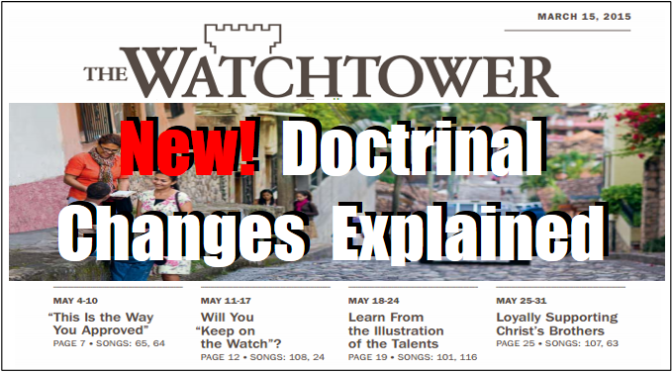
The following is an unofficial transcript of that talk. It is very informative to note the differences between this, the original talk, and the Watchtower article that was derived from it. Our site’s commentary on the March 15, 2015 Watchtower article is found here.

Transcript begins:

________________________________________________

Let’s get right into our subject: types and antitypes.

Now, years ago, our publications often applied certain Bible accounts and certain bible characters as “types” of something greater. But you’ve noticed that, in recent years, that is seldom done, and the purpose of this talk is to explain why.

First of all what is a type and what is an antitype? Well, the Watchtower of September 15, 1950 defined them this way. It said:

“A type is a representation of something that will come to pass at a future time. The antitype is the reality of the thing which the type represents.”

So that is the definition that was given by The Watchtower. And we might add that Jehovah is usually involved in designing the type.

Now, take the tabernacle. Jehovah was very clear about the construction of the tabernacle: what materials were to be used, the dimensions and so forth. Why? Well, apparently because he had designed the tabernacle to be a type of something greater: his great spiritual temple. And the temple was the antitype.

The sacrifices on the Day of Atonement. Jehovah was very careful about how events on the Day of Atonement were to unfold. And again, we have to realize that something was going to have to picture or foreshadow the perfect sacrifice of Jesus Christ. So, the sacrifice on the Day of Atonement, the type, and the perfect sacrifice of Christ, the antitype.

Now consider another example. When the disobedient Israelites in the wilderness were bitten by poisonous snakes, Moses is told by Jehovah to fashion a copper serpent and to place that serpent on a pole. Now that was a type. Now Jesus explains what it was a type of. Let’s turn to John chapter 3, John chapter 3 and verses 14 and 15. John 3: 14 and 15 If you are using an iPad, I’ll give you a chance to catch up. [Laughter] I couldn’t resist. “And just as Moses lifted up the serpent in the wilderness, so the Son of Man must be lifted up, so that everyone believing in him may have everlasting life.” Now, would anyone doubt that this is a type? Of course not. Because Jesus said it was.

Well notice that in both these examples, the tabernacle and the copper serpent, Jehovah was involved. He designed the type so that it would fit the antitype. He told Moses, for example to fashion a copper serpent and put it, not on a rock, but on a stake. And of course the tabernacle prefiguring the great spiritual temple.

And from the apostle Paul we learn even more about types and antitypes. For example, Paul, in Hebrews: Isaiah and his 2 sons represent Jesus, and the anointed. He also explains that Moses, the mediator of the Law covenant, represents Christ the mediator of the new covenant. And we learn from the letter to the Galatians that Abraham’s relationship with Sarah and Hagar, represents Jehovah’s relationship with the nation of Israel, and with the heavenly part of his organization. Type and antitype.

Now we know that these were genuine types because, the word of God says they are. But here is the question:

Who is to decide if a person or an event is a type if the word of God doesn’t say anything about it? Who is qualified to do that? Our answer? We can do no better than to quote our beloved brother, Albert Schroeder, who said:

“We need to exercise great care when applying accounts in the Hebrew Scriptures as prophetic patterns, or types, if these are accounts are not applied in the Scriptures themselves.”

Wasn’t that a beautiful statement? We agree with it.

Now the study of types and antitypes is not unique to Jehovah’s Witnesses. During the past 2,000 years, Catholic and Jewish scholars have made quite a diligent study of types and antitypes. In fact, there is even a name for the study. They call it “typology.”

The first century Jewish scholar, Philo of Alexandria, for example, suggested that the serpent in the garden of Eden, the tree of knowledge and the cherubs that were guarding the entrance to the garden were all typical of something greater.

And then describing the teachings of such early writers as Origen, Ambrose and Jerome, the International Standard Bible Encyclopedia says this:

“They sought for types and of course found them, in every incident and event, however trivial, recorded in Scripture. Even the most simple and commonplace circumstance was thought to conceal within itself a hidden truth. Even in the number of fish caught by the disciples when the risen Savior appeared to them,” he says, “How much some have tried to make of that number:, 153 .”

One scholar made much of Jacob’s purchase of Esau’s birthright with a bowl of red stew. Very significant that the stew was red. To him, the red stew pictured the red blood of Christ. The inheritance pictured the heavenly inheritance. It’s all… By that reasoning, Jacob pictures Jesus, Esau’s birthright pictures the heavenly inheritance, and the red stew pictures Jesus’ precious blood.

Now on the surface that might sound plausible to some, until you think about it. When you think about it you see three problems. First of all, Jehovah didn’t design the type. Jehovah did not tell Esau to sell his birthright. Selling his birthright was wrong, and Jehovah never tells us to do something that’s wrong. Second, who ate the stew? Esau did. So are we to conclude that, by giving up his inheritance, Esau put himself in line for the ransom sacrifice of Jesus Christ? That doesn’t make any sense. And most importantly, nowhere in Scripture do we read that the event was a type.

Now the study of types and antitypes was not only common among Catholic and Jewish scholars, but were very prominent among Protestant scholars as well. The Puritans, like Edward Taylor, applied many Bible events to themselves. The Baptists and Congregationalists did likewise. So it’s not surprising that the early Bible Students, who generally belonged to these groups were also really fond of types.

And as many of us have been. Many of us have remembered happy moments at the congregation book study studying all about types and antitypes. And it’s true that the study of types could be thrilling!

So now here’s a question. If the study of a certain subject make chills run up and down your spine, could it possibly be mistaken? And the answer is yes.

The case of brother Arch W. Smith is an example. In 1886, Brother Russell published a book that contained a chart linking the ages of mankind to the Great Pyramid of Egypt. Now that pyramid was called by the Bible Students, the “Bible in stone.” They loved the study of the Pyramid. In fact, if you have seen pictures of Brother Russell’s grave, you’ve noticed that there was a pyramid nearby. And that’s because the Bible Students believed very much in the Great Pyramid of Egypt, and some became very engrossed, in measuring certain rooms and certain features of the pyramid and to try to determine, for example, how long they had to wait before they went to heaven, and so on.

And so one who was just thrilled by the study of types was Arch W. Smith. It was a hobby of his, he loved it. In fact he gave a lot of prayerful thought to the dimension of the pyramid, and from time to time he would write in to Bethel and let them know what his findings were, to support the idea that the Great Pyramid had a place in Jehovah’s purpose. He loved it!

But when The Watchtower of 1928 came out and said that Jehovah doesn’t need a stone monument built by pagans to accomplish his purpose, Brother Smith accepted it. He let reason win out over emotion.

Well, in recent years the trend in our publications has been to look for the practical application of Bible events, and not for types where the Scriptures themselves do not clearly identify them as such. We simply cannot go beyond what is written. Now there’s a real advantage in looking for the practical application of Bible accounts, rather than confining certain applications to one class: “This applies only to the anointed.” “This applies only to the other sheep.”

Let’s just see why. Turn to Romans chapter 15 and verse 4. Now remember that Paul is writing to his anointed brothers here. Romans chapter 15 and verse 4. And he says, “For all the things that were written beforehand” . . . Well what things? The Hebrew Scriptures obviously. . . “were written for our instruction so that through our endurance, that through the comfort of the Scriptures, that we might have hope.” What is Paul telling the anointed? He’s telling them that you can learn from these accounts in the Hebrew Scriptures. You can apply principles of the Hebrew Scriptures to yourselves.

Let’s consider an example: Now soon after his conversion, Paul is preaching in the city of Damascus. The Jews are furious and they try to kill him. So anointed disciples take Paul and they lower him down the city wall in a basket. Is it possible that some of those anointed ones they thought of Rahab? Who helped the two spies escape from Jericho by a similar method? Would anyone say to them, “You can’t apply that to yourselves…Rahab pictures the other sheep, you are of the anointed?” No! They could apply the lessons of that account to themselves.

Now let’s consider another example, a modern one. In the Song of Solomon we read of a chaste young virgin who falls desperately in love with a poor shepherd boy. Solomon, who incidentally was still an inspired Bible writer at the time, but he’s a very wealthy man, he tries to lure her away but he’s unable to do so. Now suppose that in a certain congregation there’s a sweet young sister, who falls head over heels for a poor pioneer brother, who’s a real spiritual man but he doesn’t have a penny to his name. Now her friends encourage her to marry a wealthy brother, who is very rich but he doesn’t have a lot of time to spend on spiritual things. The sister remains firm. They say, you wouldn’t have to work! You can pioneer. She says no my love is for that pioneer boy. Would anyone say to her, the Song of Solomon doesn’t apply to you because you’re of the other sheep, not of the anointed?

You see how practical it is to take these Bible accounts and really apply them to the everyday life of people.

What about others of the other sheep today? In this audience there are modern-day Nehemiahs who are spurring the building programs we have. Wonderful young Timothys, graduates of our Bible schools, warmhearted Tabitha’s, hospitable Lydias. And don’t we find exceptional young Circuit Overseers who are like Elihu in giving wise counsel to elders who are much older. And don’t many Christian young women remind us of dear Rebekah who was willing to follow her husband to a distant land for the accomplishment of Jehovah’s purpose?

We deeply appreciate the spiritual heritage that was passed on to us by the early Bible Students. In harmony with Zechariah chapter 4 and verse 10: “We do not despise the day of small things.” However the light does get brighter. And we feel that we must follow the light, wherever it leads us. Our love should be for the truth and not for a particular doctrine or teaching.

Well how would you sum this talk in a few words?

The wrong answer is, “We don’t believe in types and antitypes any more.” We do! We certainly do. Where the scriptures identify them as such, we embrace them. But where the Bible is silent, we must be silent.

Now in the three talks that follow there are going to be important clarifications in our beliefs.

Perhaps a certain adjustment will touch a spiritual nerve, make us rethink a cherished teaching. Our love for Jehovah and the truth will make us receive this information gladly and with open hearts.

Often today we hear brothers say, we’re having a hard time keeping up with the celestial chariot. So are we. So are the Governing Body. We’re not driving the chariot. Jehovah is driving the chariot and we’re running just as fast as you are, trying to keep up. So let’s all do our best to keep up with it. And let us thank Jehovah for continuing to deal with us. And for continuing to provide nourishing spiritual food.

________end of transcript________

Personal notes:

  • In the commentary on the Watchtower article based on this talk ( http://ad1914.com/2015/01/26/2107/ ) we pointed out a few items of interest:

    First of all, the idea is given that these “type-antitype” explanations have already been phased out to some extent over the past few years, but with no official explanation until now.

    The talk mentions that some legitimate examples of “type/antitype” included the tabernacle (shadows), the sacrifices, Abraham’s wife and mistress, and the snake on a pole. The 3/15/2015 Watchtower article replaced the snake on a pole with the sign of Jonah.

    It’s pointed out that this “typology” stuff has had a long history among a lot of religions, Jewish, Catholic and Protestant. (And some ridiculously bad examples are mentioned as if they were more ridiculous than Watch Tower examples.)

    The logic behind using the Rahab and Shulamite examples is twisted and anachronistic. As far as Paul’s companions knew, there never was and never would be an incorrectly explained “other sheep” class represented by Rahab. And what sister says, “The reason I am choosing the broke pioneer over the rich brother because the Song of Solomon applies to me.” In Splane’s illustration, she never actually says that, but Splane indicates that there is some danger that the sister is going to hear an argument meant to to push her into the arms of the rich brother simply because she is not “anointed” — as if only “anointed” sisters should be able to choose the poor penniless pioneer.

    But the speech says, basically, that the Watch Tower teachings took this too far. It says it will only be used from now on if the Bible tells us specifically that it is a “type.” This seems commendable.

    The problem is that this new guideline is watered down considerably in the March 15, 2015 Watchtower article based on this talk. It seems very likely that between the Annual Meeting and the end of the 2014, someone noticed that following the words of this talk would completely ruin the two most important unique doctrines of JWs today:

    1. That the Kingdom of the pagan, Gentile, violent, insane, Jew-killing Nebuchadnezzar was a “type” of God’s non-Gentile Kingdom through Christ Jesus, the perfect Prince of Peace, as represented by the Jewish Davidic/Messianic Kingdom at Jerusalem.

    2. That the “faithful and discreet slave” in Matthew 24:45 was a “type” of the Governing Body.

    Also, found it “funny” how Splane treats the old Pyramid scheme, promoted in the Watch Tower publications from the 1880’s to the 1920’s.

    The March 15, 2015 article tries to keep the idea of being once “thrilled” by these explanations in the past as a good thing. Splane had used it to show that being thrilled doesn’t always mean it was right.

More Evidence for 1914 Kingdom than for Gravity, Electricity, Wind — says JW Governing Body

[wpvideo 5YXeIEOd]

The source of this video is Stephen Lett, a member of the Governing Body of Jehovah’s Witnesses, at the “Seek First God’s Kingdom” International Convention for 2014.  A better version of the video is found here: [youtube https://www.youtube.com/watch?v=zJ6405yjZfo&w=640&h=480] I made a poor copy of it above just in case it gets removed from YouTube.

He says:

God’s Kingdom has been ruling in heaven as we’ve discussed during this convention for a hundred years, and it has produced tremendous effects — tremendous results. In fact, there is more evidence confirming the existence of the Kingdom than the evidence that would convince us that there’s gravity, electricity, wind.

I couldn’t just let that “blow over.” [wind] It was “shocking.” [electricity] I had to let it “sink in.” [gravity] All jokes, aside, though…

The first thing this reminded me of, was the fact that Rutherford blatantly overused claims about facts, proof and evidence (apparently as a reminder that he had a legal background). Rutherford loved to include the word “facts” in things like “Face the Facts” “Declaration of Facts” etc.  Rutherford would say things like, “the physical facts” “the Scriptures and facts” “indisputable facts” “beyond a doubt” and “distinctly indicated” even when he was not just wrong but indisputably wrong:

“The indisputable facts, therefore, show that the “time of the end” began in 1799; that the Lord’s second presence began in 1874.” — Watchtower 1922 Mar 1 p. 7.

 “The date 1925 is even more distinctly indicated by the Scriptures than 1914.” — The Watchtower, September 1, 1922, p. 262.

“Bible prophecy shows that the Lord was due to appear for the second time in the year 1874. Fulfilled prophecy shows beyond a doubt that he did appear in 1874. Fulfilled prophecy is otherwise designated the physical facts; and these facts are indisputable.Watchtower November 1,  1922, p. 333.

Note the underlined portion: “Fulfilled prophecy” as previously interpreted and as understood by Rutherford, was the same thing as “physical facts” that are indisputable and “beyond a doubt.”

There can be no doubt that Dagon the visible god of the ancient Philistines foreshadowed the Roman Catholic Hierarchy, of which the pope is chief. The Scriptural and the historical evidence fully agree upon this point. …This further supports the conclusion that the Philistines foreshadowed the Roman Catholic Hierarchy. — Riches, 1936, p. 241.

 “The Scriptures and the facts show that the work which the man Elijah the prophet did foreshadows a work done by the faithful servant class under Christ Jesus, and which work ended in A.D. 1918… Jehu came into contact with the prophet Elijah and lived for more than 28 years of the period of the prophet Elisha….Jehovah, during the Elijah period that is from 1878 to 1918, began to prepare a people …brought over into the Elisha period, which began in A.D. 1919. — Riches, 1936, p. 66

So it wasn’t just hyperbole with Rutherford. He defined his accepted understanding of fulfilled prophecy as the same thing as “physical facts” that are indisputable. In effect, if Rutherford believed it, this was the same as “evidence,” and you didn’t dare dispute it. The last quote above from the book “Riches” repeated an idea that Rutherford had been trying to convey in several different ways since Russell died. Russell’s time had been seen as a “Day of Preparation” that was supposed to have prepared the “faithful” to remain loyal to Rutherford’s ideas, just as they had previously remained faithful to Russell’ teachings. Russell was seen as “that faithful and wise servant” of Matthew 24 who had been serving “meat in due season” (“food at the proper time”).

We could go on an on with examples like this from Rutherford.

And what about Lett? It might not be fair to attack the specifics of an unfortunate choice of hyperbole. Apparently, however, it wasn’t really intended as merely hyperbole in Lett’s case, either. He is quite serious in the video. He clearly picked “gravity, electricity and wind” because they are supposedly invisible, just like the invisible kingdom of Christ that started in 1914. There is a strange logic among certain types of non-scientists that invisible things are not real. That it somehow takes “faith” to believe in things invisible to the naked eye. Galileo had a similar problem. Religionists have been heard to speak as if these things are unreal, miraculous or in some sense, “magical.”

It’s hard to know exactly what he meant that evidence was. Possibly he’s so impressed with the growth of Jehovah’s Witnesses, but this is on par with the growth of Mormons (LDS) and Seventh Day Adventists who have similar beginnings. But growth means Jehovah’s blessing (as long it is the growth of Jehovah’s Witnesses). It is likely some combination of a strong belief in the growth of JWs  combined with his own belief that so many other things he believes in makes him feel that the Watch Tower Society and Jehovah’s Witnesses are right.  Therefore all of it combines in his mind to become evidence. If he feels they are right about everything else, then they must be right about this theory about the Kingdom, too.

Similar to Rutherford, if Lett merely believes the interpretation of 1914 to be fulfilled prophecy, then Lett sees it in the same light as indisputable evidence.

But the real problem is that even if it was hyperbole, we couldn’t excuse it. That’s because the purpose of his speech is to imply that there is at least some evidence somewhere for an invisible kingdom that has been ruling for 100 years.  As it turns out, there isn’t any. Every bit of the evidence for 1914 has been shown to be false, mistaken, and in some cases, made up dishonestly.

So the question for Stephen Lett is not, “Where is this evidence that is supposedly greater than the evidence that would make us believe in gravity, electricity or wind?” No, the real question is:

WHERE IS THERE ANY EVIDENCE AT ALL FOR 1914?


We could easily expose the inadequacy of any portion of that evidence. And if you look through the site, you’ll see that this has already been done by many others.


1914-2014: Celebrating the End of an Error!

A 100-YEAR ANNIVERSARY is usually something to take pride in — something to celebrate! And, yes, the 100-year milestone of the 1914 date truly is something to celebrate. But not for the same reasons that the majority of Jehovah’s Witnesses are giving special attention to the date. We’ll explain the reasons we are celebrating, of course. But first, some background:

1979wtIn 1979, the Watch Tower Bible and Tract Society* celebrated the 100-year anniversary of the Watchtower magazine, which was first published in July 1879 as “Zion’s Watch Tower and Herald of Christ’s Presence. wts-centennial-1984In 1984, the Watch Tower Society celebrated the 100-year anniversary of the charter of the Watch Tower Society itself.

“THIS IS THE YEAR OF THE KINGDOM”

And now, in 2014, the Watchtower celebrates the 100-year anniversary of 1914. A phrase that has been heard multiple times among Jehovah’s Witnesses from their headquarters (Bethel) is that 2014 is “The Year of the Kingdom.”

The following links (to jw.org) are examples of this kind of emphasis since the beginning of 2014.

kmaug14

(Something is just a bit ironic in this article. It’s in the ellipses, hidden in those three little dots after “Behold, the King reigns! ” . . . Give up? The answer is linked here.)


THE TRUTH BE TOLD

Many of us with years of experience among Jehovah’s Witnesses have yet another reason to celebrate 2014. Primarily, we’re celebrating Truth — finding “pleasure in truth.” Isn’t that what had attracted us to Jehovah’s Witnesses in the first place?

Psalm 51:6 says: “Look! You find pleasure in truth in the inner person.” (NWT, 2013)

It should become clear to anyone who spends much time looking at the research that has been reproduced, referenced and presented on these pages that the 1914 teaching was simply a mistake. So exactly why would we celebrate? Are we gloating?

For most of us, we are happy with the demise of the 1914 teaching because it corrects an error. And correcting an error is always a good thing.

Researching and studying about 1914 was, in fact, quite painful at first for some of those whose experience are available here. But it was a step to real progress. Many of us now have a much better understanding of the Bible, and we are now more conscious of our spiritual needs. We feel more empathy and better understand one another, especially those who, like ourselves, had found ourselves defending belief systems that required continual change and correction over time. And this empathy has often included our own families, friends and loved ones. For many of us, it was specifically the deep and sincere research into the 1914 doctrine that ultimately produced the proper humility that allowed us to make greater progress in our continued quest for truth.

A MILESTONE OR A MILLSTONE?

But wait! Aren’t we getting ahead of ourselves? Many readers of this article will surely think that the Watchtower’s celebration of this 100th Anniversary is just evidence that the 1914 teaching is not going away any time soon. Why are we acting like this anniversary is somehow a “death knell” for the Watchtower’s traditional 1914 doctrine?

There are plenty of reasons:

Any JW who has ever tried to seriously defend the 1914 doctrine has likely already discovered that there is no Biblical or secular evidence for pointing to that specific date. Worse than that, there are dozens of lines of evidence against it. (If you get to the level of studying the pivotal 607 BCE date, it turns out that there are literally tens of thousands of pieces of evidence against it. We might have thought that date was set in stone, and as it turns out, the very stones [link] cry out against it.) Every single claim about the doctrine turns out to be problematic from a doctrinal perspective. Defending it creates insurmountable contradictions, and this is something that many Witnesses have had to keep to themselves.

But the Watch Tower publications haveexplaining now asked Jehovah’s Witnesses to focus on 1914 one more time, and to try to defend it one more time. The October 2014 Our Kingdom Ministry states: “Realistically, we may find it challenging to explain deep Bible truths, such as how we know that the Kingdom started ruling in 1914.”

Most, but not all, Jehovah’s Witnesses who write for the Watch Tower publications believe the 1914 teaching, and some “cracks” have already showing up in the publications.

Even for those who still believe it, however, the renewed focus has clearly created some awkward discoveries. Claims that once appeared regularly in Watch Tower publications have almost disappeared, replaced with reworded claims that make it clear the writer discovered the problem with old claim.  Even some of the more recent doctrinal changes in just the last couple of years provide additional indications that Watch Tower writers have begun to see how the doctrine creates contradictions.

Luke 9:21 indicates the perils for a “man who has put his hand to a plow and looks at the things behind.” If you’ve ever tried to plow (or mow a lawn, at least) while continually looking back at where you’ve been, you will find that the lines aren’t straight. The Watch Tower’s own writers are looking back and finding out that the lines aren’t straight.

Most of us, whether JWs, ex-JWs, or non-JWs, already understand implicitly that the current 1914 teaching can’t last forever with world conditions going as they have been for the last hundred years. The teaching has already required adjustment in several ways, and it would be impossible to continue the current teaching without additional changes in the next couple of decades. The doctrine is like a sinking millstone. It can’t remain afloat.

KEEP ON TWEAKING FIRST THE KINGDOM

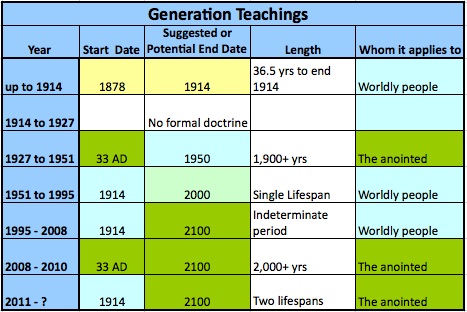
Remember this famous graphic from the 1968 “Truth Book”?generation_truth_book
Someone (on another website) produced an updated version based on the 2010 “clarification” of the meaning of “that generation.” The image indicates, graphically, why there is very little room — or appetite — for further adjustments.overlapping-generations

If anyone isn’t up-to-date with some of these more recent changes to the “generation” doctrine, it’s also discussed here.

A decade before the most recent changes to the “generation” the January 1, 2000 Watchtower stated:

“In recent years, we have been encouraged to look again with deeper understanding at—among other things—the generation that will not pass away before the end comes…. It may be difficult at times to understand such updated explanations, but the reasons for them become clear in due course.” [emphasis added]

In due course, of course, the definition of that “generation” changed again. There was an explanation that worked up until 1995, and then the 1995 explanation that was considered potentially “difficult” in the quote above, which itself preceded a new explanation in 2008, which lasted only a couple of years before the currently accepted explanation first appeared in 2010. Historically, the Watchtower has offered 7 distinct explanations, as depicted in the graphic below, found at the following web address: http://www.jwfacts.com/watchtower/generation.php

THE TRUTH, 2014 REVISED EDITION

As already stated, one excellent reason for our celebration is simply “pleasure in truth.” Jehovah’s Witnesses are repeatedly encouraged to do as the Beroeans did:

“Now these [Beroeans] were more noble-minded than those in Thessalonica, for they accepted the word with the greatest eagerness of mind, carefully examining the Scriptures daily to see whether these things were so.” — Acts 17:11

As if to drive home the point even further, Paul later wrote to those in Thessalonica, telling them to “make sure of all things.” (1 Thessalonians 5:21)

That desire — that pleasure, that eagerness of mind — to “carefully examine” and “make sure” will be clear to anyone looking at those many experiences that many have shared here on this site. And if you have never seen Carl Olof Jonsson’s most comprehensive book, Gentile Times Reconsidered, take a quick look at the book here and you will surely be impressed at the level of research and scholarship.

CENSURED SENTRIES OF THE CENTURY

There’s another good reason to celebrate, and it’s in a more serious vein. We are all aware of how the Watchtower magazine often “celebrates” the lives of those persons in history who sacrificed much for the sake of truth and for the sake of their faith.

It’s a common theme found in many Watchtower articles — one that truly touches the hearts of those who have given up so much for their faith, their conscience, and especially for those related to them in the faith. That same theme was recently highlighted in the June 1, 2014 Watchtower article: Three 16th-Century Truth Seekers—What Did They Find? (links to jw.org) Another recent example is found the April 1, 2014 issue: Thomas Emlyn—Blasphemer or Advocate of Truth? (links to jw.org)

The parallels between experiences posted on this site and “16th-Century Truth Seekers” will likely seem quite unexpected to many Witnesses. We’ve included a short post about the Watchtower’s article on Thomas Emlyn, for example, because the similarities to the experience of Witnesses who studied the 1914 teaching are really quite amazing.

HOW WE ARE CELEBRATING

  • We’re celebrating the lives and experiences of many who suffered the consequences of speaking and writing honestly about their research. We have made an entire section devoted to such experiences and expect to add several more over the coming months.
  • Another way we’ll celebrate is by highlighting some of the excellent work and research that has been done to promote the truth about this matter. Some of that research has been contributed to this site, and much more will be referenced from a special section of the site: Websites, videos, books and discussions.
  • And for those with a strong historical or scholarly interest in the development of the doctrine, we’ll also will continue to add material to the section titled: Analysis of the1914 Teaching – Biblical, Secular, Historical.
  • Of course, the most important way we are celebrating is by an effort to help everyone understand each other a little better. For example:
    • Everyone can get a better understanding of the historical development of the doctrine and the religious organization itself and therefore more empathy for people who are confused by it or object to it.
    • The included experiences should help Witnesses and ex-Witnesses understand each other better, especially those who might now find themselves in “estranged” circumstances.
    • Witnesses and ex-Witnesses alike often find themselves believing they are “on their own” when doubts or concerns arise. Hopefully this site will show otherwise, and encourage discussion with an entire community of persons who would gladly offer support and encouragement.

Truth doesn’t always lead to peace, but where both sides give truth a chance, it can offer the most stable basis for peace, understanding, empathy and love. Who could ask for anything more?

Analysis of the 1914 Teaching – Biblical, Secular, Historical

See also:

The article below was contributed by Alan Feuerbacher and contains links to numerous additional web resources throughout, especially in its Appendix. Click here for full width. Also in PDF format: evidence_against_wts_chronolog.pdf.

Biblical Evidence Against Watchtower Society Chronology

Among the Watchtower Society’s fundamental doctrines are those concerning 1914. They are the basis for its leaders’ claim to spiritual authority over the community of Jehovah’s Witnesses. This essay briefly examines the biblical evidence, with a bit of secular support, as to why the Society’s 1914 chronology is wrong.

The Society teaches that in 1914, at the end of the “gentile times” (a.k.a. “appointed times of the nations”; Luke 21:24) Christ returned invisibly (Matt. 24:3) and was given the Messianic Kingdom. It claims that the “last days” (Acts 2:17; 2 Tim. 3:1; 2 Pet. 3:3; etc.) began, the “conclusion of the system of things” began, a great harvest work of true Christians began, and that between 1914 and 1919 a time of “spiritual inspection” by the returned Jesus occurred. It teaches that by 1919 the “true Christian congregation” had been restored, in 1919 the “faithful and discreet slave” was appointed over all Jesus’ “domestics” (Matt. 24:45), and that in 1919 “false religion” (a.k.a. “Babylon the Great”; Rev. 14:8) fell. These doctrines were crucial to its claim throughout the 20th century that in 1919 all “anointed Christians” were appointed as “the faithful and discreet slave over all Christ’s belongings” on earth (the Society changed this teaching in the July 15, 2013 edition of The Watchtower).

From 1876, the phrase “gentile times” and the 1914 date were doctrinal anchors for the Society’s founder C. T. Russell, and have been so for the followers of the organization ever since. 1914 remains the key date in Watchtower “end times” teaching even though the Society has revised or abandoned most of its early claims about 1914.

In 1879 C. T. Russell began publishing what became The Watchtower magazine and therein promoted the 1914 date. Even earlier, in 1876, he published an article in the small religious journal The Bible Examiner that advocated the 1914 date as the end of the gentile times. Russell borrowed these ideas from Nelson Barbour, a semi-independent “Second Adventist” who originated the combination of the 1914 and gentile times ideas in the June, 1875 issue of his magazine Herald of the Morning.

The 1914 date is determined as follows (cf. w14 10/1 p. 10; “When Did God’s Kingdom Begin Ruling? (Part 1)”). The Society interprets the dream of Babylonian King Nebuchadnezzar described in Daniel 4 about a great tree in the center of the earth to mean that God’s direct rule over humans was interrupted, but would be restored after “seven times” had passed. The interruption is said to have begun in 607 BCE with the destruction of Jerusalem, and to have ended in 1914. Luke 21:24 is interpreted to mean that God’s rule, represented by Jerusalem, corresponds to this period, which is called “the appointed times of the nations” or “the gentile times.” The Society calculates the length as 2,520 years, based on Daniel’s statement that Nebuchadnezzar was mad for “seven times”, plus a statement in Revelation 12 that three and a half times equal 1,260 days. Then it applies a so-called “day for a year” principle. So 1,260 days (3 ½ times) x 2 = 2,520 days. A day for a year makes 2,520 years. 2,520 years forward from 607 BCE gets to 1914 CE (no zero year).

The Society derives the year 607 by beginning with the universally accepted date of 539 BCE for the conquest of the city of Babylon by the Persian king Cyrus the Great and noting that in his first regnal year he issued a decree that allowed the Jews to return to Judah. It then assumes that the Jews returned to Judah in the autumn of 537 BCE. Then the Society concludes that “the 70 years” Jeremiah spoke of (Jer. 25: 11, 12; 29:10) are a period of desolation of the land of Judah and exile and captivity of the Jews, and that this period ended when the Jews returned to Judah in 537. Working backward 70 years arrives at 607 BCE, when the destruction of Jerusalem caused the desolation of Judah to begin.

Of course, secular history—backed up by the Bible itself—shows that Jerusalem was destroyed in 587 BCE. So the Watchtower Society and its apologists go to great lengths to discount the secular evidence and to interpret the Bible according to Watchtower tradition. This essay outlines the biblical evidence that shows why Watchtower tradition is wrong. References in the appendix detail the voluminous evidence against Watchtower tradition, including secular, as do references to some excellent online resources.

Obviously, the 1914 date rests on a chain of questionable assumptions. Dubious scriptural interpretations such as equating the gentile times of Luke 21:24 to the seven times of Nebuchadnezzar’s madness, and so forth, do not lend themselves to objective resolution, so this essay will not consider them. Rather, it will examine the Watchtower’s claims about various dates and time periods derived from biblical passages that are capable of scholarly, objective resolution.

Watchtower chronology has multiple problems, many of which individually are fatal to the chronology as a whole and which, taken together, show unassailably that this chronology is wrong. Experience has shown that neither the Society nor its apologists can honestly address these problems. In many cases they simply ignore them.

This summary is in no sense a complete treatise on all the reasons Watchtower chronology is wrong. There are many excellent online resources for the interested reader, as well as the print copy of Carl Olof Jonsson’s book The Gentile Times Reconsidered. See the appendix for a list.

The 607 BCE Date for Jerusalem’s Destruction Has No Biblical Support

(1) There is no good evidence that 537 BCE was the year the Jews returned to Judah. The Society says only that “evidently” (All Scripture, p. 85) or “likely” (Insight, V. 1, p. 568) or “doubtless” (w64 2/1 p. 80) this was the date but supplies no evidence. In most discussions it simply glosses over the lack of evidence (cf. w11 10/1 p. 28).

(2) The synchronism between Josephus and the book of Ezra is solid evidence that the Jews returned to Judah in 538 BCE. Both refer to the laying of the temple foundations about half a year after the Jews were settled in their cities in the month of Tishri (autumn). Ezra gives only a relative date in Jewish terms, while Josephus gives a date in terms of the years of Cyrus’ reign, which is solidly established. This date is in the spring of 537 BCE; hence the Jews must have returned half a year earlier, in the autumn of 538. See the diagram below, and the appendix for an extended discussion.

Note that the Jews used a secular calendar beginning with the seventh month Tishri (Sep/Oct), and a religious calendar beginning with the first month Nisan (Mar/Apr). The Babylonian calendar began in Nisan.

Ezra 1 states that Cyrus, in his first year (using the accession-year system), decreed that the Jews could return to Judah. Cyrus’ first year was Nisan, 538 BCE through Adar, 537 BCE. Ezra 3:1-7 states that by the seventh month Tishri, the Jews were settled in their cities, and at that time they gathered in Jerusalem to initiate the rebuilding of the temple. So the year that ended immediately before Tishri was the first year of the Jews’ coming home, and the new year beginning in Tishri was the second year.

Ezra 3:8, 10 states that the temple foundations were laid in the second month of that second year. In Against Apion I,21, Josephus states that “in the second year of the reign of Cyrus [the temple’s] foundations were laid.” Therefore, this second Jewish year overlaps with the second year of Cyrus. Since Cyrus’ second year began in Nisan, 537 BCE, the second month was also in 537, and the first year of the Jews’ return was in 538 BCE—not 537 as the Watchtower claims.

The following diagram illustrates the above concepts.

alanchart

(3) Given (1) and (2), Watchtower chronology has no evidential foundation; on the contrary the available evidence is against it. If the Jews returned in 538, the Society’s 607 date is wrong and so is Watchtower chronology. If 607 is wrong, 1914 is wrong. If 1914 is wrong, Watchtower eschatology is wrong, and so are all the doctrines based on it.

(4) Linguistic, contextual and historical biblical facts show that Jeremiah predicted that Judah and the nations around it would, as a group, serve Nebuchadnezzar’s dynasty for 70 years (Jer. 25:8-12; 27:6-7). The key passage is Jer. 25:11: “These nations will have to serve the king of Babylon seventy years.” The Bible and secular history show that Judah and various nations individually served less than 70 years, depending on when they were first conquered and how one measures “serving.” God, through Jeremiah and other prophets, gave each nation the choice whether to serve on their own land or in exile (Jer. 27:7-11, 17; 40:9-10). To serve in their own land they had to submit to Nebuchadnezzar. The Jews under various kings refused; hence they were taken into exile at various times from 605/4 through 582 BCE (Dan 1:1-2; Jer. 52:28-30). Thus there was no 70-year exile or captivity or desolation of Judah.

(5) The 70 years of Babylonian supremacy ended in 539 BCE when Jehovah “called to account” against, or punished, Nebuchadnezzar’s dynasty (Jer. 25:12) by allowing the Medo-Persian empire under Cyrus to conquer Babylon and put an end to Nebuchadnezzar’s dynasty. This is directly stated in Daniel 5, where verses 28-30 say: “Your kingdom has been divided and given to the Medes and the Persians… in that very night Belshazzar the Chaldean king was killed.” In contrast, the Society claims that Nebuchadnezzar’s dynasty was called to account two years after its demise, when the Persians freed the Jews to return home (w79 9/15 pp. 23-24; g 5/13 p. 13), but this is ridiculous. You cannot punish a dynasty that no longer exists.

(6) 2 Chronicles 36:20 states that Nebuchadnezzar’s minions carried off Jews to Babylon, and these Jews remained servants to Nebuchadnezzar’s dynasty until the Persians under Cyrus took over, after which they were servants to Cyrus and his minions until Cyrus let them return to Judah. This confirms again that the 70 years were a time of Babylonian supremacy, not the term of the desolation of Judah. That desolation occurred during the 70 years. This is consistent with Jer. 25:8, 11, 12 which states that the Jews and nations round about would be servants to “Nebuchadnezzar and his sons” until God called them to account.

(7) Because Jeremiah spoke of Jerusalem being devastated or ruined (Hebrew chorbah; Jer. 25:18) shortly after Nebuchadnezzar conquered it in 605 BCE, the devastation of Judah began at that time. Even if the interpretation of that passage is disputed, the Hebrew word chorbah basically means “ruined” but does not specify in what sense something is ruined. It might be absolute, or relative. It might mean ruined in the sense of no longer being pristine, such as a city conquered by a foreign invader but not necessarily razed to the ground; the Bible often uses the word in this sense.

(8) Because Jews were taken into exile in 605/4, 597, 587 and 582 BCE, and released in 538, there was not a single period of exile or captivity. Therefore it is wrong to speak of a 70-year exile or captivity. Similarly it is wrong to speak of a 70-year desolation of Judah, because Jerusalem was ruined (chorbah) in a relative sense from the Jewish point of view when Nebuchadnezzar first took a few captives (including Daniel) in 605/4 BCE, and in a complete sense after most of the Jews left the land between 587 and 582 BCE.

(9) In the New World Translation Jer. 29:10 reads: “For this is what Jehovah says, ‘When 70 years at Babylon (Hebrew le-babel) are fulfilled, I will turn my attention to you, and I will make good my promise by bringing you back to this place.’ ” It has been demonstrated conclusively, in various publications, that in context, the phrase le-babel should be translated “for Babylon” not “at Babylon.” The latter is a mistranslation based on the King James Version. The Watchtower Society has laid great stress on its translation (cf. Appendix to chapter 14 in the 1981 book “Let Your Kingdom Come”) to make its claim that Jeremiah’s 70 years were a time of exile of the Jews (however, see w11 10/1 p. 27, where the correct translation is acknowledged but then ignored). Yet the translation issue, plus many other considerations, show that the Jews as a group were not in exile at Babylon for 70 years, but that various contingents were in exile for between 44 and 69 years.

(10) A careful consideration of Watchtower apologists’ (like Rolf Furuli) favorite scriptures to misinterpret, namely Daniel 9:2 and 2 Chronicles 36:21, shows that the passages are ambiguous about exactly what they mean with respect to 70 years. Because they are ambiguous, other scriptures and pieces of information that are not ambiguous must be used to determine what they mean, and when this is done the ambiguity is resolved. Watchtower apologists get this completely backwards. Following Russell and his spiritual forebears, they begin by interpreting the ambiguous passages in accord with Watchtower tradition, and then twist the meaning of the unambiguous ones to fit the tradition.

The above points prove that the Bible does not support the Society’s anchor date for the 1914 chronology—607 BCE—as the date of Jerusalem’s destruction. Rather, as scholars agree, Jerusalem was destroyed in 587 BCE (some say 586, but the discrepancy is due to ambiguity in the Bible itself, and can be resolved in favor of 587; see the appendix for references). Therefore Watchtower chronology is wrong, as is every doctrine based on it.


Appendix


References

A great deal of material has been published in print and online that disproves the Watchtower Society’s 1914 chronology. Below are listed some of these references.

The most comprehensive look at the secular evidence, with much biblical commentary, is The Gentile Times Reconsidered (Carl Olof Jonsson, Fourth Edition, Commentary Press, Atlanta, 2004). Much of this book is available online:

http://kristenfrihet.se/english/gtr4/contents.htm

Jonsson’s extensive writings on Watchtower chronology are available online:

http://kristenfrihet.se/english/epage.htm

A summary of biblical and secular evidence can be found in Jack Finegan’s Handbook of Biblical Chronology: Principles of Time Reckoning in the Ancient World and Problems of Chronology in the Bible (Revised Edition, Hendrickson Publishers, 1998).

A classic work on biblical chronology is Edwin R. Thiele’s The Mysterious Numbers of the Hebrew Kings (New Revised Edition, Kregel Publications, Grand Rapids, Michigan, 1994; Zondervan Publishing House, 1983; various editions back to 1951).

A comprehensive debunking of the Society’s scriptural claims, along with some secular material, is available at “Jeffro’s 607 pages.” This includes detailed debunkings of recent Watchtower articles:

http://jeffro77.wordpress.com/

Scholar Rodger Young gives proof of 587 BCE as the date of Jerusalem’s destruction:

http://www.galaxie.com/article/jets47-1-03

http://www.rcyoung.org/articles/jerusalem.pdf

http://www.rcyoung.org/papers.html

Seventh-Day Adventist scholar Ross E. Winkle offers these articles:

“Jeremiah’s Seventy Years For Babylon: A Reassessment. Part I: The Scriptural Data”:

http://www.auss.info/auss_publication_file.php?pub_id=755

“Jeremiah’s Seventy Years For Babylon: A Reassessment. Part II: The Historical Data”:

http://www.auss.info/auss_publication_file.php?pub_id=762&journal=1&type=pdf

Another look at the scriptural and secular evidence against Watchtower chronology is the article “Notes on the Gentile Times and 1914”:

http://corior.blogspot.com/2006/02/part-1-summary.html

Another debunking is: “Refutation of Appendix in Let Your Kingdom Come”:

http://corior.blogspot.com/2006/02/refutation-of-appendix-in-let-your.html

C. T. Russell originally used 606 BCE rather than 607 as the date of Jerusalem’s destruction and the beginning of the gentile times. While the latter date was known to Russell and his followers to be correct (in terms of Watchtower Society interpretations) as early as 1904, and was used in a handful of Watchtower and related publications after that, it was only in 1943 that the Society officially changed the date of the start of the gentile times, and in 1944 that it changed the date of Jerusalem’s destruction, to 607. Critics of the Society will not be surprised to find out-and-out lies at the heart of the change, shown in this article that examines the details of how the Society changed the dates, “The Evolution of 606 to 607 B.C.E. in Watchtower Chronology”:

http://corior.blogspot.com/2006/02/evolution-of-606-to-607-bce-in.html

The Society has produced much material claiming that the signs of the times prove the world has been in the last days since 1914. These claims are thoroughly debunked in the book The Sign of the Last Days—When? (Carl Olof Jonsson and Wolfgang Herbst, Commentary Press, Atlanta, 1987).

“The Watchtower Society and the End of the World” is a look at the Society’s extensive false predictions and distortions of biblical and secular evidence concerning its chronology:

http://corior.blogspot.com/2006/02/part-1-why-so-many-false-alarms.html

Josephus and Ezra Prove the Jews Returned in 538 Not 537 BCE

A synchronism between Josephus and the book of Ezra provides strong evidence that the Jews returned to Judah in 538 BCE. Both refer to the laying of the temple foundations about half a year after the Jews were settled in their cities in the month of Tishri (autumn). Ezra gives only a relative date in Jewish terms, while Josephus gives a date in terms of the years of Cyrus’ reign, which is solidly established. This date is in the spring of 537 BCE; hence the Jews must have returned half a year earlier, in the autumn of 538. Below are the details. The following diagram illustrates the concepts.

alanchart

Ezra 1 states that Cyrus, in his first year (using the accession-year system of dating kings’ reigns), decreed that the Jews could return to Judah. Cyrus’ first year was Nisan (Mar/Apr), 538 BCE through Adar (Feb/Mar), 537 BCE. The Bible does not say exactly when he issued this decree.

Ezra 3:1-7 states that by the seventh Jewish month Tishri (Sep/Oct), the Jews were settled in their cities, and at that time they gathered in Jerusalem to offer sacrifices and collect money for the rebuilding of the temple. From this we deduce that, whatever modern calendar year this was, the Jews returned in the preceding Jewish year, since the secular Jewish year began in Tishri (keep in mind that the sacred Jewish calendar began six months offset from Tishri, in Nisan, and the Jewish months were numbered beginning with Nisan). In other words, the year in which the Jews returned was the first year of their coming home, and the new year beginning in the Tishri mentioned in Ezra 3:1 was the second year of their coming home.

Ezra 3:8, 10 states that a little later in that second year the Temple foundations were laid (NASB):

8 Now in the second year of their coming to the house of God at Jerusalem, in the second month, Zerubbabel the son of Shealtiel and Jeshua the son of Jozadak and the rest of their brothers the priests and the Levites, and all who came from the captivity to Jerusalem, began the work and appointed the Levites from twenty years and older to oversee the work of the house of the LORD.

10 Now when the builders had laid the foundation of the temple of the LORD, the priests stood in their apparel with trumpets, and the Levites, the sons of Asaph, with cymbals, to praise the LORD according to the directions of King David of Israel.

The crucial piece of information here is that the Temple foundations were laid in the second month (Iyyar; Apr/May) of the same year in which the Jews gathered in Jerusalem immediately after they returned to Judah.

The Bible does not explicitly relate these events to any event that can be firmly dated to our modern calendar. However, a careful examination of historical data indicates that it was Cyrus’ general practice to free captives from the nations he conquered shortly after he secured his authority. Since he captured Babylon in October, 539 BCE, and the inhabitants would have known of his general practice, they would have expected him soon to begin freeing Babylonian captives, including the Jews. It is a good bet that, for political purposes, Cyrus would have done this around the time of celebrating the beginning of his first regnal year. If the books of Daniel and Jeremiah contain valid historical information about the fall of Babylon (Dan. 9:1, 2; Jer. 29:10), the Jews would have anticipated being freed soon after Cyrus entered the city in late October, 539 BCE.

A careful reading of Ezra 1-3 indicates that there might have been very little delay between the issuing of Cyrus’ decree and the departure of the Jewish captives for Judah. Because Cyrus’ first regnal year began in Nisan, and the Jews arrived by Tishri, if this all occurred in 538 BCE, there would have been at most six months for the Jews to complete their preparations and journey, and get settled in Judah. Since the trip takes about three to four months for a normal caravan, there is just enough time for these events to happen in 538 BCE.

Based on its tradition, the Watchtower Society speculates that Cyrus issued his decree sometime in late 538 or early 537 BCE, still in his first regnal year. It then claims that the Jews journeyed back to Judah in 537 BCE.

How then, can one decide whether the Jews returned in 538 or 537?

Josephus provides the tie breaker.

In Against Apion I,21, Josephus states:

These accounts agree with the true histories in our books; for in them it is written that Nebuchadnezzar, in the eighteenth year of his reign, laid our temple desolate, and so it lay in that state of obscurity for fifty years; but that in the second year of the reign of Cyrus its foundations were laid, and it was finished again in the second year of Darius.

The crucial piece of information is that the temple foundations were laid in the second regnal year of Cyrus.

Combining this with the information from Ezra that the temple foundations were laid in the second month (Iyyar) of the second year of the Jews’ return to Judah, we must conclude that this second year corresponds with the second year of Cyrus. Since Cyrus’ second year began in Nisan, 537 BCE and Iyyar was the second month of that regnal year, the first year of the Jews’ return was 538 BCE. This also works if one uses Tishri dating for Cyrus’ reign, as some might argue that Josephus did.

In other words, Josephus, with Ezra as a starting point, has provided the crucial information to determine that 538 and not 537 BCE was the year of the return of the Jews to Judah.
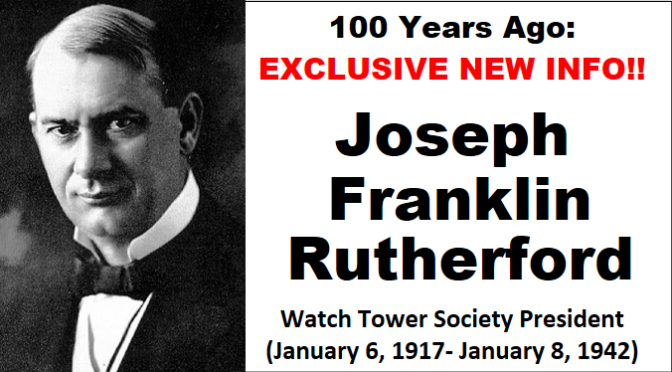
Who Was Thomas Emlyn?

The Watchtower writers didn’t intend for ex-Witnesses to see the close parallels between their own experience and that of Thomas Emlyn. But that’s not the only reason we include a reference to this recent article. It should also help JWs think twice before complaining that a site such as this one is tantamount to “hero worship.”

Although Emlyn’s specific doctrinal issues might be different than ours, the April 1, 2014 Watchtower celebrates his life because he took a stand for truth and suffered the consequences. The article says that the outcome of his trial was obviously influenced by seven bishops of the Church of Ireland. But he stood up to their scorn, suffering a year in prison and the charge of blasphemy.

Similarly we include the experiences of  many people who, like Thomas Emlyn, have stood up for truth and suffered the consequences due to the treatment by the leadership of the Watch Tower Society and other Jehovah’s Witnesses.

Although Emlyn’s issue was with the Trinity doctrine, those who researched the 1914 or related teachings have often experienced amazing parallels to this story. Some excerpts from the Watchtower article are included below:

During those times, Emlyn was carefully studying the Bible. … As he researched the Gospels, he became convinced that they supported his improved understanding.

The Watchtower often reserves the phrase “careful study of the Bible” for those interested in studying the Bible with Witnesses, in the context of conversion, baptism, and making use of the study aids provided by the “faithful slave.” But what was the attitude of Watch Tower leadership when that careful study of the Bible would convince someone of an improved understanding. Read Randy Watters experience and you might be surprised to see how member of the Governing Body responded: “Stay away from deep Bible study to determine meanings of the scriptures.”

Emlyn did not immediately reveal what he had found. However, some in his Dublin church noticed that he did not refer to [the doctrine] in his sermons.

This is common to several of the experiences. Note that Ron Frye, who had been a Circuit Overseer, spent nearly a decade reevaluating the doctrines before leaving. Naturally, these issues can never be heard in your public talks.

..[H]oping to vindicate his views, he published [a book] An Humble Inquiry Into the Scripture-Account of Jesus Christ. In this publication, he gave clear Scriptural proof…. This infuriated members of Emlyn’s former congregation in Dublin. A formal complaint was filed.

When a Witness leaves and writes a book, this is considered one of the most heinous forms of apostasy. The writing is immediately deemed “evil” or “poisonous.” The Watchtower has likened such books to “pornography.” And even knowing that someone could collect information about them that might be publicized negatively is fear-inspiring to them. Note the reaction of the “Judicial Committee” in Poul Bregninge’s experience when he told them he had a tape recorder.

Emlyn was arrested …in Dublin on June 14, 1703. …The trial proved to be a farce. Seven bishops of the Church of Ireland sat on the bench with the judges. Emlyn was not allowed to speak in his own defense. Richard Levins, a distinguished lawyer, told Emlyn that he would be run down “like a wolf, without law or game.” …

This was the climate in Brooklyn Bethel when Nestor and Toni Kuilan were “arrested.” Nestor was told that if he ever wanted to be re-instated he would have to go through the Governing Body. The Governing Body worked behind the scenes to make sure the final judgments were to their liking. This is well known in the case of Ray Franz, who also details, in his books, some of the unchristian judicial methods the Watch Tower leadership engaged in during the cases of  Edward Dunlap, Cris and Norma Sanchez and many others. And this is validated again by the experiences  contributed here by Randy Watters and Nestor Kuilan.

When Emlyn was found guilty, the solicitor-general proposed that he retract. Emlyn refused. He was fined and sentenced to a year’s imprisonment. …

This actually sounds mild compared to the way Peter Gregerson puts it: “he also knew that leaving the Watchtower, after nearly fifty years of loyalty, would not be easy. His wife and her family, his children, …and… closest friends were all Witnesses. And in their eyes, to leave the Watchtower is to turn one’s back on Jehovah himself, and to be essentially given a death sentence. If a person is disfellowshipped, other members are no longer allowed to speak with that “wicked” person.”

Emlyn moved to London, where he eventually associated with William Whiston, another Bible scholar who had been ostracized because he published what he felt was Bible truth. …

Compare this attitude with the fact that Jehovah’s Witnesses are trained to be prejudiced against those who associate themselves with non-Witnesses. We have included the contributions of some, like Joan Cetnar, who have found solace and spiritual fulfillment through other religious organizations and ministries. And, of course, others have found this same fulfillment without any need for organizations of any kind.

The example set by Emlyn and others can move us to consider whether we are willing to stand up for the truth in the face of scorn. We too can ask ourselves, ‘Which is more important—the honor and blessing of the community or upholding the truth of God’s Word?’

Clearly this article in the Watchtower is one of many examples that hits very close to home for many who happily worked and served among Jehovah’s Witnesses for years, or even decades. We celebrate how they have made the proper choice dictated by conscience: “standing up for truth in the face of scorn.” But we won’t scorn them.


New! Important CHANGES in March 15th, 2015 Watchtower, Explained & Clarified

Articles in this series:

If you are one of those few people who REALLY keeps up with the recent changes to current doctrines among JWs, then you should appreciate the upcoming series of articles we are about to post on the subject. If you are one who does NOT always keep up with the recent changes to current doctrines among the JWs then you should REALLY appreciate these articles even more.

There are a some specific doctrinal changes spelled out in the March 15, 2015 Watchtower (the “Study Edition” available on the JW.ORG website).  But the biggest, most important change is about a method for explaining Scripture that will affect many more doctrines than the specific examples mentioned in the magazine.

With this issue, literally thousands of pages of previously printed doctrinal material are rendered obsolete. It also sets a new direction for Bible commentary in The Watchtower that has the potential to completely “reset” SEVERAL of the unique doctrines of Jehovah’s Witnesses, and MOST of the prophetic interpretations. Even the chronological interpretations are at risk of becoming obsolete.  (For example, until the last decade, “1918” was taught as a prophetically significant date that was once mentioned just about as often as 1919 was mentioned. Yet, many JWs are not even aware that 1918 has already been quietly dropped as a prophetically significant date, for reasons that are aligned with the changes set forth in this March 15, 2015 issue.)

To get an idea of how sweeping the general change already is, you would have to know just how much prior doctrine is affected by these sentences from the March 15th Watchtower:

“In times past, it was more common for our literature to take what might be called a type-antitype approach to Scriptural accounts.” (p.3) “Humans cannot know which Bible accounts are shadows of things to come and which are not. The clearest course is this: Where the Scriptures teach that an individual, an event, or an object is typical of something else, we accept it as such. Otherwise, we ought to be reluctant to assign an antitypical application to a certain person or account if there is no specific Scriptural basis for doing so.” (p.18)

The following is a list of 42 of these “prophecies” or “prophetic dramas” found in one of the Watchtower publications that we (JWs) actively taught and studied when I was a younger Witness. Most of these have never been dismissed and they still represented accurate doctrine until now. Learning these teachings took up a large portion of the curriculum for the students of the Watchtower Bible School of Gilead while I was at Bethel from 1976 to 1980. One of the weekly meetings, the “Congregation Book Study,” was often devoted entirely to discussions of this type.

3-15-15wt3-15-2

Also note that the 42 examples listed only include those that specified the “great crowd” who would have an earthly hope instead of the “anointed” with the heavenly hope. Because these “prophetic dramas” have been emphasized less, especially in the last couple of decades, many Witnesses didn’t realize that most of these explanations were still “on the books.” In other words they were still considered valid, correct doctrines. At least until now.

DIDN’T THEY TRY THIS BEFORE?

It probably sounds like hyperbole to attach such a potential significance to these new changes. However, we have an excellent reason to believe that these changes are indicative of more changes underway. What’s that reason? Simple. We saw what happened when they tried this before. The Watch Tower Society didn’t try it officially, because not everyone was on board with it. Nevertheless, beginning in the late 1960’s and 1970’s, several members of the Writing Department were already reading Bible narratives and writing and teaching about their meaning in the exact way described in this new issue of the Watchtower.

In fact, the idea of changing this teaching method already came up during the research and writing of the Watch Tower’s first Bible dictionary, Aid to Bible Understanding, completed in 1971. This “Aid Book” as we called it (now slightly revised as Insight on the Scriptures) is nearly devoid of types and antitypes. By 1972, the research behind the Aid Book had already resulted in major changes to the Watch Tower organizational structure, including a re-definition of what the governing body would soon become, and the new “elder arrangement,” which was just being put into place. The following is from an article in the August 15, 1972 Watchtower that reflects some of the thinking on this subject at the time:

*** w72 8/15 p. 502 God Readjusts the Thinking of His People ***
Another thing that has given rise to questions is the use by Jehovah’s witnesses of parallels or prophetic types, applying these to circumstances and to groups or classes of people today. Many people who read the Bible view its accounts all as simply history, but when they begin to study with Jehovah’s witnesses a readjustment of viewpoint takes place as they see that there is more to the accounts than history.

The question that is sometimes asked is, Did Jehovah stage that ‘dramatic’ event, so that we would have a warning now? Well, would he cause such bad things to happen? Would he maneuver them himself? No. …

It helps us to understand more fully when we keep in mind that the people in ancient times were real, living their daily lives in association with their families and fellowmen, having hopes and desires as we do today, the same general problems with sin working in their members, and many of them faithfully waging a fine fight to serve God.

The article just quoted actually tried to play both sides of the issue in order to introduce the change but also dismiss the need to make too many changes at once. (The 1972 article tended to favor the “type-antitype” status quo.) During the late 1970’s, the brothers in Writing who were the most productive and who were the most capable of Biblical research included the brothers who had worked on the Aid Book, and by that point in time had already been getting assignments to write Watchtower articles on many Bible topics. These articles tended to minimize the “type-antitype” pattern.

Not all Watchtower writers agreed with this change. However, many letters were received that thanked the Watchtower Society for producing these “refreshing and clear” articles that “make it easier to apply the Bible in our daily lives as Jehovah’s Christian witnesses.”

The brothers in Writing who had helped with the Aid Book had become especially involved in those new articles with the “refreshing” style, as some called it. One of these brothers had an excellent knowledge of the Biblical languages, including not just Hebrew but also Aramaic and Syriac. Another other one could write an article in minutes on almost any Bible topic, pretty much from memory, and those articles could usually be used in the Watchtower without any edits or changes. Their work was approved through the appropriate review committee(s), including Governing Body members, and resulted in dozens of Watchtower articles, and several books, which are still easily identifiable by their style when looking through the bound volumes of the Watchtower from those years, or the Watchtower Library CD. Two books were written in this same “refreshing” style in a Bible commentary format. Those two books, Commentary on the Letter of James and Choosing the Best Way of Life (which was a commentary on 1st and 2nd Peter) were released at the summer District Assemblies in 1979. They became the first major examples of books that scrupulously avoided “type-antitype” patterns, even when touching upon subjects that had previously required it. This includes an “untypical” reference to the “faithful and discreet slave” that called upon all Christians to be this sort of person. A recently deceased brother who had been at Bethel during the period described it to Randall Watters like this:

 “There were a couple new books published that were nothing like the typical FWFranzesque prophetic calculus manuals. These books were not typical fare, and you could see the puzzled looks when they reached the book study groups and meetings. Biblical commentary within scriptural context…”

Unfortunately, the Watch Tower Society in general was not yet ready for this type of reading and writing about the Bible narratives. “Heads rolled” when the significance of those changes was noticed by “old school” supporters of these now obsolete doctrinal methods. This included the two mentioned above, and a few others, too, who were not disfellowshipped, but who were dismissed from Bethel. However, this March 15, 2015 issue of The Watchtower now renders that “old school” doctrinal pattern obsolete. The pattern utilized in the Aid Book and in subsequent Watchtower articles and books for the next 7 years, especially from 1976 through 1980 is now considered ‘the way Jehovah approved.’ (Watchtower 3/15/2015 p.7,8)

While we cannot vouch for the exact numerical claims in the quote below, one person has put it this way, on a site where JWs often discuss issues with other JWs:

Now, with this article, nearly half the Watchtower articles that Rutherford wrote (since about 1931) and about a quarter of the Watchtower study articles that Fred Franz wrote (since 1942 – under Knorr) have been downgraded. When I worked with the Gilead students we were still spending about half their time going over these old Bible stories to make sure they understood when the anointed class was meant and when the great crowd was meant. (Anyone who has a copy of the Gilead Notes from up to about 1980 will know what I mean.)

Historically, I find that very interesting, but from a progressive perspective, it was bound to happen now that there is less concern about distinguishing anointed from other sheep, I find it quite refreshing that we no longer need to be worried that we draw the right application to the various people in so many of these Bible accounts.

If you do not have the magazine in printed format, it is available at the following location on jw.org:

http://www.jw.org/en/publications/magazines/w20150315/

That link (on the JW.org site) displays a page that has the following articles listed. Over the next few weeks we will provide a commentary on each of them and link the titles to our commented versions of these articles.

THE WATCHTOWER (STUDY EDITION) MARCH 2015

“This Is the Way You Approved”

Why have our publications in recent years often given simpler, clearer explanations of some Bible accounts?

Will You “Keep on the Watch”? 

Read this clarified understanding of Jesus’ parable of the ten virgins, which focuses on the parable’s simple, urgent message. 

Questions From Readers

In the past, our publications often mentioned types and antitypes, but in recent years they have seldom done so. Why is that? 

Learn From the Illustration of the Talents 

This article refines our understanding of the parable of the talents.

Loyally Supporting Christ’s Brothers 

How do those whom Christ judges to be sheep support his brothers?

In attempting to comment on those Watchtower articles listed above, this site will attempt to cover each of the articles listed above that cover the updated doctrines.

Watch for the following subjects to be covered across the five articles:

  • The Prior Importance of the “Type Anti-Type” Approach
  • The Good Samaritan – Type-Antitype method reviewed
  • Naboth, Ahab, Jezebel – Type-Antitype method reviewed
  • The Prodigal Son – Type-Antitype method reviewed
  • Elijah and Elisha – Type-Antitype method reviewed
  • The Ten Virgins – Type-Antitype method reviewed
  • The Talents – Type-Antitype method reviewed
  • What happened at Bethel when this same approach was used as an aid to Bible understanding?
  • How can this approach potentially change the explanation of the “Faithful and Discreet Slave”?
  • What will this approach do to the method of explaining all prophecies in Isaiah, Jeremiah and other prophetic books with a formula linking any mention of faithful kings, priests and prophets to the faithful anointed in our day, or linking unfaithful ones to Christendom, or linking any mention of captivity to the imprisonment of Rutherford and others in 1918/1919, etc.?
  • What can this approach do to the “anti-type” fulfillment of Nebuchadnezzar’s dream and the 1914 teaching?
  • Will this ultimately make 1919 go the way of 1918? (As mentioned, 1918 was once a large part of Watch Tower doctrine and it has been gradually but effectively dismissed over the last several years.)
  • Will this ultimately make the current distinction between Great Crowd and Anointed less important?