
Tag Archives: The Watchtower

TYPES AND ANTITYPES: Transcript of discourse by David Splane at October 2014 Annual Meeting

The 2014 Annual Meeting Program video can be found on tv.jw.org (currently found under Programs and Events). The following speech can be found about the 2 hour and 8 minute mark in the video. It ends at about the 2 hour and 25 minute mark.

“David Splane of the Governing Body will speak to us on the theme: ‘Types and Antitypes.’” 

IT’S NOT FUNNY IF YOU HAVE TO “SPLANE” IT 

The following is an unofficial transcript of that talk. It is very informative to note the differences between this, the original talk, and the Watchtower article that was derived from it. Our site’s commentary on the March 15, 2015 Watchtower article is found here.

Transcript begins:

________________________________________________

Let’s get right into our subject: types and antitypes.

Now, years ago, our publications often applied certain Bible accounts and certain bible characters as “types” of something greater. But you’ve noticed that, in recent years, that is seldom done, and the purpose of this talk is to explain why.

First of all what is a type and what is an antitype? Well, the Watchtower of September 15, 1950 defined them this way. It said:

“A type is a representation of something that will come to pass at a future time. The antitype is the reality of the thing which the type represents.”

So that is the definition that was given by The Watchtower. And we might add that Jehovah is usually involved in designing the type.

Now, take the tabernacle. Jehovah was very clear about the construction of the tabernacle: what materials were to be used, the dimensions and so forth. Why? Well, apparently because he had designed the tabernacle to be a type of something greater: his great spiritual temple. And the temple was the antitype.

The sacrifices on the Day of Atonement. Jehovah was very careful about how events on the Day of Atonement were to unfold. And again, we have to realize that something was going to have to picture or foreshadow the perfect sacrifice of Jesus Christ. So, the sacrifice on the Day of Atonement, the type, and the perfect sacrifice of Christ, the antitype.

Now consider another example. When the disobedient Israelites in the wilderness were bitten by poisonous snakes, Moses is told by Jehovah to fashion a copper serpent and to place that serpent on a pole. Now that was a type. Now Jesus explains what it was a type of. Let’s turn to John chapter 3, John chapter 3 and verses 14 and 15. John 3: 14 and 15 If you are using an iPad, I’ll give you a chance to catch up. [Laughter] I couldn’t resist. “And just as Moses lifted up the serpent in the wilderness, so the Son of Man must be lifted up, so that everyone believing in him may have everlasting life.” Now, would anyone doubt that this is a type? Of course not. Because Jesus said it was.

Well notice that in both these examples, the tabernacle and the copper serpent, Jehovah was involved. He designed the type so that it would fit the antitype. He told Moses, for example to fashion a copper serpent and put it, not on a rock, but on a stake. And of course the tabernacle prefiguring the great spiritual temple.

And from the apostle Paul we learn even more about types and antitypes. For example, Paul, in Hebrews: Isaiah and his 2 sons represent Jesus, and the anointed. He also explains that Moses, the mediator of the Law covenant, represents Christ the mediator of the new covenant. And we learn from the letter to the Galatians that Abraham’s relationship with Sarah and Hagar, represents Jehovah’s relationship with the nation of Israel, and with the heavenly part of his organization. Type and antitype.

Now we know that these were genuine types because, the word of God says they are. But here is the question:

Who is to decide if a person or an event is a type if the word of God doesn’t say anything about it? Who is qualified to do that? Our answer? We can do no better than to quote our beloved brother, Albert Schroeder, who said:

“We need to exercise great care when applying accounts in the Hebrew Scriptures as prophetic patterns, or types, if these are accounts are not applied in the Scriptures themselves.”

Wasn’t that a beautiful statement? We agree with it.

Now the study of types and antitypes is not unique to Jehovah’s Witnesses. During the past 2,000 years, Catholic and Jewish scholars have made quite a diligent study of types and antitypes. In fact, there is even a name for the study. They call it “typology.”

The first century Jewish scholar, Philo of Alexandria, for example, suggested that the serpent in the garden of Eden, the tree of knowledge and the cherubs that were guarding the entrance to the garden were all typical of something greater.

And then describing the teachings of such early writers as Origen, Ambrose and Jerome, the International Standard Bible Encyclopedia says this:

“They sought for types and of course found them, in every incident and event, however trivial, recorded in Scripture. Even the most simple and commonplace circumstance was thought to conceal within itself a hidden truth. Even in the number of fish caught by the disciples when the risen Savior appeared to them,” he says, “How much some have tried to make of that number:, 153 .”

One scholar made much of Jacob’s purchase of Esau’s birthright with a bowl of red stew. Very significant that the stew was red. To him, the red stew pictured the red blood of Christ. The inheritance pictured the heavenly inheritance. It’s all… By that reasoning, Jacob pictures Jesus, Esau’s birthright pictures the heavenly inheritance, and the red stew pictures Jesus’ precious blood.

Now on the surface that might sound plausible to some, until you think about it. When you think about it you see three problems. First of all, Jehovah didn’t design the type. Jehovah did not tell Esau to sell his birthright. Selling his birthright was wrong, and Jehovah never tells us to do something that’s wrong. Second, who ate the stew? Esau did. So are we to conclude that, by giving up his inheritance, Esau put himself in line for the ransom sacrifice of Jesus Christ? That doesn’t make any sense. And most importantly, nowhere in Scripture do we read that the event was a type.

Now the study of types and antitypes was not only common among Catholic and Jewish scholars, but were very prominent among Protestant scholars as well. The Puritans, like Edward Taylor, applied many Bible events to themselves. The Baptists and Congregationalists did likewise. So it’s not surprising that the early Bible Students, who generally belonged to these groups were also really fond of types.

And as many of us have been. Many of us have remembered happy moments at the congregation book study studying all about types and antitypes. And it’s true that the study of types could be thrilling!

So now here’s a question. If the study of a certain subject make chills run up and down your spine, could it possibly be mistaken? And the answer is yes.

The case of brother Arch W. Smith is an example. In 1886, Brother Russell published a book that contained a chart linking the ages of mankind to the Great Pyramid of Egypt. Now that pyramid was called by the Bible Students, the “Bible in stone.” They loved the study of the Pyramid. In fact, if you have seen pictures of Brother Russell’s grave, you’ve noticed that there was a pyramid nearby. And that’s because the Bible Students believed very much in the Great Pyramid of Egypt, and some became very engrossed, in measuring certain rooms and certain features of the pyramid and to try to determine, for example, how long they had to wait before they went to heaven, and so on.

And so one who was just thrilled by the study of types was Arch W. Smith. It was a hobby of his, he loved it. In fact he gave a lot of prayerful thought to the dimension of the pyramid, and from time to time he would write in to Bethel and let them know what his findings were, to support the idea that the Great Pyramid had a place in Jehovah’s purpose. He loved it!

But when The Watchtower of 1928 came out and said that Jehovah doesn’t need a stone monument built by pagans to accomplish his purpose, Brother Smith accepted it. He let reason win out over emotion.

Well, in recent years the trend in our publications has been to look for the practical application of Bible events, and not for types where the Scriptures themselves do not clearly identify them as such. We simply cannot go beyond what is written. Now there’s a real advantage in looking for the practical application of Bible accounts, rather than confining certain applications to one class: “This applies only to the anointed.” “This applies only to the other sheep.”

Let’s just see why. Turn to Romans chapter 15 and verse 4. Now remember that Paul is writing to his anointed brothers here. Romans chapter 15 and verse 4. And he says, “For all the things that were written beforehand” . . . Well what things? The Hebrew Scriptures obviously. . . “were written for our instruction so that through our endurance, that through the comfort of the Scriptures, that we might have hope.” What is Paul telling the anointed? He’s telling them that you can learn from these accounts in the Hebrew Scriptures. You can apply principles of the Hebrew Scriptures to yourselves.

Let’s consider an example: Now soon after his conversion, Paul is preaching in the city of Damascus. The Jews are furious and they try to kill him. So anointed disciples take Paul and they lower him down the city wall in a basket. Is it possible that some of those anointed ones they thought of Rahab? Who helped the two spies escape from Jericho by a similar method? Would anyone say to them, “You can’t apply that to yourselves…Rahab pictures the other sheep, you are of the anointed?” No! They could apply the lessons of that account to themselves.

Now let’s consider another example, a modern one. In the Song of Solomon we read of a chaste young virgin who falls desperately in love with a poor shepherd boy. Solomon, who incidentally was still an inspired Bible writer at the time, but he’s a very wealthy man, he tries to lure her away but he’s unable to do so. Now suppose that in a certain congregation there’s a sweet young sister, who falls head over heels for a poor pioneer brother, who’s a real spiritual man but he doesn’t have a penny to his name. Now her friends encourage her to marry a wealthy brother, who is very rich but he doesn’t have a lot of time to spend on spiritual things. The sister remains firm. They say, you wouldn’t have to work! You can pioneer. She says no my love is for that pioneer boy. Would anyone say to her, the Song of Solomon doesn’t apply to you because you’re of the other sheep, not of the anointed?

You see how practical it is to take these Bible accounts and really apply them to the everyday life of people.

What about others of the other sheep today? In this audience there are modern-day Nehemiahs who are spurring the building programs we have. Wonderful young Timothys, graduates of our Bible schools, warmhearted Tabitha’s, hospitable Lydias. And don’t we find exceptional young Circuit Overseers who are like Elihu in giving wise counsel to elders who are much older. And don’t many Christian young women remind us of dear Rebekah who was willing to follow her husband to a distant land for the accomplishment of Jehovah’s purpose?

We deeply appreciate the spiritual heritage that was passed on to us by the early Bible Students. In harmony with Zechariah chapter 4 and verse 10: “We do not despise the day of small things.” However the light does get brighter. And we feel that we must follow the light, wherever it leads us. Our love should be for the truth and not for a particular doctrine or teaching.

Well how would you sum this talk in a few words?

The wrong answer is, “We don’t believe in types and antitypes any more.” We do! We certainly do. Where the scriptures identify them as such, we embrace them. But where the Bible is silent, we must be silent.

Now in the three talks that follow there are going to be important clarifications in our beliefs.

Perhaps a certain adjustment will touch a spiritual nerve, make us rethink a cherished teaching. Our love for Jehovah and the truth will make us receive this information gladly and with open hearts.

Often today we hear brothers say, we’re having a hard time keeping up with the celestial chariot. So are we. So are the Governing Body. We’re not driving the chariot. Jehovah is driving the chariot and we’re running just as fast as you are, trying to keep up. So let’s all do our best to keep up with it. And let us thank Jehovah for continuing to deal with us. And for continuing to provide nourishing spiritual food.

________end of transcript________

Personal notes:

  • In the commentary on the Watchtower article based on this talk ( http://ad1914.com/2015/01/26/2107/ ) we pointed out a few items of interest:

    First of all, the idea is given that these “type-antitype” explanations have already been phased out to some extent over the past few years, but with no official explanation until now.

    The talk mentions that some legitimate examples of “type/antitype” included the tabernacle (shadows), the sacrifices, Abraham’s wife and mistress, and the snake on a pole. The 3/15/2015 Watchtower article replaced the snake on a pole with the sign of Jonah.

    It’s pointed out that this “typology” stuff has had a long history among a lot of religions, Jewish, Catholic and Protestant. (And some ridiculously bad examples are mentioned as if they were more ridiculous than Watch Tower examples.)

    The logic behind using the Rahab and Shulamite examples is twisted and anachronistic. As far as Paul’s companions knew, there never was and never would be an incorrectly explained “other sheep” class represented by Rahab. And what sister says, “The reason I am choosing the broke pioneer over the rich brother because the Song of Solomon applies to me.” In Splane’s illustration, she never actually says that, but Splane indicates that there is some danger that the sister is going to hear an argument meant to to push her into the arms of the rich brother simply because she is not “anointed” — as if only “anointed” sisters should be able to choose the poor penniless pioneer.

    But the speech says, basically, that the Watch Tower teachings took this too far. It says it will only be used from now on if the Bible tells us specifically that it is a “type.” This seems commendable.

    The problem is that this new guideline is watered down considerably in the March 15, 2015 Watchtower article based on this talk. It seems very likely that between the Annual Meeting and the end of the 2014, someone noticed that following the words of this talk would completely ruin the two most important unique doctrines of JWs today:

    1. That the Kingdom of the pagan, Gentile, violent, insane, Jew-killing Nebuchadnezzar was a “type” of God’s non-Gentile Kingdom through Christ Jesus, the perfect Prince of Peace, as represented by the Jewish Davidic/Messianic Kingdom at Jerusalem.

    2. That the “faithful and discreet slave” in Matthew 24:45 was a “type” of the Governing Body.

    Also, found it “funny” how Splane treats the old Pyramid scheme, promoted in the Watch Tower publications from the 1880’s to the 1920’s.

    The March 15, 2015 article tries to keep the idea of being once “thrilled” by these explanations in the past as a good thing. Splane had used it to show that being thrilled doesn’t always mean it was right.
Who Was Thomas Emlyn?

The Watchtower writers didn’t intend for ex-Witnesses to see the close parallels between their own experience and that of Thomas Emlyn. But that’s not the only reason we include a reference to this recent article. It should also help JWs think twice before complaining that a site such as this one is tantamount to “hero worship.”

Although Emlyn’s specific doctrinal issues might be different than ours, the April 1, 2014 Watchtower celebrates his life because he took a stand for truth and suffered the consequences. The article says that the outcome of his trial was obviously influenced by seven bishops of the Church of Ireland. But he stood up to their scorn, suffering a year in prison and the charge of blasphemy.

Similarly we include the experiences of  many people who, like Thomas Emlyn, have stood up for truth and suffered the consequences due to the treatment by the leadership of the Watch Tower Society and other Jehovah’s Witnesses.

Although Emlyn’s issue was with the Trinity doctrine, those who researched the 1914 or related teachings have often experienced amazing parallels to this story. Some excerpts from the Watchtower article are included below:

During those times, Emlyn was carefully studying the Bible. … As he researched the Gospels, he became convinced that they supported his improved understanding.

The Watchtower often reserves the phrase “careful study of the Bible” for those interested in studying the Bible with Witnesses, in the context of conversion, baptism, and making use of the study aids provided by the “faithful slave.” But what was the attitude of Watch Tower leadership when that careful study of the Bible would convince someone of an improved understanding. Read Randy Watters experience and you might be surprised to see how member of the Governing Body responded: “Stay away from deep Bible study to determine meanings of the scriptures.”

Emlyn did not immediately reveal what he had found. However, some in his Dublin church noticed that he did not refer to [the doctrine] in his sermons.

This is common to several of the experiences. Note that Ron Frye, who had been a Circuit Overseer, spent nearly a decade reevaluating the doctrines before leaving. Naturally, these issues can never be heard in your public talks.

..[H]oping to vindicate his views, he published [a book] An Humble Inquiry Into the Scripture-Account of Jesus Christ. In this publication, he gave clear Scriptural proof…. This infuriated members of Emlyn’s former congregation in Dublin. A formal complaint was filed.

When a Witness leaves and writes a book, this is considered one of the most heinous forms of apostasy. The writing is immediately deemed “evil” or “poisonous.” The Watchtower has likened such books to “pornography.” And even knowing that someone could collect information about them that might be publicized negatively is fear-inspiring to them. Note the reaction of the “Judicial Committee” in Poul Bregninge’s experience when he told them he had a tape recorder.

Emlyn was arrested …in Dublin on June 14, 1703. …The trial proved to be a farce. Seven bishops of the Church of Ireland sat on the bench with the judges. Emlyn was not allowed to speak in his own defense. Richard Levins, a distinguished lawyer, told Emlyn that he would be run down “like a wolf, without law or game.” …

This was the climate in Brooklyn Bethel when Nestor and Toni Kuilan were “arrested.” Nestor was told that if he ever wanted to be re-instated he would have to go through the Governing Body. The Governing Body worked behind the scenes to make sure the final judgments were to their liking. This is well known in the case of Ray Franz, who also details, in his books, some of the unchristian judicial methods the Watch Tower leadership engaged in during the cases of  Edward Dunlap, Cris and Norma Sanchez and many others. And this is validated again by the experiences  contributed here by Randy Watters and Nestor Kuilan.

When Emlyn was found guilty, the solicitor-general proposed that he retract. Emlyn refused. He was fined and sentenced to a year’s imprisonment. …

This actually sounds mild compared to the way Peter Gregerson puts it: “he also knew that leaving the Watchtower, after nearly fifty years of loyalty, would not be easy. His wife and her family, his children, …and… closest friends were all Witnesses. And in their eyes, to leave the Watchtower is to turn one’s back on Jehovah himself, and to be essentially given a death sentence. If a person is disfellowshipped, other members are no longer allowed to speak with that “wicked” person.”

Emlyn moved to London, where he eventually associated with William Whiston, another Bible scholar who had been ostracized because he published what he felt was Bible truth. …

Compare this attitude with the fact that Jehovah’s Witnesses are trained to be prejudiced against those who associate themselves with non-Witnesses. We have included the contributions of some, like Joan Cetnar, who have found solace and spiritual fulfillment through other religious organizations and ministries. And, of course, others have found this same fulfillment without any need for organizations of any kind.

The example set by Emlyn and others can move us to consider whether we are willing to stand up for the truth in the face of scorn. We too can ask ourselves, ‘Which is more important—the honor and blessing of the community or upholding the truth of God’s Word?’

Clearly this article in the Watchtower is one of many examples that hits very close to home for many who happily worked and served among Jehovah’s Witnesses for years, or even decades. We celebrate how they have made the proper choice dictated by conscience: “standing up for truth in the face of scorn.” But we won’t scorn them.


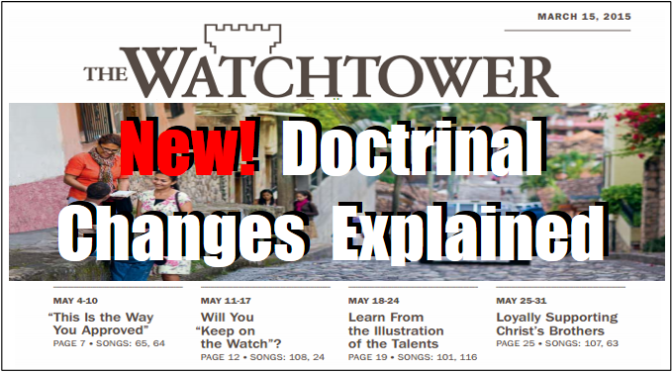
New! Important CHANGES in March 15th, 2015 Watchtower, Explained & Clarified

Articles in this series:

If you are one of those few people who REALLY keeps up with the recent changes to current doctrines among JWs, then you should appreciate the upcoming series of articles we are about to post on the subject. If you are one who does NOT always keep up with the recent changes to current doctrines among the JWs then you should REALLY appreciate these articles even more.

There are a some specific doctrinal changes spelled out in the March 15, 2015 Watchtower (the “Study Edition” available on the JW.ORG website).  But the biggest, most important change is about a method for explaining Scripture that will affect many more doctrines than the specific examples mentioned in the magazine.

With this issue, literally thousands of pages of previously printed doctrinal material are rendered obsolete. It also sets a new direction for Bible commentary in The Watchtower that has the potential to completely “reset” SEVERAL of the unique doctrines of Jehovah’s Witnesses, and MOST of the prophetic interpretations. Even the chronological interpretations are at risk of becoming obsolete.  (For example, until the last decade, “1918” was taught as a prophetically significant date that was once mentioned just about as often as 1919 was mentioned. Yet, many JWs are not even aware that 1918 has already been quietly dropped as a prophetically significant date, for reasons that are aligned with the changes set forth in this March 15, 2015 issue.)

To get an idea of how sweeping the general change already is, you would have to know just how much prior doctrine is affected by these sentences from the March 15th Watchtower:

“In times past, it was more common for our literature to take what might be called a type-antitype approach to Scriptural accounts.” (p.3) “Humans cannot know which Bible accounts are shadows of things to come and which are not. The clearest course is this: Where the Scriptures teach that an individual, an event, or an object is typical of something else, we accept it as such. Otherwise, we ought to be reluctant to assign an antitypical application to a certain person or account if there is no specific Scriptural basis for doing so.” (p.18)

The following is a list of 42 of these “prophecies” or “prophetic dramas” found in one of the Watchtower publications that we (JWs) actively taught and studied when I was a younger Witness. Most of these have never been dismissed and they still represented accurate doctrine until now. Learning these teachings took up a large portion of the curriculum for the students of the Watchtower Bible School of Gilead while I was at Bethel from 1976 to 1980. One of the weekly meetings, the “Congregation Book Study,” was often devoted entirely to discussions of this type.

3-15-15wt3-15-2

Also note that the 42 examples listed only include those that specified the “great crowd” who would have an earthly hope instead of the “anointed” with the heavenly hope. Because these “prophetic dramas” have been emphasized less, especially in the last couple of decades, many Witnesses didn’t realize that most of these explanations were still “on the books.” In other words they were still considered valid, correct doctrines. At least until now.

DIDN’T THEY TRY THIS BEFORE?

It probably sounds like hyperbole to attach such a potential significance to these new changes. However, we have an excellent reason to believe that these changes are indicative of more changes underway. What’s that reason? Simple. We saw what happened when they tried this before. The Watch Tower Society didn’t try it officially, because not everyone was on board with it. Nevertheless, beginning in the late 1960’s and 1970’s, several members of the Writing Department were already reading Bible narratives and writing and teaching about their meaning in the exact way described in this new issue of the Watchtower.

In fact, the idea of changing this teaching method already came up during the research and writing of the Watch Tower’s first Bible dictionary, Aid to Bible Understanding, completed in 1971. This “Aid Book” as we called it (now slightly revised as Insight on the Scriptures) is nearly devoid of types and antitypes. By 1972, the research behind the Aid Book had already resulted in major changes to the Watch Tower organizational structure, including a re-definition of what the governing body would soon become, and the new “elder arrangement,” which was just being put into place. The following is from an article in the August 15, 1972 Watchtower that reflects some of the thinking on this subject at the time:

*** w72 8/15 p. 502 God Readjusts the Thinking of His People ***
Another thing that has given rise to questions is the use by Jehovah’s witnesses of parallels or prophetic types, applying these to circumstances and to groups or classes of people today. Many people who read the Bible view its accounts all as simply history, but when they begin to study with Jehovah’s witnesses a readjustment of viewpoint takes place as they see that there is more to the accounts than history.

The question that is sometimes asked is, Did Jehovah stage that ‘dramatic’ event, so that we would have a warning now? Well, would he cause such bad things to happen? Would he maneuver them himself? No. …

It helps us to understand more fully when we keep in mind that the people in ancient times were real, living their daily lives in association with their families and fellowmen, having hopes and desires as we do today, the same general problems with sin working in their members, and many of them faithfully waging a fine fight to serve God.

The article just quoted actually tried to play both sides of the issue in order to introduce the change but also dismiss the need to make too many changes at once. (The 1972 article tended to favor the “type-antitype” status quo.) During the late 1970’s, the brothers in Writing who were the most productive and who were the most capable of Biblical research included the brothers who had worked on the Aid Book, and by that point in time had already been getting assignments to write Watchtower articles on many Bible topics. These articles tended to minimize the “type-antitype” pattern.

Not all Watchtower writers agreed with this change. However, many letters were received that thanked the Watchtower Society for producing these “refreshing and clear” articles that “make it easier to apply the Bible in our daily lives as Jehovah’s Christian witnesses.”

The brothers in Writing who had helped with the Aid Book had become especially involved in those new articles with the “refreshing” style, as some called it. One of these brothers had an excellent knowledge of the Biblical languages, including not just Hebrew but also Aramaic and Syriac. Another other one could write an article in minutes on almost any Bible topic, pretty much from memory, and those articles could usually be used in the Watchtower without any edits or changes. Their work was approved through the appropriate review committee(s), including Governing Body members, and resulted in dozens of Watchtower articles, and several books, which are still easily identifiable by their style when looking through the bound volumes of the Watchtower from those years, or the Watchtower Library CD. Two books were written in this same “refreshing” style in a Bible commentary format. Those two books, Commentary on the Letter of James and Choosing the Best Way of Life (which was a commentary on 1st and 2nd Peter) were released at the summer District Assemblies in 1979. They became the first major examples of books that scrupulously avoided “type-antitype” patterns, even when touching upon subjects that had previously required it. This includes an “untypical” reference to the “faithful and discreet slave” that called upon all Christians to be this sort of person. A recently deceased brother who had been at Bethel during the period described it to Randall Watters like this:

 “There were a couple new books published that were nothing like the typical FWFranzesque prophetic calculus manuals. These books were not typical fare, and you could see the puzzled looks when they reached the book study groups and meetings. Biblical commentary within scriptural context…”

Unfortunately, the Watch Tower Society in general was not yet ready for this type of reading and writing about the Bible narratives. “Heads rolled” when the significance of those changes was noticed by “old school” supporters of these now obsolete doctrinal methods. This included the two mentioned above, and a few others, too, who were not disfellowshipped, but who were dismissed from Bethel. However, this March 15, 2015 issue of The Watchtower now renders that “old school” doctrinal pattern obsolete. The pattern utilized in the Aid Book and in subsequent Watchtower articles and books for the next 7 years, especially from 1976 through 1980 is now considered ‘the way Jehovah approved.’ (Watchtower 3/15/2015 p.7,8)

While we cannot vouch for the exact numerical claims in the quote below, one person has put it this way, on a site where JWs often discuss issues with other JWs:

Now, with this article, nearly half the Watchtower articles that Rutherford wrote (since about 1931) and about a quarter of the Watchtower study articles that Fred Franz wrote (since 1942 – under Knorr) have been downgraded. When I worked with the Gilead students we were still spending about half their time going over these old Bible stories to make sure they understood when the anointed class was meant and when the great crowd was meant. (Anyone who has a copy of the Gilead Notes from up to about 1980 will know what I mean.)

Historically, I find that very interesting, but from a progressive perspective, it was bound to happen now that there is less concern about distinguishing anointed from other sheep, I find it quite refreshing that we no longer need to be worried that we draw the right application to the various people in so many of these Bible accounts.

If you do not have the magazine in printed format, it is available at the following location on jw.org:

http://www.jw.org/en/publications/magazines/w20150315/

That link (on the JW.org site) displays a page that has the following articles listed. Over the next few weeks we will provide a commentary on each of them and link the titles to our commented versions of these articles.

THE WATCHTOWER (STUDY EDITION) MARCH 2015

“This Is the Way You Approved”

Why have our publications in recent years often given simpler, clearer explanations of some Bible accounts?

Will You “Keep on the Watch”? 

Read this clarified understanding of Jesus’ parable of the ten virgins, which focuses on the parable’s simple, urgent message. 

Questions From Readers

In the past, our publications often mentioned types and antitypes, but in recent years they have seldom done so. Why is that? 

Learn From the Illustration of the Talents 

This article refines our understanding of the parable of the talents.

Loyally Supporting Christ’s Brothers 

How do those whom Christ judges to be sheep support his brothers?

In attempting to comment on those Watchtower articles listed above, this site will attempt to cover each of the articles listed above that cover the updated doctrines.

Watch for the following subjects to be covered across the five articles:

  • The Prior Importance of the “Type Anti-Type” Approach
  • The Good Samaritan – Type-Antitype method reviewed
  • Naboth, Ahab, Jezebel – Type-Antitype method reviewed
  • The Prodigal Son – Type-Antitype method reviewed
  • Elijah and Elisha – Type-Antitype method reviewed
  • The Ten Virgins – Type-Antitype method reviewed
  • The Talents – Type-Antitype method reviewed
  • What happened at Bethel when this same approach was used as an aid to Bible understanding?
  • How can this approach potentially change the explanation of the “Faithful and Discreet Slave”?
  • What will this approach do to the method of explaining all prophecies in Isaiah, Jeremiah and other prophetic books with a formula linking any mention of faithful kings, priests and prophets to the faithful anointed in our day, or linking unfaithful ones to Christendom, or linking any mention of captivity to the imprisonment of Rutherford and others in 1918/1919, etc.?
  • What can this approach do to the “anti-type” fulfillment of Nebuchadnezzar’s dream and the 1914 teaching?
  • Will this ultimately make 1919 go the way of 1918? (As mentioned, 1918 was once a large part of Watch Tower doctrine and it has been gradually but effectively dismissed over the last several years.)
  • Will this ultimately make the current distinction between Great Crowd and Anointed less important?