Generation X′+X″=Generation WHY? Already Bringing “Great Tribulation” on Watchtower Readers
The Watch Tower Society has got some “Splane-ing” to do. So they brought out Brother David Splane, hoping to bring some credibility to the incredible. (It’s in the September 2015 Monthly Broadcast at tv.jw.org.)
It is now literally possible to explain the potential length of the “overlapping generation” with a formula like the following one where X′ and X″ represent two different (overlapping) groups of anointed persons.
This formula is applicable where A′ and A″ are symbols referring to anointed persons qualified to be in group one and two, respectively. λ[A′] (lambda of A′) refers to the lifespan of the person in the first group, and α[A′] (alpha of A′) refers to the age at which A′ is said to have been anointed. A person qualifying for inclusion in the second group (A″), must not only be born, but must already be anointed, in or before the year A′ dies. We must also consider the following two limiting factors: First, the maximum length of a lifespan (λ) usually put in a range from 99 to 119 years. Second, the minimum age at which one may be considered to be anointed (α), put in a range from 10 to 20 years. And, finally, we must subtract x, the number of full years that the lifespan of A′ overlapped with A″. If A″ happened to be born in the same year that A′ died, then this x=0.
You’ll get your due in 2072!
If we plug in the information for FWF (Frederick W Franz) as a case that fits the first group of anointed, we would get:
Generation (X′+X″) <= 1914+99-20+λ[A″]-α[A″]
We would now only need to assume a lifespan and an age of anointing for a person who qualifies to be in the second group. If we also assume that A″ also has a lifespan of 99 years and also has an anointing age of 20, and was born in 1992, then the formula could be filled in as follows:
Generation (X′+X″) <= 1914+99-20+99-20 = 2072. Therefore, the overlapping generation could reach as far into the future as 2072.
2132: It’s around the corner, too!
Of course, we could also assume that FWF was not the ideal candidate to maximize the length of the generation. Perhaps there was a person, born in 1904, and anointed at 10 years old who also lived to be 119 years old. It doesn’t seem likely, of course, but it’s potentially possible. Perhaps it’s even more possible in the second group when medical advances of the 21st century might increase more lifespans toward and perhaps beyond the 119 year limit.
We could then, plug in our maximized examples for both groups and get the following numbers in our formula
Generation (X′+X″) <= 1914+119-10+119-10 = 2132. Therefore, the overlapping generation could reach as far into the future as the year 2132!
How ONE generation has become TEN generations.
Imagine! This means that “this generation” could potentially include, in my own case, my great grandfather, who was actually a co-worker with Russell in 1914, my grandfather (deceased), my father (living), myself, my children, my first grandchild (due in December 2015), my future great-grandchild (2040?), my great-great-grandchild (2065?), my great-great-great-grandchild (2090?), my great-great-great-great-grandchild (2115?). That’s TEN generations in all!
Can you imagine? When Jesus said “this generation will not pass away” that could have meant the same thing as if he had said “TEN generations will not pass away.”
Legitimate?
Of course, there are also ways to evaluate this from a Biblical perspective. We can discuss, for example:
(Deuteronomy 23:2) “No illegitimate son may come into the congregation of Jehovah. Even to the tenth generation, none of his descendants may come into the congregation of Jehovah.”
If 1 can equal 10, perhaps this actually meant 100 generations!
The 2014 Annual Meeting Program video can be found on tv.jw.org (currently found under Programs and Events). The following speech can be found about the 2 hour and 8 minute mark in the video. It ends at about the 2 hour and 25 minute mark.
“David Splane of the Governing Body will speak to us on the theme: ‘Types and Antitypes.’”
Let’s get right into our subject: types and antitypes.
Now, years ago, our publications often applied certain Bible accounts and certain bible characters as “types” of something greater. But you’ve noticed that, in recent years, that is seldom done, and the purpose of this talk is to explain why.
First of all what is a type and what is an antitype? Well, the Watchtower of September 15, 1950 defined them this way. It said:
“A type is a representation of something that will come to pass at a future time. The antitype is the reality of the thing which the type represents.”
So that is the definition that was given by The Watchtower. And we might add that Jehovah is usually involved in designing the type.
Now, take the tabernacle. Jehovah was very clear about the construction of the tabernacle: what materials were to be used, the dimensions and so forth. Why? Well, apparently because he had designed the tabernacle to be a type of something greater: his great spiritual temple. And the temple was the antitype.
The sacrifices on the Day of Atonement. Jehovah was very careful about how events on the Day of Atonement were to unfold. And again, we have to realize that something was going to have to picture or foreshadow the perfect sacrifice of Jesus Christ. So, the sacrifice on the Day of Atonement, the type, and the perfect sacrifice of Christ, the antitype.
Now consider another example. When the disobedient Israelites in the wilderness were bitten by poisonous snakes, Moses is told by Jehovah to fashion a copper serpent and to place that serpent on a pole. Now that was a type. Now Jesus explains what it was a type of. Let’s turn to John chapter 3, John chapter 3 and verses 14 and 15. John 3: 14 and 15 If you are using an iPad, I’ll give you a chance to catch up. [Laughter] I couldn’t resist. “And just as Moses lifted up the serpent in the wilderness, so the Son of Man must be lifted up, so that everyone believing in him may have everlasting life.” Now, would anyone doubt that this is a type? Of course not. Because Jesus said it was.
Well notice that in both these examples, the tabernacle and the copper serpent, Jehovah was involved. He designed the type so that it would fit the antitype. He told Moses, for example to fashion a copper serpent and put it, not on a rock, but on a stake. And of course the tabernacle prefiguring the great spiritual temple.
And from the apostle Paul we learn even more about types and antitypes. For example, Paul, in Hebrews: Isaiah and his 2 sons represent Jesus, and the anointed. He also explains that Moses, the mediator of the Law covenant, represents Christ the mediator of the new covenant. And we learn from the letter to the Galatians that Abraham’s relationship with Sarah and Hagar, represents Jehovah’s relationship with the nation of Israel, and with the heavenly part of his organization. Type and antitype.
Now we know that these were genuine types because, the word of God says they are. But here is the question:
Who is to decide if a person or an event is a type if the word of God doesn’t say anything about it? Who is qualified to do that? Our answer? We can do no better than to quote our beloved brother, Albert Schroeder, who said:
“We need to exercise great care when applying accounts in the Hebrew Scriptures as prophetic patterns, or types, if these are accounts are not applied in the Scriptures themselves.”
Wasn’t that a beautiful statement? We agree with it.
Now the study of types and antitypes is not unique to Jehovah’s Witnesses. During the past 2,000 years, Catholic and Jewish scholars have made quite a diligent study of types and antitypes. In fact, there is even a name for the study. They call it “typology.”
The first century Jewish scholar, Philo of Alexandria, for example, suggested that the serpent in the garden of Eden, the tree of knowledge and the cherubs that were guarding the entrance to the garden were all typical of something greater.
And then describing the teachings of such early writers as Origen, Ambrose and Jerome, the International Standard Bible Encyclopedia says this:
“They sought for types and of course found them, in every incident and event, however trivial, recorded in Scripture. Even the most simple and commonplace circumstance was thought to conceal within itself a hidden truth. Even in the number of fish caught by the disciples when the risen Savior appeared to them,” he says, “How much some have tried to make of that number:, 153 .”
One scholar made much of Jacob’s purchase of Esau’s birthright with a bowl of red stew. Very significant that the stew was red. To him, the red stew pictured the red blood of Christ. The inheritance pictured the heavenly inheritance. It’s all… By that reasoning, Jacob pictures Jesus, Esau’s birthright pictures the heavenly inheritance, and the red stew pictures Jesus’ precious blood.
Now on the surface that might sound plausible to some, until you think about it. When you think about it you see three problems. First of all, Jehovah didn’t design the type. Jehovah did not tell Esau to sell his birthright. Selling his birthright was wrong, and Jehovah never tells us to do something that’s wrong. Second, who ate the stew? Esau did. So are we to conclude that, by giving up his inheritance, Esau put himself in line for the ransom sacrifice of Jesus Christ? That doesn’t make any sense. And most importantly, nowhere in Scripture do we read that the event was a type.
Now the study of types and antitypes was not only common among Catholic and Jewish scholars, but were very prominent among Protestant scholars as well. The Puritans, like Edward Taylor, applied many Bible events to themselves. The Baptists and Congregationalists did likewise. So it’s not surprising that the early Bible Students, who generally belonged to these groups were also really fond of types.
And as many of us have been. Many of us have remembered happy moments at the congregation book study studying all about types and antitypes. And it’s true that the study of types could be thrilling!
So now here’s a question. If the study of a certain subject make chills run up and down your spine, could it possibly be mistaken? And the answer is yes.
The case of brother Arch W. Smith is an example. In 1886, Brother Russell published a book that contained a chart linking the ages of mankind to the Great Pyramid of Egypt. Now that pyramid was called by the Bible Students, the “Bible in stone.” They loved the study of the Pyramid. In fact, if you have seen pictures of Brother Russell’s grave, you’ve noticed that there was a pyramid nearby. And that’s because the Bible Students believed very much in the Great Pyramid of Egypt, and some became very engrossed, in measuring certain rooms and certain features of the pyramid and to try to determine, for example, how long they had to wait before they went to heaven, and so on.
And so one who was just thrilled by the study of types was Arch W. Smith. It was a hobby of his, he loved it. In fact he gave a lot of prayerful thought to the dimension of the pyramid, and from time to time he would write in to Bethel and let them know what his findings were, to support the idea that the Great Pyramid had a place in Jehovah’s purpose. He loved it!
But when The Watchtower of 1928 came out and said that Jehovah doesn’t need a stone monument built by pagans to accomplish his purpose, Brother Smith accepted it. He let reason win out over emotion.
Well, in recent years the trend in our publications has been to look for the practical application of Bible events, and not for types where the Scriptures themselves do not clearly identify them as such. We simply cannot go beyond what is written. Now there’s a real advantage in looking for the practical application of Bible accounts, rather than confining certain applications to one class: “This applies only to the anointed.” “This applies only to the other sheep.”
Let’s just see why. Turn to Romans chapter 15 and verse 4. Now remember that Paul is writing to his anointed brothers here. Romans chapter 15 and verse 4. And he says, “For all the things that were written beforehand” . . . Well what things? The Hebrew Scriptures obviously. . . “were written for our instruction so that through our endurance, that through the comfort of the Scriptures, that we might have hope.” What is Paul telling the anointed? He’s telling them that you can learn from these accounts in the Hebrew Scriptures. You can apply principles of the Hebrew Scriptures to yourselves.
Let’s consider an example: Now soon after his conversion, Paul is preaching in the city of Damascus. The Jews are furious and they try to kill him. So anointed disciples take Paul and they lower him down the city wall in a basket. Is it possible that some of those anointed ones they thought of Rahab? Who helped the two spies escape from Jericho by a similar method? Would anyone say to them, “You can’t apply that to yourselves…Rahab pictures the other sheep, you are of the anointed?” No! They could apply the lessons of that account to themselves.
Now let’s consider another example, a modern one. In the Song of Solomon we read of a chaste young virgin who falls desperately in love with a poor shepherd boy. Solomon, who incidentally was still an inspired Bible writer at the time, but he’s a very wealthy man, he tries to lure her away but he’s unable to do so. Now suppose that in a certain congregation there’s a sweet young sister, who falls head over heels for a poor pioneer brother, who’s a real spiritual man but he doesn’t have a penny to his name. Now her friends encourage her to marry a wealthy brother, who is very rich but he doesn’t have a lot of time to spend on spiritual things. The sister remains firm. They say, you wouldn’t have to work! You can pioneer. She says no my love is for that pioneer boy. Would anyone say to her, the Song of Solomon doesn’t apply to you because you’re of the other sheep, not of the anointed?
You see how practical it is to take these Bible accounts and really apply them to the everyday life of people.
What about others of the other sheep today? In this audience there are modern-day Nehemiahs who are spurring the building programs we have. Wonderful young Timothys, graduates of our Bible schools, warmhearted Tabitha’s, hospitable Lydias. And don’t we find exceptional young Circuit Overseers who are like Elihu in giving wise counsel to elders who are much older. And don’t many Christian young women remind us of dear Rebekah who was willing to follow her husband to a distant land for the accomplishment of Jehovah’s purpose?
We deeply appreciate the spiritual heritage that was passed on to us by the early Bible Students. In harmony with Zechariah chapter 4 and verse 10: “We do not despise the day of small things.” However the light does get brighter. And we feel that we must follow the light, wherever it leads us. Our love should be for the truth and not for a particular doctrine or teaching.
Well how would you sum this talk in a few words?
The wrong answer is, “We don’t believe in types and antitypes any more.” We do! We certainly do. Where the scriptures identify them as such, we embrace them. But where the Bible is silent, we must be silent.
Now in the three talks that follow there are going to be important clarifications in our beliefs.
Perhaps a certain adjustment will touch a spiritual nerve, make us rethink a cherished teaching. Our love for Jehovah and the truth will make us receive this information gladly and with open hearts.
Often today we hear brothers say, we’re having a hard time keeping up with the celestial chariot. So are we. So are the Governing Body. We’re not driving the chariot. Jehovah is driving the chariot and we’re running just as fast as you are, trying to keep up. So let’s all do our best to keep up with it. And let us thank Jehovah for continuing to deal with us. And for continuing to provide nourishing spiritual food.
________end of transcript________
Personal notes:
In the commentary on the Watchtower article based on this talk ( http://ad1914.com/2015/01/26/2107/ ) we pointed out a few items of interest:
First of all, the idea is given that these “type-antitype” explanations have already been phased out to some extent over the past few years, but with no official explanation until now.
The talk mentions that some legitimate examples of “type/antitype” included the tabernacle (shadows), the sacrifices, Abraham’s wife and mistress, and the snake on a pole. The 3/15/2015 Watchtower article replaced the snake on a pole with the sign of Jonah.
It’s pointed out that this “typology” stuff has had a long history among a lot of religions, Jewish, Catholic and Protestant. (And some ridiculously bad examples are mentioned as if they were more ridiculous than Watch Tower examples.)
The logic behind using the Rahab and Shulamite examples is twisted and anachronistic. As far as Paul’s companions knew, there never was and never would be an incorrectly explained “other sheep” class represented by Rahab. And what sister says, “The reason I am choosing the broke pioneer over the rich brother because the Song of Solomon applies to me.” In Splane’s illustration, she never actually says that, but Splane indicates that there is some danger that the sister is going to hear an argument meant to to push her into the arms of the rich brother simply because she is not “anointed” — as if only “anointed” sisters should be able to choose the poor penniless pioneer.
But the speech says, basically, that the Watch Tower teachings took this too far. It says it will only be used from now on if the Bible tells us specifically that it is a “type.” This seems commendable.
The problem is that this new guideline is watered down considerably in the March 15, 2015 Watchtower article based on this talk. It seems very likely that between the Annual Meeting and the end of the 2014, someone noticed that following the words of this talk would completely ruin the two most important unique doctrines of JWs today:
1. That the Kingdom of the pagan, Gentile, violent, insane, Jew-killing Nebuchadnezzar was a “type” of God’s non-Gentile Kingdom through Christ Jesus, the perfect Prince of Peace, as represented by the Jewish Davidic/Messianic Kingdom at Jerusalem.
2. That the “faithful and discreet slave” in Matthew 24:45 was a “type” of the Governing Body.
Also, found it “funny” how Splane treats the old Pyramid scheme, promoted in the Watch Tower publications from the 1880’s to the 1920’s.
The March 15, 2015 article tries to keep the idea of being once “thrilled” by these explanations in the past as a good thing. Splane had used it to show that being thrilled doesn’t always mean it was right.
A 100-YEAR ANNIVERSARY is usually something to take pride in — something to celebrate! And, yes, the 100-year milestone of the 1914 date truly is something to celebrate. But not for the same reasons that the majority of Jehovah’s Witnesses are giving special attention to the date. We’ll explain the reasons we are celebrating, of course. But first, some background:
In 1979, the Watch Tower Bible and Tract Society* celebrated the 100-year anniversary of the Watchtower magazine, which was first published in July 1879 as “Zion’s Watch Tower and Herald of Christ’s Presence.”
In 1984, the Watch Tower Society celebrated the 100-year anniversary of the charter of the Watch Tower Society itself.
“THIS IS THE YEAR OF THE KINGDOM”
And now, in 2014, the Watchtower celebrates the 100-year anniversary of 1914. A phrase that has been heard multiple times among Jehovah’s Witnesses from their headquarters (Bethel) is that 2014 is “The Year of the Kingdom.”
The following links (to jw.org) are examples of this kind of emphasis since the beginning of 2014.
(Something is just a bit ironic in this article. It’s in the ellipses, hidden in those three little dots after “Behold, the King reigns! ” . . . Give up? The answer is linked here.)
THE TRUTH BE TOLD
Many of us with years of experience among Jehovah’s Witnesses have yet another reason to celebrate 2014. Primarily, we’re celebrating Truth — finding“pleasure in truth.” Isn’t that what had attracted us to Jehovah’s Witnesses in the first place?
Psalm 51:6 says: “Look! You find pleasure in truth in the inner person.” (NWT, 2013)
It should become clear to anyone who spends much time looking at the research that has been reproduced, referenced and presented on these pages that the 1914 teaching was simply a mistake. So exactly why would we celebrate? Are we gloating?
For most of us, we are happy with the demise of the 1914 teaching because it corrects an error. And correcting an error is always a good thing.
Researching and studying about 1914 was, in fact, quite painful at first for some of those whose experience are available here. But it was a step to real progress. Many of us now have a much better understanding of the Bible, and we are now more conscious of our spiritual needs. We feel more empathy and better understand one another, especially those who, like ourselves, had found ourselves defending belief systems that required continual change and correction over time. And this empathy has often included our own families, friends and loved ones. For many of us, it was specifically the deep and sincere research into the 1914 doctrine that ultimately produced the proper humility that allowed us to make greater progress in our continued quest for truth.
A MILESTONE OR A MILLSTONE?
But wait! Aren’t we getting ahead of ourselves? Many readers of this article will surely think that the Watchtower’s celebration of this 100th Anniversary is just evidence that the 1914 teaching is not going away any time soon. Why are we acting like this anniversary is somehow a “death knell” for the Watchtower’s traditional 1914 doctrine?
There are plenty of reasons:
Any JW who has ever tried to seriously defend the 1914 doctrine has likely already discovered that there is no Biblical or secular evidence for pointing to that specific date. Worse than that, there are dozens of lines of evidence against it. (If you get to the level of studying the pivotal 607 BCE date, it turns out that there are literally tens of thousands of pieces of evidence against it. We might have thought that date was set in stone, and as it turns out, the very stones [link] cry out against it.) Every single claim about the doctrine turns out to be problematic from a doctrinal perspective. Defending it creates insurmountable contradictions, and this is something that many Witnesses have had to keep to themselves.
But the Watch Tower publications have now asked Jehovah’s Witnesses to focus on 1914 one more time, and to try to defend it one more time. The October 2014 Our Kingdom Ministry states: “Realistically, we may find it challenging to explain deep Bible truths, such as how we know that the Kingdom started ruling in 1914.”
Most, but not all, Jehovah’s Witnesses who write for the Watch Tower publications believe the 1914 teaching, and some “cracks” have already showing up in the publications.
Even for those who still believe it, however, the renewed focus has clearly created some awkward discoveries. Claims that once appeared regularly in Watch Tower publications have almost disappeared, replaced with reworded claims that make it clear the writer discovered the problem with old claim. Even some of the more recent doctrinal changes in just the last couple of years provide additional indications that Watch Tower writers have begun to see how the doctrine creates contradictions.
Luke 9:21 indicates the perils for a “man who has put his hand to a plow and looks at the things behind.” If you’ve ever tried to plow (or mow a lawn, at least) while continually looking back at where you’ve been, you will find that the lines aren’t straight. The Watch Tower’s own writers are looking back and finding out that the lines aren’t straight.
Most of us, whether JWs, ex-JWs, or non-JWs, already understand implicitly that the current 1914 teaching can’t last forever with world conditions going as they have been for the last hundred years. The teaching has already required adjustment in several ways, and it would be impossible to continue the current teaching without additional changes in the next couple of decades. The doctrine is like a sinking millstone. It can’t remain afloat.
KEEP ON TWEAKING FIRST THE KINGDOM
Remember this famous graphic from the 1968 “Truth Book”?
Someone (on another website) produced an updated version based on the 2010 “clarification” of the meaning of “that generation.” The image indicates, graphically, why there is very little room — or appetite — for further adjustments.
If anyone isn’t up-to-date with some of these more recent changes to the “generation” doctrine, it’s also discussed here.
A decade before the most recent changes to the “generation” the January 1, 2000 Watchtower stated:
“In recent years, we have been encouraged to look again with deeper understanding at—among other things—the generation that will not pass away before the end comes…. It may be difficult at times to understand such updated explanations, but the reasons for them become clear in due course.” [emphasis added]
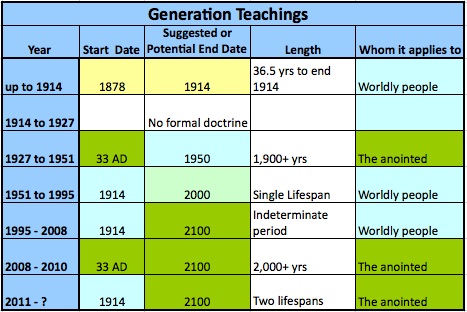
In due course, of course, the definition of that “generation” changed again. There was an explanation that worked up until 1995, and then the 1995 explanation that was considered potentially “difficult” in the quote above, which itself preceded a new explanation in 2008, which lasted only a couple of years before the currently accepted explanation first appeared in 2010. Historically, the Watchtower has offered 7 distinct explanations, as depicted in the graphic below, found at the following web address: http://www.jwfacts.com/watchtower/generation.php
THE TRUTH, 2014 REVISED EDITION
As already stated, one excellent reason for our celebration is simply “pleasure in truth.” Jehovah’s Witnesses are repeatedly encouraged to do as the Beroeans did:
“Now these [Beroeans] were more noble-minded than those in Thessalonica, for they accepted the word with the greatest eagerness of mind, carefully examining the Scriptures daily to see whether these things were so.” — Acts 17:11
As if to drive home the point even further, Paul later wrote to those in Thessalonica, telling them to “make sure of all things.” (1 Thessalonians 5:21)
That desire — that pleasure, that eagerness of mind — to “carefully examine” and “make sure” will be clear to anyone looking at those many experiences that many have shared here on this site. And if you have never seen Carl Olof Jonsson’s most comprehensive book, Gentile Times Reconsidered, take a quick look at the bookhere and you will surely be impressed at the level of research and scholarship.
CENSURED SENTRIES OF THE CENTURY
There’s another good reason to celebrate, and it’s in a more serious vein. We are all aware of how the Watchtower magazine often “celebrates” the lives of those persons in history who sacrificed much for the sake of truth and for the sake of their faith.
It’s a common theme found in many Watchtower articles — one that truly touches the hearts of those who have given up so much for their faith, their conscience, and especially for those related to them in the faith. That same theme was recently highlighted in the June 1, 2014 Watchtower article: Three 16th-Century Truth Seekers—What Did They Find? (links to jw.org) Another recent example is found the April 1, 2014 issue: Thomas Emlyn—Blasphemer or Advocate of Truth? (links to jw.org)
The parallels between experiences posted on this site and “16th-Century Truth Seekers” will likely seem quite unexpected to many Witnesses. We’ve included a short post about the Watchtower’s article on Thomas Emlyn, for example, because the similarities to the experience of Witnesses who studied the 1914 teaching are really quite amazing.
HOW WE ARE CELEBRATING
We’re celebrating the lives and experiences of many who suffered the consequences of speaking and writing honestly about their research. We have made an entire section devoted to such experiences and expect to add several more over the coming months.
Another way we’ll celebrate is by highlighting some of the excellent work and research that has been done to promote the truth about this matter. Some of that research has been contributed to this site, and much more will be referenced from a special section of the site: Websites, videos, books and discussions.
Of course, the most important way we are celebrating is by an effort to help everyone understand each other a little better. For example:
Everyone can get a better understanding of the historical development of the doctrine and the religious organization itself and therefore more empathy for people who are confused by it or object to it.
The included experiences should help Witnesses and ex-Witnesses understand each other better, especially those who might now find themselves in “estranged” circumstances.
Witnesses and ex-Witnesses alike often find themselves believing they are “on their own” when doubts or concerns arise. Hopefully this site will show otherwise, and encourage discussion with an entire community of persons who would gladly offer support and encouragement.
Truth doesn’t always lead to peace, but where both sides give truth a chance, it can offer the most stable basis for peace, understanding, empathy and love. Who could ask for anything more?
“A COHORT OF CONTEMPORARIES; AS A TIME SPAN IT’S OFTEN GIVEN AS 30 YEARS.”
“What is a Generation?” was the correct response that earned Sandie $800 in the Jeopardy game that aired on April 15, 2014. (Season 30, Episode 75)
That question aired on Jeopardy earlier today (as of this writing). But I was already thinking about that same question since yesterday evening. That’s because yesterday was the Memorial (as celebrated by JWs) and I had just attended in a rented banquet hall, where a wedding reception and a Sweet Sixteen birthday party had just occurred the day before.
It’s not common for the person giving the Memorial talk to mention either the date 1914 or 1935 anymore, and this speaker didn’t mention them either. The idea of the “this generation” was only mentioned in a very general way during the speaker’s conclusion and he happened to use the term in his closing prayer. Yet, I happen to know that it was already on the minds of more than one person in the audience. I know that because I spoke with one attendee just a few days prior to the Memorial on that very subject.
But mostly I know it because there was an awkward moment of excessive whispering at one point during the passing of the Memorial emblems that became a topic of discussion immediately after the closing prayer, even before I could make our way to the aisle.
Here’s how it started.
The audience of at least 350 was made up of 2 congregations who rented the banquet hall. The speaker was a relatively young elder, probably about 40 years old, from one of the two congregations. Out of the 350, there was nary a nibble or a sip taken from any of the emblems.
But there was one exception. And it was done in such a way that no one could miss it. It wasn’t so obvious with bread, but very obvious with the wine. There was a little table that started out with 6 glasses, all filled to the half-way point, to the exact same point. After the 6 servers completed the task of passing the wine across all the rows they brought the glasses back to the little table and it they were all still filled perfectly to the midpoint. No sips, no slips, no mishaps.
The servers sat down just off to the left of the stage facing toward the audience, and the speaker very ceremoniously walks 20 feet to that table, picks up a glass of wine and then over to the servers to offer it to each one of them. No takers. Then he walks back to the table, replaces it, and walks 20 feet back to the podium. Then in a move that looked like a mistake at first, one of the servers gets up and in a deliberate slow-motion stride, picks up the same glass of wine that the speaker had just put down, and he walks 20 feet over to the speaker’s podium and offers it to the speaker. And the little boy next to explains to his sister in a whisper, “Oh yeah, they have to give it to him too.” I was thinking that it might be clever to whisper: “The rite of last refusal.” But, of course, I didn’t, and I made a mental note to look up exactly what the original phrase, “right of first refusal” means in contract or real estate law.
It surprised me to see the 40-year elder partake. And, judging by all the young whisperers and subsequent parental hushing, it surprised a lot of others, too. The same boy next to me asked “Why is he drinking it, Daddy?” There was even a “hmm?” and a barely audible mumble from the brother sitting to my right. And one of the two sisters right behind me whispered something like “That’s right.” showing that she (or they) already knew that he would partake.
There was a time when elderly visitors from Brooklyn Bethel were often invited to congregations to give the Memorial talk, and it was fairly common to see him partake. It’s often why they were invited. As a Bethelite, assigned to a Bronx congregation, I was more than once asked if I knew of any partakers who could be invited to give the Memorial talk in our congregation. Back then, the only other person who partook was a sister who, for reasons I won’t go into here, no one wanted to believe was really “one of the anointed.”
Meanwhile, back at yesterday’s Memorial: After the closing prayer, and before I could manage to squeeze toward an aisle (about 20 tightly packed folding chairs in either direction). I overheard a brother from the first row answering a question about the “age of the anointed generation.” From what I could tell, I think he was answering it wrong, from the current JW perspective, but it was none of my business. The idea behind the question had been recently brought up in a Watchtower magazine that had just been studied a couple weeks ago. From the time of that magazine, the question had also been recently addressed to me personally in an online discussion forum that I participate in, from time to time.
The question arises because the Watchtower had created a direct connection between the “anointed” and the meaning of “this generation.” And this person, because he was a relatively young elder, clearly begged the question, based on the Watchtower‘s specific comments. Along with repeating the new long-winded definition of “this generation,” the January 15, 2014 Watchtower said:
“We understand that in mentioning “this generation,” Jesus was referring to two groups of anointed Christians. ,. . .[yet] not every anointed person today is included in “this generation” of whom Jesus spoke.”
The simple Jeopardy clue, above, highlighted to me just how ridiculously the Watchtower had twisted and stretched the natural meaning of a term like “this generation.” In the original context of Matthew and Luke, it appeared that it could refer to the time between 33 CE when Jesus made the statement, and 68 to 70 CE when Jerusalem was surrounded by encamped armies. About 37 years passed people of “that generation” might see “all these things occur.” (Matt 24, Mark 10, Luke 17 & 21) So a generation of 40 years might easily match what Jesus had in mind.
Another definition of generation — likely the one implicit in the Jeopardy clue — is the span of time from a person’s birth to the time period when their own children are born, usually 25 to 35 years later, and then again from the time of those children to the time period when the grandchildren are born, and then on to the great-grandchildren, etc. These “generation” periods might average about 30 years each.
In other words, using a common definition of generation, we’ve already had 3 or 4 since 1914, and could easily squeeze in one or two, or even three more before the Watchtower‘s legalese-laden definition runs out. For the Watchtower, “this generation” equals 3 to 6 “unstretched” generations.
In fact, if the Jeopardy question had been specifically about the current meaning of “this generation” to JWs, the clue would have to be changed. It would need to look more like this:
REFERS TO TWO GROUPS OF ANOINTED CHRISTIANS; THE FIRST GROUP WHO WERE ON HAND IN 1914, AND WHO READILY DISCERNED THE SIGN OF CHRIST’S PRESENCE IN THAT YEAR, AND WHO WERE NOT ONLY ALIVE IN 1914, BUT WHO WERE ALREADY SPIRIT ANOINTED AS SONS OF GOD IN OR BEFORE THE YEAR 1914; AND THE SECOND GROUP WHO ARE ANOINTED CONTEMPORARIES OF THE FIRST GROUP, WHO WERE NOT SIMPLY ALIVE DURING THE LIFETIME OF THOSE IN THE FIRST GROUP, BUT WHO WERE ALSO ALREADY ANOINTED DURING AT LEAST PART OF OF THE TIME THAT THOSE IN THE FIRST GROUP WERE STILL ALIVE ON EARTH
Seems to me this generation might just run out by the time Alex Trebek could finish reading the clue.
It’s a question I have seen a few times online, twice directed toward me personally in the last couple of weeks, one of which I answered on my Facebook page. (See below.) The exact question, as it was put to me by a Witness, went like this: (She quoted verbatim from the January 15, 2014 Watchtower)
March 29th, 7:11am
In his detailed prophecy about the conclusion of this system of things, Jesus said: “This generation will by no means pass away until all these things happen.” (Read Matthew 24:33-35.) We understand that in mentioning “this generation,” Jesus was referring to two groups of anointed Christians. The first group was on hand in 1914, and they readily discerned the sign of Christ’s presence in that year. Those who made up this group were not merely alive in 1914, but they were spirit-anointed as sons of God in or before that year.—Rom. 8:14-17. 16 The second group included in “this generation” are anointed contemporaries of the first group. They were not simply alive during the lifetime of those in the first group, but they were anointed with holy spirit during the time that those of the first group were still on earth. Thus, not every anointed person today is included in “this generation” of whom Jesus spoke. Today, those in this second group are themselves advancing in years. Yet, Jesus’ words at Matthew 24:34 give us confidence that at least some of “this generation will by no means pass away” before seeing the start of the great tribulation. This should add to our conviction that little time remains before the King of God’s Kingdom acts to destroy the wicked and usher in a righteous new world.—2 Pet. 3:13.
March 29th, 7:12am
My question is, Do you know who among them (second group) still alive? And their specific age? I plan to include that in my comment in the watchtower study next week. Hope you can help me. Thanks- sister [name removed]
March 30th, 9:27pm [my response]
I have seen this same question come quite a few times, lately. I get the sense that some people ask the question as a means of trying to figure out just how long — at most — this system can last. But from a purely Christian standpoint, that can be a dangerous proposition. First, we can agree that the end can come at any time, and that no matter when that is, even many true Christians will be surprised. That day will come as a thief in the night. And it can be just as big a problem when we believe that we can identify the most distant point in the future when the end is expected. What will happen if, for some reason, our understanding even among Jehovah’s Witnesses, turned out to be mistaken? If shared, this could produce a stumbling block for other Witnesses and outsiders who might otherwise have shown interest and goodwill. I’m sure you understand that but I wouldn’t feel comfortable without mentioning it first.
The first thing you’d want to look for are any possible examples from the first group described. Remember that “The first group was on hand in 1914, and they readily discerned the sign of Christ’s presence in that year.” Unfortunately, it turns out that we don’t really know even one person who met that test in its most accurate sense. Technically, anyone associated with the Watchtower Society at that time (in 1914) still believed that the last days had started in 1799, and that Jesus’ presence had begun invisibly in 1874. 1914 was to be seen as the end of Christ’s invisible presence, a time when Bible Students (as we were called then) would now see Jesus face to face, visibly. There was no specific “sign” of Christ’s presence to discern that year, because no sign would be needed to see Jesus in person. This teaching remained until around 1930 and parts of it were not officially changed until 1943. So what the Watchtower means is that there were people who saw the “sign” of Jesus’ presence in 1914 even though they did NOT readily discern anything that was true or correct about it. We can assume at least, that the Watchtower means anyone who recognized ANY significance to World War I would be in that intended group. One person in that intended group, therefore, would have been Charles Taze Russell. He saw a significance to the Great War in 1914 (even if he gave it a false significance) and he then died in 1916. So he would be one of the first that would most likely meet the intention of the contemporary generations of anointed. Any who were anointed contemporaries of him are therefore a part of that second generation of anointed. We expect that would include persons like Joseph Rutherford and Frederick Franz. Therefore, some persons who are part of that second generation of anointed contemporaries have already died. (1942 and 1992, respectively.) However, to pick an ideal example of a person many might recognize as anointed who was also part of that first generation we could, again, pick Frederick W Franz. He was alive in 1914 and old enough to recognize it as a significant event during Jesus’ presence (even if not readily discerned for what it was, based on their current understanding of Christ’s presence). Franz began his association with the Watchtower Society around 1914. So now we have someone of the first generation who lived until 1992. Any anointed persons who were contemporaries with him would therefore also be part of that second generation. Therefore even a person who became one of these anointed as late as 1992 could technically be part of this second defined group of anointed. No one can specifically say if another person is anointed, however, it is true that the youngest member of the Governing Body (Brother Sanderson, who would now be 49), for example, was born in 1965, and could therefore be seen as fitting this situation — if we assume he was “of the anointed” between 1965 and 1992, using this case. Although interesting, I still think it’s a bad idea to publicize such information in the context of the generation Jesus spoke about. There is still a danger that persons could take such an example, and think it’s the same as saying that the system could potentially last until 2055, if the example (Sanderson) lives to be 90, or as late as 2085, if he lives to be 120. I know this might seem absurd to you, but it’s how a lot of persons tend to think. Hope this helps. And I hope you understand why my answer is probably a bit longer than you might have expected.
March 31st, 4:06am
Thank you so much for your help. Jah bless u.
very kind and informative answer. it really feed my mind. Thanks
March 31st, 10:39am
No problem. It’s an interesting question. Hope all is OK with you and your friends and congregation
[Note: above was slightly edited to avoid identifying participants, etc.]
![STAY ALIVE ‘TIL 2132! Generation (X′+X″) <= (1914+λ[A′]-α[A′]+λ[A″]-α[A″]-x) <= 2132](https://photos.watchtowerdocuments.org
/wp-content/uploads/2015/09/splainin.png)