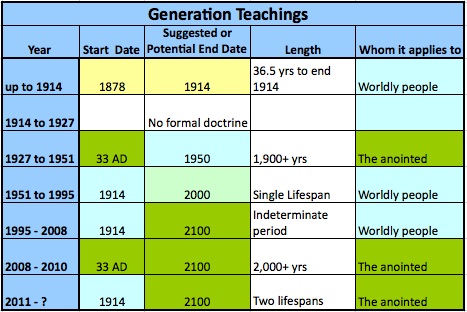
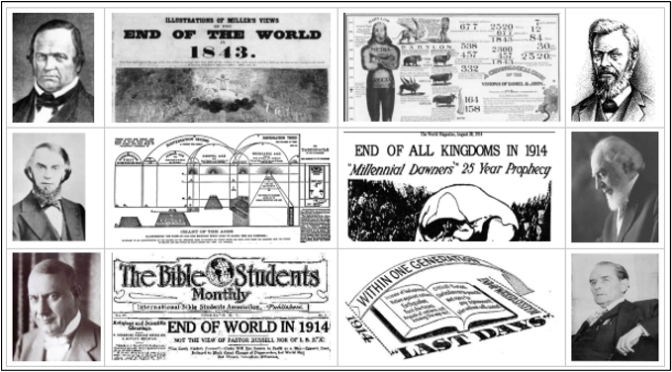
See also:
The article below was contributed by Alan Feuerbacher and contains links to numerous additional web resources throughout, especially in its Appendix. Click here for full width. Also in PDF format: evidence_against_wts_chronolog.pdf.
Biblical Evidence Against Watchtower Society Chronology
Among the Watchtower Society’s fundamental doctrines are those concerning 1914. They are the basis for its leaders’ claim to spiritual authority over the community of Jehovah’s Witnesses. This essay briefly examines the biblical evidence, with a bit of secular support, as to why the Society’s 1914 chronology is wrong.
The Society teaches that in 1914, at the end of the “gentile times” (a.k.a. “appointed times of the nations”; Luke 21:24) Christ returned invisibly (Matt. 24:3) and was given the Messianic Kingdom. It claims that the “last days” (Acts 2:17; 2 Tim. 3:1; 2 Pet. 3:3; etc.) began, the “conclusion of the system of things” began, a great harvest work of true Christians began, and that between 1914 and 1919 a time of “spiritual inspection” by the returned Jesus occurred. It teaches that by 1919 the “true Christian congregation” had been restored, in 1919 the “faithful and discreet slave” was appointed over all Jesus’ “domestics” (Matt. 24:45), and that in 1919 “false religion” (a.k.a. “Babylon the Great”; Rev. 14:8) fell. These doctrines were crucial to its claim throughout the 20th century that in 1919 all “anointed Christians” were appointed as “the faithful and discreet slave over all Christ’s belongings” on earth (the Society changed this teaching in the July 15, 2013 edition of The Watchtower).
From 1876, the phrase “gentile times” and the 1914 date were doctrinal anchors for the Society’s founder C. T. Russell, and have been so for the followers of the organization ever since. 1914 remains the key date in Watchtower “end times” teaching even though the Society has revised or abandoned most of its early claims about 1914.
In 1879 C. T. Russell began publishing what became The Watchtower magazine and therein promoted the 1914 date. Even earlier, in 1876, he published an article in the small religious journal The Bible Examiner that advocated the 1914 date as the end of the gentile times. Russell borrowed these ideas from Nelson Barbour, a semi-independent “Second Adventist” who originated the combination of the 1914 and gentile times ideas in the June, 1875 issue of his magazine Herald of the Morning.
The 1914 date is determined as follows (cf. w14 10/1 p. 10; “When Did God’s Kingdom Begin Ruling? (Part 1)”). The Society interprets the dream of Babylonian King Nebuchadnezzar described in Daniel 4 about a great tree in the center of the earth to mean that God’s direct rule over humans was interrupted, but would be restored after “seven times” had passed. The interruption is said to have begun in 607 BCE with the destruction of Jerusalem, and to have ended in 1914. Luke 21:24 is interpreted to mean that God’s rule, represented by Jerusalem, corresponds to this period, which is called “the appointed times of the nations” or “the gentile times.” The Society calculates the length as 2,520 years, based on Daniel’s statement that Nebuchadnezzar was mad for “seven times”, plus a statement in Revelation 12 that three and a half times equal 1,260 days. Then it applies a so-called “day for a year” principle. So 1,260 days (3 ½ times) x 2 = 2,520 days. A day for a year makes 2,520 years. 2,520 years forward from 607 BCE gets to 1914 CE (no zero year).
The Society derives the year 607 by beginning with the universally accepted date of 539 BCE for the conquest of the city of Babylon by the Persian king Cyrus the Great and noting that in his first regnal year he issued a decree that allowed the Jews to return to Judah. It then assumes that the Jews returned to Judah in the autumn of 537 BCE. Then the Society concludes that “the 70 years” Jeremiah spoke of (Jer. 25: 11, 12; 29:10) are a period of desolation of the land of Judah and exile and captivity of the Jews, and that this period ended when the Jews returned to Judah in 537. Working backward 70 years arrives at 607 BCE, when the destruction of Jerusalem caused the desolation of Judah to begin.
Of course, secular history—backed up by the Bible itself—shows that Jerusalem was destroyed in 587 BCE. So the Watchtower Society and its apologists go to great lengths to discount the secular evidence and to interpret the Bible according to Watchtower tradition. This essay outlines the biblical evidence that shows why Watchtower tradition is wrong. References in the appendix detail the voluminous evidence against Watchtower tradition, including secular, as do references to some excellent online resources.
Obviously, the 1914 date rests on a chain of questionable assumptions. Dubious scriptural interpretations such as equating the gentile times of Luke 21:24 to the seven times of Nebuchadnezzar’s madness, and so forth, do not lend themselves to objective resolution, so this essay will not consider them. Rather, it will examine the Watchtower’s claims about various dates and time periods derived from biblical passages that are capable of scholarly, objective resolution.
Watchtower chronology has multiple problems, many of which individually are fatal to the chronology as a whole and which, taken together, show unassailably that this chronology is wrong. Experience has shown that neither the Society nor its apologists can honestly address these problems. In many cases they simply ignore them.
This summary is in no sense a complete treatise on all the reasons Watchtower chronology is wrong. There are many excellent online resources for the interested reader, as well as the print copy of Carl Olof Jonsson’s book The Gentile Times Reconsidered. See the appendix for a list.
The 607 BCE Date for Jerusalem’s Destruction Has No Biblical Support
(1) There is no good evidence that 537 BCE was the year the Jews returned to Judah. The Society says only that “evidently” (All Scripture, p. 85) or “likely” (Insight, V. 1, p. 568) or “doubtless” (w64 2/1 p. 80) this was the date but supplies no evidence. In most discussions it simply glosses over the lack of evidence (cf. w11 10/1 p. 28).
(2) The synchronism between Josephus and the book of Ezra is solid evidence that the Jews returned to Judah in 538 BCE. Both refer to the laying of the temple foundations about half a year after the Jews were settled in their cities in the month of Tishri (autumn). Ezra gives only a relative date in Jewish terms, while Josephus gives a date in terms of the years of Cyrus’ reign, which is solidly established. This date is in the spring of 537 BCE; hence the Jews must have returned half a year earlier, in the autumn of 538. See the diagram below, and the appendix for an extended discussion.
Note that the Jews used a secular calendar beginning with the seventh month Tishri (Sep/Oct), and a religious calendar beginning with the first month Nisan (Mar/Apr). The Babylonian calendar began in Nisan.
Ezra 1 states that Cyrus, in his first year (using the accession-year system), decreed that the Jews could return to Judah. Cyrus’ first year was Nisan, 538 BCE through Adar, 537 BCE. Ezra 3:1-7 states that by the seventh month Tishri, the Jews were settled in their cities, and at that time they gathered in Jerusalem to initiate the rebuilding of the temple. So the year that ended immediately before Tishri was the first year of the Jews’ coming home, and the new year beginning in Tishri was the second year.
Ezra 3:8, 10 states that the temple foundations were laid in the second month of that second year. In Against Apion I,21, Josephus states that “in the second year of the reign of Cyrus [the temple’s] foundations were laid.” Therefore, this second Jewish year overlaps with the second year of Cyrus. Since Cyrus’ second year began in Nisan, 537 BCE, the second month was also in 537, and the first year of the Jews’ return was in 538 BCE—not 537 as the Watchtower claims.
The following diagram illustrates the above concepts.

(3) Given (1) and (2), Watchtower chronology has no evidential foundation; on the contrary the available evidence is against it. If the Jews returned in 538, the Society’s 607 date is wrong and so is Watchtower chronology. If 607 is wrong, 1914 is wrong. If 1914 is wrong, Watchtower eschatology is wrong, and so are all the doctrines based on it.
(4) Linguistic, contextual and historical biblical facts show that Jeremiah predicted that Judah and the nations around it would, as a group, serve Nebuchadnezzar’s dynasty for 70 years (Jer. 25:8-12; 27:6-7). The key passage is Jer. 25:11: “These nations will have to serve the king of Babylon seventy years.” The Bible and secular history show that Judah and various nations individually served less than 70 years, depending on when they were first conquered and how one measures “serving.” God, through Jeremiah and other prophets, gave each nation the choice whether to serve on their own land or in exile (Jer. 27:7-11, 17; 40:9-10). To serve in their own land they had to submit to Nebuchadnezzar. The Jews under various kings refused; hence they were taken into exile at various times from 605/4 through 582 BCE (Dan 1:1-2; Jer. 52:28-30). Thus there was no 70-year exile or captivity or desolation of Judah.
(5) The 70 years of Babylonian supremacy ended in 539 BCE when Jehovah “called to account” against, or punished, Nebuchadnezzar’s dynasty (Jer. 25:12) by allowing the Medo-Persian empire under Cyrus to conquer Babylon and put an end to Nebuchadnezzar’s dynasty. This is directly stated in Daniel 5, where verses 28-30 say: “Your kingdom has been divided and given to the Medes and the Persians… in that very night Belshazzar the Chaldean king was killed.” In contrast, the Society claims that Nebuchadnezzar’s dynasty was called to account two years after its demise, when the Persians freed the Jews to return home (w79 9/15 pp. 23-24; g 5/13 p. 13), but this is ridiculous. You cannot punish a dynasty that no longer exists.
(6) 2 Chronicles 36:20 states that Nebuchadnezzar’s minions carried off Jews to Babylon, and these Jews remained servants to Nebuchadnezzar’s dynasty until the Persians under Cyrus took over, after which they were servants to Cyrus and his minions until Cyrus let them return to Judah. This confirms again that the 70 years were a time of Babylonian supremacy, not the term of the desolation of Judah. That desolation occurred during the 70 years. This is consistent with Jer. 25:8, 11, 12 which states that the Jews and nations round about would be servants to “Nebuchadnezzar and his sons” until God called them to account.
(7) Because Jeremiah spoke of Jerusalem being devastated or ruined (Hebrew chorbah; Jer. 25:18) shortly after Nebuchadnezzar conquered it in 605 BCE, the devastation of Judah began at that time. Even if the interpretation of that passage is disputed, the Hebrew word chorbah basically means “ruined” but does not specify in what sense something is ruined. It might be absolute, or relative. It might mean ruined in the sense of no longer being pristine, such as a city conquered by a foreign invader but not necessarily razed to the ground; the Bible often uses the word in this sense.
(8) Because Jews were taken into exile in 605/4, 597, 587 and 582 BCE, and released in 538, there was not a single period of exile or captivity. Therefore it is wrong to speak of a 70-year exile or captivity. Similarly it is wrong to speak of a 70-year desolation of Judah, because Jerusalem was ruined (chorbah) in a relative sense from the Jewish point of view when Nebuchadnezzar first took a few captives (including Daniel) in 605/4 BCE, and in a complete sense after most of the Jews left the land between 587 and 582 BCE.
(9) In the New World Translation Jer. 29:10 reads: “For this is what Jehovah says, ‘When 70 years at Babylon (Hebrew le-babel) are fulfilled, I will turn my attention to you, and I will make good my promise by bringing you back to this place.’ ” It has been demonstrated conclusively, in various publications, that in context, the phrase le-babel should be translated “for Babylon” not “at Babylon.” The latter is a mistranslation based on the King James Version. The Watchtower Society has laid great stress on its translation (cf. Appendix to chapter 14 in the 1981 book “Let Your Kingdom Come”) to make its claim that Jeremiah’s 70 years were a time of exile of the Jews (however, see w11 10/1 p. 27, where the correct translation is acknowledged but then ignored). Yet the translation issue, plus many other considerations, show that the Jews as a group were not in exile at Babylon for 70 years, but that various contingents were in exile for between 44 and 69 years.
(10) A careful consideration of Watchtower apologists’ (like Rolf Furuli) favorite scriptures to misinterpret, namely Daniel 9:2 and 2 Chronicles 36:21, shows that the passages are ambiguous about exactly what they mean with respect to 70 years. Because they are ambiguous, other scriptures and pieces of information that are not ambiguous must be used to determine what they mean, and when this is done the ambiguity is resolved. Watchtower apologists get this completely backwards. Following Russell and his spiritual forebears, they begin by interpreting the ambiguous passages in accord with Watchtower tradition, and then twist the meaning of the unambiguous ones to fit the tradition.
The above points prove that the Bible does not support the Society’s anchor date for the 1914 chronology—607 BCE—as the date of Jerusalem’s destruction. Rather, as scholars agree, Jerusalem was destroyed in 587 BCE (some say 586, but the discrepancy is due to ambiguity in the Bible itself, and can be resolved in favor of 587; see the appendix for references). Therefore Watchtower chronology is wrong, as is every doctrine based on it.
Appendix
References
A great deal of material has been published in print and online that disproves the Watchtower Society’s 1914 chronology. Below are listed some of these references.
The most comprehensive look at the secular evidence, with much biblical commentary, is The Gentile Times Reconsidered (Carl Olof Jonsson, Fourth Edition, Commentary Press, Atlanta, 2004). Much of this book is available online:
http://kristenfrihet.se/english/gtr4/contents.htm
Jonsson’s extensive writings on Watchtower chronology are available online:
http://kristenfrihet.se/english/epage.htm
A summary of biblical and secular evidence can be found in Jack Finegan’s Handbook of Biblical Chronology: Principles of Time Reckoning in the Ancient World and Problems of Chronology in the Bible (Revised Edition, Hendrickson Publishers, 1998).
A classic work on biblical chronology is Edwin R. Thiele’s The Mysterious Numbers of the Hebrew Kings (New Revised Edition, Kregel Publications, Grand Rapids, Michigan, 1994; Zondervan Publishing House, 1983; various editions back to 1951).
A comprehensive debunking of the Society’s scriptural claims, along with some secular material, is available at “Jeffro’s 607 pages.” This includes detailed debunkings of recent Watchtower articles:
http://jeffro77.wordpress.com/
Scholar Rodger Young gives proof of 587 BCE as the date of Jerusalem’s destruction:
http://www.galaxie.com/article/jets47-1-03
http://www.rcyoung.org/articles/jerusalem.pdf
http://www.rcyoung.org/papers.html
Seventh-Day Adventist scholar Ross E. Winkle offers these articles:
“Jeremiah’s Seventy Years For Babylon: A Reassessment. Part I: The Scriptural Data”:
http://www.auss.info/auss_publication_file.php?pub_id=755
“Jeremiah’s Seventy Years For Babylon: A Reassessment. Part II: The Historical Data”:
http://www.auss.info/auss_publication_file.php?pub_id=762&journal=1&type=pdf
Another look at the scriptural and secular evidence against Watchtower chronology is the article “Notes on the Gentile Times and 1914”:
http://corior.blogspot.com/2006/02/part-1-summary.html
Another debunking is: “Refutation of Appendix in Let Your Kingdom Come”:
http://corior.blogspot.com/2006/02/refutation-of-appendix-in-let-your.html
C. T. Russell originally used 606 BCE rather than 607 as the date of Jerusalem’s destruction and the beginning of the gentile times. While the latter date was known to Russell and his followers to be correct (in terms of Watchtower Society interpretations) as early as 1904, and was used in a handful of Watchtower and related publications after that, it was only in 1943 that the Society officially changed the date of the start of the gentile times, and in 1944 that it changed the date of Jerusalem’s destruction, to 607. Critics of the Society will not be surprised to find out-and-out lies at the heart of the change, shown in this article that examines the details of how the Society changed the dates, “The Evolution of 606 to 607 B.C.E. in Watchtower Chronology”:
http://corior.blogspot.com/2006/02/evolution-of-606-to-607-bce-in.html
The Society has produced much material claiming that the signs of the times prove the world has been in the last days since 1914. These claims are thoroughly debunked in the book The Sign of the Last Days—When? (Carl Olof Jonsson and Wolfgang Herbst, Commentary Press, Atlanta, 1987).
“The Watchtower Society and the End of the World” is a look at the Society’s extensive false predictions and distortions of biblical and secular evidence concerning its chronology:
http://corior.blogspot.com/2006/02/part-1-why-so-many-false-alarms.html
Josephus and Ezra Prove the Jews Returned in 538 Not 537 BCE
A synchronism between Josephus and the book of Ezra provides strong evidence that the Jews returned to Judah in 538 BCE. Both refer to the laying of the temple foundations about half a year after the Jews were settled in their cities in the month of Tishri (autumn). Ezra gives only a relative date in Jewish terms, while Josephus gives a date in terms of the years of Cyrus’ reign, which is solidly established. This date is in the spring of 537 BCE; hence the Jews must have returned half a year earlier, in the autumn of 538. Below are the details. The following diagram illustrates the concepts.
Ezra 1 states that Cyrus, in his first year (using the accession-year system of dating kings’ reigns), decreed that the Jews could return to Judah. Cyrus’ first year was Nisan (Mar/Apr), 538 BCE through Adar (Feb/Mar), 537 BCE. The Bible does not say exactly when he issued this decree.
Ezra 3:1-7 states that by the seventh Jewish month Tishri (Sep/Oct), the Jews were settled in their cities, and at that time they gathered in Jerusalem to offer sacrifices and collect money for the rebuilding of the temple. From this we deduce that, whatever modern calendar year this was, the Jews returned in the preceding Jewish year, since the secular Jewish year began in Tishri (keep in mind that the sacred Jewish calendar began six months offset from Tishri, in Nisan, and the Jewish months were numbered beginning with Nisan). In other words, the year in which the Jews returned was the first year of their coming home, and the new year beginning in the Tishri mentioned in Ezra 3:1 was the second year of their coming home.
Ezra 3:8, 10 states that a little later in that second year the Temple foundations were laid (NASB):
8 Now in the second year of their coming to the house of God at Jerusalem, in the second month, Zerubbabel the son of Shealtiel and Jeshua the son of Jozadak and the rest of their brothers the priests and the Levites, and all who came from the captivity to Jerusalem, began the work and appointed the Levites from twenty years and older to oversee the work of the house of the LORD.
10 Now when the builders had laid the foundation of the temple of the LORD, the priests stood in their apparel with trumpets, and the Levites, the sons of Asaph, with cymbals, to praise the LORD according to the directions of King David of Israel.
The crucial piece of information here is that the Temple foundations were laid in the second month (Iyyar; Apr/May) of the same year in which the Jews gathered in Jerusalem immediately after they returned to Judah.
The Bible does not explicitly relate these events to any event that can be firmly dated to our modern calendar. However, a careful examination of historical data indicates that it was Cyrus’ general practice to free captives from the nations he conquered shortly after he secured his authority. Since he captured Babylon in October, 539 BCE, and the inhabitants would have known of his general practice, they would have expected him soon to begin freeing Babylonian captives, including the Jews. It is a good bet that, for political purposes, Cyrus would have done this around the time of celebrating the beginning of his first regnal year. If the books of Daniel and Jeremiah contain valid historical information about the fall of Babylon (Dan. 9:1, 2; Jer. 29:10), the Jews would have anticipated being freed soon after Cyrus entered the city in late October, 539 BCE.
A careful reading of Ezra 1-3 indicates that there might have been very little delay between the issuing of Cyrus’ decree and the departure of the Jewish captives for Judah. Because Cyrus’ first regnal year began in Nisan, and the Jews arrived by Tishri, if this all occurred in 538 BCE, there would have been at most six months for the Jews to complete their preparations and journey, and get settled in Judah. Since the trip takes about three to four months for a normal caravan, there is just enough time for these events to happen in 538 BCE.
Based on its tradition, the Watchtower Society speculates that Cyrus issued his decree sometime in late 538 or early 537 BCE, still in his first regnal year. It then claims that the Jews journeyed back to Judah in 537 BCE.
How then, can one decide whether the Jews returned in 538 or 537?
Josephus provides the tie breaker.
In Against Apion I,21, Josephus states:
These accounts agree with the true histories in our books; for in them it is written that Nebuchadnezzar, in the eighteenth year of his reign, laid our temple desolate, and so it lay in that state of obscurity for fifty years; but that in the second year of the reign of Cyrus its foundations were laid, and it was finished again in the second year of Darius.
The crucial piece of information is that the temple foundations were laid in the second regnal year of Cyrus.
Combining this with the information from Ezra that the temple foundations were laid in the second month (Iyyar) of the second year of the Jews’ return to Judah, we must conclude that this second year corresponds with the second year of Cyrus. Since Cyrus’ second year began in Nisan, 537 BCE and Iyyar was the second month of that regnal year, the first year of the Jews’ return was 538 BCE. This also works if one uses Tishri dating for Cyrus’ reign, as some might argue that Josephus did.
In other words, Josephus, with Ezra as a starting point, has provided the crucial information to determine that 538 and not 537 BCE was the year of the return of the Jews to Judah.

 In 1979, the Watch Tower Bible and Tract Society* celebrated the 100-year anniversary of the Watchtower magazine, which was first published in July 1879 as “Zion’s Watch Tower and Herald of Christ’s Presence.”
 In 1984, the Watch Tower Society celebrated the 100-year anniversary of the charter of the Watch Tower Society itself.
 now asked Jehovah’s Witnesses to focus on 1914 one more time, and to try to defend it one more time. The October 2014 Our Kingdom Ministry states: “Realistically, we may find it challenging to explain deep Bible truths, such as how we know that the Kingdom started ruling in 1914.”