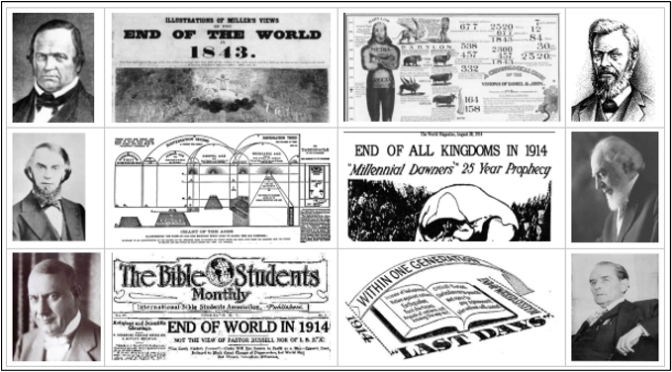
Tag Archives: 1914

Recent Finds: 1914 – Seeing What They WANT To See

“Recent Finds” will reprint interesting and relevant discoveries from various sites, blogs, and forums.

If you have seen content from such sources that might be of specific interest to readers of this site, please let us know by replying to any of our pages. In order to reprint a “Recent Find” here, we will need permission from either the owner of the source pages, or the author. These will not typically be direct contributions to this site, nor do those who give permission necessarily agree with the content of this site.

The following content comes from jw-archive.org and we have obtained permission to reprint the comments of two persons who offer comments on that site:

The question was:

How do they come up with 1914 when Jesus was installed king of the heaven ? I am still learning and trying to get full understanding – See more at: http://www.jw-archive.org/post/120082339793/how-do-they-come-up-with-1914-when-jesus-was#sthash.cd0Uoryx.dpuf
One respondent, who claims to have been assigned research work at Bethel, included a most interesting bit of Bible Student history with reference to Russell and the pyramid studies. The “executive summary” as provided by the poster, is as follows:
What is amazing is that by searching through the entrails of the various drainage and air passages that angled through the pyramid, it never mattered whether the length of these zigzagging passages was 3,416 inches, 3,457 inches, or 3,384.904 inches. In EVERY case they proved that 1874 or 1914 or BOTH 1874 and 1914 were correct. This was true even though the first measurement was nearly 3 feet off, and the first “corrected” measurement was 6 feet off.
The original post is repeated below in it’s entirety:
______________________________________________________
 

I was thinking about JTR’s statement about “intellectual honesty.” I suspect that every religion that has ever promoted chronology doctrines has been guilty of intellectual dishonesty. I have studied only a few, and most were related to the Millerite movement, Second Adventists, Seventh Day Adventists and the Bible Students, but not enough to actually make a definitive statement about others besides these.

I talked at length to followers of Harold Camping a few years ago when they were sure that Judgment Day would be on May 21, 2011. The night before, I started a study with one of them and showed him where his information was not Biblical. He (and his wife) were sure it would happen, but promised to continue their study if it didn’t. I followed up and he basically claimed that it must have been God’s will, some kind of a test perhaps, but that they were so close there would definitely be further revelation coming very soon. What got to me most was their inability to admit that Camping had really been wrong, and another claim that nothing like this had happened back on September 6, 1994. (Which very clearly had also happened despite their denials.)

As a former researcher, not just at Bethel, but also at my first full-time job with the Bureau of Labor Statistics, I was trained to believe in intellectual and scholastic honesty. And internally I even feel a certain aggravation that one of my own parents and several relatives who once took 1975 so seriously will now claim that it was just a few overzealous brothers who were misinterpreting what the literature was really saying.

But my experiences remind me that, even WITH training to appreciate the value of intellectual honesty, the human mind sees what it wants to see. One amazing example of this is a site that attempts to defend C.T.Russell’s honesty in “the case of the 41 extra pyramid inches.” In fact, this is the best site I’ve seen that defends Russell’s honesty in this case, and I agree with it. However, in spite of defending him, it should be very clear to an outsider that Russell and his followers still saw what they wanted to see. The problem comes from these two quotes, one in the 1903 edition of Studies in the Scriptures Vol III “Thy Kingdom Come,” and one from any edition after 1904:

*** 1897 through1903 edition: ***
“…this measurement is 3416 inches, symbolizing 3416 years…. This calculation shows A.D. 1874 as marking the beginning of the period of trouble….”

*** 1905 through 1923 edition, and reprints: ***
“We find it to be 3457 inches, symbolizing 3457 years….This calculation shows that the close of 1914 will be the beginning of the time of trouble….”

[Fuller context at the end of this post.]

This change has often been pointed to by opposers as if it shows Russell’s dishonesty, supposedly as 1914 got closer (to within a decade) and it was realized that 1874 hadn’t really been a start of a time of trouble that would culminate and finish in 1914. 1914 could no longer be seen as the END of a time of trouble they had been experiencing since 1874. I’m not saying Russell was always honest – there is plenty of evidence that he was not always honest – but in this case it really was a matter of having (sloppily) estimated a pyramid length that would bring them to the 1874 date based on some inaccurate diagrams of the pyramid. When more accurate diagrams came out, these new lengths pointed to 1914.

(But notice how in each case the measurement pointed to either one of Russell’s two most most important dates! 1874 or 1914.)

But then, Russell’s favorite loyal follower and speaking companion for conventions, Brother Morton Edgar, went to Egypt in 1909 and had it measured himself. Turns out that both measurements were way off. Here’s what Edgar said in 1929, based on the new measurements taken in 1909:

*** quote from Edgar ***
You may have noted that, in his early editions of Vol. III of
‘Studies in the Scriptures,” in the Pyramid chapter, Brother Russell
states that the length of the Descending Passage, from the junction of the Ascending Passage down to the Subterranean Chamber, is 3416 inches. But in all later editions of his third volume, since 1905, the length of this passage has been altered to the extent of 41 inches, the length now being said to be 3457 inches. Formerly the north wall of the Subterranean Chamber was said to mark the date 1874 A.D., but with the new measure of 3457 inches this date was shifted forward 41 years to 1915 A.D. No explanation is given for this change. (See, however, the short article, ‘The Great Pyramid Measurements,” on page 326 of 1st Nov., 1904, ‘Watch Tower.”)

We measured this passage in 1909, having first removed from
it all obstructing debris, we found that neither the earlier published
length of 3416 inches, nor the later published length of 3457 inches,
was correct. The true length was found to be more nearly 3385 ‘Pyramid” inches. (The exact length is 3384.904 ‘Pyramid” inches.) As will be seen, this is 31 inches less than the first of Brother Russell’s figures, and 72 inches less than his later one.

We, of course, immediately communicated with Brother Russell
the true length of the Descending Passage. At first sight it appeared as if we would require to abandon the time-measurements of this lower part of the Pyramid’s passage system, the true length being so different from what we had previously understood it to be. Yet, strange to say, instead of abandoning the time-measurements, we found that the true length of the passage established these time-measurements all the more thoroughly. Both dates, 1874 and 1914, are now seen to be indicated by the end of this Descending Passage. This indication is very exact and convincing, and goes far to establish our faith in the Great Pyramid as indeed a building of God.
—Morton Edgar’s Discourse: “THE GREAT PYRAMID— Why Was It Built? Who Built It?”
*** end of quote from Edgar ***

What is amazing is that by searching through the entrails of the various drainage and air passages that angled through the pyramid, it never mattered whether the length of these zigzagging passages was 3,416 inches, 3,457 inches, or 3,384.904 inches. In EVERY case they proved that 1874 or 1914 or BOTH 1874 and 1914 were correct. This was true even though the first measurement was nearly 3 feet off, and the first “corrected” measurement was 6 feet off.

Even so, after the exact measurement was given in 1909 the new editions didn’t update it a second time and kept repeating 3,457 inches. The books also kept a statement which had been there from the very beginning that some of these pyramid measurements were accurate to within a fraction of an inch.

———–for reference: Russell’s1905-1927, Vol III passage IN CONTEXT —-
So, then, if we measure backward down the “First Ascending Passage” to its junction with the “Entrance Passage,” we shall have a fixed date to mark upon the downward passage. This measure is 1542 inches, and indicates the year B.C. 1542, as the date at that point. Then measuring down the “Entrance Passage” from that point, to find the distance to the entrance of the “Pit,” representing the great trouble and destruction with which this age is to close, when evil will be overthrown from power, we find it to be 3457 inches, symbolizing 3457 years from the above date, B.C. 1542. This calculation shows A.D. 1915 as marking the beginning of the period of trouble; for 1542 years B.C. plus 1915 years A.D. equals 3457 years. Thus the Pyramid witnesses that the close of 1914 will be the beginning of the time of trouble such as was not since there was a nation–no, nor ever shall be afterward. And thus it will be noted that this “Witness” fully corroborates the Bible testimony on this subject, as shown by the “Parallel Dispensations” in Scripture Studies, Vol. II, Chap. VII.

[Note: Russell considered October 1914 to be the start of the Jewish year 1915.]

______________________________________________________

Thanks to the original poster at jw-archive.org who wishes to remain anonymous.

Additional notes: It may also interest our readers that the Wikipedia entry under Harold Camping, referenced above, has the following footnote:

“Harold Camping Says End did come May 21, spiritually; Predicts New Date: October 21”. International Business Times. Retrieved May 23, 2011.

The link no longer works, but the sentiment seemed eerily familiar to students interested in Russell and Rutherford’s teaching methods. Carl Sagan referred to this same “method” with reference to Russell’s predictions and Jehovah’s Witnesses.


TYPES AND ANTITYPES: Transcript of discourse by David Splane at October 2014 Annual Meeting

The 2014 Annual Meeting Program video can be found on tv.jw.org (currently found under Programs and Events). The following speech can be found about the 2 hour and 8 minute mark in the video. It ends at about the 2 hour and 25 minute mark.

“David Splane of the Governing Body will speak to us on the theme: ‘Types and Antitypes.’” 

IT’S NOT FUNNY IF YOU HAVE TO “SPLANE” IT 

The following is an unofficial transcript of that talk. It is very informative to note the differences between this, the original talk, and the Watchtower article that was derived from it. Our site’s commentary on the March 15, 2015 Watchtower article is found here.

Transcript begins:

________________________________________________

Let’s get right into our subject: types and antitypes.

Now, years ago, our publications often applied certain Bible accounts and certain bible characters as “types” of something greater. But you’ve noticed that, in recent years, that is seldom done, and the purpose of this talk is to explain why.

First of all what is a type and what is an antitype? Well, the Watchtower of September 15, 1950 defined them this way. It said:

“A type is a representation of something that will come to pass at a future time. The antitype is the reality of the thing which the type represents.”

So that is the definition that was given by The Watchtower. And we might add that Jehovah is usually involved in designing the type.

Now, take the tabernacle. Jehovah was very clear about the construction of the tabernacle: what materials were to be used, the dimensions and so forth. Why? Well, apparently because he had designed the tabernacle to be a type of something greater: his great spiritual temple. And the temple was the antitype.

The sacrifices on the Day of Atonement. Jehovah was very careful about how events on the Day of Atonement were to unfold. And again, we have to realize that something was going to have to picture or foreshadow the perfect sacrifice of Jesus Christ. So, the sacrifice on the Day of Atonement, the type, and the perfect sacrifice of Christ, the antitype.

Now consider another example. When the disobedient Israelites in the wilderness were bitten by poisonous snakes, Moses is told by Jehovah to fashion a copper serpent and to place that serpent on a pole. Now that was a type. Now Jesus explains what it was a type of. Let’s turn to John chapter 3, John chapter 3 and verses 14 and 15. John 3: 14 and 15 If you are using an iPad, I’ll give you a chance to catch up. [Laughter] I couldn’t resist. “And just as Moses lifted up the serpent in the wilderness, so the Son of Man must be lifted up, so that everyone believing in him may have everlasting life.” Now, would anyone doubt that this is a type? Of course not. Because Jesus said it was.

Well notice that in both these examples, the tabernacle and the copper serpent, Jehovah was involved. He designed the type so that it would fit the antitype. He told Moses, for example to fashion a copper serpent and put it, not on a rock, but on a stake. And of course the tabernacle prefiguring the great spiritual temple.

And from the apostle Paul we learn even more about types and antitypes. For example, Paul, in Hebrews: Isaiah and his 2 sons represent Jesus, and the anointed. He also explains that Moses, the mediator of the Law covenant, represents Christ the mediator of the new covenant. And we learn from the letter to the Galatians that Abraham’s relationship with Sarah and Hagar, represents Jehovah’s relationship with the nation of Israel, and with the heavenly part of his organization. Type and antitype.

Now we know that these were genuine types because, the word of God says they are. But here is the question:

Who is to decide if a person or an event is a type if the word of God doesn’t say anything about it? Who is qualified to do that? Our answer? We can do no better than to quote our beloved brother, Albert Schroeder, who said:

“We need to exercise great care when applying accounts in the Hebrew Scriptures as prophetic patterns, or types, if these are accounts are not applied in the Scriptures themselves.”

Wasn’t that a beautiful statement? We agree with it.

Now the study of types and antitypes is not unique to Jehovah’s Witnesses. During the past 2,000 years, Catholic and Jewish scholars have made quite a diligent study of types and antitypes. In fact, there is even a name for the study. They call it “typology.”

The first century Jewish scholar, Philo of Alexandria, for example, suggested that the serpent in the garden of Eden, the tree of knowledge and the cherubs that were guarding the entrance to the garden were all typical of something greater.

And then describing the teachings of such early writers as Origen, Ambrose and Jerome, the International Standard Bible Encyclopedia says this:

“They sought for types and of course found them, in every incident and event, however trivial, recorded in Scripture. Even the most simple and commonplace circumstance was thought to conceal within itself a hidden truth. Even in the number of fish caught by the disciples when the risen Savior appeared to them,” he says, “How much some have tried to make of that number:, 153 .”

One scholar made much of Jacob’s purchase of Esau’s birthright with a bowl of red stew. Very significant that the stew was red. To him, the red stew pictured the red blood of Christ. The inheritance pictured the heavenly inheritance. It’s all… By that reasoning, Jacob pictures Jesus, Esau’s birthright pictures the heavenly inheritance, and the red stew pictures Jesus’ precious blood.

Now on the surface that might sound plausible to some, until you think about it. When you think about it you see three problems. First of all, Jehovah didn’t design the type. Jehovah did not tell Esau to sell his birthright. Selling his birthright was wrong, and Jehovah never tells us to do something that’s wrong. Second, who ate the stew? Esau did. So are we to conclude that, by giving up his inheritance, Esau put himself in line for the ransom sacrifice of Jesus Christ? That doesn’t make any sense. And most importantly, nowhere in Scripture do we read that the event was a type.

Now the study of types and antitypes was not only common among Catholic and Jewish scholars, but were very prominent among Protestant scholars as well. The Puritans, like Edward Taylor, applied many Bible events to themselves. The Baptists and Congregationalists did likewise. So it’s not surprising that the early Bible Students, who generally belonged to these groups were also really fond of types.

And as many of us have been. Many of us have remembered happy moments at the congregation book study studying all about types and antitypes. And it’s true that the study of types could be thrilling!

So now here’s a question. If the study of a certain subject make chills run up and down your spine, could it possibly be mistaken? And the answer is yes.

The case of brother Arch W. Smith is an example. In 1886, Brother Russell published a book that contained a chart linking the ages of mankind to the Great Pyramid of Egypt. Now that pyramid was called by the Bible Students, the “Bible in stone.” They loved the study of the Pyramid. In fact, if you have seen pictures of Brother Russell’s grave, you’ve noticed that there was a pyramid nearby. And that’s because the Bible Students believed very much in the Great Pyramid of Egypt, and some became very engrossed, in measuring certain rooms and certain features of the pyramid and to try to determine, for example, how long they had to wait before they went to heaven, and so on.

And so one who was just thrilled by the study of types was Arch W. Smith. It was a hobby of his, he loved it. In fact he gave a lot of prayerful thought to the dimension of the pyramid, and from time to time he would write in to Bethel and let them know what his findings were, to support the idea that the Great Pyramid had a place in Jehovah’s purpose. He loved it!

But when The Watchtower of 1928 came out and said that Jehovah doesn’t need a stone monument built by pagans to accomplish his purpose, Brother Smith accepted it. He let reason win out over emotion.

Well, in recent years the trend in our publications has been to look for the practical application of Bible events, and not for types where the Scriptures themselves do not clearly identify them as such. We simply cannot go beyond what is written. Now there’s a real advantage in looking for the practical application of Bible accounts, rather than confining certain applications to one class: “This applies only to the anointed.” “This applies only to the other sheep.”

Let’s just see why. Turn to Romans chapter 15 and verse 4. Now remember that Paul is writing to his anointed brothers here. Romans chapter 15 and verse 4. And he says, “For all the things that were written beforehand” . . . Well what things? The Hebrew Scriptures obviously. . . “were written for our instruction so that through our endurance, that through the comfort of the Scriptures, that we might have hope.” What is Paul telling the anointed? He’s telling them that you can learn from these accounts in the Hebrew Scriptures. You can apply principles of the Hebrew Scriptures to yourselves.

Let’s consider an example: Now soon after his conversion, Paul is preaching in the city of Damascus. The Jews are furious and they try to kill him. So anointed disciples take Paul and they lower him down the city wall in a basket. Is it possible that some of those anointed ones they thought of Rahab? Who helped the two spies escape from Jericho by a similar method? Would anyone say to them, “You can’t apply that to yourselves…Rahab pictures the other sheep, you are of the anointed?” No! They could apply the lessons of that account to themselves.

Now let’s consider another example, a modern one. In the Song of Solomon we read of a chaste young virgin who falls desperately in love with a poor shepherd boy. Solomon, who incidentally was still an inspired Bible writer at the time, but he’s a very wealthy man, he tries to lure her away but he’s unable to do so. Now suppose that in a certain congregation there’s a sweet young sister, who falls head over heels for a poor pioneer brother, who’s a real spiritual man but he doesn’t have a penny to his name. Now her friends encourage her to marry a wealthy brother, who is very rich but he doesn’t have a lot of time to spend on spiritual things. The sister remains firm. They say, you wouldn’t have to work! You can pioneer. She says no my love is for that pioneer boy. Would anyone say to her, the Song of Solomon doesn’t apply to you because you’re of the other sheep, not of the anointed?

You see how practical it is to take these Bible accounts and really apply them to the everyday life of people.

What about others of the other sheep today? In this audience there are modern-day Nehemiahs who are spurring the building programs we have. Wonderful young Timothys, graduates of our Bible schools, warmhearted Tabitha’s, hospitable Lydias. And don’t we find exceptional young Circuit Overseers who are like Elihu in giving wise counsel to elders who are much older. And don’t many Christian young women remind us of dear Rebekah who was willing to follow her husband to a distant land for the accomplishment of Jehovah’s purpose?

We deeply appreciate the spiritual heritage that was passed on to us by the early Bible Students. In harmony with Zechariah chapter 4 and verse 10: “We do not despise the day of small things.” However the light does get brighter. And we feel that we must follow the light, wherever it leads us. Our love should be for the truth and not for a particular doctrine or teaching.

Well how would you sum this talk in a few words?

The wrong answer is, “We don’t believe in types and antitypes any more.” We do! We certainly do. Where the scriptures identify them as such, we embrace them. But where the Bible is silent, we must be silent.

Now in the three talks that follow there are going to be important clarifications in our beliefs.

Perhaps a certain adjustment will touch a spiritual nerve, make us rethink a cherished teaching. Our love for Jehovah and the truth will make us receive this information gladly and with open hearts.

Often today we hear brothers say, we’re having a hard time keeping up with the celestial chariot. So are we. So are the Governing Body. We’re not driving the chariot. Jehovah is driving the chariot and we’re running just as fast as you are, trying to keep up. So let’s all do our best to keep up with it. And let us thank Jehovah for continuing to deal with us. And for continuing to provide nourishing spiritual food.

________end of transcript________

Personal notes:

  • In the commentary on the Watchtower article based on this talk ( http://ad1914.com/2015/01/26/2107/ ) we pointed out a few items of interest:

    First of all, the idea is given that these “type-antitype” explanations have already been phased out to some extent over the past few years, but with no official explanation until now.

    The talk mentions that some legitimate examples of “type/antitype” included the tabernacle (shadows), the sacrifices, Abraham’s wife and mistress, and the snake on a pole. The 3/15/2015 Watchtower article replaced the snake on a pole with the sign of Jonah.

    It’s pointed out that this “typology” stuff has had a long history among a lot of religions, Jewish, Catholic and Protestant. (And some ridiculously bad examples are mentioned as if they were more ridiculous than Watch Tower examples.)

    The logic behind using the Rahab and Shulamite examples is twisted and anachronistic. As far as Paul’s companions knew, there never was and never would be an incorrectly explained “other sheep” class represented by Rahab. And what sister says, “The reason I am choosing the broke pioneer over the rich brother because the Song of Solomon applies to me.” In Splane’s illustration, she never actually says that, but Splane indicates that there is some danger that the sister is going to hear an argument meant to to push her into the arms of the rich brother simply because she is not “anointed” — as if only “anointed” sisters should be able to choose the poor penniless pioneer.

    But the speech says, basically, that the Watch Tower teachings took this too far. It says it will only be used from now on if the Bible tells us specifically that it is a “type.” This seems commendable.

    The problem is that this new guideline is watered down considerably in the March 15, 2015 Watchtower article based on this talk. It seems very likely that between the Annual Meeting and the end of the 2014, someone noticed that following the words of this talk would completely ruin the two most important unique doctrines of JWs today:

    1. That the Kingdom of the pagan, Gentile, violent, insane, Jew-killing Nebuchadnezzar was a “type” of God’s non-Gentile Kingdom through Christ Jesus, the perfect Prince of Peace, as represented by the Jewish Davidic/Messianic Kingdom at Jerusalem.

    2. That the “faithful and discreet slave” in Matthew 24:45 was a “type” of the Governing Body.

    Also, found it “funny” how Splane treats the old Pyramid scheme, promoted in the Watch Tower publications from the 1880’s to the 1920’s.

    The March 15, 2015 article tries to keep the idea of being once “thrilled” by these explanations in the past as a good thing. Splane had used it to show that being thrilled doesn’t always mean it was right.

More Evidence for 1914 Kingdom than for Gravity, Electricity, Wind — says JW Governing Body

[wpvideo 5YXeIEOd]

The source of this video is Stephen Lett, a member of the Governing Body of Jehovah’s Witnesses, at the “Seek First God’s Kingdom” International Convention for 2014.  A better version of the video is found here: [youtube https://www.youtube.com/watch?v=zJ6405yjZfo&w=640&h=480] I made a poor copy of it above just in case it gets removed from YouTube.

He says:

God’s Kingdom has been ruling in heaven as we’ve discussed during this convention for a hundred years, and it has produced tremendous effects — tremendous results. In fact, there is more evidence confirming the existence of the Kingdom than the evidence that would convince us that there’s gravity, electricity, wind.

I couldn’t just let that “blow over.” [wind] It was “shocking.” [electricity] I had to let it “sink in.” [gravity] All jokes, aside, though…

The first thing this reminded me of, was the fact that Rutherford blatantly overused claims about facts, proof and evidence (apparently as a reminder that he had a legal background). Rutherford loved to include the word “facts” in things like “Face the Facts” “Declaration of Facts” etc.  Rutherford would say things like, “the physical facts” “the Scriptures and facts” “indisputable facts” “beyond a doubt” and “distinctly indicated” even when he was not just wrong but indisputably wrong:

“The indisputable facts, therefore, show that the “time of the end” began in 1799; that the Lord’s second presence began in 1874.” — Watchtower 1922 Mar 1 p. 7.

 “The date 1925 is even more distinctly indicated by the Scriptures than 1914.” — The Watchtower, September 1, 1922, p. 262.

“Bible prophecy shows that the Lord was due to appear for the second time in the year 1874. Fulfilled prophecy shows beyond a doubt that he did appear in 1874. Fulfilled prophecy is otherwise designated the physical facts; and these facts are indisputable.Watchtower November 1,  1922, p. 333.

Note the underlined portion: “Fulfilled prophecy” as previously interpreted and as understood by Rutherford, was the same thing as “physical facts” that are indisputable and “beyond a doubt.”

There can be no doubt that Dagon the visible god of the ancient Philistines foreshadowed the Roman Catholic Hierarchy, of which the pope is chief. The Scriptural and the historical evidence fully agree upon this point. …This further supports the conclusion that the Philistines foreshadowed the Roman Catholic Hierarchy. — Riches, 1936, p. 241.

 “The Scriptures and the facts show that the work which the man Elijah the prophet did foreshadows a work done by the faithful servant class under Christ Jesus, and which work ended in A.D. 1918… Jehu came into contact with the prophet Elijah and lived for more than 28 years of the period of the prophet Elisha….Jehovah, during the Elijah period that is from 1878 to 1918, began to prepare a people …brought over into the Elisha period, which began in A.D. 1919. — Riches, 1936, p. 66

So it wasn’t just hyperbole with Rutherford. He defined his accepted understanding of fulfilled prophecy as the same thing as “physical facts” that are indisputable. In effect, if Rutherford believed it, this was the same as “evidence,” and you didn’t dare dispute it. The last quote above from the book “Riches” repeated an idea that Rutherford had been trying to convey in several different ways since Russell died. Russell’s time had been seen as a “Day of Preparation” that was supposed to have prepared the “faithful” to remain loyal to Rutherford’s ideas, just as they had previously remained faithful to Russell’ teachings. Russell was seen as “that faithful and wise servant” of Matthew 24 who had been serving “meat in due season” (“food at the proper time”).

We could go on an on with examples like this from Rutherford.

And what about Lett? It might not be fair to attack the specifics of an unfortunate choice of hyperbole. Apparently, however, it wasn’t really intended as merely hyperbole in Lett’s case, either. He is quite serious in the video. He clearly picked “gravity, electricity and wind” because they are supposedly invisible, just like the invisible kingdom of Christ that started in 1914. There is a strange logic among certain types of non-scientists that invisible things are not real. That it somehow takes “faith” to believe in things invisible to the naked eye. Galileo had a similar problem. Religionists have been heard to speak as if these things are unreal, miraculous or in some sense, “magical.”

It’s hard to know exactly what he meant that evidence was. Possibly he’s so impressed with the growth of Jehovah’s Witnesses, but this is on par with the growth of Mormons (LDS) and Seventh Day Adventists who have similar beginnings. But growth means Jehovah’s blessing (as long it is the growth of Jehovah’s Witnesses). It is likely some combination of a strong belief in the growth of JWs  combined with his own belief that so many other things he believes in makes him feel that the Watch Tower Society and Jehovah’s Witnesses are right.  Therefore all of it combines in his mind to become evidence. If he feels they are right about everything else, then they must be right about this theory about the Kingdom, too.

Similar to Rutherford, if Lett merely believes the interpretation of 1914 to be fulfilled prophecy, then Lett sees it in the same light as indisputable evidence.

But the real problem is that even if it was hyperbole, we couldn’t excuse it. That’s because the purpose of his speech is to imply that there is at least some evidence somewhere for an invisible kingdom that has been ruling for 100 years.  As it turns out, there isn’t any. Every bit of the evidence for 1914 has been shown to be false, mistaken, and in some cases, made up dishonestly.

So the question for Stephen Lett is not, “Where is this evidence that is supposedly greater than the evidence that would make us believe in gravity, electricity or wind?” No, the real question is:

WHERE IS THERE ANY EVIDENCE AT ALL FOR 1914?


We could easily expose the inadequacy of any portion of that evidence. And if you look through the site, you’ll see that this has already been done by many others.


Analysis of the 1914 Teaching – Biblical, Secular, Historical

See also:

The article below was contributed by Alan Feuerbacher and contains links to numerous additional web resources throughout, especially in its Appendix. Click here for full width. Also in PDF format: evidence_against_wts_chronolog.pdf.

Biblical Evidence Against Watchtower Society Chronology

Among the Watchtower Society’s fundamental doctrines are those concerning 1914. They are the basis for its leaders’ claim to spiritual authority over the community of Jehovah’s Witnesses. This essay briefly examines the biblical evidence, with a bit of secular support, as to why the Society’s 1914 chronology is wrong.

The Society teaches that in 1914, at the end of the “gentile times” (a.k.a. “appointed times of the nations”; Luke 21:24) Christ returned invisibly (Matt. 24:3) and was given the Messianic Kingdom. It claims that the “last days” (Acts 2:17; 2 Tim. 3:1; 2 Pet. 3:3; etc.) began, the “conclusion of the system of things” began, a great harvest work of true Christians began, and that between 1914 and 1919 a time of “spiritual inspection” by the returned Jesus occurred. It teaches that by 1919 the “true Christian congregation” had been restored, in 1919 the “faithful and discreet slave” was appointed over all Jesus’ “domestics” (Matt. 24:45), and that in 1919 “false religion” (a.k.a. “Babylon the Great”; Rev. 14:8) fell. These doctrines were crucial to its claim throughout the 20th century that in 1919 all “anointed Christians” were appointed as “the faithful and discreet slave over all Christ’s belongings” on earth (the Society changed this teaching in the July 15, 2013 edition of The Watchtower).

From 1876, the phrase “gentile times” and the 1914 date were doctrinal anchors for the Society’s founder C. T. Russell, and have been so for the followers of the organization ever since. 1914 remains the key date in Watchtower “end times” teaching even though the Society has revised or abandoned most of its early claims about 1914.

In 1879 C. T. Russell began publishing what became The Watchtower magazine and therein promoted the 1914 date. Even earlier, in 1876, he published an article in the small religious journal The Bible Examiner that advocated the 1914 date as the end of the gentile times. Russell borrowed these ideas from Nelson Barbour, a semi-independent “Second Adventist” who originated the combination of the 1914 and gentile times ideas in the June, 1875 issue of his magazine Herald of the Morning.

The 1914 date is determined as follows (cf. w14 10/1 p. 10; “When Did God’s Kingdom Begin Ruling? (Part 1)”). The Society interprets the dream of Babylonian King Nebuchadnezzar described in Daniel 4 about a great tree in the center of the earth to mean that God’s direct rule over humans was interrupted, but would be restored after “seven times” had passed. The interruption is said to have begun in 607 BCE with the destruction of Jerusalem, and to have ended in 1914. Luke 21:24 is interpreted to mean that God’s rule, represented by Jerusalem, corresponds to this period, which is called “the appointed times of the nations” or “the gentile times.” The Society calculates the length as 2,520 years, based on Daniel’s statement that Nebuchadnezzar was mad for “seven times”, plus a statement in Revelation 12 that three and a half times equal 1,260 days. Then it applies a so-called “day for a year” principle. So 1,260 days (3 ½ times) x 2 = 2,520 days. A day for a year makes 2,520 years. 2,520 years forward from 607 BCE gets to 1914 CE (no zero year).

The Society derives the year 607 by beginning with the universally accepted date of 539 BCE for the conquest of the city of Babylon by the Persian king Cyrus the Great and noting that in his first regnal year he issued a decree that allowed the Jews to return to Judah. It then assumes that the Jews returned to Judah in the autumn of 537 BCE. Then the Society concludes that “the 70 years” Jeremiah spoke of (Jer. 25: 11, 12; 29:10) are a period of desolation of the land of Judah and exile and captivity of the Jews, and that this period ended when the Jews returned to Judah in 537. Working backward 70 years arrives at 607 BCE, when the destruction of Jerusalem caused the desolation of Judah to begin.

Of course, secular history—backed up by the Bible itself—shows that Jerusalem was destroyed in 587 BCE. So the Watchtower Society and its apologists go to great lengths to discount the secular evidence and to interpret the Bible according to Watchtower tradition. This essay outlines the biblical evidence that shows why Watchtower tradition is wrong. References in the appendix detail the voluminous evidence against Watchtower tradition, including secular, as do references to some excellent online resources.

Obviously, the 1914 date rests on a chain of questionable assumptions. Dubious scriptural interpretations such as equating the gentile times of Luke 21:24 to the seven times of Nebuchadnezzar’s madness, and so forth, do not lend themselves to objective resolution, so this essay will not consider them. Rather, it will examine the Watchtower’s claims about various dates and time periods derived from biblical passages that are capable of scholarly, objective resolution.

Watchtower chronology has multiple problems, many of which individually are fatal to the chronology as a whole and which, taken together, show unassailably that this chronology is wrong. Experience has shown that neither the Society nor its apologists can honestly address these problems. In many cases they simply ignore them.

This summary is in no sense a complete treatise on all the reasons Watchtower chronology is wrong. There are many excellent online resources for the interested reader, as well as the print copy of Carl Olof Jonsson’s book The Gentile Times Reconsidered. See the appendix for a list.

The 607 BCE Date for Jerusalem’s Destruction Has No Biblical Support

(1) There is no good evidence that 537 BCE was the year the Jews returned to Judah. The Society says only that “evidently” (All Scripture, p. 85) or “likely” (Insight, V. 1, p. 568) or “doubtless” (w64 2/1 p. 80) this was the date but supplies no evidence. In most discussions it simply glosses over the lack of evidence (cf. w11 10/1 p. 28).

(2) The synchronism between Josephus and the book of Ezra is solid evidence that the Jews returned to Judah in 538 BCE. Both refer to the laying of the temple foundations about half a year after the Jews were settled in their cities in the month of Tishri (autumn). Ezra gives only a relative date in Jewish terms, while Josephus gives a date in terms of the years of Cyrus’ reign, which is solidly established. This date is in the spring of 537 BCE; hence the Jews must have returned half a year earlier, in the autumn of 538. See the diagram below, and the appendix for an extended discussion.

Note that the Jews used a secular calendar beginning with the seventh month Tishri (Sep/Oct), and a religious calendar beginning with the first month Nisan (Mar/Apr). The Babylonian calendar began in Nisan.

Ezra 1 states that Cyrus, in his first year (using the accession-year system), decreed that the Jews could return to Judah. Cyrus’ first year was Nisan, 538 BCE through Adar, 537 BCE. Ezra 3:1-7 states that by the seventh month Tishri, the Jews were settled in their cities, and at that time they gathered in Jerusalem to initiate the rebuilding of the temple. So the year that ended immediately before Tishri was the first year of the Jews’ coming home, and the new year beginning in Tishri was the second year.

Ezra 3:8, 10 states that the temple foundations were laid in the second month of that second year. In Against Apion I,21, Josephus states that “in the second year of the reign of Cyrus [the temple’s] foundations were laid.” Therefore, this second Jewish year overlaps with the second year of Cyrus. Since Cyrus’ second year began in Nisan, 537 BCE, the second month was also in 537, and the first year of the Jews’ return was in 538 BCE—not 537 as the Watchtower claims.

The following diagram illustrates the above concepts.

alanchart

(3) Given (1) and (2), Watchtower chronology has no evidential foundation; on the contrary the available evidence is against it. If the Jews returned in 538, the Society’s 607 date is wrong and so is Watchtower chronology. If 607 is wrong, 1914 is wrong. If 1914 is wrong, Watchtower eschatology is wrong, and so are all the doctrines based on it.

(4) Linguistic, contextual and historical biblical facts show that Jeremiah predicted that Judah and the nations around it would, as a group, serve Nebuchadnezzar’s dynasty for 70 years (Jer. 25:8-12; 27:6-7). The key passage is Jer. 25:11: “These nations will have to serve the king of Babylon seventy years.” The Bible and secular history show that Judah and various nations individually served less than 70 years, depending on when they were first conquered and how one measures “serving.” God, through Jeremiah and other prophets, gave each nation the choice whether to serve on their own land or in exile (Jer. 27:7-11, 17; 40:9-10). To serve in their own land they had to submit to Nebuchadnezzar. The Jews under various kings refused; hence they were taken into exile at various times from 605/4 through 582 BCE (Dan 1:1-2; Jer. 52:28-30). Thus there was no 70-year exile or captivity or desolation of Judah.

(5) The 70 years of Babylonian supremacy ended in 539 BCE when Jehovah “called to account” against, or punished, Nebuchadnezzar’s dynasty (Jer. 25:12) by allowing the Medo-Persian empire under Cyrus to conquer Babylon and put an end to Nebuchadnezzar’s dynasty. This is directly stated in Daniel 5, where verses 28-30 say: “Your kingdom has been divided and given to the Medes and the Persians… in that very night Belshazzar the Chaldean king was killed.” In contrast, the Society claims that Nebuchadnezzar’s dynasty was called to account two years after its demise, when the Persians freed the Jews to return home (w79 9/15 pp. 23-24; g 5/13 p. 13), but this is ridiculous. You cannot punish a dynasty that no longer exists.

(6) 2 Chronicles 36:20 states that Nebuchadnezzar’s minions carried off Jews to Babylon, and these Jews remained servants to Nebuchadnezzar’s dynasty until the Persians under Cyrus took over, after which they were servants to Cyrus and his minions until Cyrus let them return to Judah. This confirms again that the 70 years were a time of Babylonian supremacy, not the term of the desolation of Judah. That desolation occurred during the 70 years. This is consistent with Jer. 25:8, 11, 12 which states that the Jews and nations round about would be servants to “Nebuchadnezzar and his sons” until God called them to account.

(7) Because Jeremiah spoke of Jerusalem being devastated or ruined (Hebrew chorbah; Jer. 25:18) shortly after Nebuchadnezzar conquered it in 605 BCE, the devastation of Judah began at that time. Even if the interpretation of that passage is disputed, the Hebrew word chorbah basically means “ruined” but does not specify in what sense something is ruined. It might be absolute, or relative. It might mean ruined in the sense of no longer being pristine, such as a city conquered by a foreign invader but not necessarily razed to the ground; the Bible often uses the word in this sense.

(8) Because Jews were taken into exile in 605/4, 597, 587 and 582 BCE, and released in 538, there was not a single period of exile or captivity. Therefore it is wrong to speak of a 70-year exile or captivity. Similarly it is wrong to speak of a 70-year desolation of Judah, because Jerusalem was ruined (chorbah) in a relative sense from the Jewish point of view when Nebuchadnezzar first took a few captives (including Daniel) in 605/4 BCE, and in a complete sense after most of the Jews left the land between 587 and 582 BCE.

(9) In the New World Translation Jer. 29:10 reads: “For this is what Jehovah says, ‘When 70 years at Babylon (Hebrew le-babel) are fulfilled, I will turn my attention to you, and I will make good my promise by bringing you back to this place.’ ” It has been demonstrated conclusively, in various publications, that in context, the phrase le-babel should be translated “for Babylon” not “at Babylon.” The latter is a mistranslation based on the King James Version. The Watchtower Society has laid great stress on its translation (cf. Appendix to chapter 14 in the 1981 book “Let Your Kingdom Come”) to make its claim that Jeremiah’s 70 years were a time of exile of the Jews (however, see w11 10/1 p. 27, where the correct translation is acknowledged but then ignored). Yet the translation issue, plus many other considerations, show that the Jews as a group were not in exile at Babylon for 70 years, but that various contingents were in exile for between 44 and 69 years.

(10) A careful consideration of Watchtower apologists’ (like Rolf Furuli) favorite scriptures to misinterpret, namely Daniel 9:2 and 2 Chronicles 36:21, shows that the passages are ambiguous about exactly what they mean with respect to 70 years. Because they are ambiguous, other scriptures and pieces of information that are not ambiguous must be used to determine what they mean, and when this is done the ambiguity is resolved. Watchtower apologists get this completely backwards. Following Russell and his spiritual forebears, they begin by interpreting the ambiguous passages in accord with Watchtower tradition, and then twist the meaning of the unambiguous ones to fit the tradition.

The above points prove that the Bible does not support the Society’s anchor date for the 1914 chronology—607 BCE—as the date of Jerusalem’s destruction. Rather, as scholars agree, Jerusalem was destroyed in 587 BCE (some say 586, but the discrepancy is due to ambiguity in the Bible itself, and can be resolved in favor of 587; see the appendix for references). Therefore Watchtower chronology is wrong, as is every doctrine based on it.


Appendix


References

A great deal of material has been published in print and online that disproves the Watchtower Society’s 1914 chronology. Below are listed some of these references.

The most comprehensive look at the secular evidence, with much biblical commentary, is The Gentile Times Reconsidered (Carl Olof Jonsson, Fourth Edition, Commentary Press, Atlanta, 2004). Much of this book is available online:

http://kristenfrihet.se/english/gtr4/contents.htm

Jonsson’s extensive writings on Watchtower chronology are available online:

http://kristenfrihet.se/english/epage.htm

A summary of biblical and secular evidence can be found in Jack Finegan’s Handbook of Biblical Chronology: Principles of Time Reckoning in the Ancient World and Problems of Chronology in the Bible (Revised Edition, Hendrickson Publishers, 1998).

A classic work on biblical chronology is Edwin R. Thiele’s The Mysterious Numbers of the Hebrew Kings (New Revised Edition, Kregel Publications, Grand Rapids, Michigan, 1994; Zondervan Publishing House, 1983; various editions back to 1951).

A comprehensive debunking of the Society’s scriptural claims, along with some secular material, is available at “Jeffro’s 607 pages.” This includes detailed debunkings of recent Watchtower articles:

http://jeffro77.wordpress.com/

Scholar Rodger Young gives proof of 587 BCE as the date of Jerusalem’s destruction:

http://www.galaxie.com/article/jets47-1-03

http://www.rcyoung.org/articles/jerusalem.pdf

http://www.rcyoung.org/papers.html

Seventh-Day Adventist scholar Ross E. Winkle offers these articles:

“Jeremiah’s Seventy Years For Babylon: A Reassessment. Part I: The Scriptural Data”:

http://www.auss.info/auss_publication_file.php?pub_id=755

“Jeremiah’s Seventy Years For Babylon: A Reassessment. Part II: The Historical Data”:

http://www.auss.info/auss_publication_file.php?pub_id=762&journal=1&type=pdf

Another look at the scriptural and secular evidence against Watchtower chronology is the article “Notes on the Gentile Times and 1914”:

http://corior.blogspot.com/2006/02/part-1-summary.html

Another debunking is: “Refutation of Appendix in Let Your Kingdom Come”:

http://corior.blogspot.com/2006/02/refutation-of-appendix-in-let-your.html

C. T. Russell originally used 606 BCE rather than 607 as the date of Jerusalem’s destruction and the beginning of the gentile times. While the latter date was known to Russell and his followers to be correct (in terms of Watchtower Society interpretations) as early as 1904, and was used in a handful of Watchtower and related publications after that, it was only in 1943 that the Society officially changed the date of the start of the gentile times, and in 1944 that it changed the date of Jerusalem’s destruction, to 607. Critics of the Society will not be surprised to find out-and-out lies at the heart of the change, shown in this article that examines the details of how the Society changed the dates, “The Evolution of 606 to 607 B.C.E. in Watchtower Chronology”:

http://corior.blogspot.com/2006/02/evolution-of-606-to-607-bce-in.html

The Society has produced much material claiming that the signs of the times prove the world has been in the last days since 1914. These claims are thoroughly debunked in the book The Sign of the Last Days—When? (Carl Olof Jonsson and Wolfgang Herbst, Commentary Press, Atlanta, 1987).

“The Watchtower Society and the End of the World” is a look at the Society’s extensive false predictions and distortions of biblical and secular evidence concerning its chronology:

http://corior.blogspot.com/2006/02/part-1-why-so-many-false-alarms.html

Josephus and Ezra Prove the Jews Returned in 538 Not 537 BCE

A synchronism between Josephus and the book of Ezra provides strong evidence that the Jews returned to Judah in 538 BCE. Both refer to the laying of the temple foundations about half a year after the Jews were settled in their cities in the month of Tishri (autumn). Ezra gives only a relative date in Jewish terms, while Josephus gives a date in terms of the years of Cyrus’ reign, which is solidly established. This date is in the spring of 537 BCE; hence the Jews must have returned half a year earlier, in the autumn of 538. Below are the details. The following diagram illustrates the concepts.

alanchart

Ezra 1 states that Cyrus, in his first year (using the accession-year system of dating kings’ reigns), decreed that the Jews could return to Judah. Cyrus’ first year was Nisan (Mar/Apr), 538 BCE through Adar (Feb/Mar), 537 BCE. The Bible does not say exactly when he issued this decree.

Ezra 3:1-7 states that by the seventh Jewish month Tishri (Sep/Oct), the Jews were settled in their cities, and at that time they gathered in Jerusalem to offer sacrifices and collect money for the rebuilding of the temple. From this we deduce that, whatever modern calendar year this was, the Jews returned in the preceding Jewish year, since the secular Jewish year began in Tishri (keep in mind that the sacred Jewish calendar began six months offset from Tishri, in Nisan, and the Jewish months were numbered beginning with Nisan). In other words, the year in which the Jews returned was the first year of their coming home, and the new year beginning in the Tishri mentioned in Ezra 3:1 was the second year of their coming home.

Ezra 3:8, 10 states that a little later in that second year the Temple foundations were laid (NASB):

8 Now in the second year of their coming to the house of God at Jerusalem, in the second month, Zerubbabel the son of Shealtiel and Jeshua the son of Jozadak and the rest of their brothers the priests and the Levites, and all who came from the captivity to Jerusalem, began the work and appointed the Levites from twenty years and older to oversee the work of the house of the LORD.

10 Now when the builders had laid the foundation of the temple of the LORD, the priests stood in their apparel with trumpets, and the Levites, the sons of Asaph, with cymbals, to praise the LORD according to the directions of King David of Israel.

The crucial piece of information here is that the Temple foundations were laid in the second month (Iyyar; Apr/May) of the same year in which the Jews gathered in Jerusalem immediately after they returned to Judah.

The Bible does not explicitly relate these events to any event that can be firmly dated to our modern calendar. However, a careful examination of historical data indicates that it was Cyrus’ general practice to free captives from the nations he conquered shortly after he secured his authority. Since he captured Babylon in October, 539 BCE, and the inhabitants would have known of his general practice, they would have expected him soon to begin freeing Babylonian captives, including the Jews. It is a good bet that, for political purposes, Cyrus would have done this around the time of celebrating the beginning of his first regnal year. If the books of Daniel and Jeremiah contain valid historical information about the fall of Babylon (Dan. 9:1, 2; Jer. 29:10), the Jews would have anticipated being freed soon after Cyrus entered the city in late October, 539 BCE.

A careful reading of Ezra 1-3 indicates that there might have been very little delay between the issuing of Cyrus’ decree and the departure of the Jewish captives for Judah. Because Cyrus’ first regnal year began in Nisan, and the Jews arrived by Tishri, if this all occurred in 538 BCE, there would have been at most six months for the Jews to complete their preparations and journey, and get settled in Judah. Since the trip takes about three to four months for a normal caravan, there is just enough time for these events to happen in 538 BCE.

Based on its tradition, the Watchtower Society speculates that Cyrus issued his decree sometime in late 538 or early 537 BCE, still in his first regnal year. It then claims that the Jews journeyed back to Judah in 537 BCE.

How then, can one decide whether the Jews returned in 538 or 537?

Josephus provides the tie breaker.

In Against Apion I,21, Josephus states:

These accounts agree with the true histories in our books; for in them it is written that Nebuchadnezzar, in the eighteenth year of his reign, laid our temple desolate, and so it lay in that state of obscurity for fifty years; but that in the second year of the reign of Cyrus its foundations were laid, and it was finished again in the second year of Darius.

The crucial piece of information is that the temple foundations were laid in the second regnal year of Cyrus.

Combining this with the information from Ezra that the temple foundations were laid in the second month (Iyyar) of the second year of the Jews’ return to Judah, we must conclude that this second year corresponds with the second year of Cyrus. Since Cyrus’ second year began in Nisan, 537 BCE and Iyyar was the second month of that regnal year, the first year of the Jews’ return was 538 BCE. This also works if one uses Tishri dating for Cyrus’ reign, as some might argue that Josephus did.

In other words, Josephus, with Ezra as a starting point, has provided the crucial information to determine that 538 and not 537 BCE was the year of the return of the Jews to Judah.