Summary: The Watchtower explains that the initial beast of Revelation 17:8 is the “League of Nations.” Revelation 17:8 (NWT) says that persons whose names have not been written upon the scroll of life will “wonder admiringly” at this beast. It’s surely just an ironic coincidence, yet, in 1919 the Watchtower not only “wondered admiringly” at the League of Nations, they went so far as to actually use sentences that contained those literal words:
“We cannot but admirethe high principles embodied in the proposed League of Nations.”
“This fact makes all the more wonderful the ideals which they express.”
(Revelation 17:8) The wild beast that you saw was, but is not, and yet is about to ascend out of the abyss, and it is to go off into destruction. And when they see how the wild beast was, but is not, and yet will be present, those who dwell on the earth will wonder admiringly, but their names have not been written upon the scroll of life from the founding of the world. [NWT Reference Edition]
The 2013 Revised NWT changes “will wonder admiringly” and instead uses the term “will be amazed.” I couldn’t help but ‘wonder in amazement’ about whether a certain post discussing this same subject had already come to the attention of the translators. It was a post I had put on beliefnet.com several years prior which made the same point made here, along with some additional information.
The Watchtower Speaks for Itself
For many decades, the Watchtower has identified the initial beast of Revelation 17:8 as the League of Nations:
*** w85 10/1 p. 15 par. 9 Peace, Security, and the ‘Image of the Beast’ *** 9 Our identification of this beast is confirmed by some further details given by the angel: “The wild beast that you saw was, but is not, and yet is about to ascend out of the abyss, and it is to go off into destruction.” (Revelation 17:8)This has already been fulfilled in part. The second world war effectively killed the League of Nations.
In various places, the Watch Tower publications have repeatedly reminded readers (over 200 different times) that the clergy of Christendom, both Catholic and Protestant, have promoted the rejection of Christ’s kingdom and even the “worship” of this beast by hailing the League of Nations as the “political expression of God’s Kingdom on earth.” Note:
*** ka chap. 11 pp. 197-198 pars. 27-28 “Here Is the Bridegroom!” *** 27 The position taken by the “discreet” virgin class on this issue was unequivocal from the start. In evidence of this, on Sunday afternoon, September 7, 1919, at the Cedar Point convention, President Rutherford gave his public address on “The Hope for Distressed Humanity,” in which he pointed out God’s disapproval of the League of Nations. To quote from the report published in the Sandusky (Ohio) Star-Journal on Monday, September 8, 1919: “President Rutherford . . .declared a League of Nations formed by the political and economic forces moved by a desire to better mankind by establishment of peace and plenty would accomplish great good, and then asserted that the Lord’s displeasure is certain to be visited upon the League, however, because the clergy—Catholic and Protestant—claiming to be God’s representatives, have abandoned his plan and endorse the League of Nations, hailing it as a political expression of Christ’s kingdom on earth.—The Watch Tower, under date of October 1, 1919, page 298, column 1.”
*** ka chap. 13 p. 250 par. 22 Settling Accounts with the Slaves of Today *** 22 Of course, the sectarian church members of Christendom . . . . took a compromising course with the politicians and militarists of this world. . . . They turned their interest and attention to the proposed League of Nations, which the Federal Council of the Churches of Christ in America called “the political expression of the Kingdom of God on earth.” (Isaiah 9:6, 7) They tried to increase the number of supporters and worshipers of that man-made international organization for world peace and security.
Was the Watch Tower’s position on this issue really “unequivocal from the start”? In answering this question note the words that are underlined and highlighted from the February 15, 1919 Watchtower:
“We cannot but admire the high principlesembodied in the proposed League of Nations, formulated undoubtedly by those who have no knowledge of the great plan of God. This fact makes all the more wonderfulthe ideals which they express. For instance, it has been made plain by President Wilson and the advocates of his ideas that the proposed League of Nations is more than merely a league to enforce peace. They would not have us consider it to exclusively from the standpoint of politics or of military relations. It should be considered as fully from the economic and social points of view. The President’s idea seems to be that the League of Nations which he proposes would stand for world service rather than mere world regulation in the military sense, and that the very smallest of nations shall be participants in its every arrangement. In other words, his idea undoubtedly is that the league shall not be established merely for the purpose of promoting peace by threat or coercion; but that its purpose, when put into operation, will be to make all nations of earth one great family, working together for the common benefit in all the avenues of national life. Truly this is idealistic, and approximates in a small way that which God has foretold that he will bring about after this great time of trouble.” — Watch Tower, February 15, 1919, p.51 [Reprints page 6389].
In other words, this 1919 Watchtower considers the League of Nations to be, essentially, ‘the political expression of God’s kingdom on earth.’ In fact, a careful reading of the article gives at least some evidence that this particular phrase was already known to the writers of this Watchtower article, and this article was intended to show agreement with that idea.
That might sound surprising coming from the same magazine that has declared itself not to have ever compromised on that particular issue in the way that Catholic and Protestant clergy and their constituents had supposedly done. But the Watchtower took it a bit further, literally admitting their amazement at the wonderful and admirable ideals of the League of Nations.
Some Additional Details and Resources
Additional resources will be added to this article or forthcoming follow-up articles to show that the Watch Tower publications have not been totally accurate about many other claims and details surrounding this issue. These details might include:
The Watch Tower’s repeated claims about who actually promoted the idea that the League of Nations was “the political expression of God’s kingdom on earth.”
The hypocrisy of the condemnation of the “political expression” claim is not only shown in the first portion of this article, but is shown to be an ongoing problem for the Watch Tower publications. For example:
There was a supposed “cleansing” related to the political neutrality of the “Faithful Slave” (now, Governing Body) as of 1919. Yet, we see similar wording of Joseph F. Rutherford in a letter to Adolph Hitler, which also admits an admiration for the ideals and principals of the German National Socialism (Nazi regime). Rutherford similarly tied those ideals of Hitler as a political expression of the kingdom of God.
There is also a serious problem with the claim that the Watch Tower (especially through a talk by Nathan H. Knorr) actually predicted the fall of the League and its rise again as the United Nations.
A problem starting with the very application of the League of Nations to Revelation 17:8.
Most of the four points above have been made by others and can be found at various places.
#1 is fairly debunked here: https://www.jehovahs-witness.com/topic/17563/fccc-league-on-nations-un-watchtower-rare-article?size=20&page=1
The links to the actual source material may not show up any more on that site because the discussion is 15 years old, or more. The same resource pages can be found here: https://books.google.com/books?id=lEVQAQAAMAAJ
The book is called: Federal Council Bulletin: A Journal of Religious Co-operation and Inter-church Activities, Volumes 1-3
The quote(s) in question are found on page 12 of Volume 2 (1919), especially at the end of the fourth paragraph under Declarations. (The book starts out with 1918, and the page numbering starts over for 1919 and 1920.)
Note that similar sentiments can be found in that book as early as January 1918.
The most serious problem with the Watch Tower’s claim is that the WTS doesn’t seem to realize or admit that this publication of the Federal Council of Churches of Christ was speaking about what the League “should be” not what it was. They were speaking of an “ideal.” They were not promoting “worship” any more than the Watchtower itself was in the article they published the following month with similar sentiments. Also, this declaration about the proposed League only represented a small number of Protestant churches although it was presented as representing all of Christendom, Protestant and Catholic. The statement itself was evidently an invention of the executive committee of the FCCC.
The problems with the lack of neutrality in the pre-1919 era of the Watch Tower are not given much attention. Russell’s fervent Zionism that survived into the late 1920’s is a case in point. On this site, a couple of other examples are mentioned. They provide some context for the thinking published in 1919. Russell wrote a letter to the President in 1915 to advise him to sell some of the Philippines to Japan because, as Russell said, Filipinos were basically lazy and Japanese were industrious. Russell also advised his readers not to try to avoid conscription in the military and not to insist on hospital work. If assigned to the front lines, they should merely shoot over the heads of the enemies. Rutherford’s attempts to avoid prison in 1918 under the Espionage Act also involved some embarrassing compromise, which was revisited but omitted, of course, during the preparation of the “Proclaimers” book. The problems of lack of neutrality after 1919 are better known. Rutherford’s Declaration and the letter to Hitler is discussed in Jim Penton’s well-researched book: “Jehovah’s Witnesses and the Third Reich” (Amazon) and a summary of the issue is available in an article found on jwfacts.com. Under Rutherford’s presidency, especially, Watch Tower publications continued to stay involved deeply in several political matters and often tied their miscalculated political interpretations in order to predict the imminent end of this system. Since the time of Knorr, the WTS has generally been much more careful. (Although the fiasco of joining the United Nations as an NGO from 1992 through 2001 proved to be most embarrassing.)
One salient point in the 1933 “Declaration” was the sentence: “Instead of being against the principles advocated by the government of Germany, we stand squarely for such principles, and point out that Jehovah God through Christ Jesus will bring about the full realization of these principles.” In other words, the German Nazi ideals, while not the equivalent of the kingdom of God, were at least a human, ‘political expression’ of the same principles as the kingdom of God. (Sound familiar?)
The “Letter to Hitler” included the same idea as the Declaration: “To the contrary, referring to the purely religious and unpolitical goals and efforts of the [Bible Students], it can be said that these are in full agreement with the identical goals of the national government of the German Reich.”
The “prediction” by Knorr that the League would die and then come back as the United Nations is faulty primarily because it was not an interpretation exclusive to the Watch Tower Society, and had been previously and concurrently predicted several times by groups similar to the Watch Tower. A very good discussion is found here by Carl Olof Jonsson.
Whether or not such an organization as the League of Nations actually fits the ideas of Revelation 17:8 is a much more basic question that JWs rarely, if ever, would ask themselves. Yet, an interest in truth and belief that correct Bible interpretation is of value should motivate JWs to “make sure of all things.” A good summary of the history of the League of Nations can be found on Wikipedia. https://en.wikipedia.org/wiki/League_of_Nations . Note that while the League was formally founded on January 10, 1920, it was being organized and defined from the very beginning of World War I. As of late 1917 and early 1918 the form it would take was directly anticipated with U.S. involvement and promotion by President Woodrow Wilson. Also note that the League basically inherited the organizations and structure of one of the previous attempts to create such an entity, the IPU or Inter-Parliamentary Union, the League’s forerunner. (see https://en.wikipedia.org/wiki/Inter-Parliamentary_Union )
The IPU is of interest from another perspective, too. The Watch Tower publications have made a lot over the idea that the League “died” and came to life again after WWII as the United Nations. The problem is that could be said of a lot of organizations whose primary aim was to promote peace. How astonishing would it be that a generally “pacifist” leaning organization might temporarily disappear during a large war? The IPU was, of course, a relatively neutral and pacifist organization, too, and the book Neutrality in Twentieth Century Europe, p. 298 explains this and adds: “The outbreak of the First World War prevented further action, and during the war most of the IPU’s work was seriously hampered.” (Although effectively replaced by the League of Nations after the war, the IPU resumed full operations and continues to this day.) For that matter, something similar happened to the Watch Tower Society itself because of the same war.
So if it happened to the League’s “predecessor,” then how appropriate is it to say that the world would be amazed that an organization attempting neutrality and peace might disappear for a while.
If others could predict the demise of the League after failing in its agenda during WWII (just as the IPU had failed to keep peace in WWI) then it really was not astonishing at all, and for this reason the League of Nations does not fit Revelation 17:8.
An more salient point is this: The Bible often represents nations as beasts. It might be true that an international organization could act in a vicious, inhumane, beastly manner, similar to some individual nations. But how logical is it to depict an organization that tries to promote political neutrality, peace and goodwill as a beast? When the war came, did anyone expect the League of Nations to put up a vicious, beastly fight to stay in power? Was there really something so astonishing and amazing about its temporary disappearance and reappearance when the war was over? If it reappeared as the United Nations, has that entity really shown itself to be a vicious beast?
Russell wrote the President of the United States through the Secretary of State, stating that he wanted to write him privately but thought it best to send the letter to also be published in newspapers.
Russell’s letter reveals a level of political involvement that went far beyond Zionism and direct political involvement in the affairs of government.
Russell’s stated opinions about the Philippines reveals personal prejudices which are pro-American, anti-Filipino and pro-Japanese. He shows himself to be a “White-Man’s-Burden” Eurocentric racist.
A history of Russell’s opinions related to the Philippines reveal inconsistency and contradictions, but also clarify the real meaning of the expression, “End of the Gentile Times.”
________________________________
[photo above is from more recent context, unrelated to C.T.Russell]
The relevant statements in question were printed in the April 1915 Watch Tower magazine, pages 101-102. Here are some long excerpts, including most of the original article, with our own highlighted sections for emphasis using bold, color and underlining which was not found in the original text. We will interrupt the quotation to include editorial comments, which will be evident through the use of brackets and other formatting changes, when we are directly commenting on the text of the Watch Tower articles:
[Begin quotation from April 1915 Watch Tower]
SELL THE PHILIPPINES TO JAPAN
Two years ago, on our return from the Orient, we sent the below letter of suggestion to the Government with copies of it to the newspapers, some of which published the letter, which read as follows:–
Brooklyn, May 26, 1913.
Honorable Wm. J. Bryan,
Secretary of State, U.S.A.
Dear Sir:–I am addressing you, and through you the Honorable President of this Nation, and the Honorable Members of its Congress, upon a subject which I believe to be of prime importance to our Nation and to the world. I would have preferred to make this communication a private one, but believe that its object will be much better served if it be known at home and abroad that the suggestion comes from a native citizen, a minister and ambassador of Christ, rather than if the same suggestion were to emanate from some Official of our Government or from a politician.
[Editor: Russell’s claim that he preferred to make the communication private seems meaningless when it was simultaneously sent to newspapers for widespread publishing.]
THE WORLD’S PEACE ENDANGERED
. . . Japan’s need for room for her overflow population has already led her to grasp Korea, and it is no secret that she longs for possession of the Philippine Islands . . . . Many broad-minded Americans have suggested that the United States has no desire to acquire colonies in an imperial sense, and that, therefore, the Philippine Islands should be surrendered to the Filipinos.The only objection urged against this move is that the Filipinos are not as yet sufficiently advanced in civilization to properly govern themselves. And those most intimate with the situation have not the slightest doubt that if the United States withdrew from the Philippines, the Japanese Government would immediately take control, and shortly the Philippine Islands would be inundated with Japanese–undoubtedly much to their benefit, as the latter people are more thrifty and prudent and energetic than the Filipinos.
[Russell objects to allowing the Filipinos to govern themselves because they are “not sufficiently advanced in civilization.” This is an exact reflection of the imperialist ideas of President McKinley which were also expressed in an idea called “The White Man’s Burden.” In fact, the Wikipedia article explains corrrectly that Rudyard Kipling’s original poem by that name was published in 1899 with the subtitle, The United States and the Philippine Islands. The Wikipedia article includes: “At face value it appears to be a rhetorical command to white men to colonize and rule other nations for the benefit of those people . . . . the phrase “white man’s burden” as justifying imperialism as a noble enterprise. Because of its theme and title, it has become emblematic both of Eurocentric racism and of Western aspirations to dominate the developing world.” Russell was very clearly a racist.]
SOME RADICALSUGGESTIONS
I suggest that the United States Government select from amongst the Philippine Islands one island suitable as a naval base, and tender to Japan the opportunity to take over the Philippine Islands at precisely the same they have cost the United States. . . . .
. . . Surely wisdom should dictate to both Nations that, in the interest of peace, cause for friction should be as far as possible eliminated. I believe that no more fair, no more just, no more honorable method for adjudicating this matter can be found than that we are suggesting–the sale of the Islands at cost to the Japanese.
Japan would give the Filipinos a splendid government— better, I believe, than would any other nation under the sun except our own Government. No one can visit the Philippines without feeling pride for what America has done for that people–and done in so unselfish and noble a manner, as an elder brother amongst the nations helping a younger brother. Under no circumstances would I favor turning the Philippines over to the domination of a barbaric people. The Japanese are not barbarians, but highly civilized.
[Russell is indirectly admitting that, in his own mind, “highly civilized” is a term he reserves for nations who were known for success at selfishly taking land and resources from others by force of war. That is an implicit part of his equation that calls the victors “civilized” and the victims “barbaric.” He has already admitted that Japan would look for excuses to take the islands by force if the USA wouldn’t sell it to them. He then, in fact, goes on to speak of war as a necessity immediately after the above.]
My discourse in Washington on the 25th, “Peace Desirable, War a Necessity,” was evidently misunderstoodby some of my peace friends. While I claimed that nations have never been able to avoid war, and that they never will be able to wholly avoid it until the inauguration of Messiah’s Kingdom, . . . NOW seems to be the psychological moment, and, as stated at first, it seems best that these suggestions should come from an ambassador of Christ, rather than from a politician . . .. I call for its endorsement by peace societies and all who believe that war should be only a last resort. Faithfully yours,
A servant of the Lord Jesus Christ,
(Signed) C. T. RUSSELL.
[Russell’s “call for its endorsement by peace societies” is a call for the precursors of the “League of Nations” and the “United Nations” to give support to him. At the time, of course, Russell was considered not just “a faithful and discreet slave” but “THE” faithful and discreet slave. He alone held that title, and yet this is an example of his supposed “discretion.” Although the Watch Tower has consistently avoided discussing the episode in its history when the League of Nations was looked at with “wonder” and “awe” in 1919, it should not have come as much of a surprise considering these sentiments in 1915. In the near future, we plan to provide a short article on this particular part of Watch Tower history, when the Watch Tower looked at the League of Nations as if it were a political reflection of the Kingdom of God on earth.]
We learn a lot about Russell’s thinking that is not discussed in current Watch Tower publications. Whatever Charles Taze Russell thought it meant to be “no part of the world” and “to keep oneself without spot from the world,” it would not likely be recognizable to Jehovah’s Witnesses today.
RUSSELL CONTRADICTS HIMSELF
Russell’s ideas are not completely consistent with his ideas on the subject of the Philippines just a few years earlier when the United States was at war against the Spanish domination of the Philippines, beginning in 1898. Note how Russell falls into the trap of nationalism and prejudice in the same article, below, in which he speaks out against it. The following from the Watch Tower, July 1, 1898 page 195-197:
AS THE war with Spain progresses, it becomes more and more evident that “The Great Republic” [United States] is very thoroughly hated by her sisters in the family of Christian Nations so called. . . . Great Britain alone manifests sympathy: . . . Even the other republics of the world–France, Mexico and all those of Central and South America are jealous of their big sister.
The appeal to race prejudice and race pride has much to do with this condition of things and is most unwise. . . . And it is the same on both sides of the question: if one boasts of race superiority and valor, so does the other. And the more these selfish channels of thought are opened, the deeper the hatreds engendered and the more dangerous the possible results.
. . . Of course, when the time comes for Spain to sue for peace, she will probably be instigated by the pope to relinquish Cuba and close the war on condition that the United States abandon all claim on the Philippines. It is doubtless to threaten a prolongation of the war there, and thus to make the United States the more willing to relinquish the islands, that the Cadiz squadron has sailed eastward. Moreover, it is realized that the soldiers carried by this fleet will be needed to put down the Philippine rebels.The latter are the more intelligent of the natives who are rebelling as much against the tyranny of Romanism as against the oppression and cruelty of Spain.It is our opinion that the Lord wills to break the power of Papacy there, and hence that he will not permit Spanish misrule to be continued.
[We interrupt the article here, momentarily, to note that Russell feels he knows the Lord’s will and believes that this war in 1898 might even be the start of the universal anarchy still predicted for the year 1914. But he is covering his bases, something he will start to do much more often between 1906 and 1914. He doesn’t ever seem to completely lose his confidence in the year 1914, although he will despair over high probability of its failure starting around November 1913, and right up through the summer of 1914.]
To what extent the present war may be a waking up of all the world to an era of war which will impoverish all nations, and sicken all their peoples and prepare the way for the universal anarchy with which this age shall end, we know not; but such an outcome will not surprise us. If so, it will seem like the time mentioned in Joel 3:9-14. See the conclusion of the S.S. Lesson on Elijah, page 192.
[What follows is Russell’s explanation of how this could still be an expected part of God’s purposeful intervention in world affairs which should not be considered inconsistent with Russell’s predictions for 1914 when the times of the Gentile nations will truly end. After all, Russell will argue below, didn’t God intervene to make sure that America became such a great light of the nations amidst the darkness? What’s most odd about this argument is that Russell is actually claiming more providential intervention by God during the times of the Gentiles than the Watch Tower publications have ever claimed for the time since 1914 when the times of the nations have run out. In other words, NOW, since 1914 should be the only logical time since “607 BCE” when God actually would and should be constantly intervening because the nations have supposedly lost their “lease on power.” Yet, since 1914, they have seemed more powerful, with less interruption of their affairs. This is a huge inconsistency in the Watch Tower’s teaching about 1914. Here, Russell shows that he believes the end of the Gentile Times is an expression referring to the anarchy and chaos that will mark the end of this age, “The Gentile Times.”]
Of one thing we may be sure: the affairs of this world while nominally left to the “gentiles” until the end of “Gentile Times,”* the end of their lease of power, are nevertheless subject to a divine surveillance, to the intent that naught shall be permitted that our God is not abundantly able to overrule for good. Divine providence has already been manifested on behalf of America and doubtless will continue to supervise her course.Who that is God-fearing and possessed of a knowledge of history can doubt that this land was kept hidden until due time; that it was purposely made an asylum for liberty-loving people and for the oppressed of all nations? Who can doubt that its unparalleled history thus far has been a lesson to the whole world–“Liberty enlightening the world?” Who can doubt that thus the Almighty has been gradually forcing open the fetters of Church and State, of superstition and ignorance, and emancipating the peoples of Europe?
It was the influence of liberty and its blessings in America that led to the French Revolution–the French people being too ignorant,and too much under the influence of Romanism, to be able to appreciate and use the boon of liberty wisely. The same object lesson (America) has had a great influence upon Great Britain and Germany and upon the peoples of other countries in proportion to their intelligence and freedom from papal bondage.
As the reforms of Europe have been granted inch by inch by its monarchical aristocracy, under the glare of Liberty’s torch (America), it is but natural that they very generally feel a hostility; “because the darkness hateth the light,” as ever. There are exceptions to every rule, but generally speaking America is loved and appreciated only by the middle classes of Europe, and these chiefly in Protestant countries.
Nor should it surprise us if God has still some further work for America to do in pulling down the strongholds of error and waking up the mighty men and men of war. To some extent the torch of liberty may be a torch of war and destruction. This may sound strange to those who mistakenly have supposed that God is to be credited with all the peace and arbitration movements and Satan to be credited with all the moves toward war and violence.
[Back here in 1898, during the Spanish-American war, Russell is defending America’s involvement. God is to be credited with waking America up to the value of war! This is something he repeated again in 1913 in the speech he mentioned to in the letter to the President about selling the Philippines to Japan. That speech in Washington was named “Peace Desirable, War a Necessity.” ]
DO AS I SAY, NOT AS I DO
Russell’s inconsistencies show up on the same page where he printed the “SELL THE PHILIPPINES TO JAPAN” letter in April 1915. Just above that letter, the Watch Tower on page 101, said:
We have exhorted the brethren to strict neutrality so far as the combatants are concerned, whatever might be their natural inclination through accident of birth or association. . . . Let us more and more seek to take the Bible view of the great Armageddon, of which we are now having the prelude. . . . We are seeing fruits which have been ripening for forty years.
… Christendom–Christ’s Kingdom–has not yet been established. It awaits the Lord’s time and the manifestation of His power and great glory in its establishment. These are kingdoms of this world, actuated by the principles of selfishness and deceived by Satan, “the god of this world.”
The Battle of Armageddon, to which this war is leading, will be a great contest between right and wrong, and will signify the complete and everlasting overthrow of the wrong, and the permanent establishment of Messiah’s righteous Kingdom for the blessing of the world. All these things are probably easier to be seen from this side of the ocean than by the dear friends who are nearer to, and more directly influenced by, the war and their national, personal interests. . .
Meantime, another danger to the Lord’s consecrated people lies along the lines of worldly-mindedness–neglecting the things of the Kingdom in favor of the things of this present life. Our Adversary is still alert. We, also, must be alert as children of the Light, children of the Day, soldiers of the Cross.
Except for the positive use of the word Christendom, and the idea that Armageddon was already beginning with the war in 1914, those words sound correct from the Watch Tower’s current perspective of neutrality. But it’s followed immediately by one of the least neutral examples of political involvement, a letter to the President, recommending the creation of a US naval base and subsequent sale of a “barbaric” nation to another “more civilized” nation.
It’s almost as if Russell is requesting that the European brethren should remain neutral, while “clearer heads” on Russell’s side of the Atlantic should be free to promote the national interests of America and Japan.
Russell is able to mix speech about Satan being the God of this system with speech about how God has been intervening with this system because war is sometimes God’s way of promoting the American torch of liberty. And it’s OK that the torch of liberty is sometimes a torch of war and destruction.
One might wonder, then, why Russell thought it so important to concern himself with American interests while telling the rest of his readers that such concerns appeared to fall under the idea of “neglecting the things of the Kingdom in favor of the things of this present life.” He expects the Gentile Times to be a time when the nations are in control, with some minimal intervention by God, but that as soon as this age of “Gentile Times” has ended, it would be synonymous with chaos and anarchy. In the meantime, however, Russell can hypocritically promote idea that he can think of as “God’s will” if it is in the best interests of America.
In 1915, the Watch Tower still supported going to war if drafted, a policy that stayed about the same from at least as early as 1898 to as late as 1939.
Watch Tower suggests that if drafted to serve (conscripted) the Bible Student should request non-combatant service but, if not given this option, could shoot to miss, or shoot over the head of the enemy.
An interesting story is offered in support of God’s blessing on this “tactic.” Based on the meeting between between two “Bible Student” combatants, armed against each other with bayonets, early in 1915.
The odds against this story actually occurring were so astronomical that the story is, in effect, a claim of a miracle – but a miracle in support of a doctrine that Jehovah never really approved.
The primary topic of discussion about 1915 in that article is World War I. Note these excerpts:
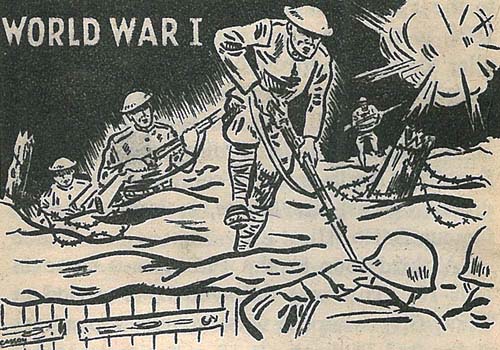
During 1915, some Bible Students battled with feelings of disappointment. Much of the world, however, fought battles of a different kind. The Great War, later known as World War I, was enveloping Europe. . . . On May 7, 1915, . . . U-boats sank the British passenger ship Lusitania. More than 1,100 people died.
The following, however, is a more interesting point from the same 2015 Yearbook article:
The Bible Students wanted no part of this war. However, they did not then fully understand the Christian position of strict neutrality. While they did not voluntarily enroll in the army, some of them accepted conscription and endeavored to obtain noncombatant roles. If forced into the trenches, others felt that they could simply “shoot over the enemy’s head.”
This policy is confirmed in the July 1, 1915 and the July 15, 1915 issues of the Watch Tower. The article “A View from the Watch Tower” gives the view that this war was the prelude of Armageddon and was predicted to end in anarchy. (By this point in time, the year 1914 was described as the year running from the fall of 1914 to the fall of 1915.) Russell recognized that there would be true Christians fighting in the armies of each nation. The following are excerpts from p.495,496 of this July 1, 1915 issue:
At the same time it should not be forgotten that there are saints of God in every land, and that doubtless there are saints in every army–in these armies because of conscription–in these armies to fulfil the demands of the governments, but with fullest determination that they at the same time owe their highest allegiance to the kingdom of kindness, and fully determined that they will kill nobody. We are hearing from the front, that they are seeking to live up to the teachings of the Word of God, pointed out in the sixth volume of SCRIPTURE STUDIES, and that they are being blessed in so doing. What more could we ask?
That reference is to the sixth volume of Studies in the Scriptures, The New Creation, and is found on pages 594-595, where we read the following:
True, government may not always exempt those opposed to war from participating in it, although a very gracious provision of this kind has in the past been made for some who, like ourselves, believe war to be unrighteous; viz., the Friends or Quakers, exempted from military duty under specially generous laws. We may be required to do military service whether we vote or not, however; and if required we would be obliged to obey the powers that be, and should consider that the Lord’s providence had permitted the conscription and that he was able to overrule it to the good of ourselves or others. In such event we would consider it not amiss to make a partial explanation to the proper officers, and to request a transference to the medical or hospital department, where our services could be used with the full consent of our consciences—but even if compelled to serve in the ranks and to fire our guns we need not feel compelled to shoot a fellow-creature.
That “sixth volume” was first published in 1904, and the idea seems very little changed in the July 1, 1915 Watch Tower magazine:
Inquiries come to us respecting the advisability of enlisting in hospital corps, rather than to be conscripted for the regular service later on. Our advice would be to wait for the leadings of the Lord’s providence and to take such steps only when fully assured of their wisdom. Now is a good time to remember the words of the Lord, “Wait ye upon Me, saith the Lord.” It would be a mistake, however, for any of the Lord’s people to think themselves called upon to interfere in any manner with the world’s course in respect to enlistment. Let the worldly use their own judgment, while God’s consecrated people use theirs. To be “subject to the powers that be,” implies not merely a willingness to serve under compulsion, but implies also that we will not oppose earthly governments in any public manner.
In other words, do not volunteer for hospital service in advance of being conscripted or drafted. Allow yourself to be conscripted even if this means you may inevitably end up fighting with guns, cannon, bayonets, and other armaments in the trenches and on the front lines. Most Bible Students would be expected to request a transfer to a non-combatant role, and then hope for the best.
Note, too, how the Watch Tower is also being very careful not to speak out against either the enlistment or conscription processes in the various countries where the Bible Students followed the advice of the Watch Tower. Before this war was over, however, that advice about not speaking out against conscription or enlistment would often be ignored when J. F. Rutherford took over the reins of the Watch Tower later the following year (1916). More specifically, it was the 1917 Finished Mystery (Studies in the Scriptures, Volume VII) with anti-war sentiment –actually anti-conscription sentiment– found on a couple of pages. Rutherford had the offending pages removed, by having them torn out of already-printed volumes. However, this wasn’t enough to appease the authorities. Papers from the 1917 FBI investigation also show that there were various letters collected from Rutherford’s offices which confirmed that Rutherford was regularly being called upon to help the Watchtower’s Bible Students avoid conscription. [Future post or article is planned on this subject.]
This idea had actually appeared well before Studies in the Scriptures, Volume VI, from 1904. It had also appeared when the United States was becoming involved in its first major international conflicts since 1879, when the first Watch Tower was published. Outside of wars with Native American tribes, 1898 was the time of a war in Samoa, resulting in a new territory: American Somoa. The most prominent conflicts in 1898 were due to the Spanish-American War involving fighting by U.S. soldiers in Cuba, Philippines, Puerto Rico and Guam.
Therefore, the July 1898 Watch Tower, p.204, had stated:
CHRISTIAN DUTY IF DRAFTED.. . . If, therefore, we were drafted, and if the government refused to accept our conscientious scruples against warfare (as they have heretofore done with “Friends,” called Quakers), we should request to be assigned to the hospital service or to the Commissary department or to some other non-combatant place of usefulness; and such requests would no doubt be granted. If not, and we ever got into battle, we might help to terrify the enemy, but need not shoot anybody.
That led to the questions printed in the August 1898 issue, p. 231:
Question. I was surprised to note your advice to any who might be drafted into the army. Would not your advice seem like compromising to avoid trouble?
Answer. It is proper to avoid trouble in a proper manner. It is proper to compromise when no principle is involved, as in the case mentioned. Notice that there is no command in the Scriptures against military service. Obedience to a draft would remind us of our Lord’s words, “If any man compel thee to go a mile, go with him twain.” The government may compel marching or drilling, but cannot compel you to kill the foe. You need not be a good marksman.
Question. You suggested in a recent WATCH TOWER that, if drafted and in the army, we need not shoot to kill. Would such a course be right? Would it not be fraudulent?
Answer. No; it would be quite right to shoot, not to kill. You forget, perhaps, our provisos, which were that we explain our conscientious scruples against war, and seek to be excused; if not excused, that we seek non-combatant positions, as nurses, etc.; but if compelled to go a mile or many miles as a soldier, we still need not kill anybody.
None of these previous references from either 1898 or 1904 had specifically mentioned the idea or the term about “shooting over the enemy’s head.” Where did that come from exactly? The idea was first mentioned in the July 15, 1915, page 216, which also included the experience that is referenced in the recent 2015 Yearbook. Quoting from that Watch Tower, it states:
I have something to read to you. It is a translation of a letter. It was written in Hungarian, to a Slav brother in the United States, and was forwarded to us. A portion of the letter follows:
“A Hungarian soldier, injured on the battlefield, was returned home wounded. He was there met by some of our brethren, and later was led to diligent and earnest study of the Scriptures, and finally made his consecration to the Lord. This he symbolized last January, at the hands of our dear Brother Szabo. A few days later he was obliged to return to the front and to the trench, in Galicia. A cannon shot burned the cap from his head; earth caved in upon him. He was dug out by his comrades, and again sent to the hospital. This brought the dear brother into our midst again, but for a short time only. Presently he had to return to the firing line again.
“This time they came within 800 feet of the Russian line, and they received the command, ‘A bayonet charge!’ The Hungarian brother was at the end of the left wing. He sought only to protect himself from the enemy, hence endeavored merely to knock the bayonet from the hand of the Russian with whom he was confronted. Just then he observed that the Russian was endeavoring to do likewise; and instead of using his opportunity to pierce his opponent, the Russian let his bayonet fall to the ground; he was weeping. Our brother then looked at his ‘enemy’ closer–and he recognized a ‘Cross and Crown’ pin on his coat! The Russian, too, was a brother in the Lord! The Hungarian brother also wore a ‘Cross and Crown’ emblem–on his cap.
“The two brethren quickly clasped hands and stepped aside. Their joy was overflowing, that our Heavenly Father had permitted them to meet even on the field of the enemy! They could not understand one another’s speech, but by signs they conversed, taking out their Bibles–and the Russian had the SCRIPTURE STUDIES in his pocket with a song book, all bound in one volume, and a photo of Brother Russell. The Brother then took the bayonet of the Russian brother, and gave him over as a prisoner of war; and he still remains as such in Hungary, while the Hungarian brother has now been sent to the hospital for the third time.”
While there are not many rich or noble amongst the Lord’s brethren, yet when it comes to telling the Truth, they manage it very well!
In Germany, Great Britain, and all over Europe, our people have been conscious for years that this war was coming on. They have been writing to me and continually inquiring how they should proceed if they were drafted or went into the army. In Volume Six of SCRIPTURE STUDIES, the friends are instructed to avoid taking life. If they were ever drafted into the army they should go. If they could be sent to the Quartermaster’s Department to take care of the food, that would be desirable, or into the hospital work. They should endeavor to get such positions. They could not be expected to do service in the way of killing. If they were obliged to go on the firing line, they could shoot over the enemy’s head, if they wished.
And that is the way these brethren did; each had this same thought in mind. This letter shows the love of the brethren even on the field of battle, and in the enemy’s land, with carnal weapons. It made no difference that one was a Hungarian and the other a Russian!
I doubt that any readers were expected to question the story although the odds against it actually happening were overwhelming.
On the one hand, there were 15,000 or more active readers of the Watch Tower in 1915. The July 1, 1915 issue quoted earlier had stated:
Approximately 15,000 have already indicated to us that they have taken the Vow, and that therefore they belong to this great world-wide Prayer Circle which remembers each other and all the laborers in the Lord’s Kingdom daily at the Throne of Grace.
Other numbers provided for this time period would tell us that there could be as many as 18,000 or more associated with the Watch Tower and Bible Students in 1915. This means that with a world population of 1,800,000,000, according to the U.S. Census Bureau, there may have been one Bible Student for every 100,000 people. (Today it’s more like 1 out of every 1,000 persons.)
But most of those were in the United States. Based on the distribution of literature worldwide, 98% or more of all Watch Tower followers were in North America, Australia, United Kingdom, Germany, Spain, Italy, Greece, etc. Between 1% and 2% (max) could be expected in Hungary and Russia.
Even the 1% to 2% estimate is probably high, but also note the following number of “active” Bible Students from within just a few years during this same period. The “Jehovah’s Witnesses – Proclaimers” book says the following on page 425:
The actual number who were then sharing in that work, however, was small. Some who had fearfully held back during 1918 became active again, and a few more joined their ranks. But the records that are available show that in 1919 there were only some 5,700 who were actively witnessing, in 43 lands.
If we average the 5,700 with the 15,000 we come up with about 10,000. But about half of these were women, leaving only 5,000. That’s no more than 50 in Russia and 50 in Hungary. And we can assume that as few as 30% would have been conscripted to military service based on age and eligibility. That would leave 15 on each side. Also Russell claimed that reports from Europe showed that there had been good success in following the Watch Tower instructions that had included making a request for non-combatant roles. Assuming only one-third found re-assignment this way, we have only about 10 “cross-and-crown” wearing Bible Students on each side that might have found themselves battling each other in the front lines.
It’s fairly easy to imagine the odds of laying out two decks of cards in rows across from each other and testing whether, for example, the Ace of Spades from each deck happens to end up exactly across from each other. But still, it might happen often enough to make you think this is a fair possibility, even if not likely. But here we are looking for something more like dumping two haystacks on top of each other, each with a single needle in it, and then finding out that those two needles had fallen exactly against each other.
If you are looking for more mathematical accuracy, it seems even less likely than the haystack example. Here’s why:
Recall that the Hungarian and Russian “Cross and Crown” wearers are in a battle in Galicia just a few days after the Hungarian has converted to become a Bible Student in January 1915. A series of battles matching this description is known to have occurred between January and March 1915. Note the following from From http://www.historyplace.com/worldhistory/firstworldwar/index-1915.html :
March 22, 1915 – The Russians capture 120,000 Austrians at Przemysl in Galicia. This marks the culmination of a series of winter battles between the Austrians and Russians to secure the strategic Carpathian Mountain passes and opens the way for a Russian invasion of Hungary. Realizing this, the Germans and Austrians make plans to combine their troops and launch a major spring offensive.
That’s quite a large number of soldiers who must have been involved in this specific series of battles. But look at the size of the military population they were chosen from, based on this chart from http://spartacus-educational.com/FWWarmies1914.htm :
Those battling against each other here were chosen from armies that ranged from 6 to 12 million on the Russian side and 3 to 8 million on the Austria-Hungary side. Therefore, Bible Students are not likely to make up more than one out of every million soldiers. (1:1,000,000). So now imagine those two card decks, not of 52 cards each, but of one million cards each with only one Ace of Spades in each deck. Now try to imagine the odds of those two aces ending up exactly across from each other.
The story of the two soldiers is repeated in the “2015 Yearbook” without any question, of course, about its authenticity.
The story, therefore, describes something no less than a mathematical miracle! And it was put to use in the defense of a doctrinal position that is now considered incorrect, and which wasn’t updated to its current form until as late as 1939. Note the “Proclaimers” book again, from page 191:
Though Jehovah’s Witnesses quickly discerned some issues that involve a Christian’s relationship to the world, other matters required more time. However, as World War II gathered momentum in Europe, a significant article in The Watchtower of November 1, 1939, helped them to appreciate the meaning of Christian neutrality.
This would mean that Jehovah, in effect, produced a miracle in support of a doctrine that he neverapproved. Oddly, no such miracle has ever occurred that would seem to support the Watch Tower’s stance on blood transfusion, for example. And for that matter, what should have been the odds for discovering a Greek manuscript of the “New Testament” with Jehovah’s name in it? Since the Watchtower claims that this was supposedly in all the correct originals, the odds in favor of such a find should be very high. It wouldn’t have even required a a miracle, and yet the miraculous protection of the accuracy of the Biblical manuscripts is often discussed in the Watchtower. Could not even one of these “accurate” manuscript examples have survived?
If Jehovah could make a miracle happen in support of a “false” doctrine, what would have made it so difficult for Jehovah to produce a miracle in support of a “true” doctrine?
“Recent Finds” reprints interesting and relevant discoveries from various sites, blogs, and forums, where we have permission either from the site owner or the person who created the post. We do not necessarily agree with everything said by the contributor on the originating site, nor does the person who gave permission necessarily agree with the contents of this site.
For this topic the contributor was “JW Insider” on jw-archive.org. Some of the points have been made before on this site, but in this case we highlight (in bold, red text) the portions of the post where spiritism is discussed:
[Post #1]
Historically, the Watchtower has always said that the resurrection of some of the 144,000 happened many years ago. Up until 1927, that resurrection had happened in 1878. This is why in 1916 after Russell died, the Watchtower claimed for many years that Russell was communicating with the Watchtower Society and was continuing to run every phase of the work “from beyond the veil.”The Watchtower defended this position against a charge of spiritism on the grounds that Russell was still alive. (Of course, he would still be a spirit, so I don’t know how well that argument worked.)
In 1927, the date for the resurrection of all the previously deceased members of the 144,000 up to that point was changed from 1878 to 1918. Up until less than 10 years ago, our official position was that the apostle Paul, for example, was resurrected in 1918. This was taught, not just as a guess, but an established fact. But then in 2007 we got a very interesting Watchtower article:
*** w07 1/1 p. 27 par. 9 “The First Resurrection”—Now Under Way! ***
Reasonably, then, anointed ones who die before Armageddon are resurrected sometime between 1914 and Armageddon. *** end of quote ***
This opened up a whole new range of possibility, including the possibility that NONE of the 144,000 have been resurrected yet. And this is still a possibility based on the updated view of the rapture in the May 15, 2015 Watchtower.
However, the old 1918 resurrection is not completely dismissed as a possibility, it’s only that it has been downgraded from an established fact to “an interesting possibility”
*** w07 1/1 p. 27 par. 10 “The First Resurrection”—Now Under Way! ***
Can we say more precisely when the first resurrection begins?
. . . It seems that resurrected ones of the 24-elders group may be involved in the communicating of divine truths today. Why is that important? Because the correct identity of the great crowd was revealed to God’s anointed servants on earth in 1935. If one of the 24 elders was used to convey that important truth, he would have had to be resurrected to heaven by 1935 at the latest. That would indicate that the first resurrection began sometime between 1914 and 1935.
. . .
Could it, then, be reasoned that since Jesus was enthroned in the fall of 1914, the resurrection of his faithful anointed followers began three and a half years later, in the spring of 1918? That is an interesting possibility. Although this cannot be directly confirmed in the Bible, it is not out of harmony with other scriptures that indicate that the first resurrection got under way soon after Christ’s presence began.
*** end of quote ***
[Post #2]
Just noticed that I referenced the May 15, 2015 about the “rapture.” I meant the July 15, 2015 issue. In fact, that’s most likely the very issue where the question comes up about whether the 144,000 are all in heaven just before the Great Tribulation starts, or just after it starts. Paragraphs 15 and 16 of the “rapture” article becomes just a bit vague at exactly that point.
Just another curiosity on the 2007 issue quoted above.There are now about three different NEW problems with the 1918 date we used to teach.
1918 used to be mentioned as much or more than 1919. But in the last couple decades we had already stopped mentioning it for many years with reference to ANY current doctrine. Also, the Governing Body as the Faithful and Discreet Slave didn’t exist until 1919 in our new understanding. So as of the July 15, 2013 issue of the Watchtower, we officially dropped the last teachings related to 1918. We used to teach that the “spiritual temple” was inspected in 1918, and also that great tribulation started in 1914 and was interrupted in 1918, and that it would start up again just before Armageddon. Note:
*** w13 7/15 p. 3 par. 3 “Tell Us, When Will These Things Be?” ***
For a number of years, we thought that the great tribulation began in 1914 with World War I and that “those days were cut short” by Jehovah in 1918 when the war ended so that the remnant would have the opportunity to preach the good news to all nations.
*** end of quote ***
*** w13 7/15 p. 11 “Look! I Am With You All the Days” ***
Paragraph 6: This is an adjustment in understanding. Previously, we thought that Jesus’ inspection took place in 1918.
*** end of quote ***
So 1918 is no longer important to any other doctrine.
Another problem with it is that the 2007 article ends with the idea that “although this cannot be directly confirmed in the Bible, it is not out of harmony with other scriptures that indicate the first resurrection got under way soon after Christ’s presence began.” The problem here is that the only scriptural example is the verse in Thessalonians 4:13 which is not that directly supportive of the claim that this resurrection happens EARLY during the presence. If anything the emphasis is on how close together the timing of the resurrection aligns with the raising of the final LIVING survivors at the end.
Also, a third problem is the idea that we kept the “spiritism” idea as the way of supposedly narrowing down the time of the first resurrection between 1914 and 1935. The article said: “If one of the 24 elders was used to convey that important truth, he would have had to be resurrected to heaven by 1935 at the latest.” (24 elders is still identified as another term for the 144,000.)
The real problem is that we used to say that although 1935 was not found through Scripture, it didn’t matter because it was revealed as “lightning flashes” going forth into the “spiritual temple.” Rutherford used this expression a lot as if it was a form of either angelic inspiration or communication with those who had already passed beyond the veil. (The idea survived for many decades in our songbooks with the words “In God’s holy temple / Lightnings flash and shine / That we may be guided / By his light divine.) The problem is that 1935 is no longer considered to have any specific significance anymore. Now, it is just a time when the Watchtower began teaching something different and therefore clarifying or identifying the hope of a class who had seemed, for many years prior, not to know exactly what there hope was.
One last consideration is not included above because it hasn’t been commented upon yet in the Watchtower with reference to the first resurrection:
(2 Timothy 2:18 ) These men have deviated from the truth, saying that the resurrection has already occurred, and they are subverting the faith of some.
The 2014 Annual Meeting Program video can be found on tv.jw.org (currently found under Programs and Events). The following speech can be found about the 2 hour and 8 minute mark in the video. It ends at about the 2 hour and 25 minute mark.
“David Splane of the Governing Body will speak to us on the theme: ‘Types and Antitypes.’”
Let’s get right into our subject: types and antitypes.
Now, years ago, our publications often applied certain Bible accounts and certain bible characters as “types” of something greater. But you’ve noticed that, in recent years, that is seldom done, and the purpose of this talk is to explain why.
First of all what is a type and what is an antitype? Well, the Watchtower of September 15, 1950 defined them this way. It said:
“A type is a representation of something that will come to pass at a future time. The antitype is the reality of the thing which the type represents.”
So that is the definition that was given by The Watchtower. And we might add that Jehovah is usually involved in designing the type.
Now, take the tabernacle. Jehovah was very clear about the construction of the tabernacle: what materials were to be used, the dimensions and so forth. Why? Well, apparently because he had designed the tabernacle to be a type of something greater: his great spiritual temple. And the temple was the antitype.
The sacrifices on the Day of Atonement. Jehovah was very careful about how events on the Day of Atonement were to unfold. And again, we have to realize that something was going to have to picture or foreshadow the perfect sacrifice of Jesus Christ. So, the sacrifice on the Day of Atonement, the type, and the perfect sacrifice of Christ, the antitype.
Now consider another example. When the disobedient Israelites in the wilderness were bitten by poisonous snakes, Moses is told by Jehovah to fashion a copper serpent and to place that serpent on a pole. Now that was a type. Now Jesus explains what it was a type of. Let’s turn to John chapter 3, John chapter 3 and verses 14 and 15. John 3: 14 and 15 If you are using an iPad, I’ll give you a chance to catch up. [Laughter] I couldn’t resist. “And just as Moses lifted up the serpent in the wilderness, so the Son of Man must be lifted up, so that everyone believing in him may have everlasting life.” Now, would anyone doubt that this is a type? Of course not. Because Jesus said it was.
Well notice that in both these examples, the tabernacle and the copper serpent, Jehovah was involved. He designed the type so that it would fit the antitype. He told Moses, for example to fashion a copper serpent and put it, not on a rock, but on a stake. And of course the tabernacle prefiguring the great spiritual temple.
And from the apostle Paul we learn even more about types and antitypes. For example, Paul, in Hebrews: Isaiah and his 2 sons represent Jesus, and the anointed. He also explains that Moses, the mediator of the Law covenant, represents Christ the mediator of the new covenant. And we learn from the letter to the Galatians that Abraham’s relationship with Sarah and Hagar, represents Jehovah’s relationship with the nation of Israel, and with the heavenly part of his organization. Type and antitype.
Now we know that these were genuine types because, the word of God says they are. But here is the question:
Who is to decide if a person or an event is a type if the word of God doesn’t say anything about it? Who is qualified to do that? Our answer? We can do no better than to quote our beloved brother, Albert Schroeder, who said:
“We need to exercise great care when applying accounts in the Hebrew Scriptures as prophetic patterns, or types, if these are accounts are not applied in the Scriptures themselves.”
Wasn’t that a beautiful statement? We agree with it.
Now the study of types and antitypes is not unique to Jehovah’s Witnesses. During the past 2,000 years, Catholic and Jewish scholars have made quite a diligent study of types and antitypes. In fact, there is even a name for the study. They call it “typology.”
The first century Jewish scholar, Philo of Alexandria, for example, suggested that the serpent in the garden of Eden, the tree of knowledge and the cherubs that were guarding the entrance to the garden were all typical of something greater.
And then describing the teachings of such early writers as Origen, Ambrose and Jerome, the International Standard Bible Encyclopedia says this:
“They sought for types and of course found them, in every incident and event, however trivial, recorded in Scripture. Even the most simple and commonplace circumstance was thought to conceal within itself a hidden truth. Even in the number of fish caught by the disciples when the risen Savior appeared to them,” he says, “How much some have tried to make of that number:, 153 .”
One scholar made much of Jacob’s purchase of Esau’s birthright with a bowl of red stew. Very significant that the stew was red. To him, the red stew pictured the red blood of Christ. The inheritance pictured the heavenly inheritance. It’s all… By that reasoning, Jacob pictures Jesus, Esau’s birthright pictures the heavenly inheritance, and the red stew pictures Jesus’ precious blood.
Now on the surface that might sound plausible to some, until you think about it. When you think about it you see three problems. First of all, Jehovah didn’t design the type. Jehovah did not tell Esau to sell his birthright. Selling his birthright was wrong, and Jehovah never tells us to do something that’s wrong. Second, who ate the stew? Esau did. So are we to conclude that, by giving up his inheritance, Esau put himself in line for the ransom sacrifice of Jesus Christ? That doesn’t make any sense. And most importantly, nowhere in Scripture do we read that the event was a type.
Now the study of types and antitypes was not only common among Catholic and Jewish scholars, but were very prominent among Protestant scholars as well. The Puritans, like Edward Taylor, applied many Bible events to themselves. The Baptists and Congregationalists did likewise. So it’s not surprising that the early Bible Students, who generally belonged to these groups were also really fond of types.
And as many of us have been. Many of us have remembered happy moments at the congregation book study studying all about types and antitypes. And it’s true that the study of types could be thrilling!
So now here’s a question. If the study of a certain subject make chills run up and down your spine, could it possibly be mistaken? And the answer is yes.
The case of brother Arch W. Smith is an example. In 1886, Brother Russell published a book that contained a chart linking the ages of mankind to the Great Pyramid of Egypt. Now that pyramid was called by the Bible Students, the “Bible in stone.” They loved the study of the Pyramid. In fact, if you have seen pictures of Brother Russell’s grave, you’ve noticed that there was a pyramid nearby. And that’s because the Bible Students believed very much in the Great Pyramid of Egypt, and some became very engrossed, in measuring certain rooms and certain features of the pyramid and to try to determine, for example, how long they had to wait before they went to heaven, and so on.
And so one who was just thrilled by the study of types was Arch W. Smith. It was a hobby of his, he loved it. In fact he gave a lot of prayerful thought to the dimension of the pyramid, and from time to time he would write in to Bethel and let them know what his findings were, to support the idea that the Great Pyramid had a place in Jehovah’s purpose. He loved it!
But when The Watchtower of 1928 came out and said that Jehovah doesn’t need a stone monument built by pagans to accomplish his purpose, Brother Smith accepted it. He let reason win out over emotion.
Well, in recent years the trend in our publications has been to look for the practical application of Bible events, and not for types where the Scriptures themselves do not clearly identify them as such. We simply cannot go beyond what is written. Now there’s a real advantage in looking for the practical application of Bible accounts, rather than confining certain applications to one class: “This applies only to the anointed.” “This applies only to the other sheep.”
Let’s just see why. Turn to Romans chapter 15 and verse 4. Now remember that Paul is writing to his anointed brothers here. Romans chapter 15 and verse 4. And he says, “For all the things that were written beforehand” . . . Well what things? The Hebrew Scriptures obviously. . . “were written for our instruction so that through our endurance, that through the comfort of the Scriptures, that we might have hope.” What is Paul telling the anointed? He’s telling them that you can learn from these accounts in the Hebrew Scriptures. You can apply principles of the Hebrew Scriptures to yourselves.
Let’s consider an example: Now soon after his conversion, Paul is preaching in the city of Damascus. The Jews are furious and they try to kill him. So anointed disciples take Paul and they lower him down the city wall in a basket. Is it possible that some of those anointed ones they thought of Rahab? Who helped the two spies escape from Jericho by a similar method? Would anyone say to them, “You can’t apply that to yourselves…Rahab pictures the other sheep, you are of the anointed?” No! They could apply the lessons of that account to themselves.
Now let’s consider another example, a modern one. In the Song of Solomon we read of a chaste young virgin who falls desperately in love with a poor shepherd boy. Solomon, who incidentally was still an inspired Bible writer at the time, but he’s a very wealthy man, he tries to lure her away but he’s unable to do so. Now suppose that in a certain congregation there’s a sweet young sister, who falls head over heels for a poor pioneer brother, who’s a real spiritual man but he doesn’t have a penny to his name. Now her friends encourage her to marry a wealthy brother, who is very rich but he doesn’t have a lot of time to spend on spiritual things. The sister remains firm. They say, you wouldn’t have to work! You can pioneer. She says no my love is for that pioneer boy. Would anyone say to her, the Song of Solomon doesn’t apply to you because you’re of the other sheep, not of the anointed?
You see how practical it is to take these Bible accounts and really apply them to the everyday life of people.
What about others of the other sheep today? In this audience there are modern-day Nehemiahs who are spurring the building programs we have. Wonderful young Timothys, graduates of our Bible schools, warmhearted Tabitha’s, hospitable Lydias. And don’t we find exceptional young Circuit Overseers who are like Elihu in giving wise counsel to elders who are much older. And don’t many Christian young women remind us of dear Rebekah who was willing to follow her husband to a distant land for the accomplishment of Jehovah’s purpose?
We deeply appreciate the spiritual heritage that was passed on to us by the early Bible Students. In harmony with Zechariah chapter 4 and verse 10: “We do not despise the day of small things.” However the light does get brighter. And we feel that we must follow the light, wherever it leads us. Our love should be for the truth and not for a particular doctrine or teaching.
Well how would you sum this talk in a few words?
The wrong answer is, “We don’t believe in types and antitypes any more.” We do! We certainly do. Where the scriptures identify them as such, we embrace them. But where the Bible is silent, we must be silent.
Now in the three talks that follow there are going to be important clarifications in our beliefs.
Perhaps a certain adjustment will touch a spiritual nerve, make us rethink a cherished teaching. Our love for Jehovah and the truth will make us receive this information gladly and with open hearts.
Often today we hear brothers say, we’re having a hard time keeping up with the celestial chariot. So are we. So are the Governing Body. We’re not driving the chariot. Jehovah is driving the chariot and we’re running just as fast as you are, trying to keep up. So let’s all do our best to keep up with it. And let us thank Jehovah for continuing to deal with us. And for continuing to provide nourishing spiritual food.
________end of transcript________
Personal notes:
In the commentary on the Watchtower article based on this talk ( http://ad1914.com/2015/01/26/2107/ ) we pointed out a few items of interest:
First of all, the idea is given that these “type-antitype” explanations have already been phased out to some extent over the past few years, but with no official explanation until now.
The talk mentions that some legitimate examples of “type/antitype” included the tabernacle (shadows), the sacrifices, Abraham’s wife and mistress, and the snake on a pole. The 3/15/2015 Watchtower article replaced the snake on a pole with the sign of Jonah.
It’s pointed out that this “typology” stuff has had a long history among a lot of religions, Jewish, Catholic and Protestant. (And some ridiculously bad examples are mentioned as if they were more ridiculous than Watch Tower examples.)
The logic behind using the Rahab and Shulamite examples is twisted and anachronistic. As far as Paul’s companions knew, there never was and never would be an incorrectly explained “other sheep” class represented by Rahab. And what sister says, “The reason I am choosing the broke pioneer over the rich brother because the Song of Solomon applies to me.” In Splane’s illustration, she never actually says that, but Splane indicates that there is some danger that the sister is going to hear an argument meant to to push her into the arms of the rich brother simply because she is not “anointed” — as if only “anointed” sisters should be able to choose the poor penniless pioneer.
But the speech says, basically, that the Watch Tower teachings took this too far. It says it will only be used from now on if the Bible tells us specifically that it is a “type.” This seems commendable.
The problem is that this new guideline is watered down considerably in the March 15, 2015 Watchtower article based on this talk. It seems very likely that between the Annual Meeting and the end of the 2014, someone noticed that following the words of this talk would completely ruin the two most important unique doctrines of JWs today:
1. That the Kingdom of the pagan, Gentile, violent, insane, Jew-killing Nebuchadnezzar was a “type” of God’s non-Gentile Kingdom through Christ Jesus, the perfect Prince of Peace, as represented by the Jewish Davidic/Messianic Kingdom at Jerusalem.
2. That the “faithful and discreet slave” in Matthew 24:45 was a “type” of the Governing Body.
Also, found it “funny” how Splane treats the old Pyramid scheme, promoted in the Watch Tower publications from the 1880’s to the 1920’s.
The March 15, 2015 article tries to keep the idea of being once “thrilled” by these explanations in the past as a good thing. Splane had used it to show that being thrilled doesn’t always mean it was right.
This article is part of a series of “commentary” articles we are presenting about the March 15, 2015 study issue of The Watchtower. Unless otherwise noted, the specific article referenced on this page is: “This Is the Way You Approved” (pps. 7-11). The original article in its original formatting is available on jw.org. Commentary provided by this site (ad1914.com) is provided in blue text which is indented and usually italicized.
Black text is from the original Watchtower article.
Blue text (usually italicized) is our added commentary. Other quotations from prior Watch Tower publications (not the specific article under discussion) or from the Bible, are often presented in black text, although indented.
Emphasis may be added to both the original article and the commentary by formatting with bold, italic or underlining.
SUMMARY OF THE NEW DOCTRINAL CHANGE
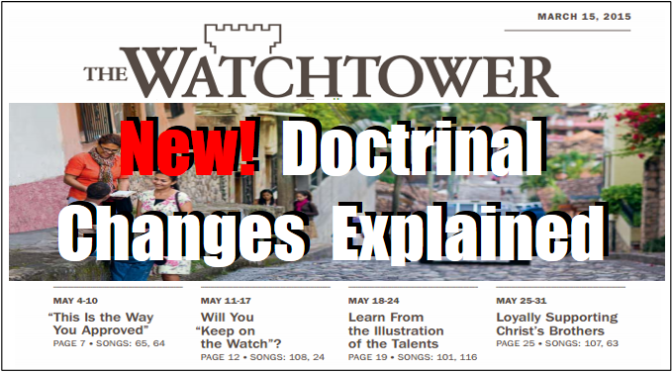
The March 15, 2015 Watchtower states that we should now see a clear change to a “way of teaching” which has often been used in the past. That “way of teaching” is referred to as the “type and antitype” method. Although it has not been abandoned entirely, the article indicates that it should only be used when there is a clear Biblical statement that the illustration or narrative is, in fact, a prophecy.
“You have carefully hidden these things from wise and intellectual ones and have revealed them to young children.” — LUKE 10:21 _______________________________________________________
THE ARTICLE TITLE
The title’s reference to “this is the way you approved” is taken from a portion of Luke 10:21, the same theme Scripture cited along with the title of the article. This Bible verse, by the way, was not mentioned in the original “2014 Annual Meeting” discourse that the Watchtower article is based on.
THE BACKGROUND
Historically, The Watch Tower publications have consistently claimed right from the very start in 1879 that Biblical parables in the Greek Scriptures (“New Testament”) and Biblical narratives from the Hebrew Scriptures (“Old Testament”) should be treated as prophecies. If it was an event or circumstance from someone’s life (like Naboth or Naaman or Jehonadab), or if it was an obvious general moral lesson (like the Good Samaritan or the Prodigal Son), it also had to be explained as a prophetic drama where various characters and details were prophetic of some future events. Those events usually related to the history of the Watch Tower Society in the last 100 years. As an older Watchtower had stated it:
“Such parables were also prophecies which find their fulfillment in happenings of our day that have a connection with the spiritual things of God. In the prophetic Psalms it is written: …’I will incline mine ear to a parable [from God]’… This shows that such parable is a prophecy which foretells coming things that have a likeness to or are comparable with the things related in the parable.” (Watchtower, November 1, 1943)
THE ORIGINAL MATERIAL FOR THE MARCH 15, 2015 ARTICLE (2014 ANNUAL MEETING)
The Watchtower article is a revision of a talk given by David Splane, a member of the Governing Body of Jehovah’s Witnesses, at their October 4, 2014 “Annual Meeting.” A video is available at tv.jw.org, and this particular segment of the program begins at about the 2 hour and 8 minute mark in that video. The Annual Meeting speech was introduced as the first of four “historic discourses” on Scriptural subjects. (An unofficial transcript of the discourse is on this site, here.) The other topics were: “The Talents” “The 10 Virgins” and “Gog and Magog.” The original talk did not reference the specific idea that “this is the way you have approved.” It was merely introduced with the words: “To begin, Brother David Splane of the Governing Body will speak to us on the theme: ‘Types and Antitypes.'”
IT’S NOT FUNNY IF YOU HAVE TO “SPLANE” IT David Splane said: “. . . So anointed disciples take Paul and they lower him down the city wall in a basket. Is it possible that some of those anointed ones, they thought of Rahab? … Would anyone say to them, ‘You can’t apply that to yourselves! Rahab pictures the other sheep. You are of the anointed’?. . .” [Note that David Splane’s words are a ludicrous anachronism, because according to the Watchtower Society, no one could know the actual identity of the “other sheep” until it was revealed through what the Watchtower has called “flashes of lightning in the spiritual temple” just prior to 1935. This awkward example provides a hint that one of the “drivers” for this change is the complete inability for Jehovah’s Witnesses to relate so many Biblical anecdotes and parables to the anointed class. It’s just as difficult for the average Witness to speak about the relationship between the anointed class and the “other sheep.” (That’s what many of the explanations were about.) In other words, Splane was looking for something ludicrous – on purpose – so that it clearly appears inappropriate to apply so many texts only to the “anointed” when, by their own expectations, no anointed person outside of the Governing Body themselves, should have any current significance to current Witnesses.]WHY CHOOSE THIS PARTICULAR SCRIPTURE THEME
Luke 10:21 is treated as a Scriptural basis for changing the Watchtower’s long-standing teaching method. Because the practice had been common in literally hundreds of prior Watch Tower teachings going back to the very beginning in the late 1870’s. It would hardly have occurred to most Jehovah’s Witnesses that this method of teaching used for the last 4 or 5 generations of Witnesses might not be “way that you [Jehovah] approved.” Yet, it was the clearly the way that Russell approved, the way that Rutherford approved, the way that Nathan Knorr and Frederick Franz approved. It was the way that the Watch Tower Society and the Governing Body had always approved, too. At least until very recently.
Luke 10:21 does appear to support such a change because the verse appears to support “simplicity and clarity” due to the reference to revealing “these things” to “children” as opposed to the “wise and intellectual ones.” The Watch Tower’s hundreds of teachings based on the idea of “types and antitypes” did, indeed, produce unclear and unnecessarily complex, ever-changing explanations. (See prior articles on this site about the Prodigal Son and Elijah/Elisha, for example.) Jesus, on the other hand, was famous for using powerfully simple illustrations that attracted disciples who were “unlettered and ordinary,” with a childlike humility, and who therefore had no problem asking Jesus himself for the explanations. It’s also true that those who were known for religious or secular education in those days, were considered to be haughty and self-important. These were the wise and intellectual persons, such as the scribes and Pharisees. Unlike the disciples, they must have thought it was beneath them to ask Jesus what these illustrations meant.
So from a logical perspective, the article appears to be on the right track. Luke 10:21 seems appropriate enough. And, of course, most anyone would agree with the basic premise that teachings should be simpler and clearer, and we would also agree that the Watchtower’s “type-antitype” method, which has been in use throughout the entire history of the Watchtower, has not been the way Jehovah approved. But…
JUST ONE PROBLEM WITH USING THAT SCRIPTURE, THOUGH . . .
Upon closer inspection, although the premise is generally true, Luke 10 is not applicable here. We won’t get into all the reasons for this, but some of them are mentioned under the discussion of Paragraph 1, below. Basically, while points in favor of simplicity and clarity could have been easily made with other scriptures, Luke 10:21 is not the appropriate verse to make this point.
Luke 10:21 is not talking about a method of teaching. In fact, “the things” that were hidden from wise and intellectual ones and revealed to young children were things related specifically to what the disciples became aware of through activities when Jesus wasn’t even with them. Jesus sent them off on their own (“by twos”) to preach in cities and villages. When they reported back to Jesus at a later time, they explained what had been revealed to them in those villages and cities.
The strained (and dishonest) method that the Watchtower article utilizes to tie “the things” revealed to a simpler “method of teaching” indicates clearly that the Watchtower writers were very well aware that Luke 10:21 was not a good fit here. So, it must have been used only because the idea of Jehovah’s “approval” was a very important and necessary theme.
LOOKING FOR APPROVAL
We’ll see why the idea of continued “approval” is as important as the change in doctrine itself.
There are two major reasons for this:
REASON #1: OVERCOMING A POTENTIALLY MASSIVE EMBARRASSMENT
The change in doctrine presented here reveals that most of the teachings of the Governing Body have been wrong. These may not have been the most important teachings, but when one goes through the Bible, page-by-page and lists all the doctrinal teachings that the Watch Tower has gleaned from the Bible’s content, it turns out that a large proportion of the teachings have been about “types and antitypes.” Just look at the list from the Watch Tower’s own publication about a few of them:
Another list of such “type-antitype” doctrines was referred to in the following Watchtower article in 1981:
*** w81 3/1 p. 27 Do You Appreciate the “Faithful and Discreet Slave”? ***
OVERWHELMING CREDENTIALS
The “faithful and discreet slave” has abundant credentials. Following is a partial list of Scriptural and prophetic designations applying to or being represented in the remnant of Jesus Christ’s anointed followers since the notable year 1919:
(1) Noah’s wife, Gen. 7:7; (2) angels sent to Lot, Gen. 19:15; (3) Rebekah, Gen. 24:64; (4) Joseph and Benjamin, Gen. 45:14; (5) gleanings left behind, Lev. 19:9; (6) two spies to Rahab, Josh. 2:4; (7) Barak, Judg. 4:14; (8) Jephthah, Judg. 11:34; (9) Naomi and Ruth, Ruth 2:2; (10) David’s Israelite warriors, 2 Sam. 18:1; (11) Jehu, 2 Ki. 10:11, 15; (12) Mordecai and Esther, Esther 4:13; (13) Job, Job 42:10, 13; (14) King’s daughter, Ps. 45:13; (15) men of loving-kindness, Ps. 50:5; (16) intimate group, Ps. 89:7; (17) Shear-jashub, Isa. 7:3; (18) light of the nations, Isa. 60:3; (19) big trees of righteousness, Isa. 61:3; (20) ministers of our God, Isa. 61:6; (21) cluster preserved, Isa. 65:8; (22) servants called by another name, Isa. 65:15; (23) men trembling at God’s word, Isa. 66:5; (24) new nation born, Isa. 66:8; (25) Jeremiah, Jer. 1:10; (26) Jehovah’s people in the new covenant, Jer. 31:33; (27) enduring watchman, Ezek. 3:16-27; (28) man in linen, Ezek. 9:2; (29) cleansed people, Ezek. 36:29-32; (30) dwellers in center of earth, Ezek. 38:12; (31) the host of heaven, Dan. 8:10; (32) sanctuary restored (cleansed), Dan. 8:14; (33) they that are wise, Dan. 11:33; (34) the happy one who is keeping in expectation, Dan. 12:12; (35) all flesh receiving the spirit, Joel 2:28; (36) Jonah, Jon. 3:1-3; (37) apple of Jehovah’s eye, Zech. 2:8; (38) liberated remnant, Zech. 2:7; (39) a Jew, Zech. 8:23; (40) sons of Levi, Mal. 3:3; (41) wheat, Matt. 13:25; (42) sons of the kingdom, Matt. 13:38; (43) workers for the vineyard, Matt. 20:1; (44) those invited to marriage feast, Matt. 22:3-14; (45) chosen ones, Matt. 24:22; (46) eagles, Matt. 24:28; (47) faithful and discreet slave, Matt. 24:45; (48) discreet virgins, Matt. 25:2; (49) brothers of the king, Matt. 25:40; (50) little flock of sheep, Luke 12:32; (51) beggar Lazarus, Luke 16:20; (52) sheep in “this fold,” John 10:1-16; (53) branches of the vine, John 15:4; (54) royal palace of David, Acts 15:16; (55) heirs with Christ, Rom. 8:17; (56) the remnant, Rom. 11:5; (57) branches in the olive tree, Rom. 11:24; (58) holy ones or saints, 1 Cor. 6:2; Rev. 16:6; (59) temple, 1 Cor. 6:19; (60) new creation, 2 Cor. 5:17; (61) ambassadors for Christ, 2 Cor. 5:20; (62) congregation of God, Gal. 1:13; (63) part of Abraham’s seed, Gal. 3:29; (64) Israel of God, Gal. 6:16; (65) body of Christ, Eph. 1:22, 23; (66) soldiers of Christ Jesus, 2 Tim. 2:3; (67) house under Christ, Heb. 3:6; (68) holy priesthood, 1 Pet. 2:5; (69) holy nation, 1 Pet. 2:9; (70) association of brothers, 1 Pet. 2:17; (71) seven congregations, Rev. 1:20; (72) twenty-four persons of advanced age, Rev. 4:4; (73) spiritual Israel, Rev. 7:4; (74) locusts, Rev. 9:3; (75) two witnesses, Rev. 11:3; (76) two olive trees, Rev. 11:4; (77) seed of the woman, Rev. 12:17; (78) New Jerusalem, Rev. 21:2; (79) the bride of Christ, Rev. 22:17; 19:7; (80) Jehovah’s witnesses, Isa. 43:10.
Amazing! Watch Tower publications claimed there were 42 “types” for the great crowd and 80 “types” for the “faithful and discreet slave.” That’s 124 places in the Bible — 124 “minor” teachings — that all add up to do little more than help create the clergy-laity distinction among Jehovah’s Witnesses.
Thinking about the amount of ink that has been poured into so many of these “type and antitype” teachings, it should be easy for anyone to see that being wrong about so many Scriptures actually brings reproach on the Governing Body for having been so “unfaithful and indiscreet” with respect to Bible teaching for so many years. The March 15, 2015 article invalidates hundreds of “little” doctrines, many of which were taught for more than one hundred years. This calls into question the Governing Body’s claim of providing spiritual food at the proper time. It calls into question any claim of being “faithful and discreet” with respect to their handling of God’s word, or claiming to be “teachers.”
Think about the following verses, for example:
(2 Timothy 2:15) Do your utmost to present yourself approved to God, a workman with nothing to be ashamed of, handling the word of the truth aright.
(2 Corinthians 4:2) …not walking with cunning or adulterating the word of God; but by making the truth manifest, ….
(James 3:1) Not many of you should become teachers, my brothers, knowing that we will receive heavier judgment.
(Matthew 15:6-9) 6. . .So you have made the word of God invalid because of your tradition. . . .9 It is in vain that they keep worshipping me, for they teach commands of men as doctrines.’”
(1 Corinthians 4:6) “. . .that through us you may learn the rule: ‘Do not go beyond the things that are written,’ so that you may not be puffed up with pride. . .”
REASON #2: THE “FAITHFUL SLAVE” DOCTRINE IS JUST ANOTHER OBSOLETE TYPE-ANTITYPE
The very doctrine of the “faithful and discreet” slave is based on this same method of teaching which is now no longer considered “the way [Jehovah] approved.” Logically then, this means that we have no reason to think of the parable of the “faithful and discreet slave” as a prophecy about a group of men who would come into existence only in the year 1919. Therefore, there is no reason to expect that the Governing Body is specially “appointed” or “approved.” Under the principles of the March 15th article, the Governing Body can no longer be “the faithful and discreet slave” based on Matthew 24:45. Therefore, the parable about “the faithful and the evil slave” is really just a moral lesson about continued patience where Christians are warned not to misbehave, and not to set themselves up above their fellow slaves just because of a delay in Jesus’ return. In other words, in the area of setting themselves up over their fellow slaves, the Governing Body has done exactly what Jesus was explaining they should not do.
Again note the following related scriptures (from the NWT) which help explain the practical meaning of Jesus’ illustration, rather than the obsolete “type-antitype” method:
(Luke 12:42, 43) And the Lord said: “Who really is the faithful steward, the discreet one, whom his master will appoint over his body of attendants to keep giving them their measure of food supplies at the proper time? Happy is that slave if his master on coming finds him doing so!
(Luke 16:10) The person faithful in what is least is faithful also in much, and the person unrighteous in what is least is unrighteous also in much.
(Galatians 6:10) So, then, as long as we have the opportunity, let us work what is good toward all, but especially toward those related to us in the faith.
(1 Peter 4:10) To the extent that each one has received a gift, use it in ministering to one another as fine stewards of God’s undeserved kindness that is expressed in various ways.
(1 Timothy 5:8) Certainly if anyone does not provide for those who are his own, and especially for those who are members of his household, he has disowned the faith and is worse than a person without faith.
(1 Corinthians 4:2) In this regard, what is expected of stewards is that they be found faithful.
What the illustration should have meant all these years to Witnesses is fairly obvious, then. All Christians are required to do good for one another, continually and faithfully, no matter how long Christ’s return seems delayed.
But the “Governing Body” isn’t about to give up this particular “type-antitype” teaching. So, one of the reasons the article provides this scriptural theme about Jehovah’s approval is so that Witnesses are diverted from noticing that this is only a “selective obsolescence.” Before the reader even thinks about the details of the new teaching, the Watchtower and the Governing Body are first aligned with “Jehovah’s approval.”
Instead, the Governing Body is intent on highlighting that they are the ones who continue to make improvements and refinements, and that this new change is the real way that Jehovah approved. And if the Governing Body are now conforming to a teaching method that Jehovah approves, then they are, therefore, teachers with a stamp of approval from Jehovah.
Also, the Governing Body is not admitting that they are finally conforming, in general, to the basic ideas that Biblical scholars and “Christendom’s” commentaries have explained for centuries. Most religions have long rejected the “type-antitype” explanations. In fact, David Splane’s speech at the 2014 Annual Meeting excused the practice by focusing on how many others religions, Jewish, Catholic, and Protestant, have done the same thing through the centuries.
EVEN IF YOU DON’T BELIEVE IN SUBLIMINALS…
The phrase “this is the way you [Jehovah] approved” will likely remind Jehovah’s Witnesses of the account of Jesus’ baptism, or Paul’s words found in 2 Cor 10:18: “For it is not the one who recommends himself who is approved, but the one whom Jehovah recommends.” But most Witnesses will also connect these ideas with Jehovah’s “approval” of the Governing Body.
*** w98 2/15 p. 21 par. 14 Glorious Freedom Soon for the Children of God *** Whether our hope is heavenly or earthly, all of us receive spiritual food through Jehovah’s approved “faithful and discreet slave.” (Matthew 24:45-47)
In fact, the original discourse during the “2014 Annual Meeting” reminded the audience that this updated teaching was related to everyone keeping up with the “celestial chariot,” and Splane added that this specifically included, “the Governing Body.” After a bit of laughter about the idea of the Governing Body also having trouble keeping up with the chariot, he said:
[Referring to the Governing Body:]“We’re not driving the chariot, Jehovah is…and let us thank Jehovah for continuing to deal with us. And for continuing to provide spiritual food.”
WHY NOT PRINT AN APOLOGY, INSTEAD?
Clearly, the Watchtower could have printed an apology. Perhaps the title and scripture text would have been:
“A Way of Teaching that Jehovah Never Approved.”
“You have made the word of God invalid because of your tradition.”—Matthew 15:6.
“Recent examples” of changes to Watch Tower teachings are invoked show that Jehovah approves all of them. This is, of course, meant to prepare the reader to approve of the changes to various teachings, and respond positively.
“Our way” (meaning: the Watch Tower Society’s way) of explaining Bible accounts has changed “gradually,” which is exactly what Jehovah’s Witnesses have been taught to expect of the Watch Tower Society through the repetition of the phrase: “The light keeps getting brighter and brighter.” This has been the solution to dozens of problems with teachings in the past so that no one ever labels them “false” doctrines. Doctrines don’t change from “false” to “true.” Past doctrines are rarely even called “mistaken.” Instead all the focus is on “further clarifications” or “brighter light.”
“Our understanding” refers (again) to the understanding presented in the Watch Tower publications, the understanding promoted by the Governing Body of Jehovah’s Witnesses. The idea of “increasing light” is repeated again using the word “refinement.” This is just another way to excuse the Watch Tower’s prior rejected teachings without ever hinting they were “false.” In fact, it implies that prior “false” teachings were in some sense “true.”
This idea has been indicated in past publications by implying that a now-changed doctrine was important at the time. In fact one of these past “false” doctrines was justified by calling it “incomplete, even inaccurate” yet the wrong (inaccurate) doctrine was referred to again just a few sentences later referred to like this: “That was an important lesson, one that fortified them during the years of world turmoil that followed.” (“Proclaimers” p. 146)
The idea of “refinement” reminds us of gold, for example, which is valuable, not to be “despised” even if unrefined. But it becomes more valuable when refined. This idea has also been used to promote the idea that even incorrect teachings somehow still had some value in our history. This idea was also found repeated in the conclusion of David Splane’s original discourse, when he pointed out that we were once “thrilled” with these doctrines. Yes, we were “thrilled” with doctrines which are now shown to be untrue, yet we should not “despise the day of small things.” (Taken from Zechariah 4:10, almost always used with this idea of appreciating the Watchtower’s small beginnings, including the mistakes of the past.)
WHOA! TAKE IT EASY! NOT TOO MUCH TRUTH ALL AT ONCE, PLEASE!
Highlighting that these are “gradual” refinements also accomplishes two other goals.
First, it keeps Witnesses from feeling overwhelmed with trying to keep up with too many changes at once. (Splane addressed that same issue with his “celestial chariot” reference.) The average Witness accepts the idea of gradual refinement as the application of the “proper time” portion of the phrase “food at the proper time.”
Second, it keeps Witnesses from making too many assumptions on their own about what this might mean with respect to further, future changes. It would be dangerous to have too many Witnesses speculating about the effect of this particular change on additional parables and narratives that haven’t been discussed yet. (Especially the very teaching that supposedly gives authority to a modern-day Governing Body or “faithful and discreet slave.”)
[Paragraph] 1. What moved Jesus to become “overjoyed in the holy spirit”? (See opening image.)
CAN you imagine what it was like to see Jesus Christ become “overjoyed in the holy spirit”? Perhaps you picture his features lit up by a broad smile, his eyes twinkling with pleasure. What was it that moved him so? He had recently sent out 70 of his disciples to preach the good news of God’s Kingdom. He was keenly interested in how they would handle their assignment. There were many powerful enemies of the good news, such as the clever and highly educated scribes and Pharisees. They influenced many to look down on Jesus as a mere carpenter and on his disciples as “uneducated and ordinary men.” (Acts 4:13; Mark 6:3) Nonetheless, the disciples returned from their mission aglow with excitement. They had preached despite opposition, even from demons! What accounted for their joy and courage?—Read Luke 10:1-23.
This first paragraph provides a good example of how a teaching method can be simple and clear, but still be wrong. The problem isn’t about wrong statements or factual mistakes, but the fact that key details are left out. This makes it easier for the reader to accept a wrong answer to the question by the time the reader gets to paragraph 3. It’s unusual for the Watchtower to ask a question in paragraph 1 that isn’t answered in the same paragraph. But paragraph 3 provides the only direct answer to the question: What moved Jesus to become “overjoyed in the holy spirit”? Note:
No wonder Jesus was so pleased! It made him happy to see the way Jehovah revealed deep spiritual truths to humble people of all sorts, regardless of their education or intellectual gifts. He was delighted that his Father approved of this way of teaching. Has Jehovah changed, and how does he show that he still approves of this kind of teaching?
The idea that Jehovah approves of simple and clear teaching methods makes perfect sense. But it was not a “method of teaching” that made Jesus rejoice in this particular case. The context of Luke 10 makes it clear that Jesus’ rejoicing, and “the things” revealed to the disciples are more closely related to power over Satan and his demons. It wasn’t about something they were taught, but about the fact that they were all now the very first subjects of a Kingdom that was already going into effect right in front of their eyes. These disciples were getting to know the Father though the power of his Kingdom. As Jesus said:
17 Then the 70 returned with joy, saying: “Lord, even the demons are made subject to us by the use of your name.” 18 At that he said to them: “I see Satan already fallen like lightning from heaven. 19 Look! I have given you the authority to trample underfoot serpents and scorpions, and over all the power of the enemy, and nothing at all will harm you. 20 Nevertheless, do not rejoice because the spirits are made subject to you, but rejoice because your names have been written in the heavens.” 21 In that very hour he became overjoyed in the holy spirit and said: “I publicly praise you, Father, Lord of heaven and earth, because you have carefully hidden these things from wise and intellectual ones and have revealed them to young children. Yes, O Father, because this is the way you approved. 22 All things have been handed over to me by my Father, and no one knows who the Son is except the Father, and no one knows who the Father is except the Son and anyone to whom the Son is willing to reveal him.” 23 With that he turned to the disciples and told them privately: “Happy are the eyes that see the things you are seeing. 24 For I say to you, many prophets and kings desired to see the things you are observing but did not see them, and to hear the things you are hearing but did not hear them.”
The Watchtower is therefore giving a wrong answer, a false answer, to the question about what moved Jesus to be overjoyed in the holy spirit?” The context of Luke 10 does not refer to a method of teaching when he spoke of “these things” which had been carefully hidden from wise and intellectual ones. Nor is a method of teaching the “way that you [Jehovah] approved.”
Note that the accompanying picture and the Watchtower’s wording might also lead a reader to believe that the scribes and Pharisees are key players in the context of Luke 10:1-24. They aren’t. They aren’t even mentioned once in this narrative about the 70 evangelizers, although it is true that they would be considered among the most wise and educated in that day.
But notice how cleverly the words of Jesus are changed in meaning: Jesus said: “I have given you authority…over all the power of the enemy….because the spirits are made subject to you…” Yet the Watchtower, not wanting to mention Satan, refers to this by explaining: “There were many powerful enemies of the good news, such as the clever and highly educated scribes and Pharisees.” The Bible referred only to Satan and the spirits, and the Watchtower referred only to “scribes and Pharisees.”
[Paragraph] 2. (a) How were Jesus’ disciples like children? (b) What enabled Christ’s followers to grasp vital spiritual truths?
2 Note what Jesus said to Jehovah: “I publicly praise you, Father, Lord of heaven and earth, because you have hidden these things from the wise and intellectual ones and have revealed them to young children. Yes, O Father, because this is the way you approved.” (Matt. 11:25,26) Of course, Jesus did not mean that his disciples were children in a literal sense. Rather, he knew that they seemed to be children compared to the intellectual and highly educated ones in the land, who were wise in their own eyes. More important, Jesus taught his followers to be like children, remaining humble and teachable. (Matt. 18:1-4) How did they benefit from being humble? By means of holy spirit, Jehovah helped them to grasp vital spiritual truths while the wise and intellectual ones, who scorned them, remained blinded by Satan and by their own pride.
Yes, it’s true that a child-like humility enabled the disciples to grasp vital spiritual truths. Although Luke 10 is not about how Jesus’ disciples grasped truths from his teaching method, there are other Bible passages that could have be used to indicate this. Luke 10 is really about how Jesus had been given authority to begin preparation for his kingship. The nearness of his Kingdom was being demonstrated through “spirit and power.” The apostle Paul made similar points in 1 Corinthians, which further helps identify “these things” that were revealed.
(1 Corinthians 1:19-2:20) …but to us who are being saved, it is God’s power. 19 For it is written: “I will make the wisdom of the wise men perish, and the intelligence of the intellectuals I will reject.” …24 … Christ is the power of God and the wisdom of God. … 30 But it is due to him that you are in union with Christ Jesus, who has become to us wisdom from God, also righteousness and , sanctification and release by ransom…” (1 Cor 2:4-12) ”…and my speech and what I preached were not with persuasive words of wisdom but with a demonstration of spirit and power,…12 Now we received, not the spirit of the world, but the spirit that is from God, so that we might know the things that have been kindly given us by God. …(1 Cor 4:20) For the Kingdom of God is a matter not of speech but of power.
Jesus was overjoyed with them in their success, especially as it proved the Kingdom was real, indicated through power and authority over the demons. As already stated, the revelation of “these things” to child-like disciples of Jesus, as opposed to revealing them to the wise and intellectual ones is really about the shift of power and authority in the world. Those who would be favored as subjects of the new king, and those who would be granted authority in this new kingdom were not the persons the world would have expected.
A KING AND HIS EMISSARIES
In fact, the whole scene starting in Luke 10:1 reminds us of how men such as a king, a general or king’s appointee were sometimes given authority to send out a delegation of dignitaries or emissaries in advance of their own arrival. (Note the opening verse of the chapter: “to every city and place where he himself [Jesus] was to go.“) ‘
This kingdom was now in the making, and was being announced around the year 33 CE as “near.” And these disciples, as subjects of the King, were now living in a special historical time — a time that kings and prophets wished they could have seen and heard according to Luke 10:24. Paul made the same point in 1 Cor 2:8-10:
8 It is this wisdom that none of the rulers of this system of things came to know…9 But just as it is written: “Eye has not seen and ear has not heard, nor have there been conceived in the heart of man the things that God has prepared for those who love him.” 10 For it is to us God has revealed them through his spirit, for the spirit searches into all things, even the deep things of God.
The idea that “these things” were revealed through a simple way of teaching misses the point. What was revealed to the disciples that caused Jesus such joy was what they had seen on their own after Jesus sent them out.
SATAN CAST OUT IN 1914?
The importance of the spirit’s power over Satan and his demons and the rulers of this world is the real focus of the passage. Yet, Satan is just barely referred to in this Watchtower article as if that was just an unimportant side point. Much more attention is given to how these disciples stood up to Pharisees and scribes — who aren’t even mentioned in the context of the disciples’ mission! Yet, Jesus’ response was a specific joy over the fact that his disciples were proving that Satan was already falling from heaven. (Luke 10:18)
This is, of course, a point of confusion to Jehovah’s Witnesses who have been taught that this event did not occur until 1914. Witnesses are also taught that Jesus did not receive his authority and power until 1914. Yet in this passage, Jesus makes specific reference to the handing over of power from the Father to Jesus (v. 22). This passage in Luke anticipates that such power was already being transferred, and was about to be transferred completely.
The Bible is clear that the kingship and authority and power of Jesus, and the real casting down of Satan happened through Jesus’ death and resurrection. Other articles on this site already cover that point. Note that the following verses are tied to the time of Jesus’ death and resurrection.
Mt 28:18,– Jesus approached and spoke to them, saying: “All authority has been given me in heaven and on the earth.
John 10:31,33 — Now there is a judging of this world; now the ruler of this world will be cast out…. 33 This he was really saying to indicate what sort of death he was about to die.
1 Corinthians 2:6 — the rulers of this system of things, who are to come to nothing. . .
The Scriptures may indeed indicate that the full destruction of Satan is still future, but there is no Scriptural reason to believe that he was not already cast down back around 33 CE, at Jesus’ death and resurrection. Therefore, there is no reason to pin this event to 1914.
[Paragraph] 3. What will we discuss in this article?
3 No wonder Jesus was so pleased! It made him happy to see the way Jehovah revealed deep spiritual truths to humble people of all sorts, regardless of their education or intellectual gifts. He was delighted that his Father approved of this way of teaching. Has Jehovah changed, and how does he show that he still approves of this kind of teaching? As we examine the answer, we may find that it brings us keen delight, just as it did Jesus.
It’s true that Jesus was happy to see deep spiritual truths revealed to humble people of all sorts regardless of their education or intellectual gifts. And it’s also true that”these things” that the Father had revealed definitely would have included “deep spiritual truths.” So, up to this point, this is a pretty good answer to why Jesus was overjoyed.
Following that, the Watchtower states that Jesus “was delighted that his Father approved of this way of teaching.” This is actually a bit sneaky. It’s just slipped in here as if it is related to the context of the Scripture. It’s not part of the Scripture. A “way of teaching” is not what his Father approved! Of course, once that wrong idea creeps in, the original correct idea is dropped quickly. It’s no longer part of the discussion, although the incorrect portion gets repeated and further highlighted and solidified by attaching it to God’s unchangeableness. Again, the idea itself is not incorrect. It’s the false logic that incorrectly extracted this idea from Luke 10:21. This wouldn’t be that much of a problem to highlight, except for the fact that this particular set of Watchtower articles is trying to tell us that the writers are determined to be more careful from now on about the way they explain the Scriptures. Therefore, their mistake already reveals sloppy, and unclear thinking in a article, ironically, about clarity of teaching.
BUT YOU CONTRADICT YOURSELF
It’s worth noting that this lack of clear thinking was so strained that it forced a contradiction when compared with the Watchtower’s own explanation of this passage just a few short years ago (in 2011).A quick look at this example will also reveal something more about how the Watchtower often walks a fine line between dogmatism and confusion. Note this previous explanation of Luke 10:18, which is the same verse just discussed that indicates how Satan was already seen as “fallen from heaven.”
*** w11 9/1 p. 9 The World’s Secret Ruler Exposed ***
With those words, Jesus was rejoicing at his future victory over the ruler of the world, to take place once Jesus was back in heaven as Michael the archangel. (Revelation 12:7-9) A thorough study of Bible prophecies indicates that this victory took place in heaven in or shortly after 1914.
The first sentence actually agrees with our own general commentary about Luke 10:18. In the context of Luke 10, Jesus was indeed rejoicing with the disciples about a victory over Satan. But that Watchtower from 2011 directly contradicts this current March 15, 2015 article’s claim that Jesus was rejoicing over a “method of teaching.”
DON’T HOLD US TO A TIMELINE
A careful look at the 2011 example above also reveals another problem in clarity, where the last quoted sentence as the Watchtower tries to be less dogmatic about 1914. By saying “in or shortly after 1914” it ends up allowing for Satan to be cast out in 1915, or 1919, or maybe 1935, or 1975. Perhaps this phrase already indicates that its writer had doubts about 1914 as the start of Christ’s presence, too. (Perhaps, the “1914” doctrine itself is already fallen like lightning from the realm of Watch Tower dogma!)
This is the same thing that recently happened with the Watch Tower’s once-absolute teaching that the “first resurrection” occurred in 1918. This was another event that had been timed to “shortly after 1914.” Note:
*** w82 4/1 p. 22 par. 8 The Kingdom and the Resurrection Hope *** The apostle Paul writes: “The Lord himself will descend from heaven with a commanding call, with an archangel’s voice and with God’s trumpet, and those who are dead in union with Christ [starting from the first century and up to Christ’s coming to the spiritual temple in 1918] will rise first.” (bracketed portion in the original)
But then in a 2007 article, quoted below, this sure thing became nothing more than “an interesting possibility” that couldn’t be directly confirmed in the Bible. Note:
*** w07 1/1 p. 28 par. 12 “The First Resurrection”—Now Under Way! ***
At this point, it may be helpful to consider what might be viewed as a Bible parallel. Jesus Christ was anointed as the future King of God’s Kingdom in the fall of 29 C.E. Three and a half years later, in the spring of 33 C.E., he was resurrected as a mighty spirit person. Could it, then, be reasoned that since Jesus was enthroned in the fall of 1914, the resurrection of his faithful anointed followers began three and a half years later, in the spring of 1918?That is an interesting possibility. Although this cannot be directly confirmed in the Bible, it is not out of harmony with other scriptures that indicate that the first resurrection got under way soon after Christ’s presence began.
It’s that second part about how “this cannot be directly confirmed in the Bible” that readers who study the March 15, 2015 issue will see repeated several times. And, this need for “direct confirmation in the Bible” may ultimately turn a lot more doctrines into nothing more than “an interesting possibility.”
DOGMATIC TRANSMISSION
People want sureness in their lives. It’s a good part of any religion’s appeal. Many people find it unsettling to read ideas that are left open to interpretation. The human mind tends to want “black and white” answers. When a trusted authority says they don’t know, this can be troubling, but it can also be a good thing, because we would then naturally attempt to think for ourselves in our desire for solid answers.
We bring up this idea because a loss of dogma on several prophetic issues is slowly becoming the “new normal” for the Watch Tower. It’s easy to imagine what could happen when Jehovah’s Witnesses will now begin to read these older Watch Tower publications with less dogmatism in their mind. How might this affect their reading of Scripture itself? For example, note how just thinking about the scriptures related to this subject of “the first resurrection” might easily put a Witness on a path to reject the entire idea of a supposed “presence” since 1914:
What happens to the theory of the “invisible presence” when a Witness reads what Jesus said in Matthew 18:20? “For where there are two or three gathered together in my name, there I am in their midst.”
What if a Witness were to think too long about the phrase from Matthew 28:20 “Look! I am with you all the days until the conclusion of the system of things.” This verse hurts 1914 from both sides. If this conclusion began in 1914, then Jesus is no longer “present” with us, because he was only going to be present until the conclusion. But if Jesus, around 33 CE, said he is already with them all the days until then, he was clearly present from 33 to 1914.
This one is more subtle, but look at how Paul indicates that all of them will begin ruling at the same time. There is therefore no need of a resurrection that starts back around 1914 and continues past 2014. Paul says in 1 Cor 4:8? “Have you begun ruling as kings without us? I really wish that you had begun ruling as kings, so that we also might rule with you as kings.”
And this will surely inform their less dogmatic reading of 1 Thessalonians 4:15? “…we the living who survive to the presence of the Lord will in no way precede those who have fallen asleep in death. . . .” In current Watch Tower teaching, almost all of them precede one another.
What about what Paul said in 2 Timothy 2:18? “. . .These men have deviated from the truth, saying that the resurrection has already occurred, and they are subverting the faith of some.”
This is the “danger” of the less dogmatic mindset supported by the March 15th issue. Over time, it is exactly the mindset that will expose these weak links in Watch Tower doctrines.
TEACHING AN OLD DOGMA NEW TRICKS
We spoke about the change in dogmatism as it might apply to a Witness reading the Bible under this new “guidance.” It’s going to hit those who go back and read older Watch Tower publications even harder. In a single step, Witnesses are told not to trust hundreds of these old type-antitype teachings, and realize they are no longer capable of reading older material without concerns on almost every page. (In some articles and books, the type-antitype doctrines are pervasive.) A Watchtower reader must now refer back to older material and continually run it the material through a mental “lower-the-dogmatism” filter. That’s what is now required after reading the March 15, 2015 Watchtower, because it tells Witnesses that what they are reading from the past might be changing — even if it has not specifically been updated yet. They are told it has been a “gradual” process that they might have noticed.
Let’s look at just a couple more examples of the Watch Tower’s past use of varying degrees of dogma. The following two examples refer to Luke 10:18 again. Imagine reading with a re-adjusted “dogmatism filter:”
*** w08 3/15 p. 32 Highlights From the Book of Luke ***
Although we cannot be dogmatic, by referring to a future event in the past tense, Jesus was evidently emphasizing that it would certainly happen.
Here, the dogmatism filter was already explicitly turned down a notch with the words “we cannot be dogmatic.” In the past, that didn’t matter, because Witnesses were to believe it anyway unless explicitly told otherwise. But when alerted to the dogmatism level, Witnesses are now more likely to take notice. Therefore, the new reading of the words quoted above actually appears to question out loud whether or not the verb tense of Luke 10:18 means that Satan already was being cast down (as it says). This begs the question, then, about whether Satan was really cast down in 1914, or was it around 33 CE.
Compare another Watchtower comment on the same Luke 10:18 question, but this time it’s part of a much more dogmatic explanation:
*** w66 7/15 p. 447 Questions From Readers ***
A careful examination of Revelation chapter 12 indicates that the ouster of the Devil and his wicked angels from heaven was to follow the birth of God’s kingdom. (Rev. 12:5, 10) As has often been proved Scripturally in the columns of The Watchtower, the heavenly kingdom with Christ as King was established in 1914 C.E.
So what happens when JWs either suspect or even notice that this so-called “birth of God’s kingdom” has never actually been proven Scripturally to have been established in 1914? The dogmatism filter is admittedly turned all the way up, so how could the new guidelines from the March 15th Watchtower change anything? In at least two ways:
1. Even the most dogmatic doctrines are called into question because these now changed “type-antitype” doctrines were once taught dogmatically. Some are now explicitly rejected, and the indication is that they are now rejected in general, unless the Bible gives us a specific reason to treat them as types and antitypes. This will happen especially as a Witness browses the Watchtower Library CD, which reaches back to 50’s, 60’s and 70’s. I think we can safely assume that the Watch Tower Society is already considering a more limited Watchtower Library that matches the “WOL” (Watchtower Online Library). A move to add some of the pictures, in the 2014 CD for example, might provide a pretext to remove some older material to make room for the more up-to-date information.
2. The second reason that even a teaching as dogmatic as “1914” can change is even more directly related to the instructions in the March 15th Watchtower. It’s this: The date “1914” itself is derived from, you guessed it, a “type-antitype” teaching. It’s even more convoluted than that, of course. But the “type-antitype” basis cannot be denied.
Nebuchadnezzar is a Gentile “type.” The non-Gentile “kingdom of God as represented by the kings who sit on God’s throne in Jerusalem” is the antitype.
The wicked, violent, pagan, false-idol worshipping King Nebuchadnezzar represents God’s Kingdom.
Nebuchadnezzar’s removal from his Gentile throne is a type of the removal of the non-Gentile kings from Jerusalem’s throne.
Nebuchadnezzar’s rise back to the throne after a period of insanity due to his lack of humility pictures Jesus coming to the throne of the Kingdom of God in 1914.
The period of time that a Gentile was interrupted from his throne for 7 years is a “type” of that period of time when Gentiles would not be interrupted for 2,520 years.
[Paragraph] 4. In what ways has the simplified edition of The Watchtower proved to be a loving gift?
4 In recent years, the spiritual instruction provided by Jehovah’s organization has reflected an increased emphasis on simplicity and clarity. Consider three examples. First, there is the simplified edition of The Watchtower.* This edition has proved to be, in effect, a loving gift to those who struggle with language or find reading a challenge. Family heads are finding that their children are now more involved in the study of this journal, the main channel of our spiritual feeding program. Many have written touching expressions of heartfelt appreciation. A sister wrote that she had held back from commenting at the Watchtower Study. “I was a wallflower,” she said. Not anymore! After making use of the simplified edition, she wrote: “I now comment more than once, and the fear is gone! I thank Jehovah and you.”
The first thing to notice here is the use of the phrase “deep truths.” The subject of the first paragraph is the Simplified Edition of the Watchtower, which doesn’t sound like it lends itself immediately to the general idea of “deep truths.” The idea is sometimes based on 1 Corinthians 2:10 which says: ”For it is to us God has revealed them through his spirit, for the spirit searches into all things, even the deep things of God.” In general Watchtower-speak, “deep truths” are what responsible men at Watch Tower headquarters learn and then impart to Witnesses through the Watch Tower publications and various assembly discourses.
In times past, we often heard talks given by F. W. Franz, for example, that highlighted complex types and antitypes, and these complex (but now mostly obsolete) teachings, were often spoken of as “new truths,” “deep truths” and even “the deep things of God.” It was one of the conceits about these presumptuous forms of “type-antitype” explanations, that they were once considered “deep truths” in the past. Perhaps some Witnesses are concerned that, now, without these “types and antitypes,” the Watchtower will start to look more like a “Sophia and Caleb” comic book. The “thrill” of the old Congregation Book Study is gone. (Splane’s talk referred to how “thrilling” we found these Congregation Book Studies with all the old type and antitype material.)
Throughout the history of the Watch Tower publications, the expression “deep truths” has sometimes been associated with Bible truth in general. But it is usually associated with something more than the general doctrines (such as: soul, Trinity, Jesus’ death, resurrection, ransom, and the forgiveness of sins). It often tends to be associated with the special relationship these “anointed” supposedly now have in both the visible and the heavenly part of Jehovah’s organization. The context will usually bring attention to the special relationship of the anointed class through whom all Jehovah’s Witnesses receive spiritual food at the proper time. Therefore, it is supposedly a “deep truth” that the Watch Tower publications are the only source of “deep truths.” The following is a general example from 2010:
*** w10 7/15 p. 23 par. 10 “The Spirit Searches Into . . . the Deep Things of God” ***
10 When the time comes to clarify a spiritual matter in our day, holy spirit helps responsible representatives of “the faithful and discreet slave” at world headquarters to discern deep truths that were not previously understood. (Matt. 24:45; 1 Cor. 2:13) The Governing Body as a whole considers adjusted explanations. (Acts 15:6) What they learn, they publish for the benefit of all. (Matt. 10:27) As time goes on, further clarifications may be needed, and these too are honestly explained.—See the box “How the Spirit Revealed the Meaning of the Spiritual Temple.”
The point about the “Spiritual Temple” is explained in the same article, and includes the line:
“Toward the year 1971, however, responsible members of the slave class began to discern that the temple spoken of by Paul in Ephesians could not be Jehovah’s great spiritual temple.”
Oddly, this refers to a time when brothers who were working on the book “Aid to Bible Understanding” began to realize that focusing doctrines on the date 1914 will often contradict related scriptures. The scriptures often refer to fulfillments that began in the first century C.E. when Watch Tower doctrines place them in and around 1914. Most of the people involved in this doctrinal change were disfellowshipped or dismissed from Bethel’s Writing Department as they soon discovered that 1914 is totally unworkable, along with all doctrines that depend on it.
A large proportion of the references to “deep truths” going all the way back to Russell’s time, and also echoed in doctrines repeated 100 years later, refer at least indirectly to a certain “mystery” doctrine that is almost forgotten these days, but still not explicitly rejected even to this day in the Watch Tower publications. But that’s another story. We’ll explain this in another article in the future.
With reference again to the paragraph 4 of this Watchtower there is something else going on here. It’s related to the idea that the Watchtower is the primary channel of “deep truths” in spite of any changes or simplifications. Whether or not the existence of a simplified Watchtower provides an improvement we will leave to another time. We will say that presenting badly formulated logic more simply can sometimes end up being even more misleading. It may give an appearance of greater certainty to conclusions that were arrived at through bad assumptions. This potential problem will prove to be all the more true of those who struggle with language or with young children, the very persons this simplified version tries to address. Care still needs to be taken that the concepts are both true and simple, not misleading and simple.
CAUTION: OPEN WITH PRAYER!
Also, it may be useful to note that the experience found in paragraph 4, finds a way to tie Jehovah’s approval to those behind The Watchtower as “the main channel of our spiritual feeding program.” A sister writes “I thank Jehovah and you,” where the word “you” is implied to be the Governing Body. The above experience is a more subtle version of the following experience printed in an earlier Watchtower:
*** w64 9/15 p. 574 Experiencing Jehovah’s Love ***
The brother went down to get the mail before breakfast, and when we had breakfast he said, “Brother Riemer, I got a new Watchtower this morning, and do you know the first thing that Ma and I do when we get that Tower? We kneel down before we take the wrapper off and ask Jehovah to make us worthy to see what the message is that Jehovah has for us. Now, before we take the wrapper off, will you kneel down and pray with us?” How different that elective elder was from this humble couple who appreciated Jehovah’s organization!
This doesn’t sound all that odd to most Jehovah’s Witnesses. Yet, imagine what the average Witness would think if they watched a Catholic receiving a monthly newsletter from the Vatican and kneeling down in front of it to pray each month, before they took the wrapper off. And just to bring this idea “full circle,” if we think about it, this Witness couple were very often kneeling down to pray that they could be worthy to open up a magazine explaining various “types and antitypes,” that have since been recognized as having no direct Scriptural support.
[Paragraph] 5. What are some benefits of the revised edition of the New World Translation of the Holy Scriptures?
5 Second, there is the revised edition of the New World Translation of the Holy Scriptures, released in English at the annual meeting on October 5, 2013.* Many Scriptures now use fewer words, yet their meaning is intact or even clearer. For example, Job 10:1 went from 27 words to 19; Proverbs 8:6 went from 20 words to 13. Both verses are clearer in the new edition. In fact, one faithful anointed brother with a record of decades of loyal service commented: “I just read the book of Job in the new edition, and I feel as if I understand it for the first time!” Many have made similar comments.
It’s a good idea to try to word a Bible translation as simply as possible so long as this remains a truly accurate translation of the original. However, we know that certain words and phrases were specifically chosen in the NWT because they support a doctrinal theory, even if it means utilizing words that do not represent the most likely or the most accurate translation. Examples, highlighted on this site, include “presence” for “parousia” even when it refers to the arrival of a royal dignitary or king. This was done, of course, to support the 1914 doctrine about an “invisible presence.” The 1984 New World Translation had an appendix about the word “Parousia” that included this:
*** Rbi8 p. 1577 5B Christ’s Presence (Parousia) ***
“Also, Bauer, p. 630, states that pa·rou·siʹa ‘became the official term for a visit of a person of high rank, esp[ecially] of kings and emperors visiting a province.'”
The sentence that followed it in that Appendix 5B attempted to remove the potential impact of learning that there might be special definition that had previously been ignored. But the simpler 2013 New World Translation removed this appendix altogether.
As to the reduction in words, two verses are mentioned.
(Job 10:1) “My soul certainly feels a loathing toward my life.” has changed to “I loathe my life.” That’s from 9 words down to 4 and the meaning appears to be intact.
(Proverbs 8:6) “Listen, for it is about the foremost things that I speak, and the opening of my lips is about uprightness.” This has changed to, “Listen, for what I say is important, My lips speak what is right.”
Of course, in the previous NWT, the Hebrew verb tenses had also been artificially stuffed with extra words. For example, Joshua 1:5 “Just as I proved to be with Moses I shall prove to be with you.” This has changed to “Just as I was with Moses, so I will be with you.”
This type of verb-tense translation might have been done so that Exodus 3:14 could make Jehovah’s name mean “I shall prove to be what I shall prove to be.” That must have sounded much more impressive than “I am what I am.” But, the attempt to be consistent ended up requiring a variation of that phrase “prove(d) to be” which appeared nearly 500 times in the rest of the old NWT, and was found in almost every book of the Hebrew Scriptures. Since the 2013 revision, however, it now only shows up in only 6 of those places. Those six places simply appear to have been accidentally missed by the editors.
In at least one respect the new translation became worse. That’s partially because words in the translation that had no equivalent in the original language were often put in square brackets. In the revised version, there are no more brackets.
All in all, the 2013 Revised NWT, appears to be a much improved, yet still deeply flawed, translation. For the most part the examples given do appear to make a much better translation. The updated example given from Proverbs 8:6 is now: ““Listen, for what I say is important, My lips speak what is right.” This is now much closer to the “Holman Christian Standard Bible” which says: “Listen, for I speak of noble things, and what my lips say is right.” It may also be compared with the “New Living Translation” which says: “Listen to me! For I have important things to tell you. Everything I say is right.” Yet, these comparisons just make us wonder just why Jehovah’s Witnesses were still saying up until 2013 that the previous, pretentious version was the best version in the world.
[Paragraph] 6. How do you feel about the refined understanding of Matthew 24:45-47?
6 Third, consider some of our recent refinements in understanding. For example, our clarified understanding of “the faithful and discreet slave,” published in the July 15, 2013, Watchtower, thrilled us. (Matt. 24:45-47) It was explained that the faithful slave is the Governing Body, while the “domestics” are all those who are fed spiritually, whether of the anointed or of the “other sheep.” (John 10:16) What a delight it is to learn such truths and to teach them to new ones! In what other ways has Jehovah shown that he approves of teaching in a simple, clear way?
We already discussed why it’s so important to address this issue first. It could be very dangerous to allow the reader to wonder about this particular parable. It is the most famous “type-antitype” doctrine that Jehovah’s Witnesses accept. (The second most famous is the idea that Nebuchadnezzar kingship was a “type” of God’s Kingdom.)
The paragraph is introduced with a curious, unconventional question. The answer isn’t found in the paragraph, because the question is about how the reader feels about the information in the paragraph. Perhaps an unthinking believer might find the words “What a delight it is” and then answer that he or she must therefore be delighted. To each his own. For those who need a historical reminder explaining the changes to the “faithful slave” doctrine, it can be found at jwfacts.comat this link. We’ll add our own version of it elsewhere on the sight.
For now we can use the Watch Tower’s “Our Kingdom Ministry” review question from a few years ago to see the specific change to the definition. The quote is taken directly from the Watchtower Library CD, although we have underlined and bolded the correct answers required at the time the question was written.
*** km 2/03 p. 6 Theocratic Ministry School Review ***
13. Multiple Choice: The faithful and discreet slave mentioned by Jesus at Matthew 24:45-47 is (a) the Governing Body of Jehovah’s Witnesses; (b) all anointed Christians as a group on earth at any given time; (c) Jesus Christ himself. This slave supplies spiritual food at the proper time to the “domestics,” who represent (a) anointed ones as individuals; (b) the other sheep; (c) all readers of Christian publications. The Master appointed the slave over all his belongings in the year (a) 1914; (b) 33 C.E.; (c) 1919.
The new answer (since 2013) to that first question is now (a) rather than (b) – the “faithful slave” is now the “Governing Body.” The second question is now answered with both (a) and (b) – both the “anointed” and the “other sheep.” And the final answer is now (c) – 1919 instead of (b) – 33 C.E.
Recall that this is the conclusion of the section about “deep truths” and it ends with this point about the special position of the Governing Body. Note that it’s worded more simply here than it was in the July 15, 2013 Watchtower. The interesting change here is that it was first written in a kind of legalese, that did not necessarily equate the faithful and discreet slave exactly with the Governing Body, but said only the following:
*** w13 7/15 p. 22 par. 10 “Who Really Is the Faithful and Discreet Slave?” *** In recent decades, that slave has been closely identified with the Governing Body of Jehovah’s Witnesses. Note, however, that the word “slave” in Jesus’ illustration is singular, indicating that this is a composite slave. The decisions of the Governing Body are thus made collectively.
The passive, loose association between the slave and the Governing Body provided a measure of deniability as if they, the Governing Body, needed a “trial balloon” to see how well this would go over before they would finally say something more like: “We, the Governing Body, have not only been closely identified with ‘faithful slave’ in recent decades. More clearly, we are, in fact, the same: the ‘faithful and discreet slave’ is the Governing Body.” The trial balloon went smoothly enough, so it is now stated directly.
In fact, it will be seen that there is another important subtext of this discussion. It will re-appear repeatedly in this issue. That idea is that JW’s should be pleased and delighted that the Governing Body is at the head of this “refinement” — this positive change. Accepting that the Governing Body has Jehovah’s approval for their position is thought to be important enough to repeat in one way or another in every article in this series. That point will be repeated explicitly, which we’ll see when we get to paragraph 6.
Speaking of the Simplified Edition of the Watchtower, the following is a quote from the very first issue of that edition, July 15, 2011, p.24. It stated the following:
***w11 7/15 p.24 [Simplified Edition] ***”We need to obey the faithful and discreet slave to have Jehovah’s approval.”***
To have Jehovah’s approval you need to obey the “faithful and discreet slave.” Also note in the right-hand column that the Governing Body represents the “slave.” Also, compare the use of the phrase “How do you feel…?” back in this July 15, 2011 Watchtower, matching the way this same question was used in the recent March 15, 2015 issue.
This slightly shifts the meaning of the following ideas, which have been repeated about a hundred times in the past, prior to the change in definition of the “slave” class. The following quotes are some examples from the time after the change in definition.
*** w13 7/15 p. 25 par. 20 “Who Really Is the Faithful and Discreet Slave?” ***
Let us be determined to show our appreciation by giving our loyal support to the anointed brothers who make up that faithful and discreet slave.
*** w13 11/15 p. 20 par. 17 Seven Shepherds, Eight Dukes—What They Mean for Us Today ***
At that time, the life-saving direction that we receive from Jehovah’s organization may not appear practical from a human standpoint. All of us must be ready to obey any instructions we may receive, whether these appear sound from a strategic or human standpoint or not.
w14 8/15 p. 21 par. 2 Hear Jehovah’s Voice Wherever You Are ***
The guidance that we receive from him is so clear that it is as if ‘our own ears hear a word behind us saying: “This is the way. Walk in it.”’ (Isa. 30:21) In effect, Jesus also conveys Jehovah’s voice to us as he directs the congregation through “the faithful and discreet slave.” (Matt. 24:45) We need to take this guidance and direction seriously, for our everlasting life depends on our obedience.—Heb. 5:9.
Whether the above three quotes are seen as either disturbing or comforting to readers is always a function of how much the reader really knows about the Governing Body’s track record.
At any rate, this brings us to the next heading in the Watchtower article which is the point where the article discusses the real subject matter: the change in the teaching method regarding types and antitypes.
[Paragraphs] 7, 8. What are some examples of inspired prophetic pictures in the Bible?
7 If you have been serving Jehovah for decades, you may have noticed a gradual shift in the way our literature explains many of the narratives recorded in the Bible. How so? In times past, it was more common for our literature to take what might be called a type-antitype approach to Scriptural accounts. The Bible narrative was considered the type, and any prophetic fulfillment of the story was the antitype. Is there a Scriptural basis for prophetic pictures? Yes. For instance, Jesus spoke of “the sign of Jonah the prophet.” (Read Matthew 12:39,40.) Jesus explained that Jonah’s sojourn in the belly of the fish—which would have been Jonah’s grave had Jehovah not preserved him alive—was prophetic of Jesus’ own time in the grave.
8 The Bible contains other inspired prophetic pictures. The apostle Paul discussed a number of them. For example, Abraham’s relationship with Hagar and Sarah provided a prophetic picture of Jehovah’s relationship with the nation of Israel and the heavenly part of God’s organization. (Gal 4:22-26) Similarly, the tabernacle and the temple, Atonement Day, the high priest, and other facets of the Mosaic Law contained “a shadow of the good things to come.” (Heb. 9:23-25; 10:1) It is fascinating and faith-strengthening to study such prophetic pictures. Can we conclude, though, that every character, event, and object described in the Bible foreshadows someone or something?
So we are just about to get to the meat of the discussion. And the point of these two paragraphs is generally correct: There were a few “true” examples of “types and antitypes” in the Bible. The examples of Jonah and Abraham/Hagar/Sarah may have been intended more as “analogies” rather than as “prophetic patterns” in the way that the Watchtower has used “types and antitypes.” Also, the foreshadowed meanings of many of the Jewish sacrificial processes are in a somewhat different category. Paragraph 8 ends with the question that correctly indicates that even if these cases really are “types and antitypes” that this would still not be a basis to consider every other narrative in the same way.
[Paragraph] 9. How was the Bible account about Naboth explained in the past?
9 In the past, such an approach was often taken. Consider, for example, the account about Naboth, whose unjust trial and execution were arranged by wicked Queen Jezebel so that her husband, Ahab, could seize Naboth’s vineyard. (1 Ki. 21:1-16) Back in 1932, that account was explained as a prophetic drama. Ahab and Jezebel were said to picture Satan and his organization; Naboth pictured Jesus; Naboth’s death, then, was prophetic of Jesus’ execution. Decades later, though, in the book “Let Your Name Be Sanctified,” published in 1961, Naboth was said to picture the anointed, and Jezebel was Christendom. Hence, Naboth’s persecution at Jezebel’s hands pictured the persecution of the anointed during the last days. For many years, God’s people found this approach to Bible accounts faith strengthening. Why, then, have things changed?
This explanation about how Naboth was once explained as a “prophetic type” of Jesus, but later as a “type” of the anointed is true. Yet this was really just a small part of a very convoluted, and ever-changing explanation of the entire set of Bible narratives regarding the lives of Elijah, Elisha and almost all the other persons and entities mentioned in their recorded experiences. The narrative about Naboth, Ahab and Jezebel was just a small part of a much larger set of now obsolete explanations.
Making the point that these incorrect and unnecessary explanations were “faith strengthening” stretches the point. Although it’s difficult to see how an incorrect explanation can actually strengthen our faith in Jehovah, it is easy to see how these incorrect explanations may have strengthened our faith in an earthly organization. Witnesses have been impressed over the years that such deep, complex and convoluted explanations could be made to fit the experiences of the leaders of the Watch Tower organization, initially in the years from 1878 to 1914, and later applied primarily to “prophetic patterns” that matched the experiences of the Watch Tower’s events and activities of its leaders especially during the years 1918, 1919, the 1920’s, 1931, 1935, and 1941 to pick the most common examples.
When the article says “Naboth was said to picture the anointed” (1961) it really referred to the experience of the Watch Tower organization under Rutherford during the years from the end of World War I up through 1941. The “prophecy” referred to time when a Jezebel-type clergy of Christendom had used the Ahab-type political powers to “stone to death” the good reputation of the Naboth-type “anointed remnant” so that the Elijah-type Rutherford fulfilled this prophetic drama between 1918 and 1941. Note some of the actual, quoted excerpts from chapter 17 of the 1961 book mentioned above in paragraph 8:
As an instance, at the London (England) international convention of May 25-31,1926, in the public address on the subject. . . Speaker Rutherford said:. . .In this same public address Rutherford exposed. . . But Rutherford said:. . . and he set forth Bible prophecies that predicted its destruction. . . .September 8, 1926. . . September 17, 1934. . . . in the year 1927. . .Many battles in law courts resulted. . . .in 1930, when, on July 30 and August 11, Volumes I and II of the book entitled “Light” were released to the headquarters family of the Watch Tower Society in Brooklyn, New York. . . In September, 1930, the book Light was released for general distribution. . . In 1931, . . .the Elijah class, the anointed remnant, the “faithful and discreet slave” class, . . .Afterward . . .the book entitled “Vindication” was released. . . . On October 7, 1934. . .For example, President Rutherford received a cablegram on April 26, 1933. . .That day Rutherford suggested . . .Then came the convention at Washington, D.C., May 31 to June 3, 1935. . . . In this address President Rutherford discussed . . .The address that Rutherford now gave. . . Years previous, on August 25, 1923, at the Los Angeles (California) convention President Rutherford had discussed . . . Also in 1931 . . . But from 1935 onward. . . .On January 31, 1936, there was released at Brooklyn headquarters the new book entitled “Riches,” . . . Then on February 23, 1936, President Rutherford broadcast the speech . . .The Watchtower as of May 1, 1937, page 130, announced . . .The Watchtower as of February 15, 1938. . .”
Clearly, this is intended to be a listing of highlights of Rutherford’s career as the president of the Watchtower Society from 1919 to about 1941. In fact the next chapter of the same book makes that point even clearer. (See this site’s previous article on Elijah and Elisha.) The incorrect doctrines had strengthened faith, not in God, but in the leadership of the Watch Tower Society and publications from their Brooklyn headquarters. Is it really such a good thing that they strengthened faith in such a way, through incorrect doctrine?
Although the original Bible narratives were considered to contain actual events that happened to various people in their real lives, they were also considered to have been recorded as prophecies about the Watch Tower Society. In other words, the Bible writer’s may have had one thing in mind, but Jehovah was supposedly inspiring them to write it in such a way that they were prophesying about the activities and trials of the Watch Tower Society and Jehovah’s Witnesses. Gradually, the Society shifted from referring so much to the fulfillment of prophecy in the “Watch Tower Society” through its various presidents, and referred to just the “anointed” or “Jehovah’s Witnesses” or “Jehovah’s people.”
Many of these ideas probably seemed silly to many Witnesses, even at the time, but they couldn’t say it. Now, of course, by formally admitting these ideas had no Scriptural support, the Watchtower opens itself up to the idea that they really were “silly,” or at least presumptuous and indiscreet.
[Paragraph] 10. (a) How has discretion led to greater caution when explaining certain Bible accounts? (b) Our literature focuses more on what today?
10 As we might expect, over the years Jehovah has helped “the faithful and discreet slave” to become steadily more discreet. Discretion has led to greater caution when it comes to calling a Bible account a prophetic drama unless there is a clear Scriptural basis for doing so. Additionally, it has been found that some of the older explanations about types and antitypes are unduly difficult for many to grasp. The details of such teachings—who pictures whom and why—can be hard to keep straight, to remember, and to apply. Of even greater concern, though, is that the moral and practical lessons of the Bible accounts under examination may be obscured or lost in all the scrutiny of possible antitypical fulfillments. Thus, we find that our literature today focuses more on the simple, practical lessons about faith, endurance, godly devotion, and other vital qualities that we learn about from Bible accounts.*
Really? “More discreet”? This is more diversionary sleight of hand by the writers. We would not necessarily expect a “faithful and discreet slave” to be chosen, let’s say, in1919, specifically for their quality of discretion, and then be found to need improvement in their discretion. At least, we shouldn’t expect them to take nearly 100 years before noticing that they had shown a lack of discretion all that time.
The paragraph frankly admits some of the problems of keeping these false doctrines around for so long. But there is a special irony in the fact that it says: “Of even greater concern, though, is that the moral and practical lessons of the Bible accounts under examination may be obscured or lost in all the scrutiny of possible antitypical fulfillments”. If this is true, then where is the concern over having lost the moral and practical lesson in Jesus’ parable of the “faithful and discreet slave”?
Another point to notice is the difference between the following two statements. One is from the Watchtower paragraph just quoted, and the other is from the original discourse by David Splane. Note how the more recent Watchtower statement has been weakened. The original statement could not have accommodated the doctrine of the “faithful and discreet slave.” It seems likely that this difference had been noticed. That would explain the weakened statement in the March 15, 2015 Watchtower:
“Discretion has led to greater caution when it comes to calling a Bible account a prophetic drama unless there is a clear Scriptural basis for doing so.”
The summary quote from the original talk by David Splane in October 2014 didn’t just ask for “greater caution” when there is no basis, it called for silence when there is no basis:
“And we feel that we must follow the light, wherever it leads us. Our love should be for the truth and not for a particular doctrine or teaching. Well how would you sum this talk in a few words. . . . The wrong answer is, ‘We don’t believe in types and antitypes any more.’ We do! We certainly do where the Scriptures identify them as such, we embrace them. But where the Bible is silent, we must be silent.”
[Paragraph] 11. (a) How do we now understand the account about Naboth, and why does that man’s example speak to us all? (b) Why have our publications in recent years seldom mentioned types and antitypes? (See “Questions From Readers” in this issue.)
11 How, then, do we now understand the account about Naboth? In much clearer, simpler terms. That righteous man died, not because he was a prophetic type of Jesus or of the anointed, but because he was an integrity keeper. He held to Jehovah’s Law in the face of horrific abuse of power. (Num. 36:7; 1 Ki. 21:3) His example thus speaks to us because any one of us may face persecution for similar reasons. (Read 2 Timothy 3:12.) People of all backgrounds can readily understand, remember, and apply such a faith-strengthening lesson.
This now conforms with the general view of almost every religious group in Judaism or “Christendom.” Jehovah’s Witnesses were fairly unique in the pervasiveness of this obsolete practice.
[Paragraph] 12. (a) What conclusion should we not draw regarding narratives recorded in the Bible? (b) Why are we able to have clear explanations of even deep things? (See footnote.)
12 Should we conclude that Bible narratives have only a practical application and no other meaning? No. Today our publications are more likely to teach that one thing reminds us of or serves to illustrate another. They are less likely to present many Bible accounts in a rigid framework of prophetic types and antitypes. For example, we can rightly say that Naboth’s integrity in the face of persecution and death reminds us of the integrity of Christ and his anointed. However, we can also be reminded of the faithful stand of many of the Lord’s “other sheep.” Such a clear and simple comparison has the hallmark of divine teaching.*
Nothing blatantly wrong here. But obviously the Watchtower writers realize they are going to need exceptions to this new rule. We, the readers, won’t necessarily know exactly which narratives will be treated one way and which will be treated another way. We will continue to rely on “our publications.” The publications will only be “less likely” to present many Bible accounts in a rigid framework of types and antitypes.”
[Paragraph] 13. What examples show that we now explain some of Jesus’ illustrations in a simpler, clearer way?
13 Jesus Christ was the greatest Teacher ever to walk this earth. One of his favorite teaching methods involved the use of illustrations. (Matt. 13:34) Illustrations paint vivid word pictures that stimulate the mind and reach the heart. Has our literature also come to explain Jesus’ illustrations in a simpler, clearer way over the years? The answer is unmistakably yes! Were we not thrilled to gain a clarified understanding of Jesus’ illustrations regarding the leaven, the mustard seed, and the dragnet in The Watchtower of July 15, 2008? We now see clearly that these illustrations apply to God’s Kingdom and its phenomenal success in gathering true followers of Christ out of this wicked world.
For many Witnesses, this may come across as some kind of a joke. Compare the following from: Man’s Salvation Out Of World Distress, 1975, p. 208:
*** sl chap. 12 p. 208 par. 8 Christendom and Judaism Now Facing Desolation ***
In the parable, the “man” that sowed the mustard grain pictures the “wicked one,” Satan the Devil.
That book was released at the summer convention. I got my copy in August, and read it in September. Also in early September, we received the October 1, 1975 Watchtower, which said:
*** w75 10/1 p. 600 pars. 21-22 The Exposing of the False Kingdom Refuge ***
“. . . Jesus as the Sower of the parable plant the symbolic mustard grain. . .Jesus Christ, with his prophetic foresight, could foreknow the outcome for the symbolic mustard grain that he planted in the first century.”
The same issue that “corrected” the sower from Satan to Jesus, also discussed the parable of the leaven a few pages later:
“. . . that the Bible unvaryingly uses leaven to symbolize something bad, unrighteousness, error, sin … So the parable must illustrate something unfavorable about matters having to do with the ‘kingdom of the heavens.’”
The July 15, 2008 Watchtower (p. 20) mentioned in paragraph 13, above, changed the leaven to mean a little something more positive:
“Like leaven, the Kingdom-preaching work … has expanded to the point that the Kingdom is now being preached ‘to the most distant part of the earth;’”
Note that although each explanation is considered to be the opposite of the previous explanation, neither is really more simple or clear than the other one. Satan-as-Sower is just as simple and clear as Jesus-as-Sower. In other words, it’s just the latest explanation. According to Splane’s original discourse, it was also “thrilling” to learn to wrong explanations. Splane actually made the point that being “thrilled” about a doctrine didn’t make it right, and he even gave the example of a brother who was thrilled with the “Satanic” explanations the Watchtower once promoted about the “Great Pyramid of Geza.” That idea, of course, didn’t make it into this Watchtower article, although the idea of being “thrilled” found its way in.
[Paragraph] 14. (a) How have we explained the parable of the neighborly Samaritan? (b) How do we understand Jesus’ parable now?
14 What, though, about the more detailed stories, or parables, that Jesus related? Some, of course, are symbolic and prophetic; others emphasize practical lessons. But which is which? Through the years, the answer has gradually become clearer. For instance, consider the way we have explained Jesus’ parable of the neighborly Samaritan. (Luke 10:30-37) In 1924, The Watch Tower said that the Samaritan pictured Jesus; the road from Jerusalem to Jericho, which ran downhill, pictured mankind’s downward course since the rebellion in Eden; the thieves on the road pictured giant corporations and profiteers; and the priest and the Levite typified ecclesiastical systems. Today, our literature uses that illustration to remind all Christians that we must be impartial in rendering aid to those in need, especially in a spiritual sense. Does it not make us happy to see that Jehovah makes his teachings clear to us?
This one about the Good Samaritan may have been chosen because it is a bit simpler than the explanation the Watchtower promoted about the Prodigal Son for example. (See the article on this site concerning that parable.) The Good Samaritan was probably chosen here because it is one of the few “type-antitype” parables, that was not tied specifically to the 19th and 20th century chronology of the Watch Tower Society.
But there is something well worth noting here. Per the Watchtower article, the Good Samaritan parable is now seen as a moral lesson about Christian conduct in general. This makes perfect sense. But notice that it was introduced in the Bible with the question: (Luke 10:29) . . .“Who really is my neighbor?”
Sound familiar? “Who really is . . . ?” is the same type of construction introducing another parable that starts out “Who really is the faithful and discreet slave?” It’s the implied construction of many parables: Who really is the wise farmer? The one who plants on rocks, gravel, or fine soil? Who really is the sower of the mustard seed?
Surely the writer noticed this (while searching the remaining context of Luke 10 that also begins this article).
[Paragraph] 15. What will we consider in the following article?
15 In our next article, we will examine another of Jesus’ parables—that of the ten virgins. (Matt. 25:1-13) How did Jesus intend his followers in the last days to understand that powerful word picture? As a detailed prophetic allegory, with a symbolic meaning applied to every person, object, and event? Or, rather, did he mean for his followers to use it as a practical lesson to guide them during the last days? Let us see.
_____________________________________________________ It was probably inevitable that the Watchtower finally had to give up on the “type-antitype” method, at least where it was obvious that the Bible didn’t provide any evidence for such a method. It’s not just that it comes across as a kind of presumptuousness to make a claim that is not substantiated with any Scriptures. That’s not the real problem. Witnesses will likely continue to accept presumptuous, unsubstantiated doctrines for years to come.
The real problem is that the Watch Tower doctrines have painted themselves into a chronological corner. That’s been true for years, but there has always been a way to extend it in a fairly rational fashion. A generation from 1914 could have been 30 or 40 years. It could have been 70 years, or even 80 years. But it’s difficult to see how it could be 100 or maybe 120 years. The new two-overlapping-sets-of-contemporaries method has not caught on very well yet. But 2014 was the year the Watch Tower was forced to openly admit, through a forced smile, that this has already gone on for 100 years. Most of the old prophetic explanations had been tied to 1918 and 1919.
Some subtle remarks in both Splane’s original speech and the Watchtower article shows that the subtext is really all about the “anointed” and the “other sheep.” The special place of the “anointed” has now been thoroughly transferred to the Governing Body alone. Witnesses can no longer be looking at the numbers of “anointed” for any speculation about “the end.” Those numbers haven’t been obeying the expected rules anyway. The “anointed” can’t matter that much any more, so these explanations about the parables and narratives can’t matter either — because they always highlighted the experiences of the “anointed” — even if it always was intended as a kind of shorthand for the Watch Tower Society’s leadership who claimed to represent them.
However, by taking the step to formally admit that these doctrines were always unsupported, as the Watchtower has finally done, a new problem will become more exposed over time. It’s the loss of control over exactly when this principle should be applied. Ultimately, the question will turn to why Jehovah’ Witnesses should believe anything claimed by the the Watch Tower publications that clearly falls into the category of “unsubstantiated.”
By attempting to define this as a better, “approved,” more “discreet” method, it is being promoted as coming from a general and fundamental style of Biblical exegesis. This goes far beyond a reason to change the traditional Watchtower explanation of just three or four specific parables. Ultimately, it effects every prophetic explanation that is unique to Jehovah’s Witnesses.
“CANON” FODDER
The doctrines of “1914” and the “faithful and discreet slave” are deeply engraved into the Watch Tower’s unique doctrinal canon. These will be surely be the last to fall, but the change described in the March 15, 2015 Watchtower inadvertently takes aim at those very doctrines.
[If this post seems off-topic, it’s here because it shows just how illogical Watchtower doctrine can get. There are those who would claim that 1914 might be right because even if it doesn’t make sense, it’s only one part of an entire set of doctrines that are Bible-based and all those doctrines are interconnected. By commenting on other doctrines that are clearly non-sensible, we hope to disabuse those who follow any doctrines without due consideration to truth, logic and Biblical precedent.]
The Watch Tower claims to suck the breasts of kings. And it also claims — seriously — to be “milking” fellow JWs who voluntarily contribute.
Nope. Not kidding at all.
And this isn’t from one of those old absurd doctrines that you can find on almost every page of the “The Finished Mystery” or “Pyramid Schemes for Dummies” (aka, “The Divine Plan of the Ages”).
No, this is current teaching, It’s in the July 1, 2002 Watchtower (and the book, Isaiah’s Prophecy, too.).
A little background: A comment came to the site a couple days ago about how, in the midst of all the stated “urgency” surrounding 1975, the Watch Tower Society was beginning to take on more and more long-term projects. Even now, projects in Warwick, NY for example, are scheduled for many years out into the future. This has even struck a lot of JWs as contradictory, and the Society sometimes has directed answers toward those raised eyebrows, explaining how it expects to continue operating even into the new system.
However, it turns out that these building projects –even the contributions of money that Jehovah’s Witnesses are giving to the Society– this is all proof that God’s organization is “sucking the breasts of kings.”
The idea behind the “milk” theme, here, is much older, but we’ll start in 1985. The Watchtower of March 1, 1985 contains material incorporated later into the “Isaiah’s Prophecy” book.
(Isaiah 60:1-4) “Arise, O woman, shed light,…..From far away your sons keep coming, And your daughters being supported on the hip.
Then Isa. 60: 14-16 says:
14 The sons of those who oppressed you will come and bow down before you;…And they will have to call you …Zion… 16 And you will actually suck the milk of nations, and the breast of kings you will suck;
It’s explained by saying that the earthly part of God’s organization makes practical use of communication, transport and printing facilities.
*** w85 3/1 p. 15 par. 14 ***
“In a figurative way the earthly representatives of God’s organization thus use all available resources in advancing true worship. They make practical use of modern facilities of communication, transport, and printing to get the good news preached. Jehovah’s watchcare and guidance have been with Jehovah’s Witnesses in this work.”
You might wonder about that claim of “Jehovah’s watchcare and guidance” if you worked at Brooklyn Bethel while they threw away literally millions of dollars on outdated press technology. (See Randall Watters experience.) [Editor’s note: My roommate at Bethel and one of my best friends, who roomed a couple doors down from us, were both called to Bethel to work in the new Computer Department. Frustrations ran high in that department, and the primary complaint was the many millions of dollars lost because uneducated and untrained “Bethel Elders” in charge, claimed they should override the decisions of IBM consultants regarding computer projects, due to their own higher seniority and “spiritual qualifications.”]
The Isaiah’s Prophecy book updated the list of “milk products” to include modern technology for translation of books and Bibles:
*** ip-2 chap. 21 p. 316 par. 21 ***
His people have sucked “the milk of nations,” using resources from the nations for the advancement of true worship. For example, wise use of modern technology has made possible the translation and publication of Bibles and Bible literature in hundreds of languages.
Then the July 1, 2002 Watchtower pushes this idea almost to point of “lactose intolerance” by adding just one more milk product to the list:
*** w02 7/1 p. 16 par. 6 ***
How does Zion feed on “the milk of nations” and suck “the breast of kings”? In that anointed Christians and their “other sheep” companions use valuable resources from the nations in order to advance pure worship. Freely given financial contributions help to make possible a great international preaching and teaching work.
The Watch Tower interpretation schema for Hebrew prophecies is certainly strange, but there is often a perceptible method to its madness. In the above quoted articles and books, however, the usual methods become more tangled than ever. We don’t need to take the space to go into it all of it here, but the Watchtower makes a complete mess of it: Even though it’s the “mother” in heaven (Zion, mother, heavenly Jerusalem) who is sucking, the article (1985) uses words apparently designed to divert attention to the idea the “sons and daughters” sucking, to move this application from God’s heavenly organization in this case to God’s earthly organization. Those ambiguous words evidently triggered the need for a clarification in a “Questions from Readers” four months later. In 2002, they clumsily add the great crowd into the mix as a contributing conduit of milk from those nations. But the kings of those nations in the same (1985 article) are pagan kings who “aptly” represent Jehovah and Jesus, and might even “moreover” represent the prospective anointed kings on earth, who serve with “foreigners” from nations all around, which picture the “great crowd” while those nations –at the same time– also picture Babylon the Great in the same chapter.
The Watch Tower Society has gotten much better at printing without losing millions of dollars of hard-earned donations from the “great crowd” (At least 99.99% anyway). And the improvements in their website indicate initially expensive, but strategically wiser decisions about technology. So it’s ironic, that no matter how good they get, it was somehow prophesied that they would still “suck….the breasts of kings.” (Isa 60:14, NWT, 1984)