Category Archives: Daniel 4

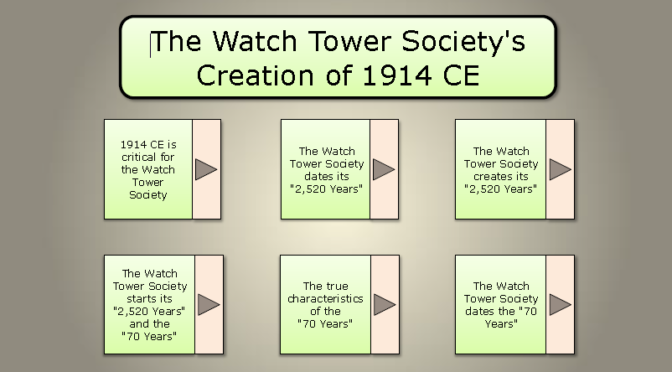
The Watch Tower’s Creation of 1914

Doug Mason has contributed another article. Actually, in this case it’s more of a presentation. And it’s 33 pages!

This one is perfect for those who wish to present the basic points of the 1914 “creation” to someone who needs a review of the basic points. Those of us who have had the doctrine repeated to us hundreds of times from several different angles, we sometimes forget a basic fact. It’s the basic fact that most JWs don’t accept 1914 because it’s simple; they accept it because they don’t understand it.

All those different perspectives on 1914: from Daniel 4 to the 70 years, to the “day for a year principle” to Nebuchadnezzar somehow representing Jehovah’s kings at Jerusalem, to the full desolation of Judea, etc. Yes, all these different angles only serve to confuse a lot of Witnesses, and they are won over through sheer bluster. By the time they have heard it often enough they pick up on some of the rationale, but it’s too late for them to see through it.

Yet, if they saw the whole thing presented at once, without feeling the weight of supposed complexity, a large audience of JWs might be able to just see through it.

We think this presentation helps, because it presents all the supposedly salient points in one sitting, only diverting from the presentation just long enough to show that there are several weak links to the Watch Tower’s arguments, but not spending so much time arguing against each weakness that we get sidetracked or bogged down.

So have a look! Enjoy!

http://i3a.ad0.mytemp.website/wp-content/uploads/2016/03/the_watch_tower_s_creation_of_1914_ce.pdf


Are We Living in a Special Time?

Are We Living in a Special Time?

by Tom Cabeen

A long-standing and very prominent Watchtower teaching is the belief that in 1914 a special period of time, which Jesus called thetom cabeen “Gentile Times” ended, the “last days” began, and Christ began to rule over the whole earth for the first time since his resurrection and ascension to heaven. Immediately prior to that time, they say, Jesus, in anticipation of his imminent reign, began inspecting the religious organizations of the world to see which one would be his official representative when he began to rule in 1914. He examined the teachings of all denominations on earth which claim to be Christian and decided that the most “faithful” one (meaning the one with the most correct interpretation of the Bible) was the small group of Charles Russell’s followers, later to be known as Jehovah’s Witnesses. As a result (according to Watchtower publications), shortly after 1914 Jesus committed all the interests of his kingdom into their hands, and they became his only approved channel of communication between God and mankind.

If they are correct, something very significant changed in 1914. Things would have to be different since 1914 than they were for the rest of the Christian era. If this proved to be true, that would add some credence to their claim that the Watchtower Society, with its origins in the nineteenth century, is the only Christian denomination which God approves. On the other hand, if the weight of scriptural and historical evidence does not support this conclusion, Watchtower claims are deeply suspect. The purpose of this article is to help clarify the implications of the Watchtower view.

Since its very origin, fundamental teachings of the Watchtower Society have been based on and intimately tied to the idea that serious Bible students can determine with reasonable accuracy the time of Christ’s return in glory, either through chronological calculations, observation of unique world events in the light of Bible prophecy, or by some other signs which would serve as reliable predictors of Christ’s imminent return or advent. Christians who believe this to be possible have been called “Adventists.”

First, let us examine the chronology which, according to Watchtower claims, establishes that 1914 marked the end of one special time period and the beginning of another.

Is Watchtower Chronology Sound?

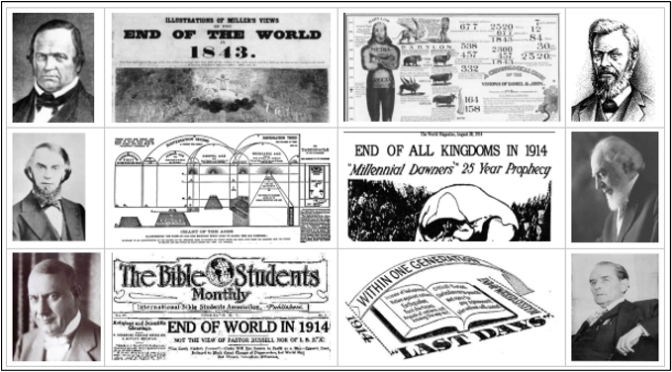
Charles T. Russell borrowed much of his chronology and methodology from the Second Adventists, which developed after William Miller’s failed attempt at predicting Christ’s return in 1843. The calculations are based largely on interpretations of passages in Daniel 4 and Luke 21. In brief, Witnesses teach that the “Gentile Times” is a special period of 2,520 years during which God’s kingdom (David’s dynasty specifically) had no king. They believe that this period began when Jerusalem was destroyed in pre-Christian times by Babylonian armies and that it ended in 1914. Considering the importance of the conclusions it supposedly supports, the chronology is based on a rather tenuous series of assumptions:

First, that the dream Nebuchadnezzar had about becoming a beast for “seven times” (recorded in Daniel 4) does not refer primarily to him (as stated directly in the text), but rather that he, a pagan king, not even a worshiper of Israel’s God, actually represents God’s kingdom.

Second, that God’s kingdom or rulership over mankind somehow “ended” when Zedekiah, David’s direct descendent, was removed from the throne of Jerusalem when it was destroyed by Babylon, and that the kingdom would “begin” again some twenty-five centuries later when Jesus, also David’s descendent, began to rule in 1914. The Jews expected a descendent of David to rule as king forever, but the concept of God’s kingdom or sovereignty “ending” at that time and “beginning” at some later date is never suggested in the Jewish sacred writings. In fact, this idea directly contradicts Daniel 4:17, which is connected to Nebuchadnezzar’s beastly experience!

Third, based on the first assumption, each “time” must represent a special “prophetic” year of 360 days, although no actual earthly year, solar or lunar, has 360 days.1 Seven of these 360-day prophetic years would add up to a total of 2,520 “prophetic” days.2 Each of these “prophetic” days in turn must represent a solar year of approximately 365¼ days. Absolutely nothing in Scripture, Jewish tradition, or the writings of early Christians even suggests that we may make this complicated series of assumptions and calculations.

Fourth, that this period of 2,520 solar years are identical to what Jesus referred to when he used the expression translated “the appointed times of the nations” or “the times of the Gentiles” in Luke 21:24 (“Jerusalem will be trampled on by the Gentiles until the times of the Gentiles are fulfilled…”), even though Jesus was specifically discussing the future destruction of Jerusalem by the Romans in 70 AD, not its past destruction by the Babylonians, and despite the fact that there is not a single word in Scripture, Jewish tradition or Christian writings that indicates that the “Gentile times” refer to any time period during which God’s eternal kingdom would be inactive.

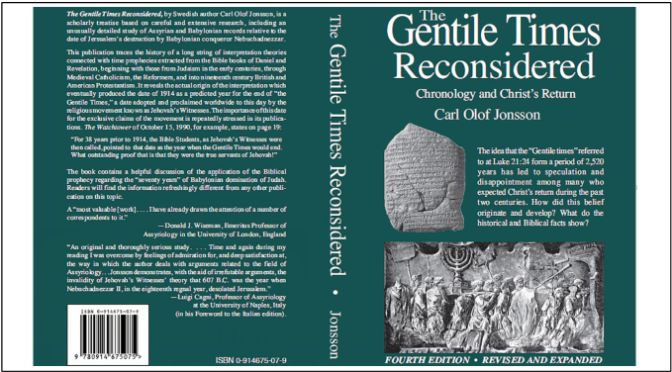
Fifth, that Jerusalem was destroyed by Nebuchadnezzar’s armies in 607 BC. The date for Jerusalem’s destruction is one of the most accurately fixed of ancient history. Even more significantly, the historical sources that establish the date for Babylon’s fall in 539 BC, (which date the Watchtower Society does accept and, in fact, which it uses as the starting point for its 1914 calculations) are exactly the same sources that establish 587/6 BC as the date for Jerusalem’s destruction! Several independent lines of evidence (historical, astronomical, archeological, etc.) point to the date of 587/6 BC, not 607 BC, as the date of Jerusalem’s destruction. There is no credible historical evidence which supports the 607 BC date. (See The Gentile Times Reconsidered, Carl Olof Jonsson, Commentary Press, 1998 for a detailed discussion of this topic.)

Sixth, that all the many passages in the Greek Scriptures that clearly state that Jesus began ruling in the first century, such as Matthew 28:18: “All authority in heaven and on earth has been given to me…” don’t really mean what they say. Below is a more extended discussion of the implications of this assumption.

Each of the six assumptions listed above are interrelated. The veracity of all of them together are absolutely critical to the Watchtower teaching that in 1914 the world entered a special time period known as “the time of the end” and that Jesus chose the Watchtower Society as God’s official channel of communication with his faithful people on earth. If any one of them is wrong, the final conclusion is completely invalid and the Watchtower claim is demonstrably false.

It is worth noting that Russell, using the same methodology, “proved” that he himself was living in a special time period, which he believed would end in 1914 with Christ’s return to judge the nations. He also admitted that if any one of the assumptions upon which he based his conclusions were wrong, it would invalidate both his entire approach and his conclusions. That did, in fact, happen. In time, nearly every one of his assumptions was rejected, and Russell’s ending date for the time of the end (1914) became the starting date for the same period in later (and current) Watchtower teaching.

When Did Jesus Begin to Reign?

If the Watchtower chronology is invalid and Jesus did not begin his reign in 1914, is he now reigning? If so, when did that reign start? Watchtower publications interpret Hebrews 1:13 (“Sit at my right hand until I make your enemies a footstool for your feet”) as follows:

“In 33 C.E., [Jesus] died, was resurrected, and ascended to heaven. … At that time, however, Jesus did not act as King and Judge over the nations. He was seated next to God, awaiting the time to act as King of God’s Kingdom. Paul wrote of him: “With reference to which one of the angels has he ever said: ‘Sit at my right hand, until I place your enemies as a stool for your feet’?” (Hebrews 1:13) Jehovah’s Witnesses have published much evidence that Jesus’ period of waiting expired in 1914, when he became ruler of God’s Kingdom in the invisible heavens.” —The Watchtower, 10/15/95, pg. 21, par. 14-16 (Emphasis added.)

Hebrews 10:12, 13 says: “But when this priest [Jesus] had offered for all time one sacrifice for sins, he sat down at the right hand of God. Since that time he waits for his enemies to be made his footstool.” If this were the only reference to Psalm 110 in the Christian Scriptures, and there was nothing else to indicate otherwise, this verse might indeed be interpreted to mean that the word “waits” in this passage refers to a period of non-rulership. This is exactly how the Watchtower Society interprets it:

“Even after Jesus’ resurrection and ascension to heaven, he had to wait at his Father’s right hand until the time came for him to rule as King over mankind. (Hebrews 10:12,13)” —The Watchtower, 6/15/94, pg. 6

But is this how the apostles and early Christians understood the expression “sit at my right hand”? No! Among ancient peoples, the imagery of a king sitting on the throne of his God was a common way to express that the king ruled with the approval and support of his God. This is consistent with how early Christians understood this phrase, as we shall see. 3

This is not the only place where this expression from Psalm 110 is quoted in the Christian Greek Scriptures. In fact, this passage from the Hebrew Scriptures is the one most often quoted in Christian Scripture. So we can examine all of its appearances to correctly establish how it was used and understood. The Watchtower interpretation that “sitting” means “waiting” is required by their chronology-based belief that Jesus could not begin his reign until 1914, as discussed above. But it is quite clear from many other places where this passage is quoted that the early Christians did not understand the passage to mean non-rulership. They understood “sitting at God’s right hand” to mean that Jesus was already ruling as king. Perhaps the clearest example of this is Paul’s citation of Psalm 110 in his first letter to the Corinthians while discussing the resurrection. In this passage, Paul actually substitutes the term “rule as king” for “sit at God’s right hand” right in the quotation:

Next, the end, when he hands over the kingdom to his God and Father, when he has brought to nothing all government and all authority and power. For he must rule as king until [God] has put all enemies under his feet. As the last enemy, death is to be brought to nothing. … But when all things will have been subjected to him, then the Son himself will also subject himself to the One who subjected all things to him, that God may be all things to everyone. —1 Cor 15:24-28 NWT (Emphasis added.)

It is clear from his use of the passage that Paul understood “placing all things under Christ’s feet” to mean rulership. Why should that not be the case, since after his resurrection, Jesus explicitly stated that he had been given “all authority in heaven and on earth.” When Jesus was born, the angel Gabriel said that he would be given the throne of David his forefather, and that he would reign forever. So it would be most natural for the apostles to understand his post-
resurrection words to mean that he was reigning as their king, even if the way in which his rulership would be expressed turned out to be different from what they expected. The psalmist’s statement that he was to reign in the midst of his enemies is consistent with the image of a ruler who sits down on his throne, at the right hand of his God, and continues his rule until all things are subject to his power. A great resurrection occurs at that time; thus death becomes the last enemy to be subject to him. Afterward, Paul writes, the Son subjects himself to God, the Father.

Many other passages show that the apostles and early disciples viewed Jesus as ruling as king in their day, several of which refer to Psalm 110. Here are but a few (all quoted from the New World Translation, 1971 ed.):

Matt 28:18-20: Jesus approached and spoke to them, saying: “All authority has been given me in heaven and on the earth. Go therefore and make disciples of people of all the nations, baptizing them in the name of the Father and of the Son and of the holy spirit, teaching them to observe all the things I have commanded YOU. And, look! I am with YOU all the days until the conclusion of the system of things.”

Mark 16:19: So, then, the Lord Jesus, after having spoken to them, was taken up to heaven and sat down at the right hand of God.

John 5:26, 27: For just as the Father has life in himself, so he has granted also to the Son to have life in himself. And he has given him authority to do judging, because Son of man he is.

John 17:1, 2: Jesus spoke these things, and, raising his eyes to heaven, he said: “Father, the hour has come; glorify your son, that your son may glorify you, according as you have given him authority over all flesh, that, as regards the whole [number] whom you have given him, he may give them everlasting life.

Col 2:9, 10: …it is in him that all the fullness of the divine quality dwells bodily. And so YOU are possessed of a fullness by means of him, who is the head of all government and authority.

Acts 17:6, 7: …they dragged Jason and certain brothers to the city rulers, crying out: “These men that have overturned the inhabited earth are present here also, and Jason has received them with hospitality. And all these [men] act in opposition to the decrees of Caesar, saying there is another king, Jesus.

Eph 1:18-23: It is according to the operation of the mightiness of his strength, with which he has operated in the case of the Christ when he raised him up from the dead and seated him at his right hand in the heavenly places, far above every government and authority and power and lordship and every name named, not only in this system of things, but also in that to come. He also subjected all things under his feet, and made him head over all things to the congregation, which is his body, the fullness of him who fills up all things in all.

Col 1: 12-14: … [The Father] delivered us from the authority of the darkness and transferred us into the kingdom of the Son of his love, by means of whom we have our release by ransom, the forgiveness of our sins.

1 Pet 3:21, 22: [Baptism] is also now saving YOU, … (not the putting away of the filth of the flesh, but the request made to God for a good conscience,) through the resurrection of Jesus Christ. He is at God’s right hand, for he went his way to heaven; and angels and authorities and powers were made subject to him.

Viewed in their context, these passages indicate clearly that early Christians believed Jesus was ruling, not waiting. The entire basis of their confidence in salvation and forgiveness of their sins was based on their understanding that they had a ruling high priest who could actively plead for them, that the glorified Jesus was in heaven, sitting at God’s right hand, that is, ruling with His Father’s full support, with full authority to act on their behalf.

Are We Living in the “Last Days?”

In addition to believing that Jesus was reigning, there is also no doubt that the first Christians believed they were living in the “last days.” Peter, on the occasion of the remarkable events of the first Pentecost after Jesus’ resurrection, quoted Joel’s prophecy as proof of that fact:

“This is what was said through the prophet Joel, ‘“And in the last days,” God says, “I shall pour out some of my spirit upon every sort of flesh.” —Acts 2:16,17

The expression “last days” here translates the Greek term eschatais hemerais, an expression used in the Greek translation of the Hebrew Scriptures and widely understood by Jews to refer to the Messianic era. (Isa 2:2; Hosea 3:5; Micah 4:1) The introduction of the inspired letter to the Hebrews reflects this perspective:

“God, who long ago spoke on many occasions and in many ways to our forefathers by means of the prophets, has at the end of these days spoken to us by means of a Son.”

The expression “at the end of these days” in the New World Translation here translates the same Greek words used by Peter at Pentecost (eschatais hemerais), but the expression is translated differently here, so its implications are not immediately apparent to any but the most diligent students.

Early Christians did not understand the expression “last days” in the same sense as we might say on a fine September day when we feel the first cool breezes of fall: “These are the last days of summer.” Jews generally believed that human history was divided into two great epochs: the “former days” or period before the Messiah appeared and the “latter days” or period after His appearance. Since Jesus’ first disciples, all Jews, accepted him as their Messiah, they believed that his appearance marked the beginning of the “latter days,” or Messianic era, in contrast with the “former days” before he appeared, and they supported that view by references to the Hebrew Scriptures.

The first Jewish Christians had to change their initial perspective on the nature of their Messiah and his rulership. They expected a political savior who would deliver them from subjection to Rome. Instead, Jesus delivered them from sin, death and the devil. His kingdom was quite real, but was no part of this world. They became part of it by accepting and obeying him as ruler. (Col 1:13) Jesus also revealed to them that he would leave and return again at an unexpected time. Many early disciples evidently thought the second coming would occur in their lifetime. But as more and more of those who had known Jesus personally, including the apostles, began to die (many as martyrs), and persecution against them intensified, they began to understand that the Messianic era was not to be a time of physical abundance and material blessing (as many Jewish teachers taught), but would instead be an extended time of tribulation, especially for Christians. Thus, it was appropriate for Paul to warn Timothy: “Know this, that in the last days critical times hard to deal with will be here.” (2 Tim 3:1) After describing the kind of people that would typify these difficult days, he told Timothy to “turn away” (“be turning yourself away” Kingdom Interlinear) from these people. Clearly he was not warning Timothy about events that would occur many centuries in the future. In Paul’s view, he and Timothy were living in the last days, that is, the Messianic or Christian era.

What about the “signs” which Jesus’ predicted?

Jehovah’s Witnesses believe that Jesus’ prophecy in Matthew 24 (and parallel passages in Mark 13 and Luke 21, sometimes called the “Olivet Discourse” or the “Eschatological Sermon,” from the Greek word for “final things”) describes a series of events which would happen at the time of Jesus’ parousia and serve as a sign that it had begun. The purpose of this document is not to present a detailed verse-by-verse consideration of these passages, but only to make a few relevant comments.

First, a brief explanation of the Watchtower understanding of the Greek word parousia in Matt. 24:3. The term is usually rendered “coming” or “arrival,” but it is translated “presence” in the New World Translation. Late in the nineteenth century, some disappointed Second Adventists, disciples of William Miller, who had expected Jesus to return in 1843, noticed that parousia was translated “presence” in the Emphatic Diaglott, a Greek/English interlinear translation prepared by Benjamin Wilson. Apparently impressed by Miller’s chronology enough that they did not want to give up that date, some of them came up with the idea that perhaps Jesus really did return in 1843 just as Miller had predicted, but that he had done so invisibly.

Russell incorporated their ideas into his own version of the “time of the end”. He saw Jesus’ parousia as a special 40-year period of invisible presence during which Russell’s followers, (then called International Bible Students; now known as Jehovah’s Witnesses) would be in a special relationship with him, after which they would be caught up in glory to heaven. Russell saw the events described in Matt 24:3-14 as proof that Jesus had already returned, invisibly.

If Jesus’ parousia was meant to be invisible, some sign might indeed be needed to show that it had begun. In that case, it would be strange for Jesus to choose things which would be in almost constant evidence during the entire Christian era as signs of some special period at its end. The difficulty that arises when one looks to these kind of things as signs is shown by the fact that Russell pointed to the events Matthew 24:6-14 (war, pestilence, famine, earthquakes, and others) as proof that Jesus’ paranoia started in 1874, and would end in 1914. Yet today Witnesses point to the same events to prove that the parousia started in 1914, when Jesus put them in charge of all his kingdom’s interests on earth.

The Greek word parousia, in its most common meaning, means bodily presence, but it can also refer to the visit of a royal person, which is consistent with Jesus’ own description of his second coming: “When the Son of Man comes in his glory, and all the angels with him, he will sit on his throne in heavenly glory. All the nations will be gathered before him, and he will separate the people one from another as a shepherd separates the sheep from the goats.” (Matt 25:31, 32) “The Lord himself will come down from heaven, with a loud command, with the voice of the archangel and with the trumpet call of God, and the dead in Christ will rise.”—1 Thess. 4:16

In Jesus’ day, many Jews believed that immediately prior to Messiah’s coming there would be a series of calamities. These “woes of the Messiah,” included wars, insurrections, pestilence, famine, earthquakes, and signs or portents from heaven. It is not unlikely that Jesus’ disciples had heard of these predictions. Since these events clearly did not appear before Jesus’ birth or baptism, when they heard him predict the destruction of the temple, they may have been asking, “Is this what we have been told to expect; the woes of the Messiah? Is the destruction of the temple part of that great time of calamity we expect to precede your coming in glory?” 4

If that was the intent of their question, Jesus’ answer was that disasters would definitely come, but they would not be a sign of his return. To the contrary, Jesus started his prophecy by warning them not to be misled. He added that when wars and rumors of wars happen, “see to it that you are not alarmed. Such things must happen, but the end is still to come.” (Matt 24:6) Other catastrophes would also appear. Even these would only be “the beginning of birth pains.” Rather than confirm that these things would be the immediate precursor to his return and their deliverance, Jesus warned them to expect an increase persecution and hatred by persons of all the nations, of a great rise in wickedness. He said that they would need endurance. His words did not point toward their imminent deliverance, but an extended period of tribulation. The events Jesus mentioned in Matt 24:3-14 have occurred often throughout the centuries since the days of the apostles. Periodically during those centuries, a small minority of Christians have tried to prove that Jesus’ return was imminent by pointing out the prevalence of war, earthquakes, famine, pestilence, and the like. They have been disappointed every time. 5 In fact, Jesus’ words have been undergoing fulfillment for nearly two thousand years, and the end is still in the future.

Jesus’ words may have been the disciples’ first inkling that the Messianic era would not be the time of great political peace and material prosperity they may have been led to expect by some Jewish teachers. Possibly they associated the destruction he spoke of with his return, and so they only asked one question, but Jesus’ reply encompassed two separate events: first, the destruction of the Jewish temple and second, Jesus’ return or parousia, both of which they may have thought would occur at the same time.

Jesus gave them specific instructions about what to do at the time of Jerusalem’s destruction. But at the same time, he warned them that events they might have considered to be signs of his parousia were not true signs at all, but false signs, expected by some Jews in connection with the glorious arrival of Messiah, but not relevant to Jesus’ second coming. It is very significant that, rather than giving them a sign which would appear some significant period of time, even years, in advance of his second coming, he instead repeatedly urged them to keep alert, on the watch. He compared his return to the visit of a thief in the night. Thieves do not provide any advance notice before they strike. —Matt 24:43, 44

Conclusion

To summarize, there are insurmountable problems with the Watchtower view. First, the idea that one can predict by any means when Christ would return is in direct contradiction to Jesus’ own clearly stated warning that he would return at a time that his disciples did not think it to be. The idea of any kind of sign which would give advance warning of Jesus’ return completely contradicts what he clearly said on numerous occasions, that his parousia would be both sudden and unexpected: “Be on guard! Be alert! You do not know when that time will come.” (Mark 13:33) If we take him at his word, Jesus’ discourse on the Mount of Olives do not provide a way to predict either an invisible presence or his imminent second coming.

Second, the concept of Jesus’ parousia as an invisible event cannot be reconciled with His words: “Look! I am with you always, until the conclusion of the system of things” (Matt 28:19 ) which clearly show that Jesus would always be invisibly present with his disciples. It also directly contradicts Rev 1:7, which says “Look, he is coming with the clouds, and every eye will see him, even those who pierced him; and all the peoples of the earth will mourn because of him.” This clearly teaches that Jesus’ parousia would be anything but invisible.

Third, if we remain true to the original and most direct sense of Scripture, we must conclude that Jesus began ruling in the first century, and that all Christians who lived from the first century until now have been living in the last days, that is, the Messianic era. Both biblical and historical evidence show that Jesus Christ began to reign in the first century, and that his reign has continued, “in the midst of his enemies.” That being so, we must also conclude that the situation that has existed among persons claiming to be Christians is what Jesus expected, and that the way things have developed is in harmony with his sovereign will as king over heaven and earth. Any group which began during any of the centuries following the apostolic age can make no serious claim to being Jesus’ true church.

We have no reason to conclude that Jesus abandoned his followers to his enemy the devil at the end of the apostolic period, as Russell believed and taught. There is also no basis to conclude that near the end of the first century, things somehow got out of Jesus’ control and the whole body of Christ became so corrupt that they lost their standing as the true Church he founded. If Jesus has “all authority in heaven and on earth” and he sent his disciples out to preach and teach on that basis, we must conclude that there have been true followers of Christ all down through the centuries since Jesus walked the earth. If one looks for and honestly examines the available historical evidence, one may see that the Church Jesus founded in the first century has remained in existence continuously ever since.

_____________________

1 The Aramaic word Daniel used here for “time” just means an unspecified period, not always a year. (The word for year, as in Daniel 1:1, is different.) The word used here is `idd’n, which, according to the Theological Wordbook of the Old Testament, means “ time, period, span , year, era. … Two basic meanings are equally a “point in time” or a “span of time.” In this context, a “time” could easily mean a week, a month or a season, not necessarily a year.

2 A reader pointed out that Revelation 11:2-3 relates “times” to days in a different way: “But as for the courtyard that is outside the temple [sanctuary], cast it clear out and do not measure it, because it has been given to the nations, and they will trample the holy city underfoot for forty-two months. And I will cause my two witnesses to prophesy a thousand two hundred and sixty days dressed in sackcloth.” (NWT) Here the wording is quite similar to that in Luke 21:24: (“Jerusalem will be trampled on by the nations”). The Greek word for “trample” is the same in both passages, and both speak of Jerusalem, the “holy city.” This text describes a period of “trampling” lasting forty-two months or 1,260 days rather than 2,520!

3 See The Gentile Times Reconsidered, 3rd Ed. , Carl Olof Jonsson, Commentary Press, 1998, pg 264-270.

4 For details, see articles by M. Brunec, S.B.D., C.D.B., published by the Pontifical Biblical Institute in successive fascicles of Volumes 30 and 31 of Verbum Domini. This article was also given to me by Ray Franz.

5 An excellent consideration of this entire subject is found in Doomsday Delusions, © 1995 by C. Marvin Pate and Calvin B. Haines, Jr., InterVarsity Press

Entire contents ©2005 Thomas W. Cabeen
An Alternative Conversation With A Neighbor, Part Deux – Watchtower, November 2014

Contributed by Ann O’Maly. (Who also contributed Part 1, here)

The second contrived and unrealistic conversation that one of Jehovah’s Witnesses imagined having with a neighbor in the November 2014 Watchtower will not be reproduced here. Instead let us imagine that the other Witness named Andre (sorry, I meant) Cameron has returned to the home of the other man also named Jon.

NEBUCHADNEZZAR’S DREAM – A TORTUOUS RECAP

Cameron: Hi there, neighbor!

Jon: Whoa! How the heck did you get in the house?

Cameron: Your wife let me in so …

Jon: MABEL! CALL THE COPS!

Cameron: Mabel cannot hear you. She’s sedated and locked in the closet.

Jon: *Reaches for the phone*

Cameron: It’s no use, Jon. I cut the cable. I so enjoyed our last conversation. Why not settle down and we can continue it in a civilized fashion?

Jon: *Gulp*

Cameron: Last time, we talked about why Jehovah’s Witnesses say that God’s Kingdom began ruling in 1914.*

* See, AN ALTERNATIVE CONVERSATION WITH A NEIGHBOR – Watchtower, October 2014

As we discussed, we find a key piece of evidence in a prophecy in chapter 4 of the Bible book of Daniel. Do you recall what is recorded there?

Jon: Yes.

Cameron: And? … What is recorded there?

Jon: Ah c’mon, you’re not starting that whole ‘treating me like a moron’ routine again, are you?

Cameron: Play the game, Jon. If necessary I’ll use this duct tape to secure you to the chair until we’re done. I’m short on my hours this month.

Jon: *Muttering*

Cameron: Pardon me?

Jon: Urrg. It was King Nebuchadnezzar’s dream about a big tree, OK?

Cameron: That’s better, and well done you! *Pats Jon on the head* In his dream, Nebuchadnezzar saw an immense tree that reached clear to heaven. He heard a messenger of God command that the tree be cut down, but its stump and roots were to be left in the ground. …

Jon: I know. I’ve read it. You went over this the last time, remember?

Cameron: We’re going to do this my way, OK? After a period of “seven times,” the tree would grow again.*

* We assume you, dear reader, have the attention span of a fruit fly and cannot find the reference to “seven times” even though a few lines up we already mentioned which Bible book and chapter we were talking about. So see Daniel 4:23-25.

We also discussed why the prophecy has two fulfillments. Do you remember what the initial fulfillment was?

Jon: Yes. Yes I do.

Cameron: *Scowls then glances at the duct tape*

Jon: OK, OK. Nebuchadnezzar lost his sanity for a period of ‘seven years’* …

* Jon actually said ‘seven times,’ but we substituted ‘years’ anyway. We’re hoping you don’t notice the continuity problem in the conversation later.

Cameron: Precisely. Nebuchadnezzar temporarily lost his sanity, so his rulership was interrupted. But in the fabricated larger fulfillment of the prophecy, God’s rulership would in a way be interrupted for a period of seven times …

Jon: *Interjecting*… although, if I had to choose between crazies I’d rather talk with right now, I’d choose ol’ dribbling, grass-eating Nebby-boy.

Cameron: … which we established were seven years.

Jon: We did?

Cameron: As we saw, the seven times began when Jerusalem was destroyed in 607 B.C.E.

Jon: 587 B.C.E.

Cameron: That’s right – 607. From then on, there were no more kings on earth who represented Jehovah God in ruling his people. However, at the end of the seven times, God would appoint a new Ruler over his people—someone in heaven. In other words, the end of the seven times would mark the start of the rulership of God’s heavenly Kingdom. Now, we already discussed when the seven times started. So if we can determine how long they lasted, then we will know when God’s Kingdom began ruling. Are you with me so far?

Jon: Sure. Nebuchadnezzar’s rule, which was at enmity with and cruelly oppressed God’s people, and which was taken away by God, symbolically represents God’s righteous rule over his people whose rule was taken away by … God … and then restored by … God … so … that he … would know … um … that God is ruler.

Cameron: Great. Let’s now consider the length of the seven times. I’ve just finished reading up on this subject to remind myself of all the eisegetical hops, skips and jumps it takes to get the desired result. I’ll try to befuddle you as well as I can.

JON WISHES FOR THE END – CAMERON IS ONLY JUST BEGINNING

Cameron: In the prophecy’s initial fulfillment involving Nebuchadnezzar, the seven times were evidently seven literal years. …

Jon: ‘Evidently’? How is it evident?

Cameron: It’s obvious.

Jon: Not to me. Explain.

Cameron: *Mumbles* … ‘iddan’ … Revelation … 3½ times … *snuffles* 

Jon: Revelation? What’s Revelation got to do with …? I’m sorry, I can’t … . Speak up.

Cameron: … 1,260 days x 2 … *stammers* … years.

Jon: What?

Cameron: In the larger fulfillment we threw together involving God’s Kingdom, the seven times must be much longer than seven literal years.

Jon: Huh? Why must they?

Cameron: B-b-because they must! Recall that the seven times began when Jerusalem was destroyed in 587 B.C.E. …

Jon: 607 B.C.E.

Cameron: That’s right – 587. If we start counting from 587 B.C.E., seven literal years would take us to … HEY, HEY, what are you trying to pull! It’s 607 B.C.E! If we start counting from 607 B.C.E., seven literal years would take us to the year 600 B.C.E. But we can’t tie anything of significance, no matter how tenuous, to that year with regard to God’s rulership. So we have to think up something longer range than literal years.

Jon: But you’ve been harping on about how the seven times are seven literal years! How long are you saying they are now?

Cameron: As we considered before, centuries later when Jesus was here on earth, he indicated that the seven times had not yet ended.

Jon: Jesus doesn’t indicate anything about any ‘seven times.’ He doesn’t even mention them.

Cameron: Pretend he does. So this period of ‘seven times’ from 607 B.C.E … *mumbles* … Revelation … pyramids … 3½ times … *snuffles* … 1,260 days x 2 … *stammers* … Ezekiel … ‘a day for a year’ … *murmur* … Lackawanna Railroad … 2,520 years … *coughs* ends 1914 which is the start of Jesus’ rule as King of God’s Kingdom.

Jon: Huh?

Cameron: But don’t worry your confused little head too much about the number jiggery-pokery because, if you are still unconvinced, we can point to how major world events – events that the Bible foretold for the last days – have happened only since 1914.

Jon: Like what?

Cameron: Jesus said at Matthew 24:7, concerning the time when he would start ruling in heaven: “Nation will rise against nation and kingdom against kingdom, and there will be food shortages and earthquakes in one place after another.” Notice that Jesus foretold food shortages and earthquakes during that time period. Our world has certainly seen a lot of that kind of trouble in the past century, hasn’t it?

Jon: It’s seen a lot of that kind of trouble in every century.

Cameron: Ahh no, see, there was never a world war before, was there? That trumps all the other wars. Do you recall when the first world war broke out?

Jon: 1754.

Cameron: Well done y… Wait. What?

Jon: 1754 to 1763. In 1756 Europe was drawn in and then it became known as the Seven Years War.

Cameron: *Chuckling* Don’t be silly. The first world war was 1914.

Jon: Not according to many historians. Check it out.

Cameron: *Laughing* Why, the Seven Years War doesn’t even have the words ‘first’ and ‘world’ in its title! No, Jon. The first world war was in 1914. 1754 doesn’t fit with our imaginary fulfillments. You see, when we cobble together all these disjointed pieces – the prophecy about the seven times as well as other Bible prophecies concerning the time of the end – it really does a mind job. Jehovah’s Witnesses are convinced that Jesus began ruling as King of God’s Kingdom in 1914 and that the last days began in the same year,* and we are simply not going to budge from that illusion.

* See chapter 9 of the book Our Current Spin On What the Bible Teaches for descriptions of undesirable human behavior from the apostle Paul’s day and a collection of cherry-picked statistics to convince you that things are really, really bad now, as well as digging up unverifiable invisible events and JW accomplishments to prove we’re definitely living in the last milliseconds of the last seconds of the last minutes of the last days.

Jon: Yeah, it explains why you’re not wrapped too tight!

Cameron: It’s perfectly understandable. As I mentioned before, it took me a while and many indoctrination sessions to see it. But at the very least, I hope our discussion has helped you to see that even though the year 1914 isn’t specifically mentioned in the Bible, it doesn’t prevent Jehovah’s Witnesses from constructing some specious scriptural links.

Jon: Yes, as I said last time (I’m strangely getting déjà vu here), I’ve always been ‘impressed’ with this about you. I guess that is why this is all so mind-bendingly complicated.

Cameron: The more we talk, the more you’ll understand it our way.

*Distant thumping and muffled sounds*

Jon: Um … what’s that?

Cameron: That will be your wife coming around from her sedation and trying to get out of the closet … which is my cue to go. I’ll be back. I may return your lawnmower next time.

Jon: Keep it. (Mabel and I really should emigrate …)


Do you have a particular Bible subject that you have wondered about? Are you curious about any of the beliefs or religious practices of Jehovah’s Witnesses? If so, think twice about asking your Jehovah’s Witness neighbor. Instead visit jwfacts.com.

Analysis of the 1914 Teaching – Biblical, Secular, Historical

See also:

The article below was contributed by Alan Feuerbacher and contains links to numerous additional web resources throughout, especially in its Appendix. Click here for full width. Also in PDF format: evidence_against_wts_chronolog.pdf.

Biblical Evidence Against Watchtower Society Chronology

Among the Watchtower Society’s fundamental doctrines are those concerning 1914. They are the basis for its leaders’ claim to spiritual authority over the community of Jehovah’s Witnesses. This essay briefly examines the biblical evidence, with a bit of secular support, as to why the Society’s 1914 chronology is wrong.

The Society teaches that in 1914, at the end of the “gentile times” (a.k.a. “appointed times of the nations”; Luke 21:24) Christ returned invisibly (Matt. 24:3) and was given the Messianic Kingdom. It claims that the “last days” (Acts 2:17; 2 Tim. 3:1; 2 Pet. 3:3; etc.) began, the “conclusion of the system of things” began, a great harvest work of true Christians began, and that between 1914 and 1919 a time of “spiritual inspection” by the returned Jesus occurred. It teaches that by 1919 the “true Christian congregation” had been restored, in 1919 the “faithful and discreet slave” was appointed over all Jesus’ “domestics” (Matt. 24:45), and that in 1919 “false religion” (a.k.a. “Babylon the Great”; Rev. 14:8) fell. These doctrines were crucial to its claim throughout the 20th century that in 1919 all “anointed Christians” were appointed as “the faithful and discreet slave over all Christ’s belongings” on earth (the Society changed this teaching in the July 15, 2013 edition of The Watchtower).

From 1876, the phrase “gentile times” and the 1914 date were doctrinal anchors for the Society’s founder C. T. Russell, and have been so for the followers of the organization ever since. 1914 remains the key date in Watchtower “end times” teaching even though the Society has revised or abandoned most of its early claims about 1914.

In 1879 C. T. Russell began publishing what became The Watchtower magazine and therein promoted the 1914 date. Even earlier, in 1876, he published an article in the small religious journal The Bible Examiner that advocated the 1914 date as the end of the gentile times. Russell borrowed these ideas from Nelson Barbour, a semi-independent “Second Adventist” who originated the combination of the 1914 and gentile times ideas in the June, 1875 issue of his magazine Herald of the Morning.

The 1914 date is determined as follows (cf. w14 10/1 p. 10; “When Did God’s Kingdom Begin Ruling? (Part 1)”). The Society interprets the dream of Babylonian King Nebuchadnezzar described in Daniel 4 about a great tree in the center of the earth to mean that God’s direct rule over humans was interrupted, but would be restored after “seven times” had passed. The interruption is said to have begun in 607 BCE with the destruction of Jerusalem, and to have ended in 1914. Luke 21:24 is interpreted to mean that God’s rule, represented by Jerusalem, corresponds to this period, which is called “the appointed times of the nations” or “the gentile times.” The Society calculates the length as 2,520 years, based on Daniel’s statement that Nebuchadnezzar was mad for “seven times”, plus a statement in Revelation 12 that three and a half times equal 1,260 days. Then it applies a so-called “day for a year” principle. So 1,260 days (3 ½ times) x 2 = 2,520 days. A day for a year makes 2,520 years. 2,520 years forward from 607 BCE gets to 1914 CE (no zero year).

The Society derives the year 607 by beginning with the universally accepted date of 539 BCE for the conquest of the city of Babylon by the Persian king Cyrus the Great and noting that in his first regnal year he issued a decree that allowed the Jews to return to Judah. It then assumes that the Jews returned to Judah in the autumn of 537 BCE. Then the Society concludes that “the 70 years” Jeremiah spoke of (Jer. 25: 11, 12; 29:10) are a period of desolation of the land of Judah and exile and captivity of the Jews, and that this period ended when the Jews returned to Judah in 537. Working backward 70 years arrives at 607 BCE, when the destruction of Jerusalem caused the desolation of Judah to begin.

Of course, secular history—backed up by the Bible itself—shows that Jerusalem was destroyed in 587 BCE. So the Watchtower Society and its apologists go to great lengths to discount the secular evidence and to interpret the Bible according to Watchtower tradition. This essay outlines the biblical evidence that shows why Watchtower tradition is wrong. References in the appendix detail the voluminous evidence against Watchtower tradition, including secular, as do references to some excellent online resources.

Obviously, the 1914 date rests on a chain of questionable assumptions. Dubious scriptural interpretations such as equating the gentile times of Luke 21:24 to the seven times of Nebuchadnezzar’s madness, and so forth, do not lend themselves to objective resolution, so this essay will not consider them. Rather, it will examine the Watchtower’s claims about various dates and time periods derived from biblical passages that are capable of scholarly, objective resolution.

Watchtower chronology has multiple problems, many of which individually are fatal to the chronology as a whole and which, taken together, show unassailably that this chronology is wrong. Experience has shown that neither the Society nor its apologists can honestly address these problems. In many cases they simply ignore them.

This summary is in no sense a complete treatise on all the reasons Watchtower chronology is wrong. There are many excellent online resources for the interested reader, as well as the print copy of Carl Olof Jonsson’s book The Gentile Times Reconsidered. See the appendix for a list.

The 607 BCE Date for Jerusalem’s Destruction Has No Biblical Support

(1) There is no good evidence that 537 BCE was the year the Jews returned to Judah. The Society says only that “evidently” (All Scripture, p. 85) or “likely” (Insight, V. 1, p. 568) or “doubtless” (w64 2/1 p. 80) this was the date but supplies no evidence. In most discussions it simply glosses over the lack of evidence (cf. w11 10/1 p. 28).

(2) The synchronism between Josephus and the book of Ezra is solid evidence that the Jews returned to Judah in 538 BCE. Both refer to the laying of the temple foundations about half a year after the Jews were settled in their cities in the month of Tishri (autumn). Ezra gives only a relative date in Jewish terms, while Josephus gives a date in terms of the years of Cyrus’ reign, which is solidly established. This date is in the spring of 537 BCE; hence the Jews must have returned half a year earlier, in the autumn of 538. See the diagram below, and the appendix for an extended discussion.

Note that the Jews used a secular calendar beginning with the seventh month Tishri (Sep/Oct), and a religious calendar beginning with the first month Nisan (Mar/Apr). The Babylonian calendar began in Nisan.

Ezra 1 states that Cyrus, in his first year (using the accession-year system), decreed that the Jews could return to Judah. Cyrus’ first year was Nisan, 538 BCE through Adar, 537 BCE. Ezra 3:1-7 states that by the seventh month Tishri, the Jews were settled in their cities, and at that time they gathered in Jerusalem to initiate the rebuilding of the temple. So the year that ended immediately before Tishri was the first year of the Jews’ coming home, and the new year beginning in Tishri was the second year.

Ezra 3:8, 10 states that the temple foundations were laid in the second month of that second year. In Against Apion I,21, Josephus states that “in the second year of the reign of Cyrus [the temple’s] foundations were laid.” Therefore, this second Jewish year overlaps with the second year of Cyrus. Since Cyrus’ second year began in Nisan, 537 BCE, the second month was also in 537, and the first year of the Jews’ return was in 538 BCE—not 537 as the Watchtower claims.

The following diagram illustrates the above concepts.

alanchart

(3) Given (1) and (2), Watchtower chronology has no evidential foundation; on the contrary the available evidence is against it. If the Jews returned in 538, the Society’s 607 date is wrong and so is Watchtower chronology. If 607 is wrong, 1914 is wrong. If 1914 is wrong, Watchtower eschatology is wrong, and so are all the doctrines based on it.

(4) Linguistic, contextual and historical biblical facts show that Jeremiah predicted that Judah and the nations around it would, as a group, serve Nebuchadnezzar’s dynasty for 70 years (Jer. 25:8-12; 27:6-7). The key passage is Jer. 25:11: “These nations will have to serve the king of Babylon seventy years.” The Bible and secular history show that Judah and various nations individually served less than 70 years, depending on when they were first conquered and how one measures “serving.” God, through Jeremiah and other prophets, gave each nation the choice whether to serve on their own land or in exile (Jer. 27:7-11, 17; 40:9-10). To serve in their own land they had to submit to Nebuchadnezzar. The Jews under various kings refused; hence they were taken into exile at various times from 605/4 through 582 BCE (Dan 1:1-2; Jer. 52:28-30). Thus there was no 70-year exile or captivity or desolation of Judah.

(5) The 70 years of Babylonian supremacy ended in 539 BCE when Jehovah “called to account” against, or punished, Nebuchadnezzar’s dynasty (Jer. 25:12) by allowing the Medo-Persian empire under Cyrus to conquer Babylon and put an end to Nebuchadnezzar’s dynasty. This is directly stated in Daniel 5, where verses 28-30 say: “Your kingdom has been divided and given to the Medes and the Persians… in that very night Belshazzar the Chaldean king was killed.” In contrast, the Society claims that Nebuchadnezzar’s dynasty was called to account two years after its demise, when the Persians freed the Jews to return home (w79 9/15 pp. 23-24; g 5/13 p. 13), but this is ridiculous. You cannot punish a dynasty that no longer exists.

(6) 2 Chronicles 36:20 states that Nebuchadnezzar’s minions carried off Jews to Babylon, and these Jews remained servants to Nebuchadnezzar’s dynasty until the Persians under Cyrus took over, after which they were servants to Cyrus and his minions until Cyrus let them return to Judah. This confirms again that the 70 years were a time of Babylonian supremacy, not the term of the desolation of Judah. That desolation occurred during the 70 years. This is consistent with Jer. 25:8, 11, 12 which states that the Jews and nations round about would be servants to “Nebuchadnezzar and his sons” until God called them to account.

(7) Because Jeremiah spoke of Jerusalem being devastated or ruined (Hebrew chorbah; Jer. 25:18) shortly after Nebuchadnezzar conquered it in 605 BCE, the devastation of Judah began at that time. Even if the interpretation of that passage is disputed, the Hebrew word chorbah basically means “ruined” but does not specify in what sense something is ruined. It might be absolute, or relative. It might mean ruined in the sense of no longer being pristine, such as a city conquered by a foreign invader but not necessarily razed to the ground; the Bible often uses the word in this sense.

(8) Because Jews were taken into exile in 605/4, 597, 587 and 582 BCE, and released in 538, there was not a single period of exile or captivity. Therefore it is wrong to speak of a 70-year exile or captivity. Similarly it is wrong to speak of a 70-year desolation of Judah, because Jerusalem was ruined (chorbah) in a relative sense from the Jewish point of view when Nebuchadnezzar first took a few captives (including Daniel) in 605/4 BCE, and in a complete sense after most of the Jews left the land between 587 and 582 BCE.

(9) In the New World Translation Jer. 29:10 reads: “For this is what Jehovah says, ‘When 70 years at Babylon (Hebrew le-babel) are fulfilled, I will turn my attention to you, and I will make good my promise by bringing you back to this place.’ ” It has been demonstrated conclusively, in various publications, that in context, the phrase le-babel should be translated “for Babylon” not “at Babylon.” The latter is a mistranslation based on the King James Version. The Watchtower Society has laid great stress on its translation (cf. Appendix to chapter 14 in the 1981 book “Let Your Kingdom Come”) to make its claim that Jeremiah’s 70 years were a time of exile of the Jews (however, see w11 10/1 p. 27, where the correct translation is acknowledged but then ignored). Yet the translation issue, plus many other considerations, show that the Jews as a group were not in exile at Babylon for 70 years, but that various contingents were in exile for between 44 and 69 years.

(10) A careful consideration of Watchtower apologists’ (like Rolf Furuli) favorite scriptures to misinterpret, namely Daniel 9:2 and 2 Chronicles 36:21, shows that the passages are ambiguous about exactly what they mean with respect to 70 years. Because they are ambiguous, other scriptures and pieces of information that are not ambiguous must be used to determine what they mean, and when this is done the ambiguity is resolved. Watchtower apologists get this completely backwards. Following Russell and his spiritual forebears, they begin by interpreting the ambiguous passages in accord with Watchtower tradition, and then twist the meaning of the unambiguous ones to fit the tradition.

The above points prove that the Bible does not support the Society’s anchor date for the 1914 chronology—607 BCE—as the date of Jerusalem’s destruction. Rather, as scholars agree, Jerusalem was destroyed in 587 BCE (some say 586, but the discrepancy is due to ambiguity in the Bible itself, and can be resolved in favor of 587; see the appendix for references). Therefore Watchtower chronology is wrong, as is every doctrine based on it.


Appendix


References

A great deal of material has been published in print and online that disproves the Watchtower Society’s 1914 chronology. Below are listed some of these references.

The most comprehensive look at the secular evidence, with much biblical commentary, is The Gentile Times Reconsidered (Carl Olof Jonsson, Fourth Edition, Commentary Press, Atlanta, 2004). Much of this book is available online:

http://kristenfrihet.se/english/gtr4/contents.htm

Jonsson’s extensive writings on Watchtower chronology are available online:

http://kristenfrihet.se/english/epage.htm

A summary of biblical and secular evidence can be found in Jack Finegan’s Handbook of Biblical Chronology: Principles of Time Reckoning in the Ancient World and Problems of Chronology in the Bible (Revised Edition, Hendrickson Publishers, 1998).

A classic work on biblical chronology is Edwin R. Thiele’s The Mysterious Numbers of the Hebrew Kings (New Revised Edition, Kregel Publications, Grand Rapids, Michigan, 1994; Zondervan Publishing House, 1983; various editions back to 1951).

A comprehensive debunking of the Society’s scriptural claims, along with some secular material, is available at “Jeffro’s 607 pages.” This includes detailed debunkings of recent Watchtower articles:

http://jeffro77.wordpress.com/

Scholar Rodger Young gives proof of 587 BCE as the date of Jerusalem’s destruction:

http://www.galaxie.com/article/jets47-1-03

http://www.rcyoung.org/articles/jerusalem.pdf

http://www.rcyoung.org/papers.html

Seventh-Day Adventist scholar Ross E. Winkle offers these articles:

“Jeremiah’s Seventy Years For Babylon: A Reassessment. Part I: The Scriptural Data”:

http://www.auss.info/auss_publication_file.php?pub_id=755

“Jeremiah’s Seventy Years For Babylon: A Reassessment. Part II: The Historical Data”:

http://www.auss.info/auss_publication_file.php?pub_id=762&journal=1&type=pdf

Another look at the scriptural and secular evidence against Watchtower chronology is the article “Notes on the Gentile Times and 1914”:

http://corior.blogspot.com/2006/02/part-1-summary.html

Another debunking is: “Refutation of Appendix in Let Your Kingdom Come”:

http://corior.blogspot.com/2006/02/refutation-of-appendix-in-let-your.html

C. T. Russell originally used 606 BCE rather than 607 as the date of Jerusalem’s destruction and the beginning of the gentile times. While the latter date was known to Russell and his followers to be correct (in terms of Watchtower Society interpretations) as early as 1904, and was used in a handful of Watchtower and related publications after that, it was only in 1943 that the Society officially changed the date of the start of the gentile times, and in 1944 that it changed the date of Jerusalem’s destruction, to 607. Critics of the Society will not be surprised to find out-and-out lies at the heart of the change, shown in this article that examines the details of how the Society changed the dates, “The Evolution of 606 to 607 B.C.E. in Watchtower Chronology”:

http://corior.blogspot.com/2006/02/evolution-of-606-to-607-bce-in.html

The Society has produced much material claiming that the signs of the times prove the world has been in the last days since 1914. These claims are thoroughly debunked in the book The Sign of the Last Days—When? (Carl Olof Jonsson and Wolfgang Herbst, Commentary Press, Atlanta, 1987).

“The Watchtower Society and the End of the World” is a look at the Society’s extensive false predictions and distortions of biblical and secular evidence concerning its chronology:

http://corior.blogspot.com/2006/02/part-1-why-so-many-false-alarms.html

Josephus and Ezra Prove the Jews Returned in 538 Not 537 BCE

A synchronism between Josephus and the book of Ezra provides strong evidence that the Jews returned to Judah in 538 BCE. Both refer to the laying of the temple foundations about half a year after the Jews were settled in their cities in the month of Tishri (autumn). Ezra gives only a relative date in Jewish terms, while Josephus gives a date in terms of the years of Cyrus’ reign, which is solidly established. This date is in the spring of 537 BCE; hence the Jews must have returned half a year earlier, in the autumn of 538. Below are the details. The following diagram illustrates the concepts.

alanchart

Ezra 1 states that Cyrus, in his first year (using the accession-year system of dating kings’ reigns), decreed that the Jews could return to Judah. Cyrus’ first year was Nisan (Mar/Apr), 538 BCE through Adar (Feb/Mar), 537 BCE. The Bible does not say exactly when he issued this decree.

Ezra 3:1-7 states that by the seventh Jewish month Tishri (Sep/Oct), the Jews were settled in their cities, and at that time they gathered in Jerusalem to offer sacrifices and collect money for the rebuilding of the temple. From this we deduce that, whatever modern calendar year this was, the Jews returned in the preceding Jewish year, since the secular Jewish year began in Tishri (keep in mind that the sacred Jewish calendar began six months offset from Tishri, in Nisan, and the Jewish months were numbered beginning with Nisan). In other words, the year in which the Jews returned was the first year of their coming home, and the new year beginning in the Tishri mentioned in Ezra 3:1 was the second year of their coming home.

Ezra 3:8, 10 states that a little later in that second year the Temple foundations were laid (NASB):

8 Now in the second year of their coming to the house of God at Jerusalem, in the second month, Zerubbabel the son of Shealtiel and Jeshua the son of Jozadak and the rest of their brothers the priests and the Levites, and all who came from the captivity to Jerusalem, began the work and appointed the Levites from twenty years and older to oversee the work of the house of the LORD.

10 Now when the builders had laid the foundation of the temple of the LORD, the priests stood in their apparel with trumpets, and the Levites, the sons of Asaph, with cymbals, to praise the LORD according to the directions of King David of Israel.

The crucial piece of information here is that the Temple foundations were laid in the second month (Iyyar; Apr/May) of the same year in which the Jews gathered in Jerusalem immediately after they returned to Judah.

The Bible does not explicitly relate these events to any event that can be firmly dated to our modern calendar. However, a careful examination of historical data indicates that it was Cyrus’ general practice to free captives from the nations he conquered shortly after he secured his authority. Since he captured Babylon in October, 539 BCE, and the inhabitants would have known of his general practice, they would have expected him soon to begin freeing Babylonian captives, including the Jews. It is a good bet that, for political purposes, Cyrus would have done this around the time of celebrating the beginning of his first regnal year. If the books of Daniel and Jeremiah contain valid historical information about the fall of Babylon (Dan. 9:1, 2; Jer. 29:10), the Jews would have anticipated being freed soon after Cyrus entered the city in late October, 539 BCE.

A careful reading of Ezra 1-3 indicates that there might have been very little delay between the issuing of Cyrus’ decree and the departure of the Jewish captives for Judah. Because Cyrus’ first regnal year began in Nisan, and the Jews arrived by Tishri, if this all occurred in 538 BCE, there would have been at most six months for the Jews to complete their preparations and journey, and get settled in Judah. Since the trip takes about three to four months for a normal caravan, there is just enough time for these events to happen in 538 BCE.

Based on its tradition, the Watchtower Society speculates that Cyrus issued his decree sometime in late 538 or early 537 BCE, still in his first regnal year. It then claims that the Jews journeyed back to Judah in 537 BCE.

How then, can one decide whether the Jews returned in 538 or 537?

Josephus provides the tie breaker.

In Against Apion I,21, Josephus states:

These accounts agree with the true histories in our books; for in them it is written that Nebuchadnezzar, in the eighteenth year of his reign, laid our temple desolate, and so it lay in that state of obscurity for fifty years; but that in the second year of the reign of Cyrus its foundations were laid, and it was finished again in the second year of Darius.

The crucial piece of information is that the temple foundations were laid in the second regnal year of Cyrus.

Combining this with the information from Ezra that the temple foundations were laid in the second month (Iyyar) of the second year of the Jews’ return to Judah, we must conclude that this second year corresponds with the second year of Cyrus. Since Cyrus’ second year began in Nisan, 537 BCE and Iyyar was the second month of that regnal year, the first year of the Jews’ return was 538 BCE. This also works if one uses Tishri dating for Cyrus’ reign, as some might argue that Josephus did.

In other words, Josephus, with Ezra as a starting point, has provided the crucial information to determine that 538 and not 537 BCE was the year of the return of the Jews to Judah.

An Alternative Conversation With A Neighbor – Watchtower, October 2014

Contributed by Ann O’Maly
The contrived and unrealistic conversation that one of Jehovah’s Witnesses imagined having with a neighbor in the October 2014 Watchtower will not be reproduced here. Instead let us imagine another conversation another Witness named Andre (ahem, sorry) Cameron has at the home of another man who is also named Jon.
“KEEP SEARCHING” FOR A SUCKER

Cameron: Jon, I’ve really enjoyed the regular discussions we’ve been having about the Bible.* The last time we spoke, you raised a question about God’s Kingdom. You asked why Jehovah’s Witnesses believe that the Kingdom began ruling in the year 1914.

*Accepting free home “Bible” studies means you’ll often have Jehovah’s Witnesses bothering you for years.

Jon: Yes, I was reading one of your flimsy leaflets, and it said that God’s Kingdom started ruling in 1914. That made me curious because I can’t remember ever seeing a passage in the Bible that mentioned the year 1914. So I went to an online Bible and did a search for “1914.” Sure enough, the search engine said: “0 results.”

Cameron: I have to patronize you now by patting you on the head and saying ‘Well done, you’ for knowing how to read and for being able to use a website search engine. Have a cookie.

Jon: Thank you. I do want to keep learning. In fact, I flipped through this book you’ve been trying to convert me with and I found some information on 1914. It mentions a wacked out dream that some Babylonian king had over 2 millennia ago about a big tree that was cut down and then grew back … or something like that.

Cameron: Ah, yes. Daniel chapter 4. It involves a dream that King Nebuchadnezzar of Babylon had.

Jon: Didn’t I just say that? Yes, that’s the one. I read the prophecy over and over. But to be honest, I still don’t see what it has to do with God’s Kingdom or the year 1914.

Cameron: Actually, Jon, you will come to see how obvious it is.

Jon: Really?

Cameron: Yes.

Jon: OK …

Cameron: Don’t feel too bad. Not even Daniel understood what he was talking about. Allow me to divert attention away from your question and lay some groundwork for mindlessly accepting what I say. It was not yet God’s time to reveal the true meaning of Daniel’s prophecy. But now, in our time, we can understand more fully. Daniel 12:9 says: “The words are to be kept secret and sealed up until the time of the end.” So these prophecies would only be understood much later when Jehovah’s Witnesses came on the scene. And as we will soon discuss in our “Bible” (*wink*) study, all evidence indicates that we are God’s chosen people.*

*Come with us if you want to live.

Jon: Um, I need to go now …

Cameron: No, I’ve not finished with you. Don’t try to run or I’ll sit on you.

A LESSON IN EISEGESIS

Cameron: To begin, let me briefly summarize what King Nebuchadnezzar saw in his dream. Then we can talk about what it means.

Jon: *nervously looking around for available exits*

Cameron: In the dream, Nebuchadnezzar saw an enormous tree that reached all the way to heaven. Then he heard God’s messenger command that the tree be cut down. However, God said for its rootstock to be left in the ground. After a period of “seven times,” the tree would grow again. This prophecy initially applied to King Nebuchadnezzar himself. Although he was a prominent king—like the tree that reached clear to heaven—he was cut down for “seven times.” Do you remember what happened?

Jon: *Buying time while thinking of a way to escape* No, I don’t recall.

Cameron: You’re not very bright, are you? The Bible shows that Nebuchadnezzar lost his sanity, evidently for seven years.

Jon: (I know the feeling). Um, you say, ‘evidently.’ What’s ‘evident’ about ‘times’ being ‘years’?

Cameron: I shall ignore your question, Jon, because I don’t want to answer it. Anyway, getting back to what I want to talk about … During that time, he was unable to rule as king. But at the end of the seven times, Nebuchadnezzar regained his sanity and started ruling again.

Jon: What does all of this have to do with God’s Kingdom and the year 1914?

Cameron: Nothing at all. So this is where we invent two fulfillments for this prophecy. The first and real fulfillment happened when King Nebuchadnezzar’s rulership was interrupted, as the Bible explicitly says. The second fulfillment involves fabricating a new interpretation where Nebuchadnezzar’s kingdom, notorious for oppressing God’s people, actually represents God’s kingdom. So it is this second made-up fulfillment that is related to God’s Kingdom.

Jon: That’s nuts.

Cameron: Hey, by the time I’ve finished with you, you’ll think it makes perfect sense. For one thing, we contort the prophecy itself. According to Daniel 4:17, the prophecy was given “so that people living may know that the Most High is Ruler in the kingdom of mankind and that he gives it to whomever he wants.” Did you notice the expression “the kingdom of mankind”?

Jon: I’m not a child.

Cameron: Right. But you are dim. Who do you suppose is “the Most High”?

Jon: Ah c’mon. Stop that!

Cameron: Were you thinking it was God? Yes? Good. Well done, you. Have another cookie. So that tells us that this prophecy is not only about Nebuchadnezzar. It also involves “the kingdom of mankind”—that is, God’s rulership over mankind. And that makes sense when we look at the prophecy in its context.

Jon: What the hell are you talking about? So God’s kingdom is represented by both God’s rulership over the ‘kingdom of mankind’ and by Nebuchadnezzar’s rulership that was taken away by God’s rulership over ‘the kingdom of mankind’. Can I go now?

Cameron: No.

THE AGENDA’S CENTRAL THEME

Cameron: Now I’m going to jump away from Daniel 4 and razzle dazzle you with another mind-bending tangent. Would you please read Daniel 2:44?

Jon: OK. …

Cameron: I meant you are to read it out loud to me. It’s an important part of the know-it-all vs. dummy ritual.

Jon: *Sigh* “In the days of those kings the God of heaven will set up a kingdom that will never be destroyed. And this kingdom will not be passed on to any other people. It will crush and put an end to all these kingdoms, and it alone will stand forever.” Happy now?

Cameron: Thank you. Would you say that this verse sounds as if it is referring to God’s Kingdom?

Jon: Hmph. You think the part where it says ‘the God of heaven will set up a kingdom’ isn’t enough of a clue for me?

Cameron: You’re not nearly as intelligent as I am, so no. Notice that it says that this Kingdom “will stand forever.” That’s true of God’s Kingdom, but it’s not something that we can say of any human government, can we?

Jon: *Taps watch* 1914. Get to 1914.

Cameron: Not yet. I need to ramble on about other prophecies in Daniel first and ask you inane questions to make you look like an imbecile.

Jon: Oh Lordy.

One hour later …

Cameron: Let’s briefly review what we’ve discussed so far.

Jon: Do we have to?

Cameron: Yes we do. I cannot seriously expect you to have kept up with my knight-jump connections and convoluted reasonings. The prophecy in Daniel chapter 4 was given so that people would know that “the Most High is Ruler in the kingdom of mankind.” This in itself indicates that the prophecy has a bigger fulfillment than just the one involving Nebuchadnezzar. And throughout the book of Daniel, we find prophecies about the establishment of God’s Kingdom under the rulership of his Son. Do you think it’s reasonable to conclude, then, that this prophecy in Daniel chapter 4 also has something to do with God’s Kingdom?

Jon: I still don’t see the connection with 1914.

LET MORE MEANDERINGS PASS

Cameron: Well, let’s go back to King Nebuchadnezzar. In the real fulfillment of the prophecy his rulership was interrupted when the tree was chopped down and left for seven times. That period of seven times ended when Nebuchadnezzar resumed his rulership. In the concocted second fulfillment of the prophecy, God’s rulership would be interrupted for a period of time—but not because of any deficiency on God’s part.

Jon: You said that the ‘kingdom of mankind’ is ruled by the Most High and that rulership was interrupted by the decree of the Most High. How can it not be ‘deficient’ on God’s part if God interrupts his own rulership?

Cameron: I’ll ignore your excellent question, Jon, because this is my imagined conversation and I can manipulate it as I see fit. In Bible times, the Israelite kings who ruled in Jerusalem were said to sit on “Jehovah’s throne.” So the rulership of those kings was really an expression of God’s rulership. In time, however, most of those kings became disobedient to God and most of their subjects followed suit. Because of the Israelites’ disobedience, God allowed them to be conquered by the Babylonians in 607 B.C.E. From that time on, no more kings represented Jehovah in Jerusalem. In that sense, then, God’s rulership was interrupted. Are you with me so far?

Jon: Um, no. Jerusalem was conquered by the Babylonian in 587 B.C.E.

Cameron: So, as I said, 607 B.C.E. was when Jerusalem was conquered by the Babylonians …

Jon: 587.

Cameron: That’s what I said, 607 … and this marked the beginning of the seven times, or the period when God’s rulership would be interrupted. At the end of the seven times, God would install a new ruler to represent Him—this time, someone in heaven. So the big question is: When did the seven times end? If we can answer that question, we will know when God’s Kingdom began ruling.

Jon: Ahh. So 1914 comes from starting to count ‘seven times’ from the wrong date.

Cameron: Exactly! You got it.

Jon: But how do we know how long ‘seven times’ is supposed to be?

Cameron: Well, I’m going to ignore that question, Jon, because I’ve just about got in my pioneer hours for this morning. During his earthly ministry, Jesus indicated that the seven times had not yet ended.* …

*Even though Jesus’ prophecy uses the future tense in Luke 21:24 where Jesus said: “Jerusalem WILL BE trampled on by the nations until the appointed times of the nations are fulfilled,” and this prophecy has frack all to do with Daniel 4, we’ll pretend otherwise.

… So they must be a very long period of time. The seven times started hundreds of years before Jesus came to earth, and they continued until sometime after he returned to heaven. Remember, too, that the meaning of the prophecies in Daniel was not to become clear until Jehovah’s Witnesses appeared on the scene.* …

*Obey us or die.

… Interestingly, during the late 1800’s, sincere students of the Bible were moved to examine this and other prophecies very carefully. Even though their ideas about 1914 were completely wrong, we’ve re-written history so that it looks like they were right. By pure chance, World War 1 began and, over the next few decades, Jehovah’s Witnesses could alter their understandings about 1914 and Daniel’s prophecies to conform to those global events, thereby declaring that year as the one where God’s Kingdom began ruling in heaven. Now, I know this is probably a lot to digest . . .

Jon: Yes. I’m definitely getting a migraine.

Cameron: Don’t worry. It took me quite a few indoctrination sessions to see how all the disparate and disjointed pieces could be loosely cobbled together too. But at the very least, I hope our discussion has helped you to see that Jehovah’s Witnesses will doggedly hang on to any old nonsense.

Jon: For sure. I’ve always been impressed with that.

Cameron: And I can see that you’ll agree to just about anything so that I’ll go. You probably still have some questions. For example, we’ve established that the seven times relate to God’s Kingdom and that they began in 607 B.C.E. But how, exactly, do we know that these seven times ended in 1914? *

*See the appendix “1914—A Significant Year in Bible Prophecy” of the book What Does the Bible Really Teach? which leaves out the really important questions you want answers to like, ‘why use the wrong year for Jerusalem’s destruction?’ and ‘what’s with using a day-for-year formula when Dan. 4 doesn’t warrant it?’ and ‘why use a 360-day year in the calculation which is neither a lunar nor solar based year?’ and ‘why make Jesus’ future prediction about the Gentile times a fulfillment starting in the distant past?’ and much, much more.

Cameron: The Bible itself helps us to determine the precise length of the seven times. Would you like to examine that topic the next time I’m here?

Jon: Not only have I lost interest but I think I have lost the will to live. Please don’t ever speak to me again. … And I want my lawnmower back. NOW.


Do you have a particular Bible subject that you have wondered about? Are you curious about any of the beliefs or religious practices of Jehovah’s Witnesses? If so, think twice about asking your Jehovah’s Witness neighbor. Instead visit jwfacts.com.

Don’t miss, Part 2 of the Jon & Cameron Show!

The Gentile Times Reconsidered – Carl Olof Jonsson (390 pages) with bonuses

This book proved to be one of most important single sources of research on the subject of chronology that anyone had ever asked the Watch Tower Society to evaluate. The book consolidates the most salient arguments about the pivotal year, 607 BCE, and produces insurmountable evidence against the claims made for it. But the book goes much further. Many have found it to be an important work because it opens up readers to a very tangible world of facts and evidence that most of us, as Witnesses, would have thought nebulous and unreachable.

This most recent edition includes a discussion of several of the the letters between Carl and various “anonymous” members of the Watch Tower staff including members of the Governing Body.

The book is available on the site managed by Carl at the following link: http://kristenfrihet.se/english/gtr4/contents.htm .

THE GENTILE TIMES RECONSIDERED by Carl Olof Jonsson

Fourth Edition (Revised and Expanded)

SUPPLEMENT TO THE GENTILE TIMES RECONSIDERED  by Carl Olof Jonsson
4th Edition: A Contextual Examination of Luke 21:24

BONUSES   (from Carl Olof Jonsson; links are to his website)

Some additional articles about chronology

(For even more materials and more recent updates, please visit the site directly.)

Those who have read works by Rolf Furuli may also be interested in several articles on Jonsson’s site that expose the failures and contradictions of Rolf Furuli’s  attempts to propose a chronology that would defend the Watch Tower’s chronology claims.

WHEN WAS ANCIENT JERUSALEM DESTROYED? Part 1
WHEN WAS ANCIENT JERUSALEM DESTROYED? Part 2

A critique of the two-part article published in the public editions of The Watchtower of October 1, 2011, pages 26-31 and The Watchtower of November 1, 2011, pages 22-28. Carl Olof Jonsson, Göteborg, Sweden, 2011

The amount of work and energy that Carl Olof Jonsson has expended in this research has culminated in works that are unparalleled in their ability to help Jehovah’s Witnesses understand the linchpins of their chronology doctrines. Those who know Carl and have spoken to him will know he is a modest man who desires no notoriety or commendation. No one can doubt the value of his work, however.