Are We Living in a Special Time?
by Tom Cabeen
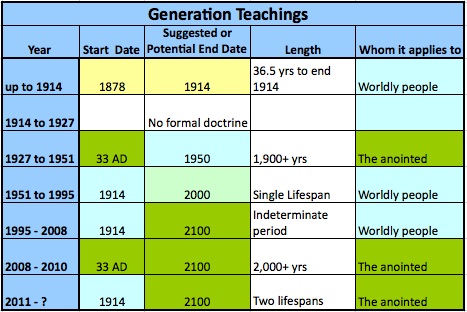
A long-standing and very prominent Watchtower teaching is the belief that in 1914 a special period of time, which Jesus called the “Gentile Times” ended, the “last days” began, and Christ began to rule over the whole earth for the first time since his resurrection and ascension to heaven. Immediately prior to that time, they say, Jesus, in anticipation of his imminent reign, began inspecting the religious organizations of the world to see which one would be his official representative when he began to rule in 1914. He examined the teachings of all denominations on earth which claim to be Christian and decided that the most “faithful” one (meaning the one with the most correct interpretation of the Bible) was the small group of Charles Russell’s followers, later to be known as Jehovah’s Witnesses. As a result (according to Watchtower publications), shortly after 1914 Jesus committed all the interests of his kingdom into their hands, and they became his only approved channel of communication between God and mankind.
If they are correct, something very significant changed in 1914. Things would have to be different since 1914 than they were for the rest of the Christian era. If this proved to be true, that would add some credence to their claim that the Watchtower Society, with its origins in the nineteenth century, is the only Christian denomination which God approves. On the other hand, if the weight of scriptural and historical evidence does not support this conclusion, Watchtower claims are deeply suspect. The purpose of this article is to help clarify the implications of the Watchtower view.
Since its very origin, fundamental teachings of the Watchtower Society have been based on and intimately tied to the idea that serious Bible students can determine with reasonable accuracy the time of Christ’s return in glory, either through chronological calculations, observation of unique world events in the light of Bible prophecy, or by some other signs which would serve as reliable predictors of Christ’s imminent return or advent. Christians who believe this to be possible have been called “Adventists.”
First, let us examine the chronology which, according to Watchtower claims, establishes that 1914 marked the end of one special time period and the beginning of another.
Is Watchtower Chronology Sound?
Charles T. Russell borrowed much of his chronology and methodology from the Second Adventists, which developed after William Miller’s failed attempt at predicting Christ’s return in 1843. The calculations are based largely on interpretations of passages in Daniel 4 and Luke 21. In brief, Witnesses teach that the “Gentile Times” is a special period of 2,520 years during which God’s kingdom (David’s dynasty specifically) had no king. They believe that this period began when Jerusalem was destroyed in pre-Christian times by Babylonian armies and that it ended in 1914. Considering the importance of the conclusions it supposedly supports, the chronology is based on a rather tenuous series of assumptions:
First, that the dream Nebuchadnezzar had about becoming a beast for “seven times” (recorded in Daniel 4) does not refer primarily to him (as stated directly in the text), but rather that he, a pagan king, not even a worshiper of Israel’s God, actually represents God’s kingdom.
Second, that God’s kingdom or rulership over mankind somehow “ended” when Zedekiah, David’s direct descendent, was removed from the throne of Jerusalem when it was destroyed by Babylon, and that the kingdom would “begin” again some twenty-five centuries later when Jesus, also David’s descendent, began to rule in 1914. The Jews expected a descendent of David to rule as king forever, but the concept of God’s kingdom or sovereignty “ending” at that time and “beginning” at some later date is never suggested in the Jewish sacred writings. In fact, this idea directly contradicts Daniel 4:17, which is connected to Nebuchadnezzar’s beastly experience!
Third, based on the first assumption, each “time” must represent a special “prophetic” year of 360 days, although no actual earthly year, solar or lunar, has 360 days.1 Seven of these 360-day prophetic years would add up to a total of 2,520 “prophetic” days.2 Each of these “prophetic” days in turn must represent a solar year of approximately 365¼ days. Absolutely nothing in Scripture, Jewish tradition, or the writings of early Christians even suggests that we may make this complicated series of assumptions and calculations.
Fourth, that this period of 2,520 solar years are identical to what Jesus referred to when he used the expression translated “the appointed times of the nations” or “the times of the Gentiles” in Luke 21:24 (“Jerusalem will be trampled on by the Gentiles until the times of the Gentiles are fulfilled…”), even though Jesus was specifically discussing the future destruction of Jerusalem by the Romans in 70 AD, not its past destruction by the Babylonians, and despite the fact that there is not a single word in Scripture, Jewish tradition or Christian writings that indicates that the “Gentile times” refer to any time period during which God’s eternal kingdom would be inactive.
Fifth, that Jerusalem was destroyed by Nebuchadnezzar’s armies in 607 BC. The date for Jerusalem’s destruction is one of the most accurately fixed of ancient history. Even more significantly, the historical sources that establish the date for Babylon’s fall in 539 BC, (which date the Watchtower Society does accept and, in fact, which it uses as the starting point for its 1914 calculations) are exactly the same sources that establish 587/6 BC as the date for Jerusalem’s destruction! Several independent lines of evidence (historical, astronomical, archeological, etc.) point to the date of 587/6 BC, not 607 BC, as the date of Jerusalem’s destruction. There is no credible historical evidence which supports the 607 BC date. (See The Gentile Times Reconsidered, Carl Olof Jonsson, Commentary Press, 1998 for a detailed discussion of this topic.)
Sixth, that all the many passages in the Greek Scriptures that clearly state that Jesus began ruling in the first century, such as Matthew 28:18: “All authority in heaven and on earth has been given to me…” don’t really mean what they say. Below is a more extended discussion of the implications of this assumption.
Each of the six assumptions listed above are interrelated. The veracity of all of them together are absolutely critical to the Watchtower teaching that in 1914 the world entered a special time period known as “the time of the end” and that Jesus chose the Watchtower Society as God’s official channel of communication with his faithful people on earth. If any one of them is wrong, the final conclusion is completely invalid and the Watchtower claim is demonstrably false.
It is worth noting that Russell, using the same methodology, “proved” that he himself was living in a special time period, which he believed would end in 1914 with Christ’s return to judge the nations. He also admitted that if any one of the assumptions upon which he based his conclusions were wrong, it would invalidate both his entire approach and his conclusions. That did, in fact, happen. In time, nearly every one of his assumptions was rejected, and Russell’s ending date for the time of the end (1914) became the starting date for the same period in later (and current) Watchtower teaching.
When Did Jesus Begin to Reign?
If the Watchtower chronology is invalid and Jesus did not begin his reign in 1914, is he now reigning? If so, when did that reign start? Watchtower publications interpret Hebrews 1:13 (“Sit at my right hand until I make your enemies a footstool for your feet”) as follows:
“In 33 C.E., [Jesus] died, was resurrected, and ascended to heaven. … At that time, however, Jesus did not act as King and Judge over the nations. He was seated next to God, awaiting the time to act as King of God’s Kingdom. Paul wrote of him: “With reference to which one of the angels has he ever said: ‘Sit at my right hand, until I place your enemies as a stool for your feet’?” (Hebrews 1:13) Jehovah’s Witnesses have published much evidence that Jesus’ period of waiting expired in 1914, when he became ruler of God’s Kingdom in the invisible heavens.” —The Watchtower, 10/15/95, pg. 21, par. 14-16 (Emphasis added.)
Hebrews 10:12, 13 says: “But when this priest [Jesus] had offered for all time one sacrifice for sins, he sat down at the right hand of God. Since that time he waits for his enemies to be made his footstool.” If this were the only reference to Psalm 110 in the Christian Scriptures, and there was nothing else to indicate otherwise, this verse might indeed be interpreted to mean that the word “waits” in this passage refers to a period of non-rulership. This is exactly how the Watchtower Society interprets it:
“Even after Jesus’ resurrection and ascension to heaven, he had to wait at his Father’s right hand until the time came for him to rule as King over mankind. (Hebrews 10:12,13)” —The Watchtower, 6/15/94, pg. 6
But is this how the apostles and early Christians understood the expression “sit at my right hand”? No! Among ancient peoples, the imagery of a king sitting on the throne of his God was a common way to express that the king ruled with the approval and support of his God. This is consistent with how early Christians understood this phrase, as we shall see. 3
This is not the only place where this expression from Psalm 110 is quoted in the Christian Greek Scriptures. In fact, this passage from the Hebrew Scriptures is the one most often quoted in Christian Scripture. So we can examine all of its appearances to correctly establish how it was used and understood. The Watchtower interpretation that “sitting” means “waiting” is required by their chronology-based belief that Jesus could not begin his reign until 1914, as discussed above. But it is quite clear from many other places where this passage is quoted that the early Christians did not understand the passage to mean non-rulership. They understood “sitting at God’s right hand” to mean that Jesus was already ruling as king. Perhaps the clearest example of this is Paul’s citation of Psalm 110 in his first letter to the Corinthians while discussing the resurrection. In this passage, Paul actually substitutes the term “rule as king” for “sit at God’s right hand” right in the quotation:
Next, the end, when he hands over the kingdom to his God and Father, when he has brought to nothing all government and all authority and power. For he must rule as king until [God] has put all enemies under his feet. As the last enemy, death is to be brought to nothing. … But when all things will have been subjected to him, then the Son himself will also subject himself to the One who subjected all things to him, that God may be all things to everyone. —1 Cor 15:24-28 NWT (Emphasis added.)
It is clear from his use of the passage that Paul understood “placing all things under Christ’s feet” to mean rulership. Why should that not be the case, since after his resurrection, Jesus explicitly stated that he had been given “all authority in heaven and on earth.” When Jesus was born, the angel Gabriel said that he would be given the throne of David his forefather, and that he would reign forever. So it would be most natural for the apostles to understand his post-
resurrection words to mean that he was reigning as their king, even if the way in which his rulership would be expressed turned out to be different from what they expected. The psalmist’s statement that he was to reign in the midst of his enemies is consistent with the image of a ruler who sits down on his throne, at the right hand of his God, and continues his rule until all things are subject to his power. A great resurrection occurs at that time; thus death becomes the last enemy to be subject to him. Afterward, Paul writes, the Son subjects himself to God, the Father.
Many other passages show that the apostles and early disciples viewed Jesus as ruling as king in their day, several of which refer to Psalm 110. Here are but a few (all quoted from the New World Translation, 1971 ed.):
Matt 28:18-20: Jesus approached and spoke to them, saying: “All authority has been given me in heaven and on the earth. Go therefore and make disciples of people of all the nations, baptizing them in the name of the Father and of the Son and of the holy spirit, teaching them to observe all the things I have commanded YOU. And, look! I am with YOU all the days until the conclusion of the system of things.”
Mark 16:19: So, then, the Lord Jesus, after having spoken to them, was taken up to heaven and sat down at the right hand of God.
John 5:26, 27: For just as the Father has life in himself, so he has granted also to the Son to have life in himself. And he has given him authority to do judging, because Son of man he is.
John 17:1, 2: Jesus spoke these things, and, raising his eyes to heaven, he said: “Father, the hour has come; glorify your son, that your son may glorify you, according as you have given him authority over all flesh, that, as regards the whole [number] whom you have given him, he may give them everlasting life.
Col 2:9, 10: …it is in him that all the fullness of the divine quality dwells bodily. And so YOU are possessed of a fullness by means of him, who is the head of all government and authority.
Acts 17:6, 7: …they dragged Jason and certain brothers to the city rulers, crying out: “These men that have overturned the inhabited earth are present here also, and Jason has received them with hospitality. And all these [men] act in opposition to the decrees of Caesar, saying there is another king, Jesus.”
Eph 1:18-23: It is according to the operation of the mightiness of his strength, with which he has operated in the case of the Christ when he raised him up from the dead and seated him at his right hand in the heavenly places, far above every government and authority and power and lordship and every name named, not only in this system of things, but also in that to come. He also subjected all things under his feet, and made him head over all things to the congregation, which is his body, the fullness of him who fills up all things in all.
Col 1: 12-14: … [The Father] delivered us from the authority of the darkness and transferred us into the kingdom of the Son of his love, by means of whom we have our release by ransom, the forgiveness of our sins.
1 Pet 3:21, 22: [Baptism] is also now saving YOU, … (not the putting away of the filth of the flesh, but the request made to God for a good conscience,) through the resurrection of Jesus Christ. He is at God’s right hand, for he went his way to heaven; and angels and authorities and powers were made subject to him.
Viewed in their context, these passages indicate clearly that early Christians believed Jesus was ruling, not waiting. The entire basis of their confidence in salvation and forgiveness of their sins was based on their understanding that they had a ruling high priest who could actively plead for them, that the glorified Jesus was in heaven, sitting at God’s right hand, that is, ruling with His Father’s full support, with full authority to act on their behalf.
Are We Living in the “Last Days?”
In addition to believing that Jesus was reigning, there is also no doubt that the first Christians believed they were living in the “last days.” Peter, on the occasion of the remarkable events of the first Pentecost after Jesus’ resurrection, quoted Joel’s prophecy as proof of that fact:
“This is what was said through the prophet Joel, ‘“And in the last days,” God says, “I shall pour out some of my spirit upon every sort of flesh.” —Acts 2:16,17
The expression “last days” here translates the Greek term eschatais hemerais, an expression used in the Greek translation of the Hebrew Scriptures and widely understood by Jews to refer to the Messianic era. (Isa 2:2; Hosea 3:5; Micah 4:1) The introduction of the inspired letter to the Hebrews reflects this perspective:
“God, who long ago spoke on many occasions and in many ways to our forefathers by means of the prophets, has at the end of these days spoken to us by means of a Son.”
The expression “at the end of these days” in the New World Translation here translates the same Greek words used by Peter at Pentecost (eschatais hemerais), but the expression is translated differently here, so its implications are not immediately apparent to any but the most diligent students.
Early Christians did not understand the expression “last days” in the same sense as we might say on a fine September day when we feel the first cool breezes of fall: “These are the last days of summer.” Jews generally believed that human history was divided into two great epochs: the “former days” or period before the Messiah appeared and the “latter days” or period after His appearance. Since Jesus’ first disciples, all Jews, accepted him as their Messiah, they believed that his appearance marked the beginning of the “latter days,” or Messianic era, in contrast with the “former days” before he appeared, and they supported that view by references to the Hebrew Scriptures.
The first Jewish Christians had to change their initial perspective on the nature of their Messiah and his rulership. They expected a political savior who would deliver them from subjection to Rome. Instead, Jesus delivered them from sin, death and the devil. His kingdom was quite real, but was no part of this world. They became part of it by accepting and obeying him as ruler. (Col 1:13) Jesus also revealed to them that he would leave and return again at an unexpected time. Many early disciples evidently thought the second coming would occur in their lifetime. But as more and more of those who had known Jesus personally, including the apostles, began to die (many as martyrs), and persecution against them intensified, they began to understand that the Messianic era was not to be a time of physical abundance and material blessing (as many Jewish teachers taught), but would instead be an extended time of tribulation, especially for Christians. Thus, it was appropriate for Paul to warn Timothy: “Know this, that in the last days critical times hard to deal with will be here.” (2 Tim 3:1) After describing the kind of people that would typify these difficult days, he told Timothy to “turn away” (“be turning yourself away” Kingdom Interlinear) from these people. Clearly he was not warning Timothy about events that would occur many centuries in the future. In Paul’s view, he and Timothy were living in the last days, that is, the Messianic or Christian era.
What about the “signs” which Jesus’ predicted?
Jehovah’s Witnesses believe that Jesus’ prophecy in Matthew 24 (and parallel passages in Mark 13 and Luke 21, sometimes called the “Olivet Discourse” or the “Eschatological Sermon,” from the Greek word for “final things”) describes a series of events which would happen at the time of Jesus’ parousia and serve as a sign that it had begun. The purpose of this document is not to present a detailed verse-by-verse consideration of these passages, but only to make a few relevant comments.
First, a brief explanation of the Watchtower understanding of the Greek word parousia in Matt. 24:3. The term is usually rendered “coming” or “arrival,” but it is translated “presence” in the New World Translation. Late in the nineteenth century, some disappointed Second Adventists, disciples of William Miller, who had expected Jesus to return in 1843, noticed that parousia was translated “presence” in the Emphatic Diaglott, a Greek/English interlinear translation prepared by Benjamin Wilson. Apparently impressed by Miller’s chronology enough that they did not want to give up that date, some of them came up with the idea that perhaps Jesus really did return in 1843 just as Miller had predicted, but that he had done so invisibly.
Russell incorporated their ideas into his own version of the “time of the end”. He saw Jesus’ parousia as a special 40-year period of invisible presence during which Russell’s followers, (then called International Bible Students; now known as Jehovah’s Witnesses) would be in a special relationship with him, after which they would be caught up in glory to heaven. Russell saw the events described in Matt 24:3-14 as proof that Jesus had already returned, invisibly.
If Jesus’ parousia was meant to be invisible, some sign might indeed be needed to show that it had begun. In that case, it would be strange for Jesus to choose things which would be in almost constant evidence during the entire Christian era as signs of some special period at its end. The difficulty that arises when one looks to these kind of things as signs is shown by the fact that Russell pointed to the events Matthew 24:6-14 (war, pestilence, famine, earthquakes, and others) as proof that Jesus’ paranoia started in 1874, and would end in 1914. Yet today Witnesses point to the same events to prove that the parousia started in 1914, when Jesus put them in charge of all his kingdom’s interests on earth.
The Greek word parousia, in its most common meaning, means bodily presence, but it can also refer to the visit of a royal person, which is consistent with Jesus’ own description of his second coming: “When the Son of Man comes in his glory, and all the angels with him, he will sit on his throne in heavenly glory. All the nations will be gathered before him, and he will separate the people one from another as a shepherd separates the sheep from the goats.” (Matt 25:31, 32) “The Lord himself will come down from heaven, with a loud command, with the voice of the archangel and with the trumpet call of God, and the dead in Christ will rise.”—1 Thess. 4:16
In Jesus’ day, many Jews believed that immediately prior to Messiah’s coming there would be a series of calamities. These “woes of the Messiah,” included wars, insurrections, pestilence, famine, earthquakes, and signs or portents from heaven. It is not unlikely that Jesus’ disciples had heard of these predictions. Since these events clearly did not appear before Jesus’ birth or baptism, when they heard him predict the destruction of the temple, they may have been asking, “Is this what we have been told to expect; the woes of the Messiah? Is the destruction of the temple part of that great time of calamity we expect to precede your coming in glory?” 4
If that was the intent of their question, Jesus’ answer was that disasters would definitely come, but they would not be a sign of his return. To the contrary, Jesus started his prophecy by warning them not to be misled. He added that when wars and rumors of wars happen, “see to it that you are not alarmed. Such things must happen, but the end is still to come.” (Matt 24:6) Other catastrophes would also appear. Even these would only be “the beginning of birth pains.” Rather than confirm that these things would be the immediate precursor to his return and their deliverance, Jesus warned them to expect an increase persecution and hatred by persons of all the nations, of a great rise in wickedness. He said that they would need endurance. His words did not point toward their imminent deliverance, but an extended period of tribulation. The events Jesus mentioned in Matt 24:3-14 have occurred often throughout the centuries since the days of the apostles. Periodically during those centuries, a small minority of Christians have tried to prove that Jesus’ return was imminent by pointing out the prevalence of war, earthquakes, famine, pestilence, and the like. They have been disappointed every time. 5 In fact, Jesus’ words have been undergoing fulfillment for nearly two thousand years, and the end is still in the future.
Jesus’ words may have been the disciples’ first inkling that the Messianic era would not be the time of great political peace and material prosperity they may have been led to expect by some Jewish teachers. Possibly they associated the destruction he spoke of with his return, and so they only asked one question, but Jesus’ reply encompassed two separate events: first, the destruction of the Jewish temple and second, Jesus’ return or parousia, both of which they may have thought would occur at the same time.
Jesus gave them specific instructions about what to do at the time of Jerusalem’s destruction. But at the same time, he warned them that events they might have considered to be signs of his parousia were not true signs at all, but false signs, expected by some Jews in connection with the glorious arrival of Messiah, but not relevant to Jesus’ second coming. It is very significant that, rather than giving them a sign which would appear some significant period of time, even years, in advance of his second coming, he instead repeatedly urged them to keep alert, on the watch. He compared his return to the visit of a thief in the night. Thieves do not provide any advance notice before they strike. —Matt 24:43, 44
Conclusion
To summarize, there are insurmountable problems with the Watchtower view. First, the idea that one can predict by any means when Christ would return is in direct contradiction to Jesus’ own clearly stated warning that he would return at a time that his disciples did not think it to be. The idea of any kind of sign which would give advance warning of Jesus’ return completely contradicts what he clearly said on numerous occasions, that his parousia would be both sudden and unexpected: “Be on guard! Be alert! You do not know when that time will come.” (Mark 13:33) If we take him at his word, Jesus’ discourse on the Mount of Olives do not provide a way to predict either an invisible presence or his imminent second coming.
Second, the concept of Jesus’ parousia as an invisible event cannot be reconciled with His words: “Look! I am with you always, until the conclusion of the system of things” (Matt 28:19 ) which clearly show that Jesus would always be invisibly present with his disciples. It also directly contradicts Rev 1:7, which says “Look, he is coming with the clouds, and every eye will see him, even those who pierced him; and all the peoples of the earth will mourn because of him.” This clearly teaches that Jesus’ parousia would be anything but invisible.
Third, if we remain true to the original and most direct sense of Scripture, we must conclude that Jesus began ruling in the first century, and that all Christians who lived from the first century until now have been living in the last days, that is, the Messianic era. Both biblical and historical evidence show that Jesus Christ began to reign in the first century, and that his reign has continued, “in the midst of his enemies.” That being so, we must also conclude that the situation that has existed among persons claiming to be Christians is what Jesus expected, and that the way things have developed is in harmony with his sovereign will as king over heaven and earth. Any group which began during any of the centuries following the apostolic age can make no serious claim to being Jesus’ true church.
We have no reason to conclude that Jesus abandoned his followers to his enemy the devil at the end of the apostolic period, as Russell believed and taught. There is also no basis to conclude that near the end of the first century, things somehow got out of Jesus’ control and the whole body of Christ became so corrupt that they lost their standing as the true Church he founded. If Jesus has “all authority in heaven and on earth” and he sent his disciples out to preach and teach on that basis, we must conclude that there have been true followers of Christ all down through the centuries since Jesus walked the earth. If one looks for and honestly examines the available historical evidence, one may see that the Church Jesus founded in the first century has remained in existence continuously ever since.
_____________________
1 The Aramaic word Daniel used here for “time” just means an unspecified period, not always a year. (The word for year, as in Daniel 1:1, is different.) The word used here is `idd’n, which, according to the Theological Wordbook of the Old Testament, means “ time, period, span , year, era. … Two basic meanings are equally a “point in time” or a “span of time.” In this context, a “time” could easily mean a week, a month or a season, not necessarily a year.
2 A reader pointed out that Revelation 11:2-3 relates “times” to days in a different way: “But as for the courtyard that is outside the temple [sanctuary], cast it clear out and do not measure it, because it has been given to the nations, and they will trample the holy city underfoot for forty-two months. And I will cause my two witnesses to prophesy a thousand two hundred and sixty days dressed in sackcloth.” (NWT) Here the wording is quite similar to that in Luke 21:24: (“Jerusalem will be trampled on by the nations”). The Greek word for “trample” is the same in both passages, and both speak of Jerusalem, the “holy city.” This text describes a period of “trampling” lasting forty-two months or 1,260 days rather than 2,520!
3 See The Gentile Times Reconsidered, 3rd Ed. , Carl Olof Jonsson, Commentary Press, 1998, pg 264-270.
4 For details, see articles by M. Brunec, S.B.D., C.D.B., published by the Pontifical Biblical Institute in successive fascicles of Volumes 30 and 31 of Verbum Domini. This article was also given to me by Ray Franz.
5 An excellent consideration of this entire subject is found in Doomsday Delusions, © 1995 by C. Marvin Pate and Calvin B. Haines, Jr., InterVarsity Press
Entire contents ©2005 Thomas W. Cabeen