Recently we posted a link to Rutherford’s “SPICY” booklet, and the first mention of it in the May 1, 1915 Watch Tower. That post highlighted how Russell distanced himself from the booklet and its publication. He offered the advertisement for it, but only after making it clear that he himself hadn’t read it.
The booklet referred to is, of course, “A Great Battle in the Ecclesiastical Heavens.” We linked to a copy on archive.org: https://archive.org/details/AGreatBattleInTheEcclesiasticalHeavens .
It’s also available on WatchtowerDocuments.org along with a lot more interesting documents that Barbara Anderson has collected, which can make for some very interesting historical reading by and about the Watch Tower Society. You’ll find it in the 1900-1919 section: http://watchtowerdocuments.org/watchtower-document-downloads-1900-1919/ .
In our post we mentioned that Russell might have distanced himself from the booklet for “legal” reasons. Some additional speculation on that subject is found in a discussion on JWN. We have permission from some of the people involved in that thread on JWN ( jehovahs-witness.com ). The relevant post (from 9 years ago) is reproduced below, although the rest of the thread is quite interesting for other reasons:
Russell needed to distance himself from Rutherford’s “Great Battle in the Ecclesiastical Heavens” for seveaal reasons. It compared him to Jesus (“SAME OLD GAME OF THE PHARISEES AGAINST ONE MAN”). It obliquely labeled his wife as a “persecutor” of Christians ultimately because a judge was convinced she was telling the truth in court. (“EVEN GOOD JOHN WESLEY’S WIFE JOINED HIS PERSECUTORS”)
The great and good John Wesley was another victim his own wife joining his persecutors. The same Pharisaical class defamed the Lord Jesus when He was on earth. They called in question the legitimacy of His birth, applied all manner of vile epithets to Him, denounced Him as an enemy of the government, and finally caused His crucifixion.
It included a hatred of Catholics that Russell was always careful to back away from. (“PAPAL ROME AND HER MONGREL PROGENY AGAINST ONE MAN”)
Also, it included the common “worship” of Russell that Russell’s followers were infamous for. Russell was always careful to accept this worship with mock humility.
THE GREATEST LIVING PREACHER In this case? PASTOR RUSSELL!
Then of course it tries to cover over Russell’s various “scandals” and likely gives untrue reasons by way of explanation. For example, the move from Pennsylvania to New York seems contrived, based on exact timing and other factors, to avoid monetary payments due his wife. The NY Corpororation and People’s Pulpit is defended for other reasons. Same goes for the defense of Russell’s “United States Investment Company”. In the same context the booklet tries to explain how Russell, who admittedly had “a quarter million dollars” had put it all into religious work and corporations. (And, for those who knew the specifics, it would therefore “go without saying” that he had truthfully claimed to have very little with which to compensate his wife, who had just been awarded damages by the court for Russell’s ill treatment and mental cruelty.)
Russell was no doubt aware that Rutherford had taken some liberties to defend Russell against any possibility of truth in the claims of his wife. If the court transcripts are read carefully, Russell actually acknowledges some of his wife’s claims up to a point by acknowledging the alleged circumstances but putting a different spin on how he had got himself into those circumstances. Rutherford goes so far as to publish some of the actual claims against Russell which was probably a legal mistake in the long run. It made it harder to ever cover up the specifics. For example, the book includes the following under the heading “THE GREATEST FISH STORY EVER MANUFACTURED”:
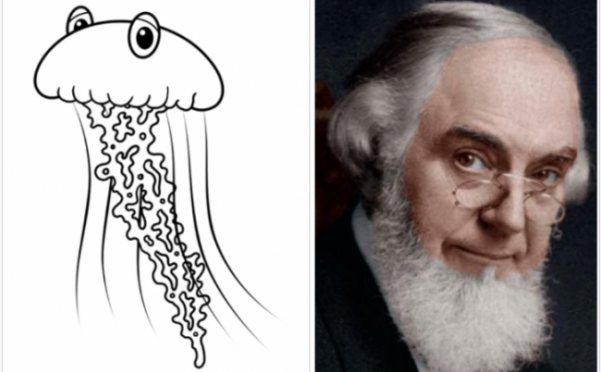
Upon the trial of this cause Mrs. Russell testified that one Miss Ball had stated to her that her husband said, “I am like a jelly-fish, I float around here and there. I touch this one and that one, and if she responds I take her to me, and if not I float on to others.”
All this matter the Court struck from the record and would not permit it to go to the jury. In his charge to the jury the Judge said: “This little incident about this girl that was in the family, that is beyond the ground of the libel and has nothing to do with the case because not being put in it, and it was condoned or allowed to pass.”
It is manifest that this “jelly-fish” story was entirely the product of Mrs. Russell’s imagination, and other facts which appear in the record conclusively show that it could not have been true.
Pastor Russell emphatically denied that any such thing ever occurred. It would seem unreasonable that any man would make such a statement about himself.
But the most conclusive facts disclosed by the record showing her statement to be untrue are these: Miss Ball came to them in 1889, a child of ten, and was taken into the home of Mr. and Mrs. Russell. She was treated as a member of the family. She was an orphan. She kissed both Mr. and Mrs. Russell good night each evening when she retired. They treated her as their own child. (Court Record, pages 90, 91.) Mrs. Russell testified that the “jelly-fish” incident transpired in 1894, when the girl could not have been more than fifteen years of age.
His [Rutherford’s] legal reasoning is full of non sequiturs. The reason for being struck from the record was not related to its truthfulness or lack thereof. Rutherford cleverly avoids this point. It is not “manifest” to be untrue. The attempt to reduce Mrs. Ball’s age to that of a young child may also be based on Rutherford’s taking advantage of a mistake in the court transcript, not Mrs. Russell’s testimony, per se. However, it misses the point. In the transcripts, Mrs. Russell was actually creating a much more general picture of infidelity that may have indeed included accusations of indiscretions with the opposite sex that could have begun at a younger age than the actual episode in question with Miss Ball. Miss Ball was not the only female mentioned. There was another “unfaithful and indiscreet servant” episode involving a servant girl in the household. Portraying Miss Ball as a young girl and later noting that Mrs. Russell continued to put up with her husband are hardly the concrete proofs that get Russell off the hook.
As an aside, all good PR men and politicians manage to work their own resume into a praise of someone else. Note this clever little turn that Rutherford managed:
“We are reminded that St. Paul was a practicing lawyer for a time, and a successful one, too, and that he also made tents to provide his temporary necessities. Jesus was a carpenter. Blessed is he that labors.”
St. Paul’s first billing is “lawyer” not “tentmaker”?
JUNE 1915 – C T RUSSELL WAS PROMOTING A “SPICY” PUBLICATION THAT HE HADN’T READ, & SAID HE WANTED NOTHING TO DO WITH.
June 1915 was the first full month wherein Watchtower readers could obtain and read a new publication that had just become available out of Brooklyn in the previous month. Here’s how it was announced in the May 1, 1915 Watchtower, known then as, Zion’s Watch Tower, emphasis ours:
Brother Rutherford, grieved by the various untruthful, slanderous attacks upon the Editor, has prepared a pamphlet in my defense. A copy of it has just been handed me.I have not yet read it, though, of course, I knew of its preparation and in a general way of its contents.I preferred not to have anything to do with its publication. It explains Brother Rutherford’s views as a lawyer, as a brother, and as a man who most fully understands the entire situation. It contains some interesting illustrations and is priced at ten cents per copy, or eight dollars per hundred copies, postpaid. It is not unreasonable to expect that nearly all of our readers will be very glad to have this pamphlet, as it will furnish them with evidence on every point thus far brought forward by my maligners.
Orders for the pamphlets should be addressed to Judge Rutherford, New York City, P.O. Box 51. However, we will have a supply at THE WATCH TOWER Office, and, if one is ordering other things, this pamphlet can be supplied also. It is entitled, “A GREAT BATTLE IN THE ECCLESIASTICAL HEAVENS.”
If you’d like to read this booklet, it is available online in a few places. (See below for one of them.) You might enjoy it. But you might also see why Russell wanted nothing to do with this particular publication. Legal experts have also surmised why, perhaps, he would state that he had not personally read the publication. The booklet is packed with information which would require a full book’s worth of commentary to do it justice.
“Recent Finds” reprints interesting and relevant discoveries from various sites, blogs, and forums, where we have permission either from the site owner or the person who created the post. We do not necessarily agree with everything said by the contributor on the originating site, nor does the person who gave permission necessarily agree with the contents of this site.
For this topic the contributor was “JW Insider” on jw-archive.org. Some of the points have been made before on this site, but in this case we highlight (in bold, red text) the portions of the post where spiritism is discussed:
[Post #1]
Historically, the Watchtower has always said that the resurrection of some of the 144,000 happened many years ago. Up until 1927, that resurrection had happened in 1878. This is why in 1916 after Russell died, the Watchtower claimed for many years that Russell was communicating with the Watchtower Society and was continuing to run every phase of the work “from beyond the veil.”The Watchtower defended this position against a charge of spiritism on the grounds that Russell was still alive. (Of course, he would still be a spirit, so I don’t know how well that argument worked.)
In 1927, the date for the resurrection of all the previously deceased members of the 144,000 up to that point was changed from 1878 to 1918. Up until less than 10 years ago, our official position was that the apostle Paul, for example, was resurrected in 1918. This was taught, not just as a guess, but an established fact. But then in 2007 we got a very interesting Watchtower article:
*** w07 1/1 p. 27 par. 9 “The First Resurrection”—Now Under Way! ***
Reasonably, then, anointed ones who die before Armageddon are resurrected sometime between 1914 and Armageddon. *** end of quote ***
This opened up a whole new range of possibility, including the possibility that NONE of the 144,000 have been resurrected yet. And this is still a possibility based on the updated view of the rapture in the May 15, 2015 Watchtower.
However, the old 1918 resurrection is not completely dismissed as a possibility, it’s only that it has been downgraded from an established fact to “an interesting possibility”
*** w07 1/1 p. 27 par. 10 “The First Resurrection”—Now Under Way! ***
Can we say more precisely when the first resurrection begins?
. . . It seems that resurrected ones of the 24-elders group may be involved in the communicating of divine truths today. Why is that important? Because the correct identity of the great crowd was revealed to God’s anointed servants on earth in 1935. If one of the 24 elders was used to convey that important truth, he would have had to be resurrected to heaven by 1935 at the latest. That would indicate that the first resurrection began sometime between 1914 and 1935.
. . .
Could it, then, be reasoned that since Jesus was enthroned in the fall of 1914, the resurrection of his faithful anointed followers began three and a half years later, in the spring of 1918? That is an interesting possibility. Although this cannot be directly confirmed in the Bible, it is not out of harmony with other scriptures that indicate that the first resurrection got under way soon after Christ’s presence began.
*** end of quote ***
[Post #2]
Just noticed that I referenced the May 15, 2015 about the “rapture.” I meant the July 15, 2015 issue. In fact, that’s most likely the very issue where the question comes up about whether the 144,000 are all in heaven just before the Great Tribulation starts, or just after it starts. Paragraphs 15 and 16 of the “rapture” article becomes just a bit vague at exactly that point.
Just another curiosity on the 2007 issue quoted above.There are now about three different NEW problems with the 1918 date we used to teach.
1918 used to be mentioned as much or more than 1919. But in the last couple decades we had already stopped mentioning it for many years with reference to ANY current doctrine. Also, the Governing Body as the Faithful and Discreet Slave didn’t exist until 1919 in our new understanding. So as of the July 15, 2013 issue of the Watchtower, we officially dropped the last teachings related to 1918. We used to teach that the “spiritual temple” was inspected in 1918, and also that great tribulation started in 1914 and was interrupted in 1918, and that it would start up again just before Armageddon. Note:
*** w13 7/15 p. 3 par. 3 “Tell Us, When Will These Things Be?” ***
For a number of years, we thought that the great tribulation began in 1914 with World War I and that “those days were cut short” by Jehovah in 1918 when the war ended so that the remnant would have the opportunity to preach the good news to all nations.
*** end of quote ***
*** w13 7/15 p. 11 “Look! I Am With You All the Days” ***
Paragraph 6: This is an adjustment in understanding. Previously, we thought that Jesus’ inspection took place in 1918.
*** end of quote ***
So 1918 is no longer important to any other doctrine.
Another problem with it is that the 2007 article ends with the idea that “although this cannot be directly confirmed in the Bible, it is not out of harmony with other scriptures that indicate the first resurrection got under way soon after Christ’s presence began.” The problem here is that the only scriptural example is the verse in Thessalonians 4:13 which is not that directly supportive of the claim that this resurrection happens EARLY during the presence. If anything the emphasis is on how close together the timing of the resurrection aligns with the raising of the final LIVING survivors at the end.
Also, a third problem is the idea that we kept the “spiritism” idea as the way of supposedly narrowing down the time of the first resurrection between 1914 and 1935. The article said: “If one of the 24 elders was used to convey that important truth, he would have had to be resurrected to heaven by 1935 at the latest.” (24 elders is still identified as another term for the 144,000.)
The real problem is that we used to say that although 1935 was not found through Scripture, it didn’t matter because it was revealed as “lightning flashes” going forth into the “spiritual temple.” Rutherford used this expression a lot as if it was a form of either angelic inspiration or communication with those who had already passed beyond the veil. (The idea survived for many decades in our songbooks with the words “In God’s holy temple / Lightnings flash and shine / That we may be guided / By his light divine.) The problem is that 1935 is no longer considered to have any specific significance anymore. Now, it is just a time when the Watchtower began teaching something different and therefore clarifying or identifying the hope of a class who had seemed, for many years prior, not to know exactly what there hope was.
One last consideration is not included above because it hasn’t been commented upon yet in the Watchtower with reference to the first resurrection:
(2 Timothy 2:18 ) These men have deviated from the truth, saying that the resurrection has already occurred, and they are subverting the faith of some.
“Recent Finds” will reprint interesting and relevant discoveries from various sites, blogs, and forums.
If you have seen content from such sources that might be of specific interest to readers of this site, please let us know by replying to any of our pages. In order to reprint a “Recent Find” here, we will need permission from either the owner of the source pages, or the author. These will not typically be direct contributions to this site, nor do those who give permission necessarily agree with the content of this site.
The following content comes from jw-archive.org and we have obtained permission to reprint the comments of two persons who offer comments on that site:
The question was:
How do they come up with 1914 when Jesus was installed king of the heaven ? I am still learning and trying to get full understanding – See more at: http://www.jw-archive.org/post/120082339793/how-do-they-come-up-with-1914-when-jesus-was#sthash.cd0Uoryx.dpuf
One respondent, who claims to have been assigned research work at Bethel, included a most interesting bit of Bible Student history with reference to Russell and the pyramid studies. The “executive summary” as provided by the poster, is as follows:
What is amazing is that by searching through the entrails of the various drainage and air passages that angled through the pyramid, it never mattered whether the length of these zigzagging passages was 3,416 inches, 3,457 inches, or 3,384.904 inches. In EVERY case they proved that 1874 or 1914 or BOTH 1874 and 1914 were correct. This was true even though the first measurement was nearly 3 feet off, and the first “corrected” measurement was 6 feet off.
The original post is repeated below in it’s entirety:
I was thinking about JTR’s statement about “intellectual honesty.” I suspect that every religion that has ever promoted chronology doctrines has been guilty of intellectual dishonesty. I have studied only a few, and most were related to the Millerite movement, Second Adventists, Seventh Day Adventists and the Bible Students, but not enough to actually make a definitive statement about others besides these.
I talked at length to followers of Harold Camping a few years ago when they were sure that Judgment Day would be on May 21, 2011. The night before, I started a study with one of them and showed him where his information was not Biblical. He (and his wife) were sure it would happen, but promised to continue their study if it didn’t. I followed up and he basically claimed that it must have been God’s will, some kind of a test perhaps, but that they were so close there would definitely be further revelation coming very soon. What got to me most was their inability to admit that Camping had really been wrong, and another claim that nothing like this had happened back on September 6, 1994. (Which very clearly had also happened despite their denials.)
As a former researcher, not just at Bethel, but also at my first full-time job with the Bureau of Labor Statistics, I was trained to believe in intellectual and scholastic honesty. And internally I even feel a certain aggravation that one of my own parents and several relatives who once took 1975 so seriously will now claim that it was just a few overzealous brothers who were misinterpreting what the literature was really saying.
But my experiences remind me that, even WITH training to appreciate the value of intellectual honesty, the human mind sees what it wants to see. One amazing example of this is a site that attempts to defend C.T.Russell’s honesty in “the case of the 41 extra pyramid inches.” In fact, this is the best site I’ve seen that defends Russell’s honesty in this case, and I agree with it. However, in spite of defending him, it should be very clear to an outsider that Russell and his followers still saw what they wanted to see. The problem comes from these two quotes, one in the 1903 edition of Studies in the Scriptures Vol III “Thy Kingdom Come,” and one from any edition after 1904:
*** 1897 through1903 edition: ***
“…this measurement is 3416 inches, symbolizing 3416 years…. This calculation shows A.D. 1874 as marking the beginning of the period of trouble….”
*** 1905 through 1923 edition, and reprints: ***
“We find it to be 3457 inches, symbolizing 3457 years….This calculation shows that the close of 1914 will be the beginning of the time of trouble….”
[Fuller context at the end of this post.]
This change has often been pointed to by opposers as if it shows Russell’s dishonesty, supposedly as 1914 got closer (to within a decade) and it was realized that 1874 hadn’t really been a start of a time of trouble that would culminate and finish in 1914. 1914 could no longer be seen as the END of a time of trouble they had been experiencing since 1874. I’m not saying Russell was always honest – there is plenty of evidence that he was not always honest – but in this case it really was a matter of having (sloppily) estimated a pyramid length that would bring them to the 1874 date based on some inaccurate diagrams of the pyramid. When more accurate diagrams came out, these new lengths pointed to 1914.
(But notice how in each case the measurement pointed to either one of Russell’s two most most important dates! 1874 or 1914.)
But then, Russell’s favorite loyal follower and speaking companion for conventions, Brother Morton Edgar, went to Egypt in 1909 and had it measured himself. Turns out that both measurements were way off. Here’s what Edgar said in 1929, based on the new measurements taken in 1909:
*** quote from Edgar ***
You may have noted that, in his early editions of Vol. III of
‘Studies in the Scriptures,” in the Pyramid chapter, Brother Russell
states that the length of the Descending Passage, from the junction of the Ascending Passage down to the Subterranean Chamber, is 3416 inches. But in all later editions of his third volume, since 1905, the length of this passage has been altered to the extent of 41 inches, the length now being said to be 3457 inches. Formerly the north wall of the Subterranean Chamber was said to mark the date 1874 A.D., but with the new measure of 3457 inches this date was shifted forward 41 years to 1915 A.D. No explanation is given for this change. (See, however, the short article, ‘The Great Pyramid Measurements,” on page 326 of 1st Nov., 1904, ‘Watch Tower.”)
We measured this passage in 1909, having first removed from
it all obstructing debris, we found that neither the earlier published
length of 3416 inches, nor the later published length of 3457 inches,
was correct. The true length was found to be more nearly 3385 ‘Pyramid” inches. (The exact length is 3384.904 ‘Pyramid” inches.) As will be seen, this is 31 inches less than the first of Brother Russell’s figures, and 72 inches less than his later one.
We, of course, immediately communicated with Brother Russell
the true length of the Descending Passage. At first sight it appeared as if we would require to abandon the time-measurements of this lower part of the Pyramid’s passage system, the true length being so different from what we had previously understood it to be. Yet, strange to say, instead of abandoning the time-measurements, we found that the true length of the passage established these time-measurements all the more thoroughly. Both dates, 1874 and 1914, are now seen to be indicated by the end of this Descending Passage. This indication is very exact and convincing, and goes far to establish our faith in the Great Pyramid as indeed a building of God.
—Morton Edgar’s Discourse: “THE GREAT PYRAMID— Why Was It Built? Who Built It?”
*** end of quote from Edgar ***
What is amazing is that by searching through the entrails of the various drainage and air passages that angled through the pyramid, it never mattered whether the length of these zigzagging passages was 3,416 inches, 3,457 inches, or 3,384.904 inches. In EVERY case they proved that 1874 or 1914 or BOTH 1874 and 1914 were correct. This was true even though the first measurement was nearly 3 feet off, and the first “corrected” measurement was 6 feet off.
Even so, after the exact measurement was given in 1909 the new editions didn’t update it a second time and kept repeating 3,457 inches. The books also kept a statement which had been there from the very beginning that some of these pyramid measurements were accurate to within a fraction of an inch.
———–for reference: Russell’s1905-1927, Vol III passage IN CONTEXT —-
So, then, if we measure backward down the “First Ascending Passage” to its junction with the “Entrance Passage,” we shall have a fixed date to mark upon the downward passage. This measure is 1542 inches, and indicates the year B.C. 1542, as the date at that point. Then measuring down the “Entrance Passage” from that point, to find the distance to the entrance of the “Pit,” representing the great trouble and destruction with which this age is to close, when evil will be overthrown from power, we find it to be 3457 inches, symbolizing 3457 years from the above date, B.C. 1542. This calculation shows A.D. 1915 as marking the beginning of the period of trouble; for 1542 years B.C. plus 1915 years A.D. equals 3457 years. Thus the Pyramid witnesses that the close of 1914 will be the beginning of the time of trouble such as was not since there was a nation–no, nor ever shall be afterward. And thus it will be noted that this “Witness” fully corroborates the Bible testimony on this subject, as shown by the “Parallel Dispensations” in Scripture Studies, Vol. II, Chap. VII.
[Note: Russell considered October 1914 to be the start of the Jewish year 1915.]
The link no longer works, but the sentiment seemed eerily familiar to students interested in Russell and Rutherford’s teaching methods. Carl Sagan referred to this same “method” with reference to Russell’s predictions and Jehovah’s Witnesses.
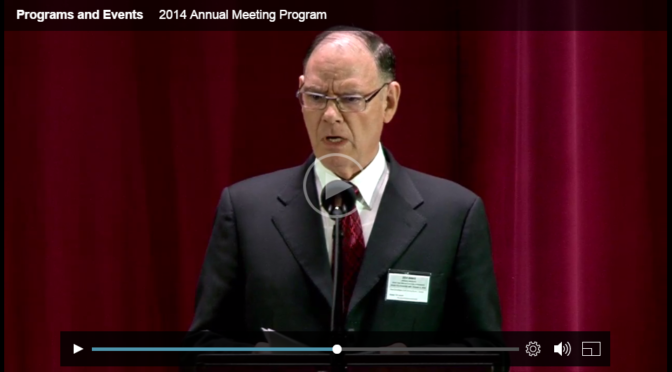
The 2014 Annual Meeting Program video can be found on tv.jw.org (currently found under Programs and Events). The following speech can be found about the 2 hour and 8 minute mark in the video. It ends at about the 2 hour and 25 minute mark.
“David Splane of the Governing Body will speak to us on the theme: ‘Types and Antitypes.’”
Let’s get right into our subject: types and antitypes.
Now, years ago, our publications often applied certain Bible accounts and certain bible characters as “types” of something greater. But you’ve noticed that, in recent years, that is seldom done, and the purpose of this talk is to explain why.
First of all what is a type and what is an antitype? Well, the Watchtower of September 15, 1950 defined them this way. It said:
“A type is a representation of something that will come to pass at a future time. The antitype is the reality of the thing which the type represents.”
So that is the definition that was given by The Watchtower. And we might add that Jehovah is usually involved in designing the type.
Now, take the tabernacle. Jehovah was very clear about the construction of the tabernacle: what materials were to be used, the dimensions and so forth. Why? Well, apparently because he had designed the tabernacle to be a type of something greater: his great spiritual temple. And the temple was the antitype.
The sacrifices on the Day of Atonement. Jehovah was very careful about how events on the Day of Atonement were to unfold. And again, we have to realize that something was going to have to picture or foreshadow the perfect sacrifice of Jesus Christ. So, the sacrifice on the Day of Atonement, the type, and the perfect sacrifice of Christ, the antitype.
Now consider another example. When the disobedient Israelites in the wilderness were bitten by poisonous snakes, Moses is told by Jehovah to fashion a copper serpent and to place that serpent on a pole. Now that was a type. Now Jesus explains what it was a type of. Let’s turn to John chapter 3, John chapter 3 and verses 14 and 15. John 3: 14 and 15 If you are using an iPad, I’ll give you a chance to catch up. [Laughter] I couldn’t resist. “And just as Moses lifted up the serpent in the wilderness, so the Son of Man must be lifted up, so that everyone believing in him may have everlasting life.” Now, would anyone doubt that this is a type? Of course not. Because Jesus said it was.
Well notice that in both these examples, the tabernacle and the copper serpent, Jehovah was involved. He designed the type so that it would fit the antitype. He told Moses, for example to fashion a copper serpent and put it, not on a rock, but on a stake. And of course the tabernacle prefiguring the great spiritual temple.
And from the apostle Paul we learn even more about types and antitypes. For example, Paul, in Hebrews: Isaiah and his 2 sons represent Jesus, and the anointed. He also explains that Moses, the mediator of the Law covenant, represents Christ the mediator of the new covenant. And we learn from the letter to the Galatians that Abraham’s relationship with Sarah and Hagar, represents Jehovah’s relationship with the nation of Israel, and with the heavenly part of his organization. Type and antitype.
Now we know that these were genuine types because, the word of God says they are. But here is the question:
Who is to decide if a person or an event is a type if the word of God doesn’t say anything about it? Who is qualified to do that? Our answer? We can do no better than to quote our beloved brother, Albert Schroeder, who said:
“We need to exercise great care when applying accounts in the Hebrew Scriptures as prophetic patterns, or types, if these are accounts are not applied in the Scriptures themselves.”
Wasn’t that a beautiful statement? We agree with it.
Now the study of types and antitypes is not unique to Jehovah’s Witnesses. During the past 2,000 years, Catholic and Jewish scholars have made quite a diligent study of types and antitypes. In fact, there is even a name for the study. They call it “typology.”
The first century Jewish scholar, Philo of Alexandria, for example, suggested that the serpent in the garden of Eden, the tree of knowledge and the cherubs that were guarding the entrance to the garden were all typical of something greater.
And then describing the teachings of such early writers as Origen, Ambrose and Jerome, the International Standard Bible Encyclopedia says this:
“They sought for types and of course found them, in every incident and event, however trivial, recorded in Scripture. Even the most simple and commonplace circumstance was thought to conceal within itself a hidden truth. Even in the number of fish caught by the disciples when the risen Savior appeared to them,” he says, “How much some have tried to make of that number:, 153 .”
One scholar made much of Jacob’s purchase of Esau’s birthright with a bowl of red stew. Very significant that the stew was red. To him, the red stew pictured the red blood of Christ. The inheritance pictured the heavenly inheritance. It’s all… By that reasoning, Jacob pictures Jesus, Esau’s birthright pictures the heavenly inheritance, and the red stew pictures Jesus’ precious blood.
Now on the surface that might sound plausible to some, until you think about it. When you think about it you see three problems. First of all, Jehovah didn’t design the type. Jehovah did not tell Esau to sell his birthright. Selling his birthright was wrong, and Jehovah never tells us to do something that’s wrong. Second, who ate the stew? Esau did. So are we to conclude that, by giving up his inheritance, Esau put himself in line for the ransom sacrifice of Jesus Christ? That doesn’t make any sense. And most importantly, nowhere in Scripture do we read that the event was a type.
Now the study of types and antitypes was not only common among Catholic and Jewish scholars, but were very prominent among Protestant scholars as well. The Puritans, like Edward Taylor, applied many Bible events to themselves. The Baptists and Congregationalists did likewise. So it’s not surprising that the early Bible Students, who generally belonged to these groups were also really fond of types.
And as many of us have been. Many of us have remembered happy moments at the congregation book study studying all about types and antitypes. And it’s true that the study of types could be thrilling!
So now here’s a question. If the study of a certain subject make chills run up and down your spine, could it possibly be mistaken? And the answer is yes.
The case of brother Arch W. Smith is an example. In 1886, Brother Russell published a book that contained a chart linking the ages of mankind to the Great Pyramid of Egypt. Now that pyramid was called by the Bible Students, the “Bible in stone.” They loved the study of the Pyramid. In fact, if you have seen pictures of Brother Russell’s grave, you’ve noticed that there was a pyramid nearby. And that’s because the Bible Students believed very much in the Great Pyramid of Egypt, and some became very engrossed, in measuring certain rooms and certain features of the pyramid and to try to determine, for example, how long they had to wait before they went to heaven, and so on.
And so one who was just thrilled by the study of types was Arch W. Smith. It was a hobby of his, he loved it. In fact he gave a lot of prayerful thought to the dimension of the pyramid, and from time to time he would write in to Bethel and let them know what his findings were, to support the idea that the Great Pyramid had a place in Jehovah’s purpose. He loved it!
But when The Watchtower of 1928 came out and said that Jehovah doesn’t need a stone monument built by pagans to accomplish his purpose, Brother Smith accepted it. He let reason win out over emotion.
Well, in recent years the trend in our publications has been to look for the practical application of Bible events, and not for types where the Scriptures themselves do not clearly identify them as such. We simply cannot go beyond what is written. Now there’s a real advantage in looking for the practical application of Bible accounts, rather than confining certain applications to one class: “This applies only to the anointed.” “This applies only to the other sheep.”
Let’s just see why. Turn to Romans chapter 15 and verse 4. Now remember that Paul is writing to his anointed brothers here. Romans chapter 15 and verse 4. And he says, “For all the things that were written beforehand” . . . Well what things? The Hebrew Scriptures obviously. . . “were written for our instruction so that through our endurance, that through the comfort of the Scriptures, that we might have hope.” What is Paul telling the anointed? He’s telling them that you can learn from these accounts in the Hebrew Scriptures. You can apply principles of the Hebrew Scriptures to yourselves.
Let’s consider an example: Now soon after his conversion, Paul is preaching in the city of Damascus. The Jews are furious and they try to kill him. So anointed disciples take Paul and they lower him down the city wall in a basket. Is it possible that some of those anointed ones they thought of Rahab? Who helped the two spies escape from Jericho by a similar method? Would anyone say to them, “You can’t apply that to yourselves…Rahab pictures the other sheep, you are of the anointed?” No! They could apply the lessons of that account to themselves.
Now let’s consider another example, a modern one. In the Song of Solomon we read of a chaste young virgin who falls desperately in love with a poor shepherd boy. Solomon, who incidentally was still an inspired Bible writer at the time, but he’s a very wealthy man, he tries to lure her away but he’s unable to do so. Now suppose that in a certain congregation there’s a sweet young sister, who falls head over heels for a poor pioneer brother, who’s a real spiritual man but he doesn’t have a penny to his name. Now her friends encourage her to marry a wealthy brother, who is very rich but he doesn’t have a lot of time to spend on spiritual things. The sister remains firm. They say, you wouldn’t have to work! You can pioneer. She says no my love is for that pioneer boy. Would anyone say to her, the Song of Solomon doesn’t apply to you because you’re of the other sheep, not of the anointed?
You see how practical it is to take these Bible accounts and really apply them to the everyday life of people.
What about others of the other sheep today? In this audience there are modern-day Nehemiahs who are spurring the building programs we have. Wonderful young Timothys, graduates of our Bible schools, warmhearted Tabitha’s, hospitable Lydias. And don’t we find exceptional young Circuit Overseers who are like Elihu in giving wise counsel to elders who are much older. And don’t many Christian young women remind us of dear Rebekah who was willing to follow her husband to a distant land for the accomplishment of Jehovah’s purpose?
We deeply appreciate the spiritual heritage that was passed on to us by the early Bible Students. In harmony with Zechariah chapter 4 and verse 10: “We do not despise the day of small things.” However the light does get brighter. And we feel that we must follow the light, wherever it leads us. Our love should be for the truth and not for a particular doctrine or teaching.
Well how would you sum this talk in a few words?
The wrong answer is, “We don’t believe in types and antitypes any more.” We do! We certainly do. Where the scriptures identify them as such, we embrace them. But where the Bible is silent, we must be silent.
Now in the three talks that follow there are going to be important clarifications in our beliefs.
Perhaps a certain adjustment will touch a spiritual nerve, make us rethink a cherished teaching. Our love for Jehovah and the truth will make us receive this information gladly and with open hearts.
Often today we hear brothers say, we’re having a hard time keeping up with the celestial chariot. So are we. So are the Governing Body. We’re not driving the chariot. Jehovah is driving the chariot and we’re running just as fast as you are, trying to keep up. So let’s all do our best to keep up with it. And let us thank Jehovah for continuing to deal with us. And for continuing to provide nourishing spiritual food.
________end of transcript________
Personal notes:
In the commentary on the Watchtower article based on this talk ( http://ad1914.com/2015/01/26/2107/ ) we pointed out a few items of interest:
First of all, the idea is given that these “type-antitype” explanations have already been phased out to some extent over the past few years, but with no official explanation until now.
The talk mentions that some legitimate examples of “type/antitype” included the tabernacle (shadows), the sacrifices, Abraham’s wife and mistress, and the snake on a pole. The 3/15/2015 Watchtower article replaced the snake on a pole with the sign of Jonah.
It’s pointed out that this “typology” stuff has had a long history among a lot of religions, Jewish, Catholic and Protestant. (And some ridiculously bad examples are mentioned as if they were more ridiculous than Watch Tower examples.)
The logic behind using the Rahab and Shulamite examples is twisted and anachronistic. As far as Paul’s companions knew, there never was and never would be an incorrectly explained “other sheep” class represented by Rahab. And what sister says, “The reason I am choosing the broke pioneer over the rich brother because the Song of Solomon applies to me.” In Splane’s illustration, she never actually says that, but Splane indicates that there is some danger that the sister is going to hear an argument meant to to push her into the arms of the rich brother simply because she is not “anointed” — as if only “anointed” sisters should be able to choose the poor penniless pioneer.
But the speech says, basically, that the Watch Tower teachings took this too far. It says it will only be used from now on if the Bible tells us specifically that it is a “type.” This seems commendable.
The problem is that this new guideline is watered down considerably in the March 15, 2015 Watchtower article based on this talk. It seems very likely that between the Annual Meeting and the end of the 2014, someone noticed that following the words of this talk would completely ruin the two most important unique doctrines of JWs today:
1. That the Kingdom of the pagan, Gentile, violent, insane, Jew-killing Nebuchadnezzar was a “type” of God’s non-Gentile Kingdom through Christ Jesus, the perfect Prince of Peace, as represented by the Jewish Davidic/Messianic Kingdom at Jerusalem.
2. That the “faithful and discreet slave” in Matthew 24:45 was a “type” of the Governing Body.
Also, found it “funny” how Splane treats the old Pyramid scheme, promoted in the Watch Tower publications from the 1880’s to the 1920’s.
The March 15, 2015 article tries to keep the idea of being once “thrilled” by these explanations in the past as a good thing. Splane had used it to show that being thrilled doesn’t always mean it was right.
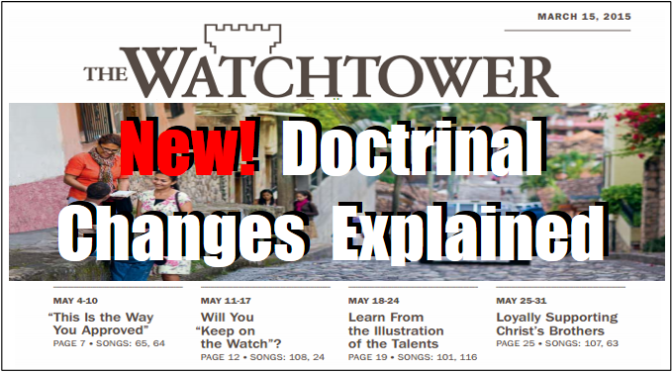
This article is part of a series of “commentary” articles we are presenting about the March 15, 2015 study issue of The Watchtower. Unless otherwise noted, the specific article referenced on this page is: “This Is the Way You Approved” (pps. 7-11). The original article in its original formatting is available on jw.org. Commentary provided by this site (ad1914.com) is provided in blue text which is indented and usually italicized.
Black text is from the original Watchtower article.
Blue text (usually italicized) is our added commentary. Other quotations from prior Watch Tower publications (not the specific article under discussion) or from the Bible, are often presented in black text, although indented.
Emphasis may be added to both the original article and the commentary by formatting with bold, italic or underlining.
SUMMARY OF THE NEW DOCTRINAL CHANGE
The March 15, 2015 Watchtower states that we should now see a clear change to a “way of teaching” which has often been used in the past. That “way of teaching” is referred to as the “type and antitype” method. Although it has not been abandoned entirely, the article indicates that it should only be used when there is a clear Biblical statement that the illustration or narrative is, in fact, a prophecy.
“You have carefully hidden these things from wise and intellectual ones and have revealed them to young children.” — LUKE 10:21 _______________________________________________________
THE ARTICLE TITLE
The title’s reference to “this is the way you approved” is taken from a portion of Luke 10:21, the same theme Scripture cited along with the title of the article. This Bible verse, by the way, was not mentioned in the original “2014 Annual Meeting” discourse that the Watchtower article is based on.
THE BACKGROUND
Historically, The Watch Tower publications have consistently claimed right from the very start in 1879 that Biblical parables in the Greek Scriptures (“New Testament”) and Biblical narratives from the Hebrew Scriptures (“Old Testament”) should be treated as prophecies. If it was an event or circumstance from someone’s life (like Naboth or Naaman or Jehonadab), or if it was an obvious general moral lesson (like the Good Samaritan or the Prodigal Son), it also had to be explained as a prophetic drama where various characters and details were prophetic of some future events. Those events usually related to the history of the Watch Tower Society in the last 100 years. As an older Watchtower had stated it:
“Such parables were also prophecies which find their fulfillment in happenings of our day that have a connection with the spiritual things of God. In the prophetic Psalms it is written: …’I will incline mine ear to a parable [from God]’… This shows that such parable is a prophecy which foretells coming things that have a likeness to or are comparable with the things related in the parable.” (Watchtower, November 1, 1943)
THE ORIGINAL MATERIAL FOR THE MARCH 15, 2015 ARTICLE (2014 ANNUAL MEETING)
The Watchtower article is a revision of a talk given by David Splane, a member of the Governing Body of Jehovah’s Witnesses, at their October 4, 2014 “Annual Meeting.” A video is available at tv.jw.org, and this particular segment of the program begins at about the 2 hour and 8 minute mark in that video. The Annual Meeting speech was introduced as the first of four “historic discourses” on Scriptural subjects. (An unofficial transcript of the discourse is on this site, here.) The other topics were: “The Talents” “The 10 Virgins” and “Gog and Magog.” The original talk did not reference the specific idea that “this is the way you have approved.” It was merely introduced with the words: “To begin, Brother David Splane of the Governing Body will speak to us on the theme: ‘Types and Antitypes.'”
IT’S NOT FUNNY IF YOU HAVE TO “SPLANE” IT David Splane said: “. . . So anointed disciples take Paul and they lower him down the city wall in a basket. Is it possible that some of those anointed ones, they thought of Rahab? … Would anyone say to them, ‘You can’t apply that to yourselves! Rahab pictures the other sheep. You are of the anointed’?. . .” [Note that David Splane’s words are a ludicrous anachronism, because according to the Watchtower Society, no one could know the actual identity of the “other sheep” until it was revealed through what the Watchtower has called “flashes of lightning in the spiritual temple” just prior to 1935. This awkward example provides a hint that one of the “drivers” for this change is the complete inability for Jehovah’s Witnesses to relate so many Biblical anecdotes and parables to the anointed class. It’s just as difficult for the average Witness to speak about the relationship between the anointed class and the “other sheep.” (That’s what many of the explanations were about.) In other words, Splane was looking for something ludicrous – on purpose – so that it clearly appears inappropriate to apply so many texts only to the “anointed” when, by their own expectations, no anointed person outside of the Governing Body themselves, should have any current significance to current Witnesses.]WHY CHOOSE THIS PARTICULAR SCRIPTURE THEME
Luke 10:21 is treated as a Scriptural basis for changing the Watchtower’s long-standing teaching method. Because the practice had been common in literally hundreds of prior Watch Tower teachings going back to the very beginning in the late 1870’s. It would hardly have occurred to most Jehovah’s Witnesses that this method of teaching used for the last 4 or 5 generations of Witnesses might not be “way that you [Jehovah] approved.” Yet, it was the clearly the way that Russell approved, the way that Rutherford approved, the way that Nathan Knorr and Frederick Franz approved. It was the way that the Watch Tower Society and the Governing Body had always approved, too. At least until very recently.
Luke 10:21 does appear to support such a change because the verse appears to support “simplicity and clarity” due to the reference to revealing “these things” to “children” as opposed to the “wise and intellectual ones.” The Watch Tower’s hundreds of teachings based on the idea of “types and antitypes” did, indeed, produce unclear and unnecessarily complex, ever-changing explanations. (See prior articles on this site about the Prodigal Son and Elijah/Elisha, for example.) Jesus, on the other hand, was famous for using powerfully simple illustrations that attracted disciples who were “unlettered and ordinary,” with a childlike humility, and who therefore had no problem asking Jesus himself for the explanations. It’s also true that those who were known for religious or secular education in those days, were considered to be haughty and self-important. These were the wise and intellectual persons, such as the scribes and Pharisees. Unlike the disciples, they must have thought it was beneath them to ask Jesus what these illustrations meant.
So from a logical perspective, the article appears to be on the right track. Luke 10:21 seems appropriate enough. And, of course, most anyone would agree with the basic premise that teachings should be simpler and clearer, and we would also agree that the Watchtower’s “type-antitype” method, which has been in use throughout the entire history of the Watchtower, has not been the way Jehovah approved. But…
JUST ONE PROBLEM WITH USING THAT SCRIPTURE, THOUGH . . .
Upon closer inspection, although the premise is generally true, Luke 10 is not applicable here. We won’t get into all the reasons for this, but some of them are mentioned under the discussion of Paragraph 1, below. Basically, while points in favor of simplicity and clarity could have been easily made with other scriptures, Luke 10:21 is not the appropriate verse to make this point.
Luke 10:21 is not talking about a method of teaching. In fact, “the things” that were hidden from wise and intellectual ones and revealed to young children were things related specifically to what the disciples became aware of through activities when Jesus wasn’t even with them. Jesus sent them off on their own (“by twos”) to preach in cities and villages. When they reported back to Jesus at a later time, they explained what had been revealed to them in those villages and cities.
The strained (and dishonest) method that the Watchtower article utilizes to tie “the things” revealed to a simpler “method of teaching” indicates clearly that the Watchtower writers were very well aware that Luke 10:21 was not a good fit here. So, it must have been used only because the idea of Jehovah’s “approval” was a very important and necessary theme.
LOOKING FOR APPROVAL
We’ll see why the idea of continued “approval” is as important as the change in doctrine itself.
There are two major reasons for this:
REASON #1: OVERCOMING A POTENTIALLY MASSIVE EMBARRASSMENT
The change in doctrine presented here reveals that most of the teachings of the Governing Body have been wrong. These may not have been the most important teachings, but when one goes through the Bible, page-by-page and lists all the doctrinal teachings that the Watch Tower has gleaned from the Bible’s content, it turns out that a large proportion of the teachings have been about “types and antitypes.” Just look at the list from the Watch Tower’s own publication about a few of them:
Another list of such “type-antitype” doctrines was referred to in the following Watchtower article in 1981:
*** w81 3/1 p. 27 Do You Appreciate the “Faithful and Discreet Slave”? ***
OVERWHELMING CREDENTIALS
The “faithful and discreet slave” has abundant credentials. Following is a partial list of Scriptural and prophetic designations applying to or being represented in the remnant of Jesus Christ’s anointed followers since the notable year 1919:
(1) Noah’s wife, Gen. 7:7; (2) angels sent to Lot, Gen. 19:15; (3) Rebekah, Gen. 24:64; (4) Joseph and Benjamin, Gen. 45:14; (5) gleanings left behind, Lev. 19:9; (6) two spies to Rahab, Josh. 2:4; (7) Barak, Judg. 4:14; (8) Jephthah, Judg. 11:34; (9) Naomi and Ruth, Ruth 2:2; (10) David’s Israelite warriors, 2 Sam. 18:1; (11) Jehu, 2 Ki. 10:11, 15; (12) Mordecai and Esther, Esther 4:13; (13) Job, Job 42:10, 13; (14) King’s daughter, Ps. 45:13; (15) men of loving-kindness, Ps. 50:5; (16) intimate group, Ps. 89:7; (17) Shear-jashub, Isa. 7:3; (18) light of the nations, Isa. 60:3; (19) big trees of righteousness, Isa. 61:3; (20) ministers of our God, Isa. 61:6; (21) cluster preserved, Isa. 65:8; (22) servants called by another name, Isa. 65:15; (23) men trembling at God’s word, Isa. 66:5; (24) new nation born, Isa. 66:8; (25) Jeremiah, Jer. 1:10; (26) Jehovah’s people in the new covenant, Jer. 31:33; (27) enduring watchman, Ezek. 3:16-27; (28) man in linen, Ezek. 9:2; (29) cleansed people, Ezek. 36:29-32; (30) dwellers in center of earth, Ezek. 38:12; (31) the host of heaven, Dan. 8:10; (32) sanctuary restored (cleansed), Dan. 8:14; (33) they that are wise, Dan. 11:33; (34) the happy one who is keeping in expectation, Dan. 12:12; (35) all flesh receiving the spirit, Joel 2:28; (36) Jonah, Jon. 3:1-3; (37) apple of Jehovah’s eye, Zech. 2:8; (38) liberated remnant, Zech. 2:7; (39) a Jew, Zech. 8:23; (40) sons of Levi, Mal. 3:3; (41) wheat, Matt. 13:25; (42) sons of the kingdom, Matt. 13:38; (43) workers for the vineyard, Matt. 20:1; (44) those invited to marriage feast, Matt. 22:3-14; (45) chosen ones, Matt. 24:22; (46) eagles, Matt. 24:28; (47) faithful and discreet slave, Matt. 24:45; (48) discreet virgins, Matt. 25:2; (49) brothers of the king, Matt. 25:40; (50) little flock of sheep, Luke 12:32; (51) beggar Lazarus, Luke 16:20; (52) sheep in “this fold,” John 10:1-16; (53) branches of the vine, John 15:4; (54) royal palace of David, Acts 15:16; (55) heirs with Christ, Rom. 8:17; (56) the remnant, Rom. 11:5; (57) branches in the olive tree, Rom. 11:24; (58) holy ones or saints, 1 Cor. 6:2; Rev. 16:6; (59) temple, 1 Cor. 6:19; (60) new creation, 2 Cor. 5:17; (61) ambassadors for Christ, 2 Cor. 5:20; (62) congregation of God, Gal. 1:13; (63) part of Abraham’s seed, Gal. 3:29; (64) Israel of God, Gal. 6:16; (65) body of Christ, Eph. 1:22, 23; (66) soldiers of Christ Jesus, 2 Tim. 2:3; (67) house under Christ, Heb. 3:6; (68) holy priesthood, 1 Pet. 2:5; (69) holy nation, 1 Pet. 2:9; (70) association of brothers, 1 Pet. 2:17; (71) seven congregations, Rev. 1:20; (72) twenty-four persons of advanced age, Rev. 4:4; (73) spiritual Israel, Rev. 7:4; (74) locusts, Rev. 9:3; (75) two witnesses, Rev. 11:3; (76) two olive trees, Rev. 11:4; (77) seed of the woman, Rev. 12:17; (78) New Jerusalem, Rev. 21:2; (79) the bride of Christ, Rev. 22:17; 19:7; (80) Jehovah’s witnesses, Isa. 43:10.
Amazing! Watch Tower publications claimed there were 42 “types” for the great crowd and 80 “types” for the “faithful and discreet slave.” That’s 124 places in the Bible — 124 “minor” teachings — that all add up to do little more than help create the clergy-laity distinction among Jehovah’s Witnesses.
Thinking about the amount of ink that has been poured into so many of these “type and antitype” teachings, it should be easy for anyone to see that being wrong about so many Scriptures actually brings reproach on the Governing Body for having been so “unfaithful and indiscreet” with respect to Bible teaching for so many years. The March 15, 2015 article invalidates hundreds of “little” doctrines, many of which were taught for more than one hundred years. This calls into question the Governing Body’s claim of providing spiritual food at the proper time. It calls into question any claim of being “faithful and discreet” with respect to their handling of God’s word, or claiming to be “teachers.”
Think about the following verses, for example:
(2 Timothy 2:15) Do your utmost to present yourself approved to God, a workman with nothing to be ashamed of, handling the word of the truth aright.
(2 Corinthians 4:2) …not walking with cunning or adulterating the word of God; but by making the truth manifest, ….
(James 3:1) Not many of you should become teachers, my brothers, knowing that we will receive heavier judgment.
(Matthew 15:6-9) 6. . .So you have made the word of God invalid because of your tradition. . . .9 It is in vain that they keep worshipping me, for they teach commands of men as doctrines.’”
(1 Corinthians 4:6) “. . .that through us you may learn the rule: ‘Do not go beyond the things that are written,’ so that you may not be puffed up with pride. . .”
REASON #2: THE “FAITHFUL SLAVE” DOCTRINE IS JUST ANOTHER OBSOLETE TYPE-ANTITYPE
The very doctrine of the “faithful and discreet” slave is based on this same method of teaching which is now no longer considered “the way [Jehovah] approved.” Logically then, this means that we have no reason to think of the parable of the “faithful and discreet slave” as a prophecy about a group of men who would come into existence only in the year 1919. Therefore, there is no reason to expect that the Governing Body is specially “appointed” or “approved.” Under the principles of the March 15th article, the Governing Body can no longer be “the faithful and discreet slave” based on Matthew 24:45. Therefore, the parable about “the faithful and the evil slave” is really just a moral lesson about continued patience where Christians are warned not to misbehave, and not to set themselves up above their fellow slaves just because of a delay in Jesus’ return. In other words, in the area of setting themselves up over their fellow slaves, the Governing Body has done exactly what Jesus was explaining they should not do.
Again note the following related scriptures (from the NWT) which help explain the practical meaning of Jesus’ illustration, rather than the obsolete “type-antitype” method:
(Luke 12:42, 43) And the Lord said: “Who really is the faithful steward, the discreet one, whom his master will appoint over his body of attendants to keep giving them their measure of food supplies at the proper time? Happy is that slave if his master on coming finds him doing so!
(Luke 16:10) The person faithful in what is least is faithful also in much, and the person unrighteous in what is least is unrighteous also in much.
(Galatians 6:10) So, then, as long as we have the opportunity, let us work what is good toward all, but especially toward those related to us in the faith.
(1 Peter 4:10) To the extent that each one has received a gift, use it in ministering to one another as fine stewards of God’s undeserved kindness that is expressed in various ways.
(1 Timothy 5:8) Certainly if anyone does not provide for those who are his own, and especially for those who are members of his household, he has disowned the faith and is worse than a person without faith.
(1 Corinthians 4:2) In this regard, what is expected of stewards is that they be found faithful.
What the illustration should have meant all these years to Witnesses is fairly obvious, then. All Christians are required to do good for one another, continually and faithfully, no matter how long Christ’s return seems delayed.
But the “Governing Body” isn’t about to give up this particular “type-antitype” teaching. So, one of the reasons the article provides this scriptural theme about Jehovah’s approval is so that Witnesses are diverted from noticing that this is only a “selective obsolescence.” Before the reader even thinks about the details of the new teaching, the Watchtower and the Governing Body are first aligned with “Jehovah’s approval.”
Instead, the Governing Body is intent on highlighting that they are the ones who continue to make improvements and refinements, and that this new change is the real way that Jehovah approved. And if the Governing Body are now conforming to a teaching method that Jehovah approves, then they are, therefore, teachers with a stamp of approval from Jehovah.
Also, the Governing Body is not admitting that they are finally conforming, in general, to the basic ideas that Biblical scholars and “Christendom’s” commentaries have explained for centuries. Most religions have long rejected the “type-antitype” explanations. In fact, David Splane’s speech at the 2014 Annual Meeting excused the practice by focusing on how many others religions, Jewish, Catholic, and Protestant, have done the same thing through the centuries.
EVEN IF YOU DON’T BELIEVE IN SUBLIMINALS…
The phrase “this is the way you [Jehovah] approved” will likely remind Jehovah’s Witnesses of the account of Jesus’ baptism, or Paul’s words found in 2 Cor 10:18: “For it is not the one who recommends himself who is approved, but the one whom Jehovah recommends.” But most Witnesses will also connect these ideas with Jehovah’s “approval” of the Governing Body.
*** w98 2/15 p. 21 par. 14 Glorious Freedom Soon for the Children of God *** Whether our hope is heavenly or earthly, all of us receive spiritual food through Jehovah’s approved “faithful and discreet slave.” (Matthew 24:45-47)
In fact, the original discourse during the “2014 Annual Meeting” reminded the audience that this updated teaching was related to everyone keeping up with the “celestial chariot,” and Splane added that this specifically included, “the Governing Body.” After a bit of laughter about the idea of the Governing Body also having trouble keeping up with the chariot, he said:
[Referring to the Governing Body:]“We’re not driving the chariot, Jehovah is…and let us thank Jehovah for continuing to deal with us. And for continuing to provide spiritual food.”
WHY NOT PRINT AN APOLOGY, INSTEAD?
Clearly, the Watchtower could have printed an apology. Perhaps the title and scripture text would have been:
“A Way of Teaching that Jehovah Never Approved.”
“You have made the word of God invalid because of your tradition.”—Matthew 15:6.
“Recent examples” of changes to Watch Tower teachings are invoked show that Jehovah approves all of them. This is, of course, meant to prepare the reader to approve of the changes to various teachings, and respond positively.
“Our way” (meaning: the Watch Tower Society’s way) of explaining Bible accounts has changed “gradually,” which is exactly what Jehovah’s Witnesses have been taught to expect of the Watch Tower Society through the repetition of the phrase: “The light keeps getting brighter and brighter.” This has been the solution to dozens of problems with teachings in the past so that no one ever labels them “false” doctrines. Doctrines don’t change from “false” to “true.” Past doctrines are rarely even called “mistaken.” Instead all the focus is on “further clarifications” or “brighter light.”
“Our understanding” refers (again) to the understanding presented in the Watch Tower publications, the understanding promoted by the Governing Body of Jehovah’s Witnesses. The idea of “increasing light” is repeated again using the word “refinement.” This is just another way to excuse the Watch Tower’s prior rejected teachings without ever hinting they were “false.” In fact, it implies that prior “false” teachings were in some sense “true.”
This idea has been indicated in past publications by implying that a now-changed doctrine was important at the time. In fact one of these past “false” doctrines was justified by calling it “incomplete, even inaccurate” yet the wrong (inaccurate) doctrine was referred to again just a few sentences later referred to like this: “That was an important lesson, one that fortified them during the years of world turmoil that followed.” (“Proclaimers” p. 146)
The idea of “refinement” reminds us of gold, for example, which is valuable, not to be “despised” even if unrefined. But it becomes more valuable when refined. This idea has also been used to promote the idea that even incorrect teachings somehow still had some value in our history. This idea was also found repeated in the conclusion of David Splane’s original discourse, when he pointed out that we were once “thrilled” with these doctrines. Yes, we were “thrilled” with doctrines which are now shown to be untrue, yet we should not “despise the day of small things.” (Taken from Zechariah 4:10, almost always used with this idea of appreciating the Watchtower’s small beginnings, including the mistakes of the past.)
WHOA! TAKE IT EASY! NOT TOO MUCH TRUTH ALL AT ONCE, PLEASE!
Highlighting that these are “gradual” refinements also accomplishes two other goals.
First, it keeps Witnesses from feeling overwhelmed with trying to keep up with too many changes at once. (Splane addressed that same issue with his “celestial chariot” reference.) The average Witness accepts the idea of gradual refinement as the application of the “proper time” portion of the phrase “food at the proper time.”
Second, it keeps Witnesses from making too many assumptions on their own about what this might mean with respect to further, future changes. It would be dangerous to have too many Witnesses speculating about the effect of this particular change on additional parables and narratives that haven’t been discussed yet. (Especially the very teaching that supposedly gives authority to a modern-day Governing Body or “faithful and discreet slave.”)
[Paragraph] 1. What moved Jesus to become “overjoyed in the holy spirit”? (See opening image.)
CAN you imagine what it was like to see Jesus Christ become “overjoyed in the holy spirit”? Perhaps you picture his features lit up by a broad smile, his eyes twinkling with pleasure. What was it that moved him so? He had recently sent out 70 of his disciples to preach the good news of God’s Kingdom. He was keenly interested in how they would handle their assignment. There were many powerful enemies of the good news, such as the clever and highly educated scribes and Pharisees. They influenced many to look down on Jesus as a mere carpenter and on his disciples as “uneducated and ordinary men.” (Acts 4:13; Mark 6:3) Nonetheless, the disciples returned from their mission aglow with excitement. They had preached despite opposition, even from demons! What accounted for their joy and courage?—Read Luke 10:1-23.
This first paragraph provides a good example of how a teaching method can be simple and clear, but still be wrong. The problem isn’t about wrong statements or factual mistakes, but the fact that key details are left out. This makes it easier for the reader to accept a wrong answer to the question by the time the reader gets to paragraph 3. It’s unusual for the Watchtower to ask a question in paragraph 1 that isn’t answered in the same paragraph. But paragraph 3 provides the only direct answer to the question: What moved Jesus to become “overjoyed in the holy spirit”? Note:
No wonder Jesus was so pleased! It made him happy to see the way Jehovah revealed deep spiritual truths to humble people of all sorts, regardless of their education or intellectual gifts. He was delighted that his Father approved of this way of teaching. Has Jehovah changed, and how does he show that he still approves of this kind of teaching?
The idea that Jehovah approves of simple and clear teaching methods makes perfect sense. But it was not a “method of teaching” that made Jesus rejoice in this particular case. The context of Luke 10 makes it clear that Jesus’ rejoicing, and “the things” revealed to the disciples are more closely related to power over Satan and his demons. It wasn’t about something they were taught, but about the fact that they were all now the very first subjects of a Kingdom that was already going into effect right in front of their eyes. These disciples were getting to know the Father though the power of his Kingdom. As Jesus said:
17 Then the 70 returned with joy, saying: “Lord, even the demons are made subject to us by the use of your name.” 18 At that he said to them: “I see Satan already fallen like lightning from heaven. 19 Look! I have given you the authority to trample underfoot serpents and scorpions, and over all the power of the enemy, and nothing at all will harm you. 20 Nevertheless, do not rejoice because the spirits are made subject to you, but rejoice because your names have been written in the heavens.” 21 In that very hour he became overjoyed in the holy spirit and said: “I publicly praise you, Father, Lord of heaven and earth, because you have carefully hidden these things from wise and intellectual ones and have revealed them to young children. Yes, O Father, because this is the way you approved. 22 All things have been handed over to me by my Father, and no one knows who the Son is except the Father, and no one knows who the Father is except the Son and anyone to whom the Son is willing to reveal him.” 23 With that he turned to the disciples and told them privately: “Happy are the eyes that see the things you are seeing. 24 For I say to you, many prophets and kings desired to see the things you are observing but did not see them, and to hear the things you are hearing but did not hear them.”
The Watchtower is therefore giving a wrong answer, a false answer, to the question about what moved Jesus to be overjoyed in the holy spirit?” The context of Luke 10 does not refer to a method of teaching when he spoke of “these things” which had been carefully hidden from wise and intellectual ones. Nor is a method of teaching the “way that you [Jehovah] approved.”
Note that the accompanying picture and the Watchtower’s wording might also lead a reader to believe that the scribes and Pharisees are key players in the context of Luke 10:1-24. They aren’t. They aren’t even mentioned once in this narrative about the 70 evangelizers, although it is true that they would be considered among the most wise and educated in that day.
But notice how cleverly the words of Jesus are changed in meaning: Jesus said: “I have given you authority…over all the power of the enemy….because the spirits are made subject to you…” Yet the Watchtower, not wanting to mention Satan, refers to this by explaining: “There were many powerful enemies of the good news, such as the clever and highly educated scribes and Pharisees.” The Bible referred only to Satan and the spirits, and the Watchtower referred only to “scribes and Pharisees.”
[Paragraph] 2. (a) How were Jesus’ disciples like children? (b) What enabled Christ’s followers to grasp vital spiritual truths?
2 Note what Jesus said to Jehovah: “I publicly praise you, Father, Lord of heaven and earth, because you have hidden these things from the wise and intellectual ones and have revealed them to young children. Yes, O Father, because this is the way you approved.” (Matt. 11:25,26) Of course, Jesus did not mean that his disciples were children in a literal sense. Rather, he knew that they seemed to be children compared to the intellectual and highly educated ones in the land, who were wise in their own eyes. More important, Jesus taught his followers to be like children, remaining humble and teachable. (Matt. 18:1-4) How did they benefit from being humble? By means of holy spirit, Jehovah helped them to grasp vital spiritual truths while the wise and intellectual ones, who scorned them, remained blinded by Satan and by their own pride.
Yes, it’s true that a child-like humility enabled the disciples to grasp vital spiritual truths. Although Luke 10 is not about how Jesus’ disciples grasped truths from his teaching method, there are other Bible passages that could have be used to indicate this. Luke 10 is really about how Jesus had been given authority to begin preparation for his kingship. The nearness of his Kingdom was being demonstrated through “spirit and power.” The apostle Paul made similar points in 1 Corinthians, which further helps identify “these things” that were revealed.
(1 Corinthians 1:19-2:20) …but to us who are being saved, it is God’s power. 19 For it is written: “I will make the wisdom of the wise men perish, and the intelligence of the intellectuals I will reject.” …24 … Christ is the power of God and the wisdom of God. … 30 But it is due to him that you are in union with Christ Jesus, who has become to us wisdom from God, also righteousness and , sanctification and release by ransom…” (1 Cor 2:4-12) ”…and my speech and what I preached were not with persuasive words of wisdom but with a demonstration of spirit and power,…12 Now we received, not the spirit of the world, but the spirit that is from God, so that we might know the things that have been kindly given us by God. …(1 Cor 4:20) For the Kingdom of God is a matter not of speech but of power.
Jesus was overjoyed with them in their success, especially as it proved the Kingdom was real, indicated through power and authority over the demons. As already stated, the revelation of “these things” to child-like disciples of Jesus, as opposed to revealing them to the wise and intellectual ones is really about the shift of power and authority in the world. Those who would be favored as subjects of the new king, and those who would be granted authority in this new kingdom were not the persons the world would have expected.
A KING AND HIS EMISSARIES
In fact, the whole scene starting in Luke 10:1 reminds us of how men such as a king, a general or king’s appointee were sometimes given authority to send out a delegation of dignitaries or emissaries in advance of their own arrival. (Note the opening verse of the chapter: “to every city and place where he himself [Jesus] was to go.“) ‘
This kingdom was now in the making, and was being announced around the year 33 CE as “near.” And these disciples, as subjects of the King, were now living in a special historical time — a time that kings and prophets wished they could have seen and heard according to Luke 10:24. Paul made the same point in 1 Cor 2:8-10:
8 It is this wisdom that none of the rulers of this system of things came to know…9 But just as it is written: “Eye has not seen and ear has not heard, nor have there been conceived in the heart of man the things that God has prepared for those who love him.” 10 For it is to us God has revealed them through his spirit, for the spirit searches into all things, even the deep things of God.
The idea that “these things” were revealed through a simple way of teaching misses the point. What was revealed to the disciples that caused Jesus such joy was what they had seen on their own after Jesus sent them out.
SATAN CAST OUT IN 1914?
The importance of the spirit’s power over Satan and his demons and the rulers of this world is the real focus of the passage. Yet, Satan is just barely referred to in this Watchtower article as if that was just an unimportant side point. Much more attention is given to how these disciples stood up to Pharisees and scribes — who aren’t even mentioned in the context of the disciples’ mission! Yet, Jesus’ response was a specific joy over the fact that his disciples were proving that Satan was already falling from heaven. (Luke 10:18)
This is, of course, a point of confusion to Jehovah’s Witnesses who have been taught that this event did not occur until 1914. Witnesses are also taught that Jesus did not receive his authority and power until 1914. Yet in this passage, Jesus makes specific reference to the handing over of power from the Father to Jesus (v. 22). This passage in Luke anticipates that such power was already being transferred, and was about to be transferred completely.
The Bible is clear that the kingship and authority and power of Jesus, and the real casting down of Satan happened through Jesus’ death and resurrection. Other articles on this site already cover that point. Note that the following verses are tied to the time of Jesus’ death and resurrection.
Mt 28:18,– Jesus approached and spoke to them, saying: “All authority has been given me in heaven and on the earth.
John 10:31,33 — Now there is a judging of this world; now the ruler of this world will be cast out…. 33 This he was really saying to indicate what sort of death he was about to die.
1 Corinthians 2:6 — the rulers of this system of things, who are to come to nothing. . .
The Scriptures may indeed indicate that the full destruction of Satan is still future, but there is no Scriptural reason to believe that he was not already cast down back around 33 CE, at Jesus’ death and resurrection. Therefore, there is no reason to pin this event to 1914.
[Paragraph] 3. What will we discuss in this article?
3 No wonder Jesus was so pleased! It made him happy to see the way Jehovah revealed deep spiritual truths to humble people of all sorts, regardless of their education or intellectual gifts. He was delighted that his Father approved of this way of teaching. Has Jehovah changed, and how does he show that he still approves of this kind of teaching? As we examine the answer, we may find that it brings us keen delight, just as it did Jesus.
It’s true that Jesus was happy to see deep spiritual truths revealed to humble people of all sorts regardless of their education or intellectual gifts. And it’s also true that”these things” that the Father had revealed definitely would have included “deep spiritual truths.” So, up to this point, this is a pretty good answer to why Jesus was overjoyed.
Following that, the Watchtower states that Jesus “was delighted that his Father approved of this way of teaching.” This is actually a bit sneaky. It’s just slipped in here as if it is related to the context of the Scripture. It’s not part of the Scripture. A “way of teaching” is not what his Father approved! Of course, once that wrong idea creeps in, the original correct idea is dropped quickly. It’s no longer part of the discussion, although the incorrect portion gets repeated and further highlighted and solidified by attaching it to God’s unchangeableness. Again, the idea itself is not incorrect. It’s the false logic that incorrectly extracted this idea from Luke 10:21. This wouldn’t be that much of a problem to highlight, except for the fact that this particular set of Watchtower articles is trying to tell us that the writers are determined to be more careful from now on about the way they explain the Scriptures. Therefore, their mistake already reveals sloppy, and unclear thinking in a article, ironically, about clarity of teaching.
BUT YOU CONTRADICT YOURSELF
It’s worth noting that this lack of clear thinking was so strained that it forced a contradiction when compared with the Watchtower’s own explanation of this passage just a few short years ago (in 2011).A quick look at this example will also reveal something more about how the Watchtower often walks a fine line between dogmatism and confusion. Note this previous explanation of Luke 10:18, which is the same verse just discussed that indicates how Satan was already seen as “fallen from heaven.”
*** w11 9/1 p. 9 The World’s Secret Ruler Exposed ***
With those words, Jesus was rejoicing at his future victory over the ruler of the world, to take place once Jesus was back in heaven as Michael the archangel. (Revelation 12:7-9) A thorough study of Bible prophecies indicates that this victory took place in heaven in or shortly after 1914.
The first sentence actually agrees with our own general commentary about Luke 10:18. In the context of Luke 10, Jesus was indeed rejoicing with the disciples about a victory over Satan. But that Watchtower from 2011 directly contradicts this current March 15, 2015 article’s claim that Jesus was rejoicing over a “method of teaching.”
DON’T HOLD US TO A TIMELINE
A careful look at the 2011 example above also reveals another problem in clarity, where the last quoted sentence as the Watchtower tries to be less dogmatic about 1914. By saying “in or shortly after 1914” it ends up allowing for Satan to be cast out in 1915, or 1919, or maybe 1935, or 1975. Perhaps this phrase already indicates that its writer had doubts about 1914 as the start of Christ’s presence, too. (Perhaps, the “1914” doctrine itself is already fallen like lightning from the realm of Watch Tower dogma!)
This is the same thing that recently happened with the Watch Tower’s once-absolute teaching that the “first resurrection” occurred in 1918. This was another event that had been timed to “shortly after 1914.” Note:
*** w82 4/1 p. 22 par. 8 The Kingdom and the Resurrection Hope *** The apostle Paul writes: “The Lord himself will descend from heaven with a commanding call, with an archangel’s voice and with God’s trumpet, and those who are dead in union with Christ [starting from the first century and up to Christ’s coming to the spiritual temple in 1918] will rise first.” (bracketed portion in the original)
But then in a 2007 article, quoted below, this sure thing became nothing more than “an interesting possibility” that couldn’t be directly confirmed in the Bible. Note:
*** w07 1/1 p. 28 par. 12 “The First Resurrection”—Now Under Way! ***
At this point, it may be helpful to consider what might be viewed as a Bible parallel. Jesus Christ was anointed as the future King of God’s Kingdom in the fall of 29 C.E. Three and a half years later, in the spring of 33 C.E., he was resurrected as a mighty spirit person. Could it, then, be reasoned that since Jesus was enthroned in the fall of 1914, the resurrection of his faithful anointed followers began three and a half years later, in the spring of 1918?That is an interesting possibility. Although this cannot be directly confirmed in the Bible, it is not out of harmony with other scriptures that indicate that the first resurrection got under way soon after Christ’s presence began.
It’s that second part about how “this cannot be directly confirmed in the Bible” that readers who study the March 15, 2015 issue will see repeated several times. And, this need for “direct confirmation in the Bible” may ultimately turn a lot more doctrines into nothing more than “an interesting possibility.”
DOGMATIC TRANSMISSION
People want sureness in their lives. It’s a good part of any religion’s appeal. Many people find it unsettling to read ideas that are left open to interpretation. The human mind tends to want “black and white” answers. When a trusted authority says they don’t know, this can be troubling, but it can also be a good thing, because we would then naturally attempt to think for ourselves in our desire for solid answers.
We bring up this idea because a loss of dogma on several prophetic issues is slowly becoming the “new normal” for the Watch Tower. It’s easy to imagine what could happen when Jehovah’s Witnesses will now begin to read these older Watch Tower publications with less dogmatism in their mind. How might this affect their reading of Scripture itself? For example, note how just thinking about the scriptures related to this subject of “the first resurrection” might easily put a Witness on a path to reject the entire idea of a supposed “presence” since 1914:
What happens to the theory of the “invisible presence” when a Witness reads what Jesus said in Matthew 18:20? “For where there are two or three gathered together in my name, there I am in their midst.”
What if a Witness were to think too long about the phrase from Matthew 28:20 “Look! I am with you all the days until the conclusion of the system of things.” This verse hurts 1914 from both sides. If this conclusion began in 1914, then Jesus is no longer “present” with us, because he was only going to be present until the conclusion. But if Jesus, around 33 CE, said he is already with them all the days until then, he was clearly present from 33 to 1914.
This one is more subtle, but look at how Paul indicates that all of them will begin ruling at the same time. There is therefore no need of a resurrection that starts back around 1914 and continues past 2014. Paul says in 1 Cor 4:8? “Have you begun ruling as kings without us? I really wish that you had begun ruling as kings, so that we also might rule with you as kings.”
And this will surely inform their less dogmatic reading of 1 Thessalonians 4:15? “…we the living who survive to the presence of the Lord will in no way precede those who have fallen asleep in death. . . .” In current Watch Tower teaching, almost all of them precede one another.
What about what Paul said in 2 Timothy 2:18? “. . .These men have deviated from the truth, saying that the resurrection has already occurred, and they are subverting the faith of some.”
This is the “danger” of the less dogmatic mindset supported by the March 15th issue. Over time, it is exactly the mindset that will expose these weak links in Watch Tower doctrines.
TEACHING AN OLD DOGMA NEW TRICKS
We spoke about the change in dogmatism as it might apply to a Witness reading the Bible under this new “guidance.” It’s going to hit those who go back and read older Watch Tower publications even harder. In a single step, Witnesses are told not to trust hundreds of these old type-antitype teachings, and realize they are no longer capable of reading older material without concerns on almost every page. (In some articles and books, the type-antitype doctrines are pervasive.) A Watchtower reader must now refer back to older material and continually run it the material through a mental “lower-the-dogmatism” filter. That’s what is now required after reading the March 15, 2015 Watchtower, because it tells Witnesses that what they are reading from the past might be changing — even if it has not specifically been updated yet. They are told it has been a “gradual” process that they might have noticed.
Let’s look at just a couple more examples of the Watch Tower’s past use of varying degrees of dogma. The following two examples refer to Luke 10:18 again. Imagine reading with a re-adjusted “dogmatism filter:”
*** w08 3/15 p. 32 Highlights From the Book of Luke ***
Although we cannot be dogmatic, by referring to a future event in the past tense, Jesus was evidently emphasizing that it would certainly happen.
Here, the dogmatism filter was already explicitly turned down a notch with the words “we cannot be dogmatic.” In the past, that didn’t matter, because Witnesses were to believe it anyway unless explicitly told otherwise. But when alerted to the dogmatism level, Witnesses are now more likely to take notice. Therefore, the new reading of the words quoted above actually appears to question out loud whether or not the verb tense of Luke 10:18 means that Satan already was being cast down (as it says). This begs the question, then, about whether Satan was really cast down in 1914, or was it around 33 CE.
Compare another Watchtower comment on the same Luke 10:18 question, but this time it’s part of a much more dogmatic explanation:
*** w66 7/15 p. 447 Questions From Readers ***
A careful examination of Revelation chapter 12 indicates that the ouster of the Devil and his wicked angels from heaven was to follow the birth of God’s kingdom. (Rev. 12:5, 10) As has often been proved Scripturally in the columns of The Watchtower, the heavenly kingdom with Christ as King was established in 1914 C.E.
So what happens when JWs either suspect or even notice that this so-called “birth of God’s kingdom” has never actually been proven Scripturally to have been established in 1914? The dogmatism filter is admittedly turned all the way up, so how could the new guidelines from the March 15th Watchtower change anything? In at least two ways:
1. Even the most dogmatic doctrines are called into question because these now changed “type-antitype” doctrines were once taught dogmatically. Some are now explicitly rejected, and the indication is that they are now rejected in general, unless the Bible gives us a specific reason to treat them as types and antitypes. This will happen especially as a Witness browses the Watchtower Library CD, which reaches back to 50’s, 60’s and 70’s. I think we can safely assume that the Watch Tower Society is already considering a more limited Watchtower Library that matches the “WOL” (Watchtower Online Library). A move to add some of the pictures, in the 2014 CD for example, might provide a pretext to remove some older material to make room for the more up-to-date information.
2. The second reason that even a teaching as dogmatic as “1914” can change is even more directly related to the instructions in the March 15th Watchtower. It’s this: The date “1914” itself is derived from, you guessed it, a “type-antitype” teaching. It’s even more convoluted than that, of course. But the “type-antitype” basis cannot be denied.
Nebuchadnezzar is a Gentile “type.” The non-Gentile “kingdom of God as represented by the kings who sit on God’s throne in Jerusalem” is the antitype.
The wicked, violent, pagan, false-idol worshipping King Nebuchadnezzar represents God’s Kingdom.
Nebuchadnezzar’s removal from his Gentile throne is a type of the removal of the non-Gentile kings from Jerusalem’s throne.
Nebuchadnezzar’s rise back to the throne after a period of insanity due to his lack of humility pictures Jesus coming to the throne of the Kingdom of God in 1914.
The period of time that a Gentile was interrupted from his throne for 7 years is a “type” of that period of time when Gentiles would not be interrupted for 2,520 years.
[Paragraph] 4. In what ways has the simplified edition of The Watchtower proved to be a loving gift?
4 In recent years, the spiritual instruction provided by Jehovah’s organization has reflected an increased emphasis on simplicity and clarity. Consider three examples. First, there is the simplified edition of The Watchtower.* This edition has proved to be, in effect, a loving gift to those who struggle with language or find reading a challenge. Family heads are finding that their children are now more involved in the study of this journal, the main channel of our spiritual feeding program. Many have written touching expressions of heartfelt appreciation. A sister wrote that she had held back from commenting at the Watchtower Study. “I was a wallflower,” she said. Not anymore! After making use of the simplified edition, she wrote: “I now comment more than once, and the fear is gone! I thank Jehovah and you.”
The first thing to notice here is the use of the phrase “deep truths.” The subject of the first paragraph is the Simplified Edition of the Watchtower, which doesn’t sound like it lends itself immediately to the general idea of “deep truths.” The idea is sometimes based on 1 Corinthians 2:10 which says: ”For it is to us God has revealed them through his spirit, for the spirit searches into all things, even the deep things of God.” In general Watchtower-speak, “deep truths” are what responsible men at Watch Tower headquarters learn and then impart to Witnesses through the Watch Tower publications and various assembly discourses.
In times past, we often heard talks given by F. W. Franz, for example, that highlighted complex types and antitypes, and these complex (but now mostly obsolete) teachings, were often spoken of as “new truths,” “deep truths” and even “the deep things of God.” It was one of the conceits about these presumptuous forms of “type-antitype” explanations, that they were once considered “deep truths” in the past. Perhaps some Witnesses are concerned that, now, without these “types and antitypes,” the Watchtower will start to look more like a “Sophia and Caleb” comic book. The “thrill” of the old Congregation Book Study is gone. (Splane’s talk referred to how “thrilling” we found these Congregation Book Studies with all the old type and antitype material.)
Throughout the history of the Watch Tower publications, the expression “deep truths” has sometimes been associated with Bible truth in general. But it is usually associated with something more than the general doctrines (such as: soul, Trinity, Jesus’ death, resurrection, ransom, and the forgiveness of sins). It often tends to be associated with the special relationship these “anointed” supposedly now have in both the visible and the heavenly part of Jehovah’s organization. The context will usually bring attention to the special relationship of the anointed class through whom all Jehovah’s Witnesses receive spiritual food at the proper time. Therefore, it is supposedly a “deep truth” that the Watch Tower publications are the only source of “deep truths.” The following is a general example from 2010:
*** w10 7/15 p. 23 par. 10 “The Spirit Searches Into . . . the Deep Things of God” ***
10 When the time comes to clarify a spiritual matter in our day, holy spirit helps responsible representatives of “the faithful and discreet slave” at world headquarters to discern deep truths that were not previously understood. (Matt. 24:45; 1 Cor. 2:13) The Governing Body as a whole considers adjusted explanations. (Acts 15:6) What they learn, they publish for the benefit of all. (Matt. 10:27) As time goes on, further clarifications may be needed, and these too are honestly explained.—See the box “How the Spirit Revealed the Meaning of the Spiritual Temple.”
The point about the “Spiritual Temple” is explained in the same article, and includes the line:
“Toward the year 1971, however, responsible members of the slave class began to discern that the temple spoken of by Paul in Ephesians could not be Jehovah’s great spiritual temple.”
Oddly, this refers to a time when brothers who were working on the book “Aid to Bible Understanding” began to realize that focusing doctrines on the date 1914 will often contradict related scriptures. The scriptures often refer to fulfillments that began in the first century C.E. when Watch Tower doctrines place them in and around 1914. Most of the people involved in this doctrinal change were disfellowshipped or dismissed from Bethel’s Writing Department as they soon discovered that 1914 is totally unworkable, along with all doctrines that depend on it.
A large proportion of the references to “deep truths” going all the way back to Russell’s time, and also echoed in doctrines repeated 100 years later, refer at least indirectly to a certain “mystery” doctrine that is almost forgotten these days, but still not explicitly rejected even to this day in the Watch Tower publications. But that’s another story. We’ll explain this in another article in the future.
With reference again to the paragraph 4 of this Watchtower there is something else going on here. It’s related to the idea that the Watchtower is the primary channel of “deep truths” in spite of any changes or simplifications. Whether or not the existence of a simplified Watchtower provides an improvement we will leave to another time. We will say that presenting badly formulated logic more simply can sometimes end up being even more misleading. It may give an appearance of greater certainty to conclusions that were arrived at through bad assumptions. This potential problem will prove to be all the more true of those who struggle with language or with young children, the very persons this simplified version tries to address. Care still needs to be taken that the concepts are both true and simple, not misleading and simple.
CAUTION: OPEN WITH PRAYER!
Also, it may be useful to note that the experience found in paragraph 4, finds a way to tie Jehovah’s approval to those behind The Watchtower as “the main channel of our spiritual feeding program.” A sister writes “I thank Jehovah and you,” where the word “you” is implied to be the Governing Body. The above experience is a more subtle version of the following experience printed in an earlier Watchtower:
*** w64 9/15 p. 574 Experiencing Jehovah’s Love ***
The brother went down to get the mail before breakfast, and when we had breakfast he said, “Brother Riemer, I got a new Watchtower this morning, and do you know the first thing that Ma and I do when we get that Tower? We kneel down before we take the wrapper off and ask Jehovah to make us worthy to see what the message is that Jehovah has for us. Now, before we take the wrapper off, will you kneel down and pray with us?” How different that elective elder was from this humble couple who appreciated Jehovah’s organization!
This doesn’t sound all that odd to most Jehovah’s Witnesses. Yet, imagine what the average Witness would think if they watched a Catholic receiving a monthly newsletter from the Vatican and kneeling down in front of it to pray each month, before they took the wrapper off. And just to bring this idea “full circle,” if we think about it, this Witness couple were very often kneeling down to pray that they could be worthy to open up a magazine explaining various “types and antitypes,” that have since been recognized as having no direct Scriptural support.
[Paragraph] 5. What are some benefits of the revised edition of the New World Translation of the Holy Scriptures?
5 Second, there is the revised edition of the New World Translation of the Holy Scriptures, released in English at the annual meeting on October 5, 2013.* Many Scriptures now use fewer words, yet their meaning is intact or even clearer. For example, Job 10:1 went from 27 words to 19; Proverbs 8:6 went from 20 words to 13. Both verses are clearer in the new edition. In fact, one faithful anointed brother with a record of decades of loyal service commented: “I just read the book of Job in the new edition, and I feel as if I understand it for the first time!” Many have made similar comments.
It’s a good idea to try to word a Bible translation as simply as possible so long as this remains a truly accurate translation of the original. However, we know that certain words and phrases were specifically chosen in the NWT because they support a doctrinal theory, even if it means utilizing words that do not represent the most likely or the most accurate translation. Examples, highlighted on this site, include “presence” for “parousia” even when it refers to the arrival of a royal dignitary or king. This was done, of course, to support the 1914 doctrine about an “invisible presence.” The 1984 New World Translation had an appendix about the word “Parousia” that included this:
*** Rbi8 p. 1577 5B Christ’s Presence (Parousia) ***
“Also, Bauer, p. 630, states that pa·rou·siʹa ‘became the official term for a visit of a person of high rank, esp[ecially] of kings and emperors visiting a province.'”
The sentence that followed it in that Appendix 5B attempted to remove the potential impact of learning that there might be special definition that had previously been ignored. But the simpler 2013 New World Translation removed this appendix altogether.
As to the reduction in words, two verses are mentioned.
(Job 10:1) “My soul certainly feels a loathing toward my life.” has changed to “I loathe my life.” That’s from 9 words down to 4 and the meaning appears to be intact.
(Proverbs 8:6) “Listen, for it is about the foremost things that I speak, and the opening of my lips is about uprightness.” This has changed to, “Listen, for what I say is important, My lips speak what is right.”
Of course, in the previous NWT, the Hebrew verb tenses had also been artificially stuffed with extra words. For example, Joshua 1:5 “Just as I proved to be with Moses I shall prove to be with you.” This has changed to “Just as I was with Moses, so I will be with you.”
This type of verb-tense translation might have been done so that Exodus 3:14 could make Jehovah’s name mean “I shall prove to be what I shall prove to be.” That must have sounded much more impressive than “I am what I am.” But, the attempt to be consistent ended up requiring a variation of that phrase “prove(d) to be” which appeared nearly 500 times in the rest of the old NWT, and was found in almost every book of the Hebrew Scriptures. Since the 2013 revision, however, it now only shows up in only 6 of those places. Those six places simply appear to have been accidentally missed by the editors.
In at least one respect the new translation became worse. That’s partially because words in the translation that had no equivalent in the original language were often put in square brackets. In the revised version, there are no more brackets.
All in all, the 2013 Revised NWT, appears to be a much improved, yet still deeply flawed, translation. For the most part the examples given do appear to make a much better translation. The updated example given from Proverbs 8:6 is now: ““Listen, for what I say is important, My lips speak what is right.” This is now much closer to the “Holman Christian Standard Bible” which says: “Listen, for I speak of noble things, and what my lips say is right.” It may also be compared with the “New Living Translation” which says: “Listen to me! For I have important things to tell you. Everything I say is right.” Yet, these comparisons just make us wonder just why Jehovah’s Witnesses were still saying up until 2013 that the previous, pretentious version was the best version in the world.
[Paragraph] 6. How do you feel about the refined understanding of Matthew 24:45-47?
6 Third, consider some of our recent refinements in understanding. For example, our clarified understanding of “the faithful and discreet slave,” published in the July 15, 2013, Watchtower, thrilled us. (Matt. 24:45-47) It was explained that the faithful slave is the Governing Body, while the “domestics” are all those who are fed spiritually, whether of the anointed or of the “other sheep.” (John 10:16) What a delight it is to learn such truths and to teach them to new ones! In what other ways has Jehovah shown that he approves of teaching in a simple, clear way?
We already discussed why it’s so important to address this issue first. It could be very dangerous to allow the reader to wonder about this particular parable. It is the most famous “type-antitype” doctrine that Jehovah’s Witnesses accept. (The second most famous is the idea that Nebuchadnezzar kingship was a “type” of God’s Kingdom.)
The paragraph is introduced with a curious, unconventional question. The answer isn’t found in the paragraph, because the question is about how the reader feels about the information in the paragraph. Perhaps an unthinking believer might find the words “What a delight it is” and then answer that he or she must therefore be delighted. To each his own. For those who need a historical reminder explaining the changes to the “faithful slave” doctrine, it can be found at jwfacts.comat this link. We’ll add our own version of it elsewhere on the sight.
For now we can use the Watch Tower’s “Our Kingdom Ministry” review question from a few years ago to see the specific change to the definition. The quote is taken directly from the Watchtower Library CD, although we have underlined and bolded the correct answers required at the time the question was written.
*** km 2/03 p. 6 Theocratic Ministry School Review ***
13. Multiple Choice: The faithful and discreet slave mentioned by Jesus at Matthew 24:45-47 is (a) the Governing Body of Jehovah’s Witnesses; (b) all anointed Christians as a group on earth at any given time; (c) Jesus Christ himself. This slave supplies spiritual food at the proper time to the “domestics,” who represent (a) anointed ones as individuals; (b) the other sheep; (c) all readers of Christian publications. The Master appointed the slave over all his belongings in the year (a) 1914; (b) 33 C.E.; (c) 1919.
The new answer (since 2013) to that first question is now (a) rather than (b) – the “faithful slave” is now the “Governing Body.” The second question is now answered with both (a) and (b) – both the “anointed” and the “other sheep.” And the final answer is now (c) – 1919 instead of (b) – 33 C.E.
Recall that this is the conclusion of the section about “deep truths” and it ends with this point about the special position of the Governing Body. Note that it’s worded more simply here than it was in the July 15, 2013 Watchtower. The interesting change here is that it was first written in a kind of legalese, that did not necessarily equate the faithful and discreet slave exactly with the Governing Body, but said only the following:
*** w13 7/15 p. 22 par. 10 “Who Really Is the Faithful and Discreet Slave?” *** In recent decades, that slave has been closely identified with the Governing Body of Jehovah’s Witnesses. Note, however, that the word “slave” in Jesus’ illustration is singular, indicating that this is a composite slave. The decisions of the Governing Body are thus made collectively.
The passive, loose association between the slave and the Governing Body provided a measure of deniability as if they, the Governing Body, needed a “trial balloon” to see how well this would go over before they would finally say something more like: “We, the Governing Body, have not only been closely identified with ‘faithful slave’ in recent decades. More clearly, we are, in fact, the same: the ‘faithful and discreet slave’ is the Governing Body.” The trial balloon went smoothly enough, so it is now stated directly.
In fact, it will be seen that there is another important subtext of this discussion. It will re-appear repeatedly in this issue. That idea is that JW’s should be pleased and delighted that the Governing Body is at the head of this “refinement” — this positive change. Accepting that the Governing Body has Jehovah’s approval for their position is thought to be important enough to repeat in one way or another in every article in this series. That point will be repeated explicitly, which we’ll see when we get to paragraph 6.
Speaking of the Simplified Edition of the Watchtower, the following is a quote from the very first issue of that edition, July 15, 2011, p.24. It stated the following:
***w11 7/15 p.24 [Simplified Edition] ***”We need to obey the faithful and discreet slave to have Jehovah’s approval.”***
To have Jehovah’s approval you need to obey the “faithful and discreet slave.” Also note in the right-hand column that the Governing Body represents the “slave.” Also, compare the use of the phrase “How do you feel…?” back in this July 15, 2011 Watchtower, matching the way this same question was used in the recent March 15, 2015 issue.
This slightly shifts the meaning of the following ideas, which have been repeated about a hundred times in the past, prior to the change in definition of the “slave” class. The following quotes are some examples from the time after the change in definition.
*** w13 7/15 p. 25 par. 20 “Who Really Is the Faithful and Discreet Slave?” ***
Let us be determined to show our appreciation by giving our loyal support to the anointed brothers who make up that faithful and discreet slave.
*** w13 11/15 p. 20 par. 17 Seven Shepherds, Eight Dukes—What They Mean for Us Today ***
At that time, the life-saving direction that we receive from Jehovah’s organization may not appear practical from a human standpoint. All of us must be ready to obey any instructions we may receive, whether these appear sound from a strategic or human standpoint or not.
w14 8/15 p. 21 par. 2 Hear Jehovah’s Voice Wherever You Are ***
The guidance that we receive from him is so clear that it is as if ‘our own ears hear a word behind us saying: “This is the way. Walk in it.”’ (Isa. 30:21) In effect, Jesus also conveys Jehovah’s voice to us as he directs the congregation through “the faithful and discreet slave.” (Matt. 24:45) We need to take this guidance and direction seriously, for our everlasting life depends on our obedience.—Heb. 5:9.
Whether the above three quotes are seen as either disturbing or comforting to readers is always a function of how much the reader really knows about the Governing Body’s track record.
At any rate, this brings us to the next heading in the Watchtower article which is the point where the article discusses the real subject matter: the change in the teaching method regarding types and antitypes.
[Paragraphs] 7, 8. What are some examples of inspired prophetic pictures in the Bible?
7 If you have been serving Jehovah for decades, you may have noticed a gradual shift in the way our literature explains many of the narratives recorded in the Bible. How so? In times past, it was more common for our literature to take what might be called a type-antitype approach to Scriptural accounts. The Bible narrative was considered the type, and any prophetic fulfillment of the story was the antitype. Is there a Scriptural basis for prophetic pictures? Yes. For instance, Jesus spoke of “the sign of Jonah the prophet.” (Read Matthew 12:39,40.) Jesus explained that Jonah’s sojourn in the belly of the fish—which would have been Jonah’s grave had Jehovah not preserved him alive—was prophetic of Jesus’ own time in the grave.
8 The Bible contains other inspired prophetic pictures. The apostle Paul discussed a number of them. For example, Abraham’s relationship with Hagar and Sarah provided a prophetic picture of Jehovah’s relationship with the nation of Israel and the heavenly part of God’s organization. (Gal 4:22-26) Similarly, the tabernacle and the temple, Atonement Day, the high priest, and other facets of the Mosaic Law contained “a shadow of the good things to come.” (Heb. 9:23-25; 10:1) It is fascinating and faith-strengthening to study such prophetic pictures. Can we conclude, though, that every character, event, and object described in the Bible foreshadows someone or something?
So we are just about to get to the meat of the discussion. And the point of these two paragraphs is generally correct: There were a few “true” examples of “types and antitypes” in the Bible. The examples of Jonah and Abraham/Hagar/Sarah may have been intended more as “analogies” rather than as “prophetic patterns” in the way that the Watchtower has used “types and antitypes.” Also, the foreshadowed meanings of many of the Jewish sacrificial processes are in a somewhat different category. Paragraph 8 ends with the question that correctly indicates that even if these cases really are “types and antitypes” that this would still not be a basis to consider every other narrative in the same way.
[Paragraph] 9. How was the Bible account about Naboth explained in the past?
9 In the past, such an approach was often taken. Consider, for example, the account about Naboth, whose unjust trial and execution were arranged by wicked Queen Jezebel so that her husband, Ahab, could seize Naboth’s vineyard. (1 Ki. 21:1-16) Back in 1932, that account was explained as a prophetic drama. Ahab and Jezebel were said to picture Satan and his organization; Naboth pictured Jesus; Naboth’s death, then, was prophetic of Jesus’ execution. Decades later, though, in the book “Let Your Name Be Sanctified,” published in 1961, Naboth was said to picture the anointed, and Jezebel was Christendom. Hence, Naboth’s persecution at Jezebel’s hands pictured the persecution of the anointed during the last days. For many years, God’s people found this approach to Bible accounts faith strengthening. Why, then, have things changed?
This explanation about how Naboth was once explained as a “prophetic type” of Jesus, but later as a “type” of the anointed is true. Yet this was really just a small part of a very convoluted, and ever-changing explanation of the entire set of Bible narratives regarding the lives of Elijah, Elisha and almost all the other persons and entities mentioned in their recorded experiences. The narrative about Naboth, Ahab and Jezebel was just a small part of a much larger set of now obsolete explanations.
Making the point that these incorrect and unnecessary explanations were “faith strengthening” stretches the point. Although it’s difficult to see how an incorrect explanation can actually strengthen our faith in Jehovah, it is easy to see how these incorrect explanations may have strengthened our faith in an earthly organization. Witnesses have been impressed over the years that such deep, complex and convoluted explanations could be made to fit the experiences of the leaders of the Watch Tower organization, initially in the years from 1878 to 1914, and later applied primarily to “prophetic patterns” that matched the experiences of the Watch Tower’s events and activities of its leaders especially during the years 1918, 1919, the 1920’s, 1931, 1935, and 1941 to pick the most common examples.
When the article says “Naboth was said to picture the anointed” (1961) it really referred to the experience of the Watch Tower organization under Rutherford during the years from the end of World War I up through 1941. The “prophecy” referred to time when a Jezebel-type clergy of Christendom had used the Ahab-type political powers to “stone to death” the good reputation of the Naboth-type “anointed remnant” so that the Elijah-type Rutherford fulfilled this prophetic drama between 1918 and 1941. Note some of the actual, quoted excerpts from chapter 17 of the 1961 book mentioned above in paragraph 8:
As an instance, at the London (England) international convention of May 25-31,1926, in the public address on the subject. . . Speaker Rutherford said:. . .In this same public address Rutherford exposed. . . But Rutherford said:. . . and he set forth Bible prophecies that predicted its destruction. . . .September 8, 1926. . . September 17, 1934. . . . in the year 1927. . .Many battles in law courts resulted. . . .in 1930, when, on July 30 and August 11, Volumes I and II of the book entitled “Light” were released to the headquarters family of the Watch Tower Society in Brooklyn, New York. . . In September, 1930, the book Light was released for general distribution. . . In 1931, . . .the Elijah class, the anointed remnant, the “faithful and discreet slave” class, . . .Afterward . . .the book entitled “Vindication” was released. . . . On October 7, 1934. . .For example, President Rutherford received a cablegram on April 26, 1933. . .That day Rutherford suggested . . .Then came the convention at Washington, D.C., May 31 to June 3, 1935. . . . In this address President Rutherford discussed . . .The address that Rutherford now gave. . . Years previous, on August 25, 1923, at the Los Angeles (California) convention President Rutherford had discussed . . . Also in 1931 . . . But from 1935 onward. . . .On January 31, 1936, there was released at Brooklyn headquarters the new book entitled “Riches,” . . . Then on February 23, 1936, President Rutherford broadcast the speech . . .The Watchtower as of May 1, 1937, page 130, announced . . .The Watchtower as of February 15, 1938. . .”
Clearly, this is intended to be a listing of highlights of Rutherford’s career as the president of the Watchtower Society from 1919 to about 1941. In fact the next chapter of the same book makes that point even clearer. (See this site’s previous article on Elijah and Elisha.) The incorrect doctrines had strengthened faith, not in God, but in the leadership of the Watch Tower Society and publications from their Brooklyn headquarters. Is it really such a good thing that they strengthened faith in such a way, through incorrect doctrine?
Although the original Bible narratives were considered to contain actual events that happened to various people in their real lives, they were also considered to have been recorded as prophecies about the Watch Tower Society. In other words, the Bible writer’s may have had one thing in mind, but Jehovah was supposedly inspiring them to write it in such a way that they were prophesying about the activities and trials of the Watch Tower Society and Jehovah’s Witnesses. Gradually, the Society shifted from referring so much to the fulfillment of prophecy in the “Watch Tower Society” through its various presidents, and referred to just the “anointed” or “Jehovah’s Witnesses” or “Jehovah’s people.”
Many of these ideas probably seemed silly to many Witnesses, even at the time, but they couldn’t say it. Now, of course, by formally admitting these ideas had no Scriptural support, the Watchtower opens itself up to the idea that they really were “silly,” or at least presumptuous and indiscreet.
[Paragraph] 10. (a) How has discretion led to greater caution when explaining certain Bible accounts? (b) Our literature focuses more on what today?
10 As we might expect, over the years Jehovah has helped “the faithful and discreet slave” to become steadily more discreet. Discretion has led to greater caution when it comes to calling a Bible account a prophetic drama unless there is a clear Scriptural basis for doing so. Additionally, it has been found that some of the older explanations about types and antitypes are unduly difficult for many to grasp. The details of such teachings—who pictures whom and why—can be hard to keep straight, to remember, and to apply. Of even greater concern, though, is that the moral and practical lessons of the Bible accounts under examination may be obscured or lost in all the scrutiny of possible antitypical fulfillments. Thus, we find that our literature today focuses more on the simple, practical lessons about faith, endurance, godly devotion, and other vital qualities that we learn about from Bible accounts.*
Really? “More discreet”? This is more diversionary sleight of hand by the writers. We would not necessarily expect a “faithful and discreet slave” to be chosen, let’s say, in1919, specifically for their quality of discretion, and then be found to need improvement in their discretion. At least, we shouldn’t expect them to take nearly 100 years before noticing that they had shown a lack of discretion all that time.
The paragraph frankly admits some of the problems of keeping these false doctrines around for so long. But there is a special irony in the fact that it says: “Of even greater concern, though, is that the moral and practical lessons of the Bible accounts under examination may be obscured or lost in all the scrutiny of possible antitypical fulfillments”. If this is true, then where is the concern over having lost the moral and practical lesson in Jesus’ parable of the “faithful and discreet slave”?
Another point to notice is the difference between the following two statements. One is from the Watchtower paragraph just quoted, and the other is from the original discourse by David Splane. Note how the more recent Watchtower statement has been weakened. The original statement could not have accommodated the doctrine of the “faithful and discreet slave.” It seems likely that this difference had been noticed. That would explain the weakened statement in the March 15, 2015 Watchtower:
“Discretion has led to greater caution when it comes to calling a Bible account a prophetic drama unless there is a clear Scriptural basis for doing so.”
The summary quote from the original talk by David Splane in October 2014 didn’t just ask for “greater caution” when there is no basis, it called for silence when there is no basis:
“And we feel that we must follow the light, wherever it leads us. Our love should be for the truth and not for a particular doctrine or teaching. Well how would you sum this talk in a few words. . . . The wrong answer is, ‘We don’t believe in types and antitypes any more.’ We do! We certainly do where the Scriptures identify them as such, we embrace them. But where the Bible is silent, we must be silent.”
[Paragraph] 11. (a) How do we now understand the account about Naboth, and why does that man’s example speak to us all? (b) Why have our publications in recent years seldom mentioned types and antitypes? (See “Questions From Readers” in this issue.)
11 How, then, do we now understand the account about Naboth? In much clearer, simpler terms. That righteous man died, not because he was a prophetic type of Jesus or of the anointed, but because he was an integrity keeper. He held to Jehovah’s Law in the face of horrific abuse of power. (Num. 36:7; 1 Ki. 21:3) His example thus speaks to us because any one of us may face persecution for similar reasons. (Read 2 Timothy 3:12.) People of all backgrounds can readily understand, remember, and apply such a faith-strengthening lesson.
This now conforms with the general view of almost every religious group in Judaism or “Christendom.” Jehovah’s Witnesses were fairly unique in the pervasiveness of this obsolete practice.
[Paragraph] 12. (a) What conclusion should we not draw regarding narratives recorded in the Bible? (b) Why are we able to have clear explanations of even deep things? (See footnote.)
12 Should we conclude that Bible narratives have only a practical application and no other meaning? No. Today our publications are more likely to teach that one thing reminds us of or serves to illustrate another. They are less likely to present many Bible accounts in a rigid framework of prophetic types and antitypes. For example, we can rightly say that Naboth’s integrity in the face of persecution and death reminds us of the integrity of Christ and his anointed. However, we can also be reminded of the faithful stand of many of the Lord’s “other sheep.” Such a clear and simple comparison has the hallmark of divine teaching.*
Nothing blatantly wrong here. But obviously the Watchtower writers realize they are going to need exceptions to this new rule. We, the readers, won’t necessarily know exactly which narratives will be treated one way and which will be treated another way. We will continue to rely on “our publications.” The publications will only be “less likely” to present many Bible accounts in a rigid framework of types and antitypes.”
[Paragraph] 13. What examples show that we now explain some of Jesus’ illustrations in a simpler, clearer way?
13 Jesus Christ was the greatest Teacher ever to walk this earth. One of his favorite teaching methods involved the use of illustrations. (Matt. 13:34) Illustrations paint vivid word pictures that stimulate the mind and reach the heart. Has our literature also come to explain Jesus’ illustrations in a simpler, clearer way over the years? The answer is unmistakably yes! Were we not thrilled to gain a clarified understanding of Jesus’ illustrations regarding the leaven, the mustard seed, and the dragnet in The Watchtower of July 15, 2008? We now see clearly that these illustrations apply to God’s Kingdom and its phenomenal success in gathering true followers of Christ out of this wicked world.
For many Witnesses, this may come across as some kind of a joke. Compare the following from: Man’s Salvation Out Of World Distress, 1975, p. 208:
*** sl chap. 12 p. 208 par. 8 Christendom and Judaism Now Facing Desolation ***
In the parable, the “man” that sowed the mustard grain pictures the “wicked one,” Satan the Devil.
That book was released at the summer convention. I got my copy in August, and read it in September. Also in early September, we received the October 1, 1975 Watchtower, which said:
*** w75 10/1 p. 600 pars. 21-22 The Exposing of the False Kingdom Refuge ***
“. . . Jesus as the Sower of the parable plant the symbolic mustard grain. . .Jesus Christ, with his prophetic foresight, could foreknow the outcome for the symbolic mustard grain that he planted in the first century.”
The same issue that “corrected” the sower from Satan to Jesus, also discussed the parable of the leaven a few pages later:
“. . . that the Bible unvaryingly uses leaven to symbolize something bad, unrighteousness, error, sin … So the parable must illustrate something unfavorable about matters having to do with the ‘kingdom of the heavens.’”
The July 15, 2008 Watchtower (p. 20) mentioned in paragraph 13, above, changed the leaven to mean a little something more positive:
“Like leaven, the Kingdom-preaching work … has expanded to the point that the Kingdom is now being preached ‘to the most distant part of the earth;’”
Note that although each explanation is considered to be the opposite of the previous explanation, neither is really more simple or clear than the other one. Satan-as-Sower is just as simple and clear as Jesus-as-Sower. In other words, it’s just the latest explanation. According to Splane’s original discourse, it was also “thrilling” to learn to wrong explanations. Splane actually made the point that being “thrilled” about a doctrine didn’t make it right, and he even gave the example of a brother who was thrilled with the “Satanic” explanations the Watchtower once promoted about the “Great Pyramid of Geza.” That idea, of course, didn’t make it into this Watchtower article, although the idea of being “thrilled” found its way in.
[Paragraph] 14. (a) How have we explained the parable of the neighborly Samaritan? (b) How do we understand Jesus’ parable now?
14 What, though, about the more detailed stories, or parables, that Jesus related? Some, of course, are symbolic and prophetic; others emphasize practical lessons. But which is which? Through the years, the answer has gradually become clearer. For instance, consider the way we have explained Jesus’ parable of the neighborly Samaritan. (Luke 10:30-37) In 1924, The Watch Tower said that the Samaritan pictured Jesus; the road from Jerusalem to Jericho, which ran downhill, pictured mankind’s downward course since the rebellion in Eden; the thieves on the road pictured giant corporations and profiteers; and the priest and the Levite typified ecclesiastical systems. Today, our literature uses that illustration to remind all Christians that we must be impartial in rendering aid to those in need, especially in a spiritual sense. Does it not make us happy to see that Jehovah makes his teachings clear to us?
This one about the Good Samaritan may have been chosen because it is a bit simpler than the explanation the Watchtower promoted about the Prodigal Son for example. (See the article on this site concerning that parable.) The Good Samaritan was probably chosen here because it is one of the few “type-antitype” parables, that was not tied specifically to the 19th and 20th century chronology of the Watch Tower Society.
But there is something well worth noting here. Per the Watchtower article, the Good Samaritan parable is now seen as a moral lesson about Christian conduct in general. This makes perfect sense. But notice that it was introduced in the Bible with the question: (Luke 10:29) . . .“Who really is my neighbor?”
Sound familiar? “Who really is . . . ?” is the same type of construction introducing another parable that starts out “Who really is the faithful and discreet slave?” It’s the implied construction of many parables: Who really is the wise farmer? The one who plants on rocks, gravel, or fine soil? Who really is the sower of the mustard seed?
Surely the writer noticed this (while searching the remaining context of Luke 10 that also begins this article).
[Paragraph] 15. What will we consider in the following article?
15 In our next article, we will examine another of Jesus’ parables—that of the ten virgins. (Matt. 25:1-13) How did Jesus intend his followers in the last days to understand that powerful word picture? As a detailed prophetic allegory, with a symbolic meaning applied to every person, object, and event? Or, rather, did he mean for his followers to use it as a practical lesson to guide them during the last days? Let us see.
_____________________________________________________ It was probably inevitable that the Watchtower finally had to give up on the “type-antitype” method, at least where it was obvious that the Bible didn’t provide any evidence for such a method. It’s not just that it comes across as a kind of presumptuousness to make a claim that is not substantiated with any Scriptures. That’s not the real problem. Witnesses will likely continue to accept presumptuous, unsubstantiated doctrines for years to come.
The real problem is that the Watch Tower doctrines have painted themselves into a chronological corner. That’s been true for years, but there has always been a way to extend it in a fairly rational fashion. A generation from 1914 could have been 30 or 40 years. It could have been 70 years, or even 80 years. But it’s difficult to see how it could be 100 or maybe 120 years. The new two-overlapping-sets-of-contemporaries method has not caught on very well yet. But 2014 was the year the Watch Tower was forced to openly admit, through a forced smile, that this has already gone on for 100 years. Most of the old prophetic explanations had been tied to 1918 and 1919.
Some subtle remarks in both Splane’s original speech and the Watchtower article shows that the subtext is really all about the “anointed” and the “other sheep.” The special place of the “anointed” has now been thoroughly transferred to the Governing Body alone. Witnesses can no longer be looking at the numbers of “anointed” for any speculation about “the end.” Those numbers haven’t been obeying the expected rules anyway. The “anointed” can’t matter that much any more, so these explanations about the parables and narratives can’t matter either — because they always highlighted the experiences of the “anointed” — even if it always was intended as a kind of shorthand for the Watch Tower Society’s leadership who claimed to represent them.
However, by taking the step to formally admit that these doctrines were always unsupported, as the Watchtower has finally done, a new problem will become more exposed over time. It’s the loss of control over exactly when this principle should be applied. Ultimately, the question will turn to why Jehovah’ Witnesses should believe anything claimed by the the Watch Tower publications that clearly falls into the category of “unsubstantiated.”
By attempting to define this as a better, “approved,” more “discreet” method, it is being promoted as coming from a general and fundamental style of Biblical exegesis. This goes far beyond a reason to change the traditional Watchtower explanation of just three or four specific parables. Ultimately, it effects every prophetic explanation that is unique to Jehovah’s Witnesses.
“CANON” FODDER
The doctrines of “1914” and the “faithful and discreet slave” are deeply engraved into the Watch Tower’s unique doctrinal canon. These will be surely be the last to fall, but the change described in the March 15, 2015 Watchtower inadvertently takes aim at those very doctrines.
The source of this video is Stephen Lett, a member of the Governing Body of Jehovah’s Witnesses, at the “Seek First God’s Kingdom” International Convention for 2014. A better version of the video is found here: [youtube https://www.youtube.com/watch?v=zJ6405yjZfo&w=640&h=480] I made a poor copy of it above just in case it gets removed from YouTube.
He says:
God’s Kingdom has been ruling in heaven as we’ve discussed during this convention for a hundred years, and it has produced tremendous effects — tremendous results. In fact, there is more evidence confirming the existence of the Kingdom than the evidence that would convince us that there’s gravity, electricity, wind.
I couldn’t just let that “blow over.” [wind] It was “shocking.” [electricity] I had to let it “sink in.” [gravity] All jokes, aside, though…
The first thing this reminded me of, was the fact that Rutherford blatantly overused claims about facts, proof and evidence(apparently as a reminder that he had a legal background). Rutherford loved to include the word “facts” in things like “Face the Facts” “Declaration of Facts” etc. Rutherford would say things like, “the physical facts” “the Scriptures and facts” “indisputable facts” “beyond a doubt” and “distinctly indicated” even when he was not just wrong but indisputably wrong:
“The indisputable facts, therefore, show that the “time of the end” began in 1799; that the Lord’s second presence began in 1874.” — Watchtower 1922 Mar 1 p. 7.
“The date 1925 is even more distinctly indicated by the Scriptures than 1914.” — The Watchtower, September 1, 1922, p. 262.
“Bible prophecy shows that the Lord was due to appear for the second time in the year 1874. Fulfilled prophecy shows beyond a doubt that he did appear in 1874. Fulfilled prophecy is otherwise designated the physical facts; and these facts are indisputable.“ — Watchtower November 1, 1922, p. 333.
Note the underlined portion: “Fulfilled prophecy” as previously interpreted and as understood by Rutherford, was the same thing as “physical facts” that are indisputable and “beyond a doubt.”
There can be no doubt that Dagon the visible god of the ancient Philistines foreshadowed the Roman Catholic Hierarchy, of which the pope is chief. The Scriptural and the historical evidence fully agree upon this point. …This further supports the conclusion that the Philistines foreshadowed the Roman Catholic Hierarchy. — Riches, 1936, p. 241.
“The Scriptures and the facts show that the work which the man Elijah the prophet did foreshadows a work done by the faithful servant class under Christ Jesus, and which work ended in A.D. 1918… Jehu came into contact with the prophet Elijah and lived for more than 28 years of the period of the prophet Elisha….Jehovah, during the Elijah period that is from 1878 to 1918, began to prepare a people …brought over into the Elisha period, which began in A.D. 1919. — Riches, 1936, p. 66
So it wasn’t just hyperbole with Rutherford. He defined his accepted understanding of fulfilled prophecy as the same thing as “physical facts” that are indisputable. In effect, if Rutherford believed it, this was the same as “evidence,” and you didn’t dare dispute it. The last quote above from the book “Riches” repeated an idea that Rutherford had been trying to convey in several different ways since Russell died. Russell’s time had been seen as a “Day of Preparation” that was supposed to have prepared the “faithful” to remain loyal to Rutherford’s ideas, just as they had previously remained faithful to Russell’ teachings. Russell was seen as “that faithful and wise servant” of Matthew 24 who had been serving “meat in due season” (“food at the proper time”).
We could go on an on with examples like this from Rutherford.
And what about Lett? It might not be fair to attack the specifics of an unfortunate choice of hyperbole. Apparently, however, it wasn’t really intended as merely hyperbole in Lett’s case, either. He is quite serious in the video. He clearly picked “gravity, electricity and wind” because they are supposedly invisible, just like the invisible kingdom of Christ that started in 1914. There is a strange logic among certain types of non-scientists that invisible things are not real. That it somehow takes “faith” to believe in things invisible to the naked eye. Galileo had a similar problem. Religionists have been heard to speak as if these things are unreal, miraculous or in some sense, “magical.”
It’s hard to know exactly what he meant that evidence was. Possibly he’s so impressed with the growth of Jehovah’s Witnesses, but this is on par with the growth of Mormons (LDS) and Seventh Day Adventists who have similar beginnings. But growth means Jehovah’s blessing (as long it is the growth of Jehovah’s Witnesses). It is likely some combination of a strong belief in the growth of JWs combined with his own belief that so many other things he believes in makes him feel that the Watch Tower Society and Jehovah’s Witnesses are right. Therefore all of it combines in his mind to become evidence. If he feels they are right about everything else, then they must be right about this theory about the Kingdom, too.
Similar to Rutherford, if Lett merely believes the interpretation of 1914 to be fulfilled prophecy, then Lett sees it in the same light as indisputable evidence.
But the real problem is that even if it was hyperbole, we couldn’t excuse it. That’s because the purpose of his speech is to imply that there is at least some evidence somewhere for an invisible kingdom that has been ruling for 100 years. As it turns out, there isn’t any. Every bit of the evidence for 1914 has been shown to be false, mistaken, and in some cases, made up dishonestly.
So the question for Stephen Lett is not, “Where is this evidence that is supposedly greater than the evidence that would make us believe in gravity, electricity or wind?” No, the real question is:
WHERE IS THERE ANY EVIDENCE AT ALL FOR 1914?
We could easily expose the inadequacy of any portion of that evidence. And if you look through the site, you’ll see that this has already been done by many others.
A long-standing and very prominent Watchtower teaching is the belief that in 1914 a special period of time, which Jesus called the “Gentile Times” ended, the “last days” began, and Christ began to rule over the whole earth for the first time since his resurrection and ascension to heaven. Immediately prior to that time, they say, Jesus, in anticipation of his imminent reign, began inspecting the religious organizations of the world to see which one would be his official representative when he began to rule in 1914. He examined the teachings of all denominations on earth which claim to be Christian and decided that the most “faithful” one (meaning the one with the most correct interpretation of the Bible) was the small group of Charles Russell’s followers, later to be known as Jehovah’s Witnesses. As a result (according to Watchtower publications), shortly after 1914 Jesus committed all the interests of his kingdom into their hands, and they became his only approved channel of communication between God and mankind.
If they are correct, something very significant changed in 1914. Things would have to be different since 1914 than they were for the rest of the Christian era. If this proved to be true, that would add some credence to their claim that the Watchtower Society, with its origins in the nineteenth century, is the only Christian denomination which God approves. On the other hand, if the weight of scriptural and historical evidence does not support this conclusion, Watchtower claims are deeply suspect. The purpose of this article is to help clarify the implications of the Watchtower view.
Since its very origin, fundamental teachings of the Watchtower Society have been based on and intimately tied to the idea that serious Bible students can determine with reasonable accuracy the time of Christ’s return in glory, either through chronological calculations, observation of unique world events in the light of Bible prophecy, or by some other signs which would serve as reliable predictors of Christ’s imminent return or advent. Christians who believe this to be possible have been called “Adventists.”
First, let us examine the chronology which, according to Watchtower claims, establishes that 1914 marked the end of one special time period and the beginning of another.
Is Watchtower Chronology Sound?
Charles T. Russell borrowed much of his chronology and methodology from the Second Adventists, which developed after William Miller’s failed attempt at predicting Christ’s return in 1843. The calculations are based largely on interpretations of passages in Daniel 4 and Luke 21. In brief, Witnesses teach that the “Gentile Times” is a special period of 2,520 years during which God’s kingdom (David’s dynasty specifically) had no king. They believe that this period began when Jerusalem was destroyed in pre-Christian times by Babylonian armies and that it ended in 1914. Considering the importance of the conclusions it supposedly supports, the chronology is based on a rather tenuous series of assumptions:
First, that the dream Nebuchadnezzar had about becoming a beast for “seven times” (recorded in Daniel 4) does not refer primarily to him (as stated directly in the text), but rather that he, a pagan king, not even a worshiper of Israel’s God, actually represents God’s kingdom.
Second, that God’s kingdom or rulership over mankind somehow “ended” when Zedekiah, David’s direct descendent, was removed from the throne of Jerusalem when it was destroyed by Babylon, and that the kingdom would “begin” again some twenty-five centuries later when Jesus, also David’s descendent, began to rule in 1914. The Jews expected a descendent of David to rule as king forever, but the concept of God’s kingdom or sovereignty “ending” at that time and “beginning” at some later date is never suggested in the Jewish sacred writings. In fact, this idea directly contradicts Daniel 4:17, which is connected to Nebuchadnezzar’s beastly experience!
Third, based on the first assumption, each “time” must represent a special “prophetic” year of 360 days, although no actual earthly year, solar or lunar, has 360 days.1 Seven of these 360-day prophetic years would add up to a total of 2,520 “prophetic” days.2 Each of these “prophetic” days in turn must represent a solar year of approximately 365¼ days. Absolutely nothing in Scripture, Jewish tradition, or the writings of early Christians even suggests that we may make this complicated series of assumptions and calculations.
Fourth, that this period of 2,520 solar years are identical to what Jesus referred to when he used the expression translated “the appointed times of the nations” or “the times of the Gentiles” in Luke 21:24 (“Jerusalem will be trampled on by the Gentiles until the times of the Gentiles are fulfilled…”), even though Jesus was specifically discussing the future destruction of Jerusalem by the Romans in 70 AD, not its past destruction by the Babylonians, and despite the fact that there is not a single word in Scripture, Jewish tradition or Christian writings that indicates that the “Gentile times” refer to any time period during which God’s eternal kingdom would be inactive.
Fifth, that Jerusalem was destroyed by Nebuchadnezzar’s armies in 607 BC. The date for Jerusalem’s destruction is one of the most accurately fixed of ancient history. Even more significantly, the historical sources that establish the date for Babylon’s fall in 539 BC, (which date the Watchtower Society does accept and, in fact, which it uses as the starting point for its 1914 calculations) are exactly the same sources that establish 587/6 BC as the date for Jerusalem’s destruction! Several independent lines of evidence (historical, astronomical, archeological, etc.) point to the date of 587/6 BC, not 607 BC, as the date of Jerusalem’s destruction. There is no credible historical evidence which supports the 607 BC date. (See The Gentile Times Reconsidered, Carl Olof Jonsson, Commentary Press, 1998 for a detailed discussion of this topic.)
Sixth, that all the many passages in the Greek Scriptures that clearly state that Jesus began ruling in the first century, such as Matthew 28:18: “All authority in heaven and on earth has been given to me…” don’t really mean what they say. Below is a more extended discussion of the implications of this assumption.
Each of the six assumptions listed above are interrelated. The veracity of all of them together are absolutely critical to the Watchtower teaching that in 1914 the world entered a special time period known as “the time of the end” and that Jesus chose the Watchtower Society as God’s official channel of communication with his faithful people on earth. If any one of them is wrong, the final conclusion is completely invalid and the Watchtower claim is demonstrably false.
It is worth noting that Russell, using the same methodology, “proved” that he himself was living in a special time period, which he believed would end in 1914 with Christ’s return to judge the nations. He also admitted that if any one of the assumptions upon which he based his conclusions were wrong, it would invalidate both his entire approach and his conclusions. That did, in fact, happen. In time, nearly every one of his assumptions was rejected, and Russell’s ending date for the time of the end (1914) became the starting date for the same period in later (and current) Watchtower teaching.
When Did Jesus Begin to Reign?
If the Watchtower chronology is invalid and Jesus did not begin his reign in 1914, is he now reigning? If so, when did that reign start? Watchtower publications interpret Hebrews 1:13 (“Sit at my right hand until I make your enemies a footstool for your feet”) as follows:
“In 33 C.E., [Jesus] died, was resurrected, and ascended to heaven. … At that time, however, Jesus did not act as King and Judge over the nations. He was seated next to God, awaiting the time to act as King of God’s Kingdom. Paul wrote of him: “With reference to which one of the angels has he ever said: ‘Sit at my right hand, until I place your enemies as a stool for your feet’?” (Hebrews 1:13) Jehovah’s Witnesses have published much evidence that Jesus’ period of waiting expired in 1914, when he became ruler of God’s Kingdom in the invisible heavens.” —The Watchtower, 10/15/95, pg. 21, par. 14-16 (Emphasis added.)
Hebrews 10:12, 13 says: “But when this priest [Jesus] had offered for all time one sacrifice for sins, he sat down at the right hand of God. Since that time he waits for his enemies to be made his footstool.” If this were the only reference to Psalm 110 in the Christian Scriptures, and there was nothing else to indicate otherwise, this verse might indeed be interpreted to mean that the word “waits” in this passage refers to a period of non-rulership. This is exactly how the Watchtower Society interprets it:
“Even after Jesus’ resurrection and ascension to heaven, he had to wait at his Father’s right hand until the time came for him to rule as King over mankind. (Hebrews 10:12,13)” —The Watchtower, 6/15/94, pg. 6
But is this how the apostles and early Christians understood the expression “sit at my right hand”? No! Among ancient peoples, the imagery of a king sitting on the throne of his God was a common way to express that the king ruled with the approval and support of his God. This is consistent with how early Christians understood this phrase, as we shall see. 3
This is not the only place where this expression from Psalm 110 is quoted in the Christian Greek Scriptures. In fact, this passage from the Hebrew Scriptures is the one most often quoted in Christian Scripture. So we can examine all of its appearances to correctly establish how it was used and understood. The Watchtower interpretation that “sitting” means “waiting” is required by their chronology-based belief that Jesus could not begin his reign until 1914, as discussed above. But it is quite clear from many other places where this passage is quoted that the early Christians did not understand the passage to mean non-rulership. They understood “sitting at God’s right hand” to mean that Jesus was already ruling as king. Perhaps the clearest example of this is Paul’s citation of Psalm 110 in his first letter to the Corinthians while discussing the resurrection. In this passage, Paul actually substitutes the term “rule as king” for “sit at God’s right hand” right in the quotation:
Next, the end, when he hands over the kingdom to his God and Father, when he has brought to nothing all government and all authority and power. For he must rule as king until [God] has put all enemies under his feet. As the last enemy, death is to be brought to nothing. … But when all things will have been subjected to him, then the Son himself will also subject himself to the One who subjected all things to him, that God may be all things to everyone. —1 Cor 15:24-28 NWT (Emphasis added.)
It is clear from his use of the passage that Paul understood “placing all things under Christ’s feet” to mean rulership. Why should that not be the case, since after his resurrection, Jesus explicitly stated that he had been given “all authority in heaven and on earth.” When Jesus was born, the angel Gabriel said that he would be given the throne of David his forefather, and that he would reign forever. So it would be most natural for the apostles to understand his post-
resurrection words to mean that he was reigning as their king, even if the way in which his rulership would be expressed turned out to be different from what they expected. The psalmist’s statement that he was to reign in the midst of his enemies is consistent with the image of a ruler who sits down on his throne, at the right hand of his God, and continues his rule until all things are subject to his power. A great resurrection occurs at that time; thus death becomes the last enemy to be subject to him. Afterward, Paul writes, the Son subjects himself to God, the Father.
Many other passages show that the apostles and early disciples viewed Jesus as ruling as king in their day, several of which refer to Psalm 110. Here are but a few (all quoted from the New World Translation, 1971 ed.):
Matt 28:18-20: Jesus approached and spoke to them, saying: “All authority has been given me in heaven and on the earth. Go therefore and make disciples of people of all the nations, baptizing them in the name of the Father and of the Son and of the holy spirit, teaching them to observe all the things I have commanded YOU. And, look! I am with YOU all the days until the conclusion of the system of things.”
Mark 16:19: So, then, the Lord Jesus, after having spoken to them, was taken up to heaven and sat down at the right hand of God.
John 5:26, 27: For just as the Father has life in himself, so he has granted also to the Son to have life in himself. And he has given him authority to do judging, because Son of man he is.
John 17:1, 2: Jesus spoke these things, and, raising his eyes to heaven, he said: “Father, the hour has come; glorify your son, that your son may glorify you, according as you have given him authority over all flesh, that, as regards the whole [number] whom you have given him, he may give them everlasting life.
Col 2:9, 10: …it is in him that all the fullness of the divine quality dwells bodily. And so YOU are possessed of a fullness by means of him, who is the head of all government and authority.
Acts 17:6, 7: …they dragged Jason and certain brothers to the city rulers, crying out: “These men that have overturned the inhabited earth are present here also, and Jason has received them with hospitality. And all these [men] act in opposition to the decrees of Caesar, saying there is another king, Jesus.”
Eph 1:18-23: It is according to the operation of the mightiness of his strength, with which he has operated in the case of the Christ when he raised him up from the dead and seated him at his right hand in the heavenly places, far above every government and authority and power and lordship and every name named, not only in this system of things, but also in that to come. He also subjected all things under his feet, and made him head over all things to the congregation, which is his body, the fullness of him who fills up all things in all.
Col 1: 12-14: … [The Father] delivered us from the authority of the darkness and transferred us into the kingdom of the Son of his love, by means of whom we have our release by ransom, the forgiveness of our sins.
1 Pet 3:21, 22: [Baptism] is also now saving YOU, … (not the putting away of the filth of the flesh, but the request made to God for a good conscience,) through the resurrection of Jesus Christ. He is at God’s right hand, for he went his way to heaven; and angels and authorities and powers were made subject to him.
Viewed in their context, these passages indicate clearly that early Christians believed Jesus was ruling, not waiting. The entire basis of their confidence in salvation and forgiveness of their sins was based on their understanding that they had a ruling high priest who could actively plead for them, that the glorified Jesus was in heaven, sitting at God’s right hand, that is, ruling with His Father’s full support, with full authority to act on their behalf.
Are We Living in the “Last Days?”
In addition to believing that Jesus was reigning, there is also no doubt that the first Christians believed they were living in the “last days.” Peter, on the occasion of the remarkable events of the first Pentecost after Jesus’ resurrection, quoted Joel’s prophecy as proof of that fact:
“This is what was said through the prophet Joel, ‘“And in the last days,” God says, “I shall pour out some of my spirit upon every sort of flesh.” —Acts 2:16,17
The expression “last days” here translates the Greek term eschatais hemerais, an expression used in the Greek translation of the Hebrew Scriptures and widely understood by Jews to refer to the Messianic era. (Isa 2:2; Hosea 3:5; Micah 4:1) The introduction of the inspired letter to the Hebrews reflects this perspective:
“God, who long ago spoke on many occasions and in many ways to our forefathers by means of the prophets, has at the end of these days spoken to us by means of a Son.”
The expression “at the end of these days” in the New World Translation here translates the same Greek words used by Peter at Pentecost (eschatais hemerais), but the expression is translated differently here, so its implications are not immediately apparent to any but the most diligent students.
Early Christians did not understand the expression “last days” in the same sense as we might say on a fine September day when we feel the first cool breezes of fall: “These are the last days of summer.” Jews generally believed that human history was divided into two great epochs: the “former days” or period before the Messiah appeared and the “latter days” or period after His appearance. Since Jesus’ first disciples, all Jews, accepted him as their Messiah, they believed that his appearance marked the beginning of the “latter days,” or Messianic era, in contrast with the “former days” before he appeared, and they supported that view by references to the Hebrew Scriptures.
The first Jewish Christians had to change their initial perspective on the nature of their Messiah and his rulership. They expected a political savior who would deliver them from subjection to Rome. Instead, Jesus delivered them from sin, death and the devil. His kingdom was quite real, but was no part of this world. They became part of it by accepting and obeying him as ruler. (Col 1:13) Jesus also revealed to them that he would leave and return again at an unexpected time. Many early disciples evidently thought the second coming would occur in their lifetime. But as more and more of those who had known Jesus personally, including the apostles, began to die (many as martyrs), and persecution against them intensified, they began to understand that the Messianic era was not to be a time of physical abundance and material blessing (as many Jewish teachers taught), but would instead be an extended time of tribulation, especially for Christians. Thus, it was appropriate for Paul to warn Timothy: “Know this, that in the last days critical times hard to deal with will be here.” (2 Tim 3:1) After describing the kind of people that would typify these difficult days, he told Timothy to “turn away” (“be turning yourself away” Kingdom Interlinear) from these people. Clearly he was not warning Timothy about events that would occur many centuries in the future. In Paul’s view, he and Timothy were living in the last days, that is, the Messianic or Christian era.
What about the “signs” which Jesus’ predicted?
Jehovah’s Witnesses believe that Jesus’ prophecy in Matthew 24 (and parallel passages in Mark 13 and Luke 21, sometimes called the “Olivet Discourse” or the “Eschatological Sermon,” from the Greek word for “final things”) describes a series of events which would happen at the time of Jesus’ parousia and serve as a sign that it had begun. The purpose of this document is not to present a detailed verse-by-verse consideration of these passages, but only to make a few relevant comments.
First, a brief explanation of the Watchtower understanding of the Greek word parousia in Matt. 24:3. The term is usually rendered “coming” or “arrival,” but it is translated “presence” in the New World Translation. Late in the nineteenth century, some disappointed Second Adventists, disciples of William Miller, who had expected Jesus to return in 1843, noticed that parousia was translated “presence” in the Emphatic Diaglott, a Greek/English interlinear translation prepared by Benjamin Wilson. Apparently impressed by Miller’s chronology enough that they did not want to give up that date, some of them came up with the idea that perhaps Jesus really did return in 1843 just as Miller had predicted, but that he had done so invisibly.
Russell incorporated their ideas into his own version of the “time of the end”. He saw Jesus’ parousia as a special 40-year period of invisible presence during which Russell’s followers, (then called International Bible Students; now known as Jehovah’s Witnesses) would be in a special relationship with him, after which they would be caught up in glory to heaven. Russell saw the events described in Matt 24:3-14 as proof that Jesus had already returned, invisibly.
If Jesus’ parousia was meant to be invisible, some sign might indeed be needed to show that it had begun. In that case, it would be strange for Jesus to choose things which would be in almost constant evidence during the entire Christian era as signs of some special period at its end. The difficulty that arises when one looks to these kind of things as signs is shown by the fact that Russell pointed to the events Matthew 24:6-14 (war, pestilence, famine, earthquakes, and others) as proof that Jesus’ paranoia started in 1874, and would end in 1914. Yet today Witnesses point to the same events to prove that the parousia started in 1914, when Jesus put them in charge of all his kingdom’s interests on earth.
The Greek word parousia, in its most common meaning, means bodily presence, but it can also refer to the visit of a royal person, which is consistent with Jesus’ own description of his second coming: “When the Son of Man comes in his glory, and all the angels with him, he will sit on his throne in heavenly glory. All the nations will be gathered before him, and he will separate the people one from another as a shepherd separates the sheep from the goats.” (Matt 25:31, 32) “The Lord himself will come down from heaven, with a loud command, with the voice of the archangel and with the trumpet call of God, and the dead in Christ will rise.”—1 Thess. 4:16
In Jesus’ day, many Jews believed that immediately prior to Messiah’s coming there would be a series of calamities. These “woes of the Messiah,” included wars, insurrections, pestilence, famine, earthquakes, and signs or portents from heaven. It is not unlikely that Jesus’ disciples had heard of these predictions. Since these events clearly did not appear before Jesus’ birth or baptism, when they heard him predict the destruction of the temple, they may have been asking, “Is this what we have been told to expect; the woes of the Messiah? Is the destruction of the temple part of that great time of calamity we expect to precede your coming in glory?” 4
If that was the intent of their question, Jesus’ answer was that disasters would definitely come, but they would not be a sign of his return. To the contrary, Jesus started his prophecy by warning them not to be misled. He added that when wars and rumors of wars happen, “see to it that you are not alarmed. Such things must happen, but the end is still to come.” (Matt 24:6) Other catastrophes would also appear. Even these would only be “the beginning of birth pains.” Rather than confirm that these things would be the immediate precursor to his return and their deliverance, Jesus warned them to expect an increase persecution and hatred by persons of all the nations, of a great rise in wickedness. He said that they would need endurance. His words did not point toward their imminent deliverance, but an extended period of tribulation. The events Jesus mentioned in Matt 24:3-14 have occurred often throughout the centuries since the days of the apostles. Periodically during those centuries, a small minority of Christians have tried to prove that Jesus’ return was imminent by pointing out the prevalence of war, earthquakes, famine, pestilence, and the like. They have been disappointed every time. 5 In fact, Jesus’ words have been undergoing fulfillment for nearly two thousand years, and the end is still in the future.
Jesus’ words may have been the disciples’ first inkling that the Messianic era would not be the time of great political peace and material prosperity they may have been led to expect by some Jewish teachers. Possibly they associated the destruction he spoke of with his return, and so they only asked one question, but Jesus’ reply encompassed two separate events: first, the destruction of the Jewish temple and second, Jesus’ return or parousia, both of which they may have thought would occur at the same time.
Jesus gave them specific instructions about what to do at the time of Jerusalem’s destruction. But at the same time, he warned them that events they might have considered to be signs of his parousia were not true signs at all, but false signs, expected by some Jews in connection with the glorious arrival of Messiah, but not relevant to Jesus’ second coming. It is very significant that, rather than giving them a sign which would appear some significant period of time, even years, in advance of his second coming, he instead repeatedly urged them to keep alert, on the watch. He compared his return to the visit of a thief in the night. Thieves do not provide any advance notice before they strike. —Matt 24:43, 44
Conclusion
To summarize, there are insurmountable problems with the Watchtower view. First, the idea that one can predict by any means when Christ would return is in direct contradiction to Jesus’ own clearly stated warning that he would return at a time that his disciples did not think it to be. The idea of any kind of sign which would give advance warning of Jesus’ return completely contradicts what he clearly said on numerous occasions, that his parousia would be both sudden and unexpected: “Be on guard! Be alert! You do not know when that time will come.” (Mark 13:33) If we take him at his word, Jesus’ discourse on the Mount of Olives do not provide a way to predict either an invisible presence or his imminent second coming.
Second, the concept of Jesus’ parousia as an invisible event cannot be reconciled with His words: “Look! I am with you always, until the conclusion of the system of things” (Matt 28:19 ) which clearly show that Jesus would always be invisibly present with his disciples. It also directly contradicts Rev 1:7, which says “Look, he is coming with the clouds, and every eye will see him, even those who pierced him; and all the peoples of the earth will mourn because of him.” This clearly teaches that Jesus’ parousia would be anything but invisible.
Third, if we remain true to the original and most direct sense of Scripture, we must conclude that Jesus began ruling in the first century, and that all Christians who lived from the first century until now have been living in the last days, that is, the Messianic era. Both biblical and historical evidence show that Jesus Christ began to reign in the first century, and that his reign has continued, “in the midst of his enemies.” That being so, we must also conclude that the situation that has existed among persons claiming to be Christians is what Jesus expected, and that the way things have developed is in harmony with his sovereign will as king over heaven and earth. Any group which began during any of the centuries following the apostolic age can make no serious claim to being Jesus’ true church.
We have no reason to conclude that Jesus abandoned his followers to his enemy the devil at the end of the apostolic period, as Russell believed and taught. There is also no basis to conclude that near the end of the first century, things somehow got out of Jesus’ control and the whole body of Christ became so corrupt that they lost their standing as the true Church he founded. If Jesus has “all authority in heaven and on earth” and he sent his disciples out to preach and teach on that basis, we must conclude that there have been true followers of Christ all down through the centuries since Jesus walked the earth. If one looks for and honestly examines the available historical evidence, one may see that the Church Jesus founded in the first century has remained in existence continuously ever since.
_____________________
1 The Aramaic word Daniel used here for “time” just means an unspecified period, not always a year. (The word for year, as in Daniel 1:1, is different.) The word used here is `idd’n, which, according to the Theological Wordbook of the Old Testament, means “ time, period, span , year, era. … Two basic meanings are equally a “point in time” or a “span of time.” In this context, a “time” could easily mean a week, a month or a season, not necessarily a year.
2 A reader pointed out that Revelation 11:2-3 relates “times” to days in a different way: “But as for the courtyard that is outside the temple [sanctuary], cast it clear out and do not measure it, because it has been given to the nations, and they will trample the holy city underfoot for forty-two months. And I will cause my two witnesses to prophesy a thousand two hundred and sixty days dressed in sackcloth.” (NWT) Here the wording is quite similar to that in Luke 21:24: (“Jerusalem will be trampled on by the nations”). The Greek word for “trample” is the same in both passages, and both speak of Jerusalem, the “holy city.” This text describes a period of “trampling” lasting forty-two months or 1,260 days rather than 2,520!
3 See The Gentile Times Reconsidered, 3rd Ed. , Carl Olof Jonsson, Commentary Press, 1998, pg 264-270.
4 For details, see articles by M. Brunec, S.B.D., C.D.B., published by the Pontifical Biblical Institute in successive fascicles of Volumes 30 and 31 of Verbum Domini. This article was also given to me by Ray Franz.
Contributed by Ann O’Maly. (Who also contributed Part 1, here)
The second contrived and unrealistic conversation that one of Jehovah’s Witnesses imagined having with a neighbor in theNovember 2014Watchtowerwill not be reproduced here. Instead let us imagine that the other Witness namedAndre(sorry, I meant) Cameron has returned to the home of the other man also named Jon.
NEBUCHADNEZZAR’S DREAM – A TORTUOUS RECAP
Cameron:Hi there, neighbor!
Jon:Whoa! How the heck did you get in the house?
Cameron:Your wife let me in so …
Jon:MABEL! CALL THE COPS!
Cameron:Mabel cannot hear you. She’s sedated and locked in the closet.
Jon:*Reaches for the phone*
Cameron:It’s no use, Jon. I cut the cable. Isoenjoyed our last conversation. Why not settle down and we can continue it in a civilized fashion?
Jon:*Gulp*
Cameron:Last time, we talked about why Jehovah’s Witnesses say that God’s Kingdom began ruling in 1914.*
As we discussed, we find a key piece of evidence in a prophecy in chapter 4 of the Bible book of Daniel. Do you recall what is recorded there?
Jon:Yes.
Cameron:And? … What is recorded there?
Jon:Ah c’mon, you’re not starting that whole ‘treating me like a moron’ routine again, are you?
Cameron:Play the game, Jon. If necessary I’ll use this duct tape to secure you to the chair until we’re done. I’m short on my hours this month.
Jon:*Muttering*
Cameron:Pardon me?
Jon:Urrg. It was King Nebuchadnezzar’s dream about a big tree, OK?
Cameron:That’s better, and well done you!*Pats Jon on the head*In his dream, Nebuchadnezzar saw an immense tree that reached clear to heaven. He heard a messenger of God command that the tree be cut down, but its stump and roots were to be left in the ground. …
Jon:Iknow. I’ve read it. You went over this the last time, remember?
Cameron:We’re going to do thismyway, OK? After a period of “seven times,” the tree would grow again.*
* We assume you, dear reader, have the attention span of a fruit fly and cannot find the reference to “seven times” even though a few lines up we already mentioned which Bible book and chapter we were talking about. So see Daniel 4:23-25.
We also discussed why the prophecy has two fulfillments. Do you remember what the initial fulfillment was?
Jon:Yes. Yes I do.
Cameron:*Scowls then glances at the duct tape*
Jon:OK, OK. Nebuchadnezzar lost his sanity for a period of ‘seven years’* …
* Jon actually said ‘seven times,’ but we substituted ‘years’ anyway. We’re hoping you don’t notice the continuity problem in the conversation later.
Cameron:Precisely. Nebuchadnezzar temporarily lost his sanity, so his rulership was interrupted. But in the fabricated larger fulfillment of the prophecy,God’srulership would in a way be interrupted for a period of seven times …
Jon:*Interjecting*… although, if I had to choose between crazies I’d rather talk with right now, I’d choose ol’ dribbling, grass-eating Nebby-boy.
Cameron:… which we established were seven years.
Jon:We did?
Cameron:As we saw, the seven times began when Jerusalem was destroyed in 607 B.C.E.
Jon:587 B.C.E.
Cameron:That’s right – 607. From then on, there were no more kings on earth who represented Jehovah God in ruling his people. However, at the end of the seven times, God would appoint a new Ruler over his people—someone in heaven. In other words, the end of the seven times would mark the start of the rulership of God’s heavenly Kingdom. Now, we already discussed when the seven times started. So if we can determine how long they lasted, then we will know when God’s Kingdom began ruling. Are you with me so far?
Jon:Sure. Nebuchadnezzar’s rule, which was at enmity with and cruelly oppressed God’s people, and which was taken away by God, symbolically represents God’s righteous rule over his people whose rule was taken away by … God … and then restored by … God … so … that he … would know … um … that God is ruler.
Cameron:Great. Let’s now consider the length of the seven times. I’ve just finished reading up on this subject to remind myself of all the eisegetical hops, skips and jumps it takes to get the desired result. I’ll try to befuddle you as well as I can.
JON WISHES FOR THE END – CAMERON IS ONLY JUST BEGINNING
Cameron:In the prophecy’s initial fulfillment involving Nebuchadnezzar, the seven times were evidently seven literal years. …
Jon:‘Evidently’? How is it evident?
Cameron:It’s obvious.
Jon:Not to me. Explain.
Cameron:*Mumbles*… ‘iddan’ … Revelation … 3½ times …*snuffles*…
Jon:Revelation? What’s Revelation got to do with …? I’m sorry, I can’t … . Speak up.
Cameron:… 1,260 days x 2 …*stammers*… years.
Jon:What?
Cameron:In the larger fulfillment we threw together involving God’s Kingdom, the seven times must be much longer than seven literal years.
Jon:Huh? Why must they?
Cameron:B-b-because they must! Recall that the seven times began when Jerusalem was destroyed in 587 B.C.E. …
Jon:607 B.C.E.
Cameron:That’s right – 587. If we start counting from 587 B.C.E., seven literal years would take us to … HEY, HEY, what are you trying to pull! It’s 607 B.C.E! If we start counting from 607 B.C.E., seven literal years would take us to the year 600 B.C.E. But we can’t tie anything of significance, no matter how tenuous, to that year with regard to God’s rulership. So we have to think up something longer range than literal years.
Jon:But you’ve been harping on about how the seven times are seven literal years! How long are you saying they are now?
Cameron:As we considered before, centuries later when Jesus was here on earth, he indicated that the seven times had not yet ended.
Jon:Jesus doesn’t indicate anything about any ‘seven times.’ He doesn’t even mention them.
Cameron:Pretend he does. So this period of ‘seven times’ from 607 B.C.E …*mumbles*… Revelation … pyramids … 3½ times …*snuffles*… 1,260 days x 2 …*stammers*… Ezekiel … ‘a day for a year’ …*murmur*… Lackawanna Railroad … 2,520 years …*coughs*ends 1914 which is the start of Jesus’ rule as King of God’s Kingdom.
Jon:Huh?
Cameron:But don’t worry your confused little head too much about the number jiggery-pokery because, if you are still unconvinced, we can point to how major world events – events that the Bible foretold for the last days – have happened only since 1914.
Jon:Like what?
Cameron:Jesus said at Matthew 24:7, concerning the time when he would start ruling in heaven: “Nation will rise against nation and kingdom against kingdom, and there will be food shortages and earthquakes in one place after another.” Notice that Jesus foretold food shortages and earthquakes during that time period. Our world has certainly seen a lot of that kind of trouble in the past century, hasn’t it?
Jon:It’s seen a lot of that kind of trouble ineverycentury.
Cameron:Ahh no, see, there was never aworldwar before, was there? That trumps all the other wars. Do you recall when the firstworldwar broke out?
Jon:1754.
Cameron:Well done y… Wait.What?
Jon:1754 to 1763. In 1756 Europe was drawn in and then it became known as the Seven Years War.
Cameron:*Chuckling*Don’t be silly. Thefirstworld war was 1914.
Cameron:*Laughing*Why, the Seven Years War doesn’t even have the words ‘first’ and ‘world’ in its title! No, Jon. The first world war was in 1914. 1754 doesn’t fit with our imaginary fulfillments. You see, when we cobble together all these disjointed pieces – the prophecy about the seven times as well as other Bible prophecies concerning the time of the end – it really does a mind job. Jehovah’s Witnesses are convinced that Jesus began ruling as King of God’s Kingdom in 1914 and that the last days began in the same year,* and we are simply not going to budge from that illusion.
* See chapter 9 of the bookOur Current Spin On What the Bible Teachesfor descriptions of undesirable human behavior from the apostle Paul’s day and a collection of cherry-picked statistics to convince you that things are really, really bad now, as well as digging up unverifiable invisible events and JW accomplishments to prove we’re definitely living in the last milliseconds of the last seconds of the last minutes of the last days.
Jon:Yeah, it explains why you’re not wrapped too tight!
Cameron:It’s perfectly understandable. As I mentioned before, it took me a while and many indoctrination sessions to see it. But at the very least, I hope our discussion has helped you to see that even though the year 1914 isn’t specifically mentioned in the Bible, it doesn’t prevent Jehovah’s Witnesses from constructing some specious scriptural links.
Jon:Yes, as I said last time (I’m strangely gettingdéjà vuhere), I’ve always been ‘impressed’ with this about you. I guess that is why this is all so mind-bendingly complicated.
Cameron:The more we talk, the more you’ll understand itour way.
*Distant thumping and muffled sounds*
Jon:Um … what’s that?
Cameron:That will be your wife coming around from her sedation and trying to get out of the closet … which is my cue to go. I’ll be back. Imayreturn your lawnmower next time.
Jon:Keep it.(Mabel and I really should emigrate …)
Do you have a particular Bible subject that you have wondered about? Are you curious about any of the beliefs or religious practices of Jehovah’s Witnesses? If so, think twice about asking your Jehovah’s Witness neighbor. Instead visitjwfacts.com.
This site does not compete with existing sites that discuss issues relevant to JWs to and ex-JWs. We are focused primarily on doctrinal issues related to chronology. Of course, there are already many of those sites, too, but we hope to help make sense of which material is accurate and relevant. A lot of the best information is hard to sift from incorrect information. We hope to create a kind of consolidation or index of the best material.
And it’s not because we believe chronology doctrines are so important.On the contrary, we believe there are much more important things for JWs to be concerned with. The most serious issues are only indirectly related to doctrine. Just look at some of the other websites mentioned below to find out about JWs facing problems related to stress, fear, dishonesty, control, family relationships, child protection, uncertainty, mental health, doubt, putting too much trust in men, and hypocrisy.
We know that chronology doctrines are some of the “weakest links” in the armor that keeps JWs from seeing more serious problems. Therefore, some of these unimportant doctrinal issues might easily become an eye-opener for JWs and ex-JWs to look into the more important things, even if at the moment, they are not being recognized as problems. So while we begin to put together an “index” of the best sites about 1914 and related doctrines, we are happy to point you some of these other sites that address doctrines and array of other matters, too.
Excellent Sites for JW and ex-JW Research
These were taken (with permission) from the site ex-jw.com, copyrighted by ex-jw.com and John Hoyle.
We will be editing the list over time to focus on chronology and doctrinal research.
JW Survey
Founded and edited by “Cedars,” a former JW elder from the UK. In addition to maintaining a public survey, the site publishes well-written and timely articles. The fastest growing readership among all JW discussion blogs.
Watchtower Observer
Kent Steinhaug’s classic anti-Watchtower website is back! Mostly off-line since 2005, this new version resurrects Kent’s critical news articles originally published between 1998-2004. Many articles include updates. This is a classic!
Watchtower Watch
Cutting edge website designed for maximum educational value. Focuses on current Watchtower publications, unique personal testimonies and educated opinions. Provides current JW news feeds. Most of the material offered can not be found anywhere else online.
Blogs
Governing Body Letters
Interesting but somewhat disorganized Blogger site hosted by “Theocratic Joker.” Awkward at times to navigate, this site has a ton of WT insider information and documents. Take a look.
Jehovah’s Witness Reporter
Quick and dirty Tumblr site. Short posts, lots of videos and graphics. News and announcement blog that serves as support to another (not yet announced) site that will focus on information and literature offered through JW.org.
Book Sites
Out of the Cocoon
Brenda Lee’s website dedicated to anyone who has experienced abuse, alcoholism, depression, or a parent’s rejection due to being raised in a cult. Lot’s of supporting material and ordering information. Her book has become a classic.
Richard E. Kelly
Personal site of the author of “Growing Up in Mama’s Club- a Childhood Perspective of Jehovah’s Witnesses,” his memoir of growing up in a Jehovah’s Witness family. Site includes additional background and ordering information.
Watchtower Books Store
This site is a retailer for mostly out of print Watchtower Society publications. Claims to be the largest online store offering original materials including Watchtower, Awake!, Golden Age and Consolation magazines. Some items can be pricey.
Documents & History
Jehovah’s Witnesses Exposed
Located in a subdirectory of this Canadian based website, this somewhat dated resource is full of interesting historical perspectives of JW teachings and scandals. Well worth a visit…
Truth Before Lies
This site is still being updated. Good intentions to be encouraged. Offers links to very valuable documentation, PDF version of older Watchtower publications, and other resources. Give this one a long and close look. See also JW Media Films (above).
Watchtower Documents LLC
You want proof? Barbara Anderson’s got plenty of proof. Spend hours viewing copies of actual documents, newspaper clippings, and old Watchtower publications. Great site for writers, researchers, and those who just have to prove the facts to themselves!
Ex-JW Information
Doc Bob’s Jehovah’s Witness Website
“Doc” Bob, a former JW pioneer and elder, left after 22 years when he found things about the Watchtower to be troublesome. He realized that JWs were not spiritual but organizational. Good site to rummage around in for odd new fact or two.
JW Struggle
A well-designed and informative blog with a good selection of videos, personal stories, and critiques of Watchtower history, policy, and beliefs.
JWFacts.com – Facts About Jehovah’s Witnesses
Paul Grundy’s Australian based site. Contains a broad range of information, both from historical and theological viewpoints. Site design is a little overwhelming and outdated, but well worth the time and effort to visit and learn.
Six Screens of the Watchtower
A unique site with moderated free weekend conference calls exposing Watchtower secrets and lies. Rick Fearon has turned this site into a multimedia extravaganza that provides a wide range of personal testimony.
Forums & Support Groups
Advocates for Awareness of Watchtower Abuses (AAWA.co)
AAWA was formed in March 2013 as a resource for activists speaking out against harmful Watchtower policies. Provides news and personal stories. Good resource for videos, flyers, and handouts. Has a Forum with an active team of dedicated volunteers.
Channel C
Channel C maintains a somewhat restricted membership and focused discussions. Good site for lurking and for general reading. Excellent panel of some prominent former JWs. Site administrator will accept submitted questions for panel discussions.
Ex-Jehovah’s Witness Forum and Recovery Site
A very open forum with a broad range of defined categories. This forum can be a lot of fun to browse through and membership is open to almost anyone with some connection to the JWs. Most forum members are well informed with a sense of humor.
Jehovah’s Witness Recovery
Website and forum that provides a generally positive and encouraging environment for former Jehovah’s Witnesses, to help their transition from the organization into normal society.
Jehovah’s Witness Discussion Forum
The largest ex-JW Internet forum. Originally a discussion board for Jehovah’s Witnesses, it morphed into the central gathering place for ex-JWs, unhappy Witnesses, and other contributors. Experiencing some technical problems (June, 2009).
JW Match
Commercial dating site for single Jehovah’s Witnesses in the USA. Looking for a red hot date with a “lover of Jehovah”? Not sure if this should be in the “Pro-Watchtower” or “Scandals & Secrets” categories…
General Information and News
Jehovah’s Witness Report
Newly created, this site is still under development. It’s designed to be a “news aggregation” site much like Huffington Post, somewhat like Watchtower Observer was from 1998-2004. Expected to be fully operational by Summer 2014.
Personal Testimonies
Atheist Geek News
The “Geek” isn’t spreading atheism, nor being overly critical of Jehovah’s Witnesses. Definitely not a “hate the Watchtower” or a “become an atheist” site. A very insightful and entertaining blog with a slightly off-center approach to its subjects…
Pro-Watchtower
Jehovah’s Witnesses – Official Media Web Site
Official media outlet from the Watchtower organization. Presents a very limited and sanitized view of the WT and its beliefs. Generic and unexciting….
Worldwide Association of Jehovah’s Witnesses
An official Watchtower website providing MP3 and AAC audio versions of recent Watchtower and Awake! magazine articles. Also audio versions of recent Yearbook and other study books. Provides a look-up for upcoming convention dates and locations…
Scandals & Secrets
Associated Jehovah’s Witnesses for Reform on Blood
A new version of the site is coming online soon [Spring 2014]. Provides hard to find information about the Watchtower’s ever changing position on blood and transfusion therapy. You will be amazed at the number of doctrinal changes on this subject.
Silent Lambs
Supportive, yet gutsy site dedicated to tell the background stories of the many cases of child abuse within the Watchtower organization. This site is worth your time and your support…
Watchtower Lies
Well presented French and English language website that clearly presents most of the scandals and questionable practices connected to the Watchtower Society…
Video & Audio Sites
Cult Free Radio (UStream)
“MadSweeney’s” bi-weekly podcast discussing how to combat the influence of cults (like Jehovah’s Witnesses) and lead confused and misguided followers to personal freedom. Includes audio recordings of past broadcasts…
JW Media Films
A relatively new video site connected to the website www.TruthBeforeLies.com. Excellent and well constructed videos with strong preparation and documentation. Ranks among the very best video sites. Spend some time checking this one out.
Watchtower Comments
A great collection of high quality informative videos about Jehovah’s Witnesses and the Watchtower Society. Produced by an active JW, this site tries to be very even handed and informative. See website for direct YouTube link.