All posts by admin

JWINSIDER #002: ALL aspects of 1914 doctrine are now problematic from a Scriptural point of view

This site now has permission to reprint various postings and articles from JWFacts, JWStudies, JWInsider, and several others. We are still working on getting more content from still other posters, bloggers, and site creators, and are especially looking for JWs who have taken up the same studies about chronology that we focus on here.

JWINSIDER #002 on 1914: From posts in the topic ALL aspects of 1914 doctrine are now problematic from a Scriptural point of view.

The original context is found here:  https://www.theworldnewsmedia.org/topic/39516-all-aspects-of-1914-doctrine-are-now-problematic-from-a-scriptural-point-of-view/

[response or question from other forum participants removed]

Yes. Partly 607, and partly the inconsistent views and inconsistencies in translation and explanations surrounding the 70 years desolation and captivities, the 70 years of Babylonian hegemony. Each of these bullet points could probably be expanded into 10 more bullet points, and a lot more scriptures than the ones listed. I’ll give just a few examples which would all be included in the first bullet point:

  1. The NWT has a fairly obvious mistranslation in Jeremiah 29:10. It has been discussed ad nauseum, but the general view from Hebrew scholars is that we have chosen the word “at” instead of “for” because the more obvious translation would lead people to notice that the verse is directly about Babylon and only indirectly about Judah. Our current doctrine requires the opposite.
  2. There was a time when the entire NWT was only translated into a dozen additional languages, and in order to say that these were actual “Bible translations” and not just translations from the English into another language, brothers in a couple countries with Biblical language skills translated directly from Hebrew. Two of these translations came out with the dreaded “for” instead of “at” and had to be changed back to match the NWT English.
  3. After many consistent denials of the validity of “for” here, the Isaiah’s Prophecy book made use of the exact same point about Babylonian hegemony in the discussion of Tyre.
  4. The Insight Book admits that Zechariah 1:12 and 7:4 must have been written almost 90 years after 607 BCE, which would be 90 years after the destruction of Jerusalem, if it had happened in 607. Ten different independent “witnesses” and literally thousands of dated contract documents all combine to provide evidence that it was only 70 years earlier that Jerusalem was destroyed, not 90. Yet, Zechariah 7:4 also indicates that it was only 70 years earlier, showing that Bible history is confirmed by archaeology. This is something that we would normally get excited about, whenever archaeology confirms the Bible record. But in this case we don’t say anything because we have a doctrine that has forced us to add 20 years to every date prior to 539, all the way back to the creation of Adam.
  5. [edited to add:] Also I had included the reference to Ezra 3 in that initial bullet point because it says that the sound of those who must have been 70-plus-year-olds (per Zechariah) wept with such a loud voice that some people couldn’t distinguish the shouts of joy from the weeping. This is far from definitive, but in the Watchtower’s theory of events, this would have referred to the sound of the 90-plus-year-olds. If we accept the history from Zechariah 1 & 7, they would have been within the range of the expected life-span, 70-plus.(Psalm 90:10) . . .The span of our life is 70 years, Or 80 if one is especially strong.. . .(Ezra 3:12,13) Many of the priests, the Levites, and the heads of the paternal houses—the old men who had seen the former house—wept with a loud voice when they saw the foundation of this house being laid, while many others shouted joyfully at the top of their voice. 13 So the people could not distinguish the sound of the joyful shouts from the sound of the weeping, for the people were shouting so loudly that the sound was heard from a great distance.

100 Years Ago: What was Bethel like in January 1917?

Q. Where did the Watch Tower Society get the idea to call it “Bethel” in the first place?

A. The answer to this question is being saved, not for this post, but the next one. This will give a chance for readers to participate if they think they know the answer. We’ll ask this question on Facebook and Twitter, where we already have a couple thousand followers, and we’ll give credit to anyone who knows. The question is not as obvious as it sounds at first. We’re not asking  why calling it Bethel is scripturally appropriate, or what reasons we might think we have for calling it Bethel now. We are asking why it was called Bethel at the time it was first given that name.

We learn from the 1975 Yearbook that the adjacent buildings, 122 and 124 Columbia Heights, had already been owned together since 1908. It was in 1911 when a rear addition was added.

*** yb75 pp. 52-53 Part 1—United States of America ***
For a time the Society’s headquarters staff was housed largely at 124 Columbia Heights. Later, the adjoining building at 122 Columbia Heights was purchased, enlarging the Bethel home. The year 1911 saw the completion of a rear addition extending nine floors down a precipice to Furman Street. It provided much more space for living quarters and other facilities, including a new dining room.

We also gather from a 1969 Watchtower magazine that it was in 1908 when the two adjacent 4-story buildings were purchased, and that they were converted into a home for about 30 persons in 1909, and then torn down to put up a single 9-story structure, housing about 180 persons in 1927.

*** w69 6/15 p. 380 Expansion at Headquarters of Jehovah’s Witnesses ***
During the dedication program the president of the Watchtower Society, Nathan H. Knorr, described the expansion of the headquarters of Jehovah’s witnesses since its move to Brooklyn in 1909. In 1908 the old four-story brownstone parsonage of Henry Ward Beecher at 124 Columbia Heights and a similar building adjoining it had been purchased. These were converted into a home for the Society’s headquarters staff of thirty persons.
But due to rapid expansion, in 1911 spacious new housing accommodations adjoining the rear of the home on Columbia Heights were completed. Then in 1927, N. H. Knorr explained, further expansion at headquarters necessitated tearing down the buildings on Columbia Heights and putting up a new nine-story structure there, providing, in all, approximately 120 rooms. At that time there were about 180 members of the headquarters family.

So the number was 30 in 1909, and “rapidly expanded” by 1911. We also read that it was about 180 in 1927.

So how many in 1917? That would depend on how rapidly it had expanded by 1911. Another factor would be the number of persons affected when Rutherford dismissed some persons in January 1917 and a larger number left by July 1917. (For reasons many readers will already be aware of, and which we will detail in later posts.)

Based on the description of the expansion, and the number of intervening years, we should expect the number to be between 30 and 180, probably under 110, which would be the midpoint between 30 and 180.

But we can get a pretty good sense of the actual number from the 1920 Census. Here we have 83 persons listed at 122 and 124 Columbia Heights.

It was actually split up as 3 persons at 122, and 80 persons in 124. We would expect that the persons listed here in January 1920 would be a fair reflection of the persons who had remained after July 1917. The Census includes information about their age, gender, and national backgrounds, too.

Most JWs will also recognize many of these names as persons they have read about, and even met in many cases:

1920brooklyn1

1920brooklyn2

1920brooklyn3

1920brooklyn4

1920brooklyn5


One more rarely seen source of information about Bethel, 100 years ago, is the testimony of Charles Taze Russell in 1914 when he hoped to win a libel suit against a local Brooklyn newspaper.

Recall that 1914 was the culmination of a lot of growth and activity by the Watch Tower Society due to the expectations for October 1914. Naturally, when 1914 proved disappointing, many of these persons left. In addition, 1914 was a year when the Watch Tower Society was spending as if there were no tomorrow. Of course, they would never have spent so much on “moving pictures” for the “Photo-Drama of Creation” if they thought they would need this money in 1915.

Due to those expenses, a lot of persons were laid off from Bethel by the end of 1914. We would expect the numbers in the middle of 1914 to be even higher, then, than the numbers in early 1917. That’s exactly what the evidence from Russell’s testimony bears out, along with a few more hints about the activity there.

These images below may be hard to read, but they indicate about 40 persons who belong directly to the Peoples Pulpit Association who live at “Bethel” in addition to another 60 or 70 who are assistants, wives and helpers to the ministers. This would be 100 or 110 living there in early 1914, and therefore the number of 86 in the 1920 Census appears to be a reasonable reflection of the persons there in 1917.

russell-test4

russell-test3

russell-test1


Save

Save

Save

Save

Save

Who ‘wondered admiringly’ at the League of Nations [as if] to fulfill Revelation 17:8?

Summary: The Watchtower explains that the initial beast of Revelation 17:8 is the “League of Nations.”  Revelation 17:8 (NWT) says that persons whose names have not been written upon the scroll of life will “wonder admiringly” at this beast.  It’s surely just an ironic coincidence, yet, in 1919 the Watchtower not only “wondered admiringly” at the League of Nations, they went so far as to actually use sentences that contained those literal words:

  • “We cannot but admire the high principles embodied in the proposed League of Nations.”
  • “This fact makes all the more wonderful the ideals which they express.”

(Revelation 17:8)  The wild beast that you saw was, but is not, and yet is about to ascend out of the abyss, and it is to go off into destruction. And when they see how the wild beast was, but is not, and yet will be present, those who dwell on the earth will wonder admiringly, but their names have not been written upon the scroll of life from the founding of the world. [NWT Reference Edition]

The 2013 Revised NWT changes “will wonder admiringly” and instead uses the term “will be amazed.” I couldn’t help but ‘wonder in amazement’ about whether a certain post discussing this same subject had already come to the attention of the translators. It was a post I had put on beliefnet.com several years prior which made the same point made here, along with some additional information.

The Watchtower Speaks for Itself

For many decades, the Watchtower has identified the initial beast of Revelation 17:8 as the League of Nations:

*** w85 10/1 p. 15 par. 9 Peace, Security, and the ‘Image of the Beast’ ***
9 Our identification of this beast is confirmed by some further details given by the angel: “The wild beast that you saw was, but is not, and yet is about to ascend out of the abyss, and it is to go off into destruction.” (Revelation 17:8) This has already been fulfilled in part. The second world war effectively killed the League of Nations.

In various places, the Watch Tower publications have repeatedly reminded readers (over 200 different times)  that the clergy of Christendom, both Catholic and Protestant, have promoted the rejection of Christ’s kingdom and even the “worship” of this beast by hailing the League of Nations as the “political expression of God’s Kingdom on earth.” Note:

*** ka chap. 11 pp. 197-198 pars. 27-28 “Here Is the Bridegroom!” ***
27 The position taken by the “discreet” virgin class on this issue was unequivocal from the start. In evidence of this, on Sunday afternoon, September 7, 1919, at the Cedar Point convention, President Rutherford gave his public address on “The Hope for Distressed Humanity,” in which he pointed out God’s disapproval of the League of Nations. To quote from the report published in the Sandusky (Ohio) Star-Journal on Monday, September 8, 1919:
“President Rutherford . . .declared a League of Nations formed by the political and economic forces moved by a desire to better mankind by establishment of peace and plenty would accomplish great good, and then asserted that the Lord’s displeasure is certain to be visited upon the League, however, because the clergy—Catholic and Protestant—claiming to be God’s representatives, have abandoned his plan and endorse the League of Nations, hailing it as a political expression of Christ’s kingdom on earth.—The Watch Tower, under date of October 1, 1919, page 298, column 1.”

*** ka chap. 13 p. 250 par. 22 Settling Accounts with the Slaves of Today ***
22 Of course, the sectarian church members of Christendom . . . . took a compromising course with the politicians and militarists of this world. . . . They turned their interest and attention to the proposed League of Nations, which the Federal Council of the Churches of Christ in America called “the political expression of the Kingdom of God on earth.” (Isaiah 9:6, 7) They tried to increase the number of supporters and worshipers of that man-made international organization for world peace and security.

Was the Watch Tower’s position on this issue really “unequivocal from the start”? In answering this question note the words that are underlined and highlighted from the February 15, 1919 Watchtower:

“We cannot but admire the high principles embodied in the proposed League of Nations, formulated undoubtedly by those who have no knowledge of the great plan of God. This fact makes all the more wonderful the ideals which they express. For instance, it has been made plain by President Wilson and the advocates of his ideas that the proposed League of Nations is more than merely a league to enforce peace. They would not have us consider it to exclusively from the standpoint of politics or of military relations. It should be considered as fully from the economic and social points of view. The President’s idea seems to be that the League of Nations which he proposes would stand for world service rather than mere world regulation in the military sense, and that the very smallest of nations shall be participants in its every arrangement. In other words, his idea undoubtedly is that the league shall not be established merely for the purpose of promoting peace by threat or coercion; but that its purpose, when put into operation, will be to make all nations of earth one great family, working together for the common benefit in all the avenues of national life. Truly this is idealistic, and approximates in a small way that which God has foretold that he will bring about after this great time of trouble.” — Watch Tower,  February 15, 1919,  p.51 [Reprints page 6389].

In other words, this 1919 Watchtower considers the League of Nations to be, essentially, ‘the political expression of God’s kingdom on earth.’ In fact, a careful reading of the article gives at least some evidence that this particular phrase was already known to the writers of this Watchtower article, and this article was intended to show agreement with that idea.

That might sound surprising coming from the same magazine that has declared itself not to have ever compromised on that particular issue in the way that Catholic and Protestant clergy and their constituents had supposedly done. But the Watchtower took it a bit further, literally admitting their amazement at the wonderful and admirable ideals of the League of Nations.

Some Additional Details and Resources 

Additional resources will be added to this article or forthcoming follow-up articles to show that the Watch Tower publications have not been totally accurate about many other claims and details surrounding this issue. These details might include:

  1. The Watch Tower’s repeated claims about who actually promoted the idea that the League of Nations was “the political expression of God’s kingdom on earth.”
  2. The hypocrisy of the condemnation of the “political expression” claim is not only shown in the first portion of this article, but is shown to be an ongoing problem for the Watch Tower publications. For example:
    • There was a supposed “cleansing” related to the political neutrality of the “Faithful Slave” (now, Governing Body) as of 1919. Yet, we see similar wording of Joseph F. Rutherford in a letter to Adolph Hitler, which also admits an admiration for the ideals and principals of the German National Socialism (Nazi regime). Rutherford similarly tied those ideals of Hitler as a political expression of the kingdom of God.
  3. There is also a serious problem with the claim that the Watch Tower (especially through a talk by Nathan H. Knorr) actually predicted the fall of the League and its rise again as the United Nations.
  4. A problem starting with the very application of the League of Nations to Revelation 17:8.

Most of the four points above have been made by others and can be found at various places.

  1. #1 is fairly debunked here: https://www.jehovahs-witness.com/topic/17563/fccc-league-on-nations-un-watchtower-rare-article?size=20&page=1
    • The links to the actual source material may not show up any more on that site because the discussion is 15 years old, or more. The same resource pages can be found here: https://books.google.com/books?id=lEVQAQAAMAAJ
    • The book is called: Federal Council Bulletin: A Journal of Religious Co-operation and Inter-church Activities, Volumes 1-3
    • The quote(s) in question are found on page 12 of Volume 2 (1919), especially at the end of the fourth paragraph under Declarations. (The book starts out with 1918, and the page numbering starts over for 1919 and 1920.)
    • Note that similar sentiments can be found in that book as early as January 1918.
    • The most serious problem with the Watch Tower’s claim is that the WTS doesn’t seem to realize or admit that this publication of the Federal Council of Churches of Christ was speaking about what the League “should be” not what it was. They were speaking of an “ideal.” They were not promoting “worship” any more than the Watchtower itself was in the article they published the following month with similar sentiments. Also, this declaration about the proposed League only represented a small number of Protestant churches although it was presented as representing all of Christendom, Protestant and Catholic. The statement itself was evidently an invention of the executive committee of the FCCC.
  2. The problems with the lack of neutrality in the pre-1919 era of the Watch Tower are not given much attention. Russell’s fervent Zionism that survived into the late 1920’s is a case in point. On this site, a couple of other examples are mentioned. They provide some context for the thinking published in 1919. Russell wrote a letter to the President in 1915 to advise him to sell some of the Philippines to Japan because, as Russell said, Filipinos were basically lazy and Japanese were industrious. Russell also advised his readers not to try to avoid conscription in the military and not to insist on hospital work. If assigned to the front lines, they should merely shoot over the heads of the enemies. Rutherford’s attempts to avoid prison in 1918 under the Espionage Act also involved some embarrassing compromise, which was revisited but omitted, of course, during the preparation of the “Proclaimers” book. The problems of lack of neutrality after 1919 are better known. Rutherford’s Declaration and the letter to Hitler is discussed in Jim Penton’s well-researched book: “Jehovah’s Witnesses and the Third Reich” (Amazon) and a summary of the issue is available in an article found on jwfacts.com. Under Rutherford’s presidency, especially, Watch Tower publications continued to stay involved deeply in several political matters and often tied their miscalculated political interpretations in order to predict the imminent end of this system. Since the time of Knorr, the WTS has generally been much more careful. (Although the fiasco of joining the United Nations as an NGO from 1992 through 2001 proved to be most embarrassing.)
    • One salient point in the 1933 “Declaration” was the sentence: “Instead of being against the principles advocated by the government of Germany, we stand squarely for such principles, and point out that Jehovah God through Christ Jesus will bring about the full realization of these principles.” In other words, the German Nazi ideals, while not the equivalent of the kingdom of God, were at least a human, ‘political expression’ of the same principles as the kingdom of God. (Sound familiar?)
    • The “Letter to Hitler” included the same idea as the Declaration: “To the contrary, referring to the purely religious and unpolitical goals and efforts of the [Bible Students], it can be said that these are in full agreement with the identical goals of the national government of the German Reich.”
  3. The “prediction” by Knorr that the League would die and then come back as the United Nations is faulty primarily because it was not an interpretation exclusive to the Watch Tower Society, and had been previously and concurrently predicted several times by groups similar to the Watch Tower. A very good discussion is found here by Carl Olof Jonsson.
  4. Whether or not such an organization as the League of Nations actually fits the ideas of Revelation 17:8 is a much more basic question that JWs rarely, if ever, would ask themselves. Yet, an interest in truth and belief that correct Bible interpretation is of value should motivate JWs to “make sure of all things.” A good summary of the history of the League of Nations can be found on Wikipedia. https://en.wikipedia.org/wiki/League_of_Nations .  Note that while the League was formally founded on January 10, 1920, it was being organized and defined from the very beginning of World War I. As of late 1917 and early 1918 the form it would take was directly anticipated with U.S. involvement and promotion by President Woodrow Wilson. Also note that the League basically inherited the organizations and structure of one of the previous attempts to create such an entity, the IPU or Inter-Parliamentary Union, the League’s forerunner. (see https://en.wikipedia.org/wiki/Inter-Parliamentary_Union )
    • The IPU is of interest from another perspective, too. The Watch Tower publications have made a lot over the idea that the League “died” and came to life again after WWII as the United Nations. The problem is that could be said of a lot of organizations whose primary aim was to promote peace. How astonishing would it be that a generally “pacifist” leaning organization might temporarily disappear during a large war? The IPU was, of course, a relatively neutral and pacifist organization, too, and the book Neutrality in Twentieth Century Europe, p. 298 explains this and adds: “The outbreak of the First World War prevented further action, and during the war most of the IPU’s work was seriously hampered.” (Although effectively replaced by the League of Nations after the war, the IPU resumed full operations and continues to this day.) For that matter, something similar happened to the Watch Tower Society itself because of the same war.
    • So if it happened to the League’s “predecessor,” then how appropriate is it to say that the world would be amazed that an organization attempting neutrality and peace might disappear for a while.
    • If others could predict the demise of the League after failing in its agenda during WWII (just as the IPU had failed to keep peace in WWI) then it really was not astonishing at all, and for this reason the League of Nations does not fit Revelation 17:8.
    • An more salient point is this: The Bible often represents nations as beasts. It might be true that an international organization could act in a vicious, inhumane, beastly manner, similar to some individual nations. But how logical is it to depict an organization that tries to promote political neutrality, peace and goodwill as a beast? When the war came, did anyone expect the League of Nations to put up a vicious, beastly fight to stay in power? Was there really something so astonishing and amazing about its temporary disappearance and reappearance when the war was over? If it reappeared as the United Nations, has that entity really shown itself to be a vicious beast?

The Watchtower Society’s 607 BCE Foundation Exposed (Doug Mason)

Doug Mason has produced several excellent scholarly studies and many of them deal specifically with WTS chronology. He has generously contributed many of these articles to this site (ad1914.com) Doug Mason also maintains his own site at jwstudies.com where he continues to post new work and updated versions of previous works. You will find some several of them on his site that we have not posted on this site. of his work there that we have not posted on this site.

The following study is 40 pages, well-organized, well-documented, and well-illustrated.

Watchtower’s 607 BCE Foundation Exposed Revision 2 – Doug Mason

Sample page is shown here:70years


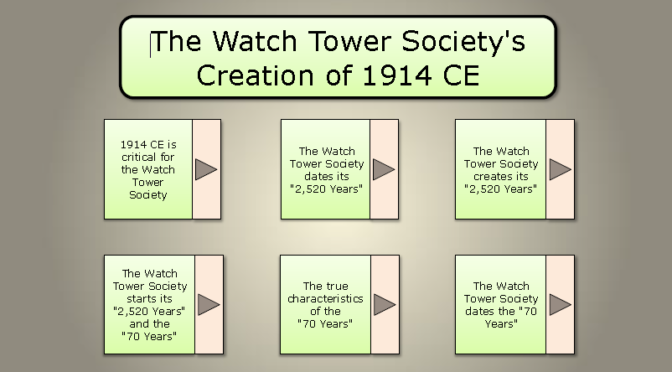
The Watch Tower’s Creation of 1914

Doug Mason has contributed another article. Actually, in this case it’s more of a presentation. And it’s 33 pages!

This one is perfect for those who wish to present the basic points of the 1914 “creation” to someone who needs a review of the basic points. Those of us who have had the doctrine repeated to us hundreds of times from several different angles, we sometimes forget a basic fact. It’s the basic fact that most JWs don’t accept 1914 because it’s simple; they accept it because they don’t understand it.

All those different perspectives on 1914: from Daniel 4 to the 70 years, to the “day for a year principle” to Nebuchadnezzar somehow representing Jehovah’s kings at Jerusalem, to the full desolation of Judea, etc. Yes, all these different angles only serve to confuse a lot of Witnesses, and they are won over through sheer bluster. By the time they have heard it often enough they pick up on some of the rationale, but it’s too late for them to see through it.

Yet, if they saw the whole thing presented at once, without feeling the weight of supposed complexity, a large audience of JWs might be able to just see through it.

We think this presentation helps, because it presents all the supposedly salient points in one sitting, only diverting from the presentation just long enough to show that there are several weak links to the Watch Tower’s arguments, but not spending so much time arguing against each weakness that we get sidetracked or bogged down.

So have a look! Enjoy!

http://i3a.ad0.mytemp.website/wp-content/uploads/2016/03/the_watch_tower_s_creation_of_1914_ce.pdf


The Babylonian Exile Shaped the Future [of Prophetic Speculation] – Doug Mason

Doug Mason has favored us again with another of his very detailed and scholarly studies of subjects related to chronological speculation. (Click here.) We have always found these studies informative and useful for any serious student of the Bible, history, prophecy, chronology and eschatology. These are not studies that push a particular religious agenda. Doug Mason’s knowledge of the specific issues and concerns of Jehovah’s Witnesses make his writing very relevant for this site.

This latest article he has contributed, “The Babylonian Exile Shaped the Future,” is 107 pages long, and available in PDF.

The following is a high level summary of the content and theme as given by Doug Mason:

The theme of the attached Study is simple:
  1. The Hebrews considered themselves to be “God’s Chosen People”, yet Israel had been dispersed by the Assyrians and Judah was dominated by Egypt and then by Babylon.
  2. In response to Judah’s captivity, its prophets promised the nation that God would restore them to their rightful position and that God would forever maintain the throne of David.
  3. When exiles returned from Babylon, they set about creating a nation that was faithful to God.
  4. Centuries passed but the Hebrews remained oppressed by successive Gentile powers. In response, the Jews anticipated imminent divine intervention.
  5. Followers of Jesus Christ applied the prophets’ promises to their leaders and to themselves, anticipating an imminent divine intervention.
  6. In every succeeding century, people kept expecting divine intervention during their life.

One of the images that shows the scope of the study is included below:

scopemason

And lastly, just to give a preview, the Table of Contents is included (in spite of the fact that it will not be formatted correctly):

  • Outline and Summary …………………………………………………………………………………………………………….. 4
  • Contents ………………………………………………………………………………………………………………………………. 6
  • Table of Figures ………………………………………………………………………………………………………………….. 14
  • References cited in this Study ………………………………………………………………………………………………… 16
  • Recommended further reading ……………………………………………………………………………………………….. 18 I. PROMISES TO THE EXILES ……………………………………………………………………………………….. 19
  • THE EXILES ………………………………………………………………………………………………………………….. 20
  • Little documented evidence of the exilic period ………………………………………………………………… 20
  • Exiles mostly came from Jerusalem and its environs …………………………………………………………. 20
  • Exiles permitted to settle in their own groups ……………………………………………………………………. 21
  • The religion of the Exiled Jews……………………………………………………………………………………….. 22
  • The exiled Jews had to reformulate themselves …………………………………………………………………. 22
  • Expressed with sad literature their longing for home …………………………………………………………. 23
  • Babylon appointed a local as Governor of Judah ……………………………………………………………….. 23
  • Babylonians comprehended Israelite practice ……………………………………………………………………. 23
  • Worship by the Exiles in Egypt ………………………………………………………………………………………. 23
  • JEREMIAH …………………………………………………………………………………………………………………….. 23
  • Jeremiah, a tortured soul ………………………………………………………………………………………………… 23
  • Jeremiah’s promises to the exiles …………………………………………………………………………………….. 24
  • Foreigners will no longer enslave them ………………………………………………………………………… 24
  • The LORD will heal them and restore them ………………………………………………………………….. 24
  • God promised to enter into a new agreement with them …………………………………………………. 24
  • David will always have a man on the throne of Israel …………………………………………………….. 25
  • The composition of the book of Jeremiah is an untraceable complex process ……………………….. 25
  • The Hebrew and Greek texts of Jeremiah differ significantly ……………………………………………… 25
  • EZEKIEL ……………………………………………………………………………………………………………………….. 25
  • Ezekiel and Jeremiah were of a different order of priests ……………………………………………………. 25
  • Older generations blamed for their situation ……………………………………………………………………… 25
  • Ezekiel’s covenant promises: Restoration of the nation and of the throne …………………………….. 26
  • ISAIAH CHAPTERS 40 TO 66 …………………………………………………………………………………………. 26
  • The sixth-century setting of Isaiah 40-66 …………………………………………………………………………. 26
  • Deutero-Isaiah’s promises to the Exiles ……………………………………………………………………………. 27
  • Monotheistic statements located at the early part of “Deutero-Isaiah” ………………………………….. 27
  • DEUTERONOMIC HISTORY ………………………………………………………………………………………….. 28
  • The Sources …………………………………………………………………………………………………………………. 28
  • Deuteronomy provides the key ……………………………………………………………………………………….. 28
  • 7
  • Discovery of Deuteronomy …………………………………………………………………………………………….. 28
  • The Deuteronomists’ History ………………………………………………………………………………………….. 29
  • The Deuteronomic Historian …………………………………………………………………………………………… 29
  • Israel’s history was reshaped in Babylon ………………………………………………………………………….. 30
  • Subsequent redactions ……………………………………………………………………………………………………. 30 II. PROMISES PRODUCED POST-EXILIC ACTION …………………………………………………………. 31
  • THE FALL OF BABYLON ………………………………………………………………………………………………. 32
  • The 50 years of exile had been an age of mysteries ……………………………………………………………. 33
  • Decree by Cyrus ……………………………………………………………………………………………………………. 33
  • SOME EXILES RETURN …………………………………………………………………………………………………. 33
  • Returnees led by Sheshbazzar and Zerubbabel ………………………………………………………………….. 33
  • Social Stratification ……………………………………………………………………………………………………….. 33
  • Conflict in the Postexilic Community ………………………………………………………………………………. 34
  • Little clarity in the record of the Persian period ………………………………………………………………… 34
  • Archaeological material not reliable for the period ……………………………………………………………. 35
  • Subsistence farming continued during the Persian period …………………………………………………… 35
  • Persian strategy …………………………………………………………………………………………………………….. 35
  • Emphases of the Biblical texts from the Persian period ……………………………………………………… 35
  • RESURGENCE OF THE PRIESTLY CLASS …………………………………………………………………….. 36
  • Success of the Aaronid priesthood …………………………………………………………………………………… 36
  • Religion’s attempt at continuity with the past……………………………………………………………………. 36
  • The Priesthood ……………………………………………………………………………………………………………… 37
  • The Temple …………………………………………………………………………………………………………………. 37
  • WRITINGS WERE COMPOSED DURING AND AFTER THE EXILE ………………………………… 37
  • EZRA AND NEHEMIAH …………………………………………………………………………………………………. 38
  • Two phases of attempted restoration ……………………………………………………………………………….. 38
  • Ezra arrived with two important documents ……………………………………………………………………… 38
  • Ezra the lawgiver ………………………………………………………………………………………………………….. 38
  • Ezra, architect of Israel’s new identity ……………………………………………………………………………… 38
  • The book of Ezra …………………………………………………………………………………………………………… 39
  • Theme of Ezra-Nehemiah ………………………………………………………………………………………………. 39
  • Ezra influential in the redaction process …………………………………………………………………………… 40
  • Nehemiah, visionary and a man of action …………………………………………………………………………. 40
  • Nehemiah repaired the walls of Jerusalem………………………………………………………………………… 41
  • Dedication of the new walls marked the end of the Exile ……………………………………………………. 41
  • CHRONICLES ……………………………………………………………………………………………………………….. 41
  • Two Histories: Kings (part of the “Deuteronomic History”) and Chronicles …………………………. 41
  • Chronicles: Date ……………………………………………………………………………………………………………. 41
  • Chronicles: Style …………………………………………………………………………………………………………… 42
  • 8
  • Chronicles: Is not literal history ………………………………………………………………………………………. 42
  • Chronicles: Is theological history ……………………………………………………………………………………. 42
  • POST-EXILIC PSALMS …………………………………………………………………………………………………… 43 III. UNFULFILLED PROMISES PRODUCED CHANGE ………………………………………………….. 44
  • ROOTS OF APOCALYPTICISM ………………………………………………………………………………………. 45
  • Failure of Ezekiel’s promise of national resurrection …………………………………………………………. 45
  • Prophecy declined and apocalyptic speculation grew …………………………………………………………. 45
  • Postexilic writings are proto-apocalyptic ………………………………………………………………………….. 45
  • Apocalypticism’s indebtedness to ancient Near Eastern myths and Hebrew prophecy ……………. 45
  • Apocalypticism not the exclusive property of any one sect or movement ……………………………… 46
  • Apocalyptic writings do not reflects the viewpoint of established power ……………………………… 46
  • First major cluster of Jewish apocalyptic writings are about the time of the Maccabean revolt .. 46
  • Cluster of eschatological prophets …………………………………………………………………………………… 46
  • Jubilees ……………………………………………………………………………………………………………………….. 47
  • 1 and 2 Maccabees record the Antiochene crisis ……………………………………………………………….. 47
  • 1 Maccabees shows that Daniel 9 had Antiochus IV in mind ………………………………………………. 47
  • The Testaments …………………………………………………………………………………………………………….. 47
  • 1 Enoch ………………………………………………………………………………………………………………………. 48
  • First Book of Enoch may be the starting point of apocalypticism ………………………………………… 48
  • Apocalyptic texts were the alchemist’s crucible ………………………………………………………………… 49
  • Unfulfilled prophecy appears to be a major defect of apocalyptic works ………………………………. 49
  • The most influential passage in Jewish apocalyptic literature ……………………………………………… 49
  • ASSIMILATION WITH HELLENISTIC WORLD LED TO THE MACCABEAN REVOLT …… 50
  • The Maccabees/Hasmoneans: History & Overview (166 – 129 BCE) …………………………………… 50
  • The contemporary Maccabean/Hasmonean history ……………………………………………………………. 50
  • The Jewish Hammer ………………………………………………………………………………………………….. 51
  • Jews Regain Their Independence …………………………………………………………………………………. 51
  • The words “Maccabee” and “Hasmonean” ……………………………………………………………………….. 52
  • THE BOOK OF DANIEL …………………………………………………………………………………………………. 52
  • The plot of the book of Daniel ………………………………………………………………………………………… 52
  • Daniel is a composite book …………………………………………………………………………………………….. 52
  • Versions of the Book of Daniel ……………………………………………………………………………………….. 52
  • Less stable and diverse redaction, editing, and transmission of Ezekiel, Jeremiah, and Daniel … 53
  • The Jews place the book of Daniel in the Writings ……………………………………………………………. 53
  • The author of Daniel drew from the surrounding cultures …………………………………………………… 53
  • The book of Daniel is Hellenistic ……………………………………………………………………………………. 53
  • Daniel reflects the Hellenistic belief in an afterlife ……………………………………………………………. 53
  • DANIEL COMPOSED IN THE SECOND CENTURY BCE ………………………………………………… 54
  • Daniel is a historical book written around 167-165 BCE ……………………………………………………… 54
  • 9
  • Stories of Daniel and the visions collected during the 2nd century BCE ………………………………… 54
  • Daniel written in response to a religious and political threat in the 2nd century BCE ………………. 54
  • Daniel’s interest in the Seleucid Kingdom………………………………………………………………………… 55
  • Enoch and Daniel arise out of crises created by Hellenism and Antiochus Epiphanes ……………. 55
  • Daniel completed shortly before the death of Antiochus …………………………………………………….. 55
  • Most scholars assign the final form of Daniel 7-12 to the Antiochene period ………………………… 55
  • The “Daniel” seems to have lived in the second century BCE ……………………………………………… 55
  • Development of the idea that Daniel related to the second century BCE ……………………………….. 55
  • HISTORICAL ACCURACIES AND INACCURACIES OF DANIEL……………………………………. 56
  • The Book of Daniel is not meant as literal history……………………………………………………………… 56
  • Nothing is known historically of a Daniel in Babylon ………………………………………………………… 56
  • Jerusalem fell to Nebuchadnezzar for the first time in 597 BCE …………………………………………… 56
  • Some of the historical errors in Daniel …………………………………………………………………………….. 56
  • Historical accuracies and inaccuracies date the completion of the book of Daniel …………………. 57
  • The writer lived long after the events, and made mistakes ………………………………………………….. 57
  • No place in history for “Darius the Mede” ……………………………………………………………………….. 57
  • Daniel records Alexander, the Ptolemies and the Seleucids ………………………………………………… 58
  • RELIGIOUS PURPOSE OF THE BOOK OF DANIEL ………………………………………………………… 58
  • The author of Daniel is preoccupied with cultic issues ……………………………………………………….. 58
  • The stories prove that God is great ………………………………………………………………………………….. 59
  • Stories illustrate an attitude about living as a Jew ……………………………………………………………… 59
  • The fanciful narratives provide instruction for living in the Diaspora …………………………………… 59
  • They endure martyrdom to purify themselves for union with God and his angels ………………….. 60
  • DANIEL PROVIDES ESOTERIC EXPLANATIONS ………………………………………………………….. 60
  • The four kingdoms of Daniel ………………………………………………………………………………………….. 60
  • Do not set dates today from the book of Daniel…………………………………………………………………. 60
  • THE LAST-DAY COMMUNITY AT QUMRAN ………………………………………………………………… 61
  • The authors of the DSS formed a sect ………………………………………………………………………………. 61
  • Qumran history ran from 150 BCE to 68 CE ………………………………………………………………………. 61
  • Two events might have impacted early Qumran history……………………………………………………… 61
  • Authors of the DSS were anti-Hasmonean ……………………………………………………………………….. 62
  • QUMRAN WRITINGS …………………………………………………………………………………………………….. 62
  • Scrolls, but no book or codex………………………………………………………………………………………….. 62
  • The Qumran community had no single, stable text …………………………………………………………….. 62
  • Various editions of several books ……………………………………………………………………………………. 63
  • Extreme fluidity of the DSS texts ……………………………………………………………………………………. 63
  • Assumed link between the DSS and the Masoretic Text contradicted by historical evidence ….. 63
  • The Masoretic Text is not the main witness to the Hebrew Bible ………………………………………… 63
  • A variety of sources used during the Second Temple period ……………………………………………….. 64
  • 10
  • There were collections of scripture but no fixed list (canon) ……………………………………………….. 64
  • Qumran had no list of sacred titles …………………………………………………………………………………… 65
  • The Temple Scroll and the Book of Jubilees were cited as authoritative ……………………………….. 65
  • QUMRAN EXPECTATIONS ……………………………………………………………………………………………. 65
  • Qumran considered themselves the restored Israel …………………………………………………………….. 65
  • Full restoration still hoped for …………………………………………………………………………………………. 66
  • The End of Days was imminent ………………………………………………………………………………………. 66
  • They expected Daniel’s visions would be fulfilled in their day ……………………………………………. 66
  • Qumran believed their times were the fulfilment of biblical predictions ………………………………. 67
  • Qumran anticipated the restoration of David’s throne ………………………………………………………… 67
  • They considered themselves the true Israel ………………………………………………………………………. 67
  • Qumran was the true Israel of the last days, receiving the new covenant ………………………………. 67
  • Actions taken at Qumran in preparation for the coming messianic age …………………………………. 67
  • THE QUMRAN COMMUNITY AND CHRISTIANITY ……………………………………………………… 67
  • Similarities of the Qumran community and Christianity …………………………………………………….. 67
  • The Dead Sea Scrolls and the origins of Christianity …………………………………………………………. 68
  • The DSS, the NT and apocalypticism ………………………………………………………………………………. 68
  • The DSS and the NT retell Israel’s story from an apocalyptic view ……………………………………… 68
  • Qumran and Christianity each believed they were the apocalyptic restored Israel ………………….. 68
  • DSS and the NT are reconstructions of Israel’s story …………………………………………………………. 69
  • Essene and Christian use of the Hebrew Scriptures ……………………………………………………………. 69
  • Real relationship of the DSS and the NT ………………………………………………………………………….. 69
  • John the Baptist might have been associated with the Qumran sect ……………………………………… 70
  • JEWISH MYSTICISM ……………………………………………………………………………………………………… 70
  • The four most well-known Jewish groups concurrent with Qumran …………………………………….. 70
  • Pharisees, Sadducees, Essenes, and Zealots………………………………………………………………………. 70
  • The religious movements cannot be understood independently of the others ………………………… 71
  • Expulsion practised at Qumran ……………………………………………………………………………………….. 71
  • Recording of history was not strong among those Jews ……………………………………………………… 72 IV. PROMISES EXTENDED TO THE GENTILES ……………………………………………………………. 73
  • JESUS (YESHUA) …………………………………………………………………………………………………………… 74
  • Daniel influenced Jesus ………………………………………………………………………………………………….. 74
  • The Gospel’s “little apocalypses” were a midrash on Daniel ………………………………………………. 74
  • Jesus reinterpreted Israel’s Scriptures ………………………………………………………………………………. 74
  • Jesus contradicted many of Qumran’s standards ……………………………………………………………….. 74
  • Jesus threatened the ideologies of the priestly establishment and groups like those at Qumran .. 75
  • Jesus’ call to be open to all nations ………………………………………………………………………………….. 75
  • Luke emphasised Jesus’ outreach beyond Judaism ……………………………………………………………. 75
  • The Temple was for “all nations” ……………………………………………………………………………………. 75
  • 11
  • Defining the New Community (Matthew 11-13) ……………………………………………………………….. 75
  • The reconstitution of God’s promise to his covenant people ……………………………………………….. 75
  • The inclusiveness of the community of faith …………………………………………………………………….. 76
  • PAUL …………………………………………………………………………………………………………………………….. 76
  • Paul, the single most important figure in spreading the movement ………………………………………. 76
  • Paul was not a disciple and he was at odds with the leaders of the primitive church ………………. 76
  • Paul was in common with Jews of the Diaspora ………………………………………………………………… 76
  • Paul was also influenced by Hellenistic thinking ………………………………………………………………. 76
  • Stoicism…………………………………………………………………………………………………………………… 77
  • Conscience ………………………………………………………………………………………………………………. 77
  • Paul focused his mission towards Gentiles and pagans ………………………………………………………. 77
  • Paul excused Gentile Christians from having to observe ceremonial and dietary Jewish laws …. 77
  • Jesus’ and Paul’s expectation of the Parousia removed; church hierarchy instituted ……………… 78
  • PAUL’S JESUS ………………………………………………………………………………………………………………. 78
  • Paul’s Jesus is different to the Gospel’s Jesus …………………………………………………………………… 78
  • The status of Christ in the Pauline religion ……………………………………………………………………….. 78
  • PAUL’S ESCHATOLOGY ……………………………………………………………………………………………….. 78
  • Paul’s “gathering” goes back to the OT gathering of the exiles …………………………………………… 78
  • Paul recalled the OT prophetic literature ………………………………………………………………………….. 79
  • Fulfillment of the eschatological promises made to Israel …………………………………………………… 79
  • Daniel influenced Paul …………………………………………………………………………………………………… 79
  • Apocalyptic eschatology means revealed eschatology ……………………………………………………….. 79
  • “Apocalyptic eschatology” can apply to Paul ……………………………………………………………………. 79
  • Paul’s imminent cosmic triumph of God ………………………………………………………………………….. 80
  • Paul: the present era nearly at its end and the return of Christ is imminent ……………………………. 80
  • Paul’s philadelphia (brotherly love) was an eschatological blessing ……………………………………. 80
  • PAUL’S CREATIVE MYTHOLOGIES ……………………………………………………………………………… 80
  • Paul turned baptism into a mythical re-enactment ……………………………………………………………… 80
  • Mythical meaning of the “Lord’s Supper” revealed to Paul by Christ, not from man ……………… 82
  • Paul was cautious about Charismatic manifestations ………………………………………………………….. 82
  • Paul’s fertile mind created an elaborate doctrinal construct ………………………………………………… 82
  • Paul’s part in the formation of Christianity……………………………………………………………………….. 83
  • PRIMITIVE CHRISTIANITY AND SCRIPTURE ………………………………………………………………. 83
  • Earliest Christians focused on a person, not on scripture ……………………………………………………. 83
  • NT writers sought prophecies about Jesus rather than in exegesis ……………………………………….. 83
  • NT writers saw continuity with the Hebrew Scriptures but not exact interpretations ……………… 83
  • Christians made highly selective use of the OT …………………………………………………………………. 83
  • The LXX was the Christians’ Bible …………………………………………………………………………………. 84
  • Paul cited the LXX rather than the MT, and he employed creative exegesis …………………………. 84
  • 12
  • The outward expression of Christianity changed ……………………………………………………………….. 84
  • “Original inspiration only” does not resolve the NT’s use of the Hebrew Scriptures ……………… 84
  • THE CHURCH DEPENDED ON ITS JEWISH APOCALYPTIC HERITAGE ……………………….. 84
  • The early church preserved a vast number of apocalyptic texts …………………………………………… 84
  • Primitive Christianity took root in Jewish apocalyptic literature ………………………………………….. 85
  • The debt of Christianity to its Jewish heritage, particularly its apocalyptic heritage ………………. 85
  • Jesus and the Gospel writers read Daniel typologically ………………………………………………………. 85
  • The OT, especially Daniel, permeates Revelation ……………………………………………………………… 85
  • Book of Daniel had the greatest influence on the book of Revelation …………………………………… 86
  • JUDAISM FOLLOWING THE DESTRUCTION OF JERUSALEM ……………………………………… 86
  • After the destruction of Jerusalem (70 CE), Judaism shifted from temple-based to text-based …. 86
  • The myth of Jamnia ………………………………………………………………………………………………………. 86
  • Second major cluster of Jewish apocalyptic writings …………………………………………………………. 87 V. PROMISES KEEP BEING REPEATED………………………………………………………………………. 88
  • IT IS HAZARDOUS TO ASSUME SCRIPTURE TALKS OF ONE’S OWN TIME ………………… 91
  • Hazardous to claim that the book of Daniel directly refers to events of one’s own day …………… 91
  • Pesher assumes, as with the Qumran community, that Scripture is talking of one’s own time …. 91
  • The visions were addressed to people who needed to hear them ………………………………………….. 91
  • Numerous expositors see prophecies fulfilled in their own time ………………………………………….. 91
  • Daniel influenced succeeding millennia …………………………………………………………………………… 92
  • Each new generation applied Revelation to their own generation ………………………………………… 92
  • Revelation is a “language arsenal” that has stirred dangerous men and women …………………….. 92
  • The predictions of Revelation did not come to pass …………………………………………………………… 92
  • The world had persistently refused to end ………………………………………………………………………… 92
  • EACH GENERATION APPLIES PROPHECIES TO ITS OWN TIME ………………………………….. 93
  • Jesus announced the end would be seen by his contemporaries …………………………………………… 93
  • The first Christians expected they would witness the end of the world …………………………………. 93
  • First century CE Jews applied Daniel to themselves ………………………………………………………….. 93
  • First century apocalypses influenced by Daniel 7 ………………………………………………………………. 93
  • Josephus believed Daniel was speaking of the Roman Empire ……………………………………………. 93
  • Various interpretations of Daniel’s “four kingdoms” …………………………………………………………. 93
  • Revelation influenced succeeding millennia ……………………………………………………………………… 94
  • Fourth century upsurge of interest in Revelation ……………………………………………………………….. 94
  • Three-and-a-half year period invoked throughout late antiquity and the Middle Ages ……………. 95
  • Eschatological expectation in the Medieval times ……………………………………………………………… 95
  • 14th century: Beguines saw the church as the Antichrist ……………………………………………………. 95
  • 15th and 16th century applications to their own day ………………………………………………………….. 95
  • 16th century: Martin Luther identified the Turks as the eschatological fourth beast……………….. 95
  • 16th century: John Knox applied Daniel to the Papacy ………………………………………………………. 96
  • 13
  • 16th century: Joseph Mede expected the end to come in 1716 or in 1736 …………………………….. 96
  • 17th century: Aspinall applied Daniel to his own times ……………………………………………………… 96
  • 17th century: Tillinghast predicted the end to come in 1656 ……………………………………………….. 96
  • Daniel chapters 2 and 7 stimulated centuries of missionary movements ……………………………….. 96
  • 17th century: The “Fifth Monarchy Men” were the saints of Daniel 7 ………………………………….. 97
  • 18th century: The First Great Awakening of the American revival ………………………………………. 97
  • 19th century: Leaders saw Daniel being fulfilled in their own day ………………………………………. 97
  • 19th century: William Miller expected the end around 1843 ……………………………………………….. 97
  • 19th century: Invention of the “Rapture” by Darby; followed by Scofield and Moody …………… 98
  • 19th century: Special hope offered for the Jewish people …………………………………………………… 98
  • 19th century: Numerous speculative commentaries …………………………………………………………… 99
  • 19th century: The Shakers; Latter-day Saints; Charles Taze Russell ……………………………………. 99
  • 19th century: Sandford; Purnell; Pentacostalism ……………………………………………………………….. 99
  • The Great War of 1914-1918 sparked apocalyptic speculation ………………………………………….. 100
  • 20th century: Explosive growth of interest in apocalyptic …………………………………………………. 100
  • 20th century: Christabel Pankhurst on the “promised return of Jesus Christ” ………………………. 100
  • 1917: Toppling of Russian Czar seen as fulfilment of Ezekiel’s prophecy ………………………….. 100
  • 20th century: Signs produced anticipation in Christian circles …………………………………………… 101
  • 20th century: The number 666 applied to a string of contemporary candidates ……………………. 101
  • 20th century: Reagan feared the number 666; current events fulfilled biblical prophecy ………. 101
  • 1967 Six-Day war and Jerusalem’s liberation hailed as “a forward leap” ……………………………. 101 BONUS: ISRAEL’S DESCENDANTS…………………………………………………………………………………. 102
  • London, cleansed by fire, would be the ‘New Jerusalem’ …………………………………………………. 104

STAY ALIVE ‘TIL 2132! Generation (X′+X″) <= (1914+λ[A′]-α[A′]+λ[A″]-α[A″]-x) <= 2132

Generation X′+X″=Generation WHY? Already Bringing “Great Tribulation” on Watchtower Readers

The Watch Tower Society has got some “Splane-ing” to do. So they brought out Brother David Splane, hoping to bring some credibility to the incredible. (It’s in the September 2015 Monthly Broadcast at tv.jw.org.)

It is now literally possible to explain the potential length of the “overlapping generation” with a formula like the following one where X′ and X″ represent two different (overlapping) groups of anointed persons.

Generation (X′+X″) <= 1914+λ[A′]-α[A′]+λ[A″]-α[A″]-x

This formula is applicable where A′ and A″ are symbols referring to anointed persons qualified to be in group one and two, respectively. λ[A′] (lambda of A′) refers to the lifespan of the person in the first group, and α[A′] (alpha of A′) refers to the age at which A′ is said to have been anointed. A person qualifying for inclusion in the second group (A″), must not only be born, but must already be anointed, in or before the year A′ dies. We must also consider the following two limiting factors: First, the maximum length of a lifespan (λ) usually put in a range from 99 to 119 years. Second, the minimum age at which one may be considered to be anointed (α), put in a range from 10 to 20 years. And, finally, we must subtract x, the number of full years that the lifespan of A′ overlapped with A″. If A″ happened to be born in the same year that A′ died, then this x=0.

You’ll get your due in 2072!

If we plug in the information for FWF (Frederick W Franz) as a case that fits the first group of anointed, we would get:

Generation (X′+X″) <= 1914+99-20+λ[A″]-α[A″]

We would now only need to assume a lifespan and an age of anointing for a person who qualifies to be in the second group. If we also assume that A″ also has a lifespan of 99 years and also has an anointing age of 20, and was born in 1992, then the formula could be filled in as follows:

Generation (X′+X″) <= 1914+99-20+99-20 = 2072. Therefore, the overlapping generation could reach as far into the future as 2072.

2132: It’s around the corner, too!

Of course, we could also assume that FWF was not the ideal candidate to maximize the length of the generation. Perhaps there was a person, born in 1904, and anointed at 10 years old who also lived to be 119 years old. It doesn’t seem likely, of course, but it’s potentially possible. Perhaps it’s even more possible in the second group when medical advances of the 21st century might increase more lifespans toward and perhaps beyond the 119 year limit.

We could then, plug in our maximized examples for both groups and get the following numbers in our formula

Generation (X′+X″) <= 1914+119-10+119-10 = 2132. Therefore, the overlapping generation could reach as far into the future as the year 2132!

How ONE generation has become TEN generations.

Imagine! This means that “this generation” could potentially include, in my own case, my great grandfather, who was actually a co-worker with Russell in 1914, my grandfather (deceased), my father (living), myself, my children, my first grandchild (due in December 2015), my future great-grandchild (2040?), my great-great-grandchild (2065?), my great-great-great-grandchild (2090?), my great-great-great-great-grandchild (2115?). That’s TEN generations in all!

Can you imagine? When Jesus said “this generation will not pass away” that could have meant the same thing as if he had said “TEN generations will not pass away.”

Legitimate?

Of course, there are also ways to evaluate this from a Biblical perspective. We can discuss, for example:

(Deuteronomy 23:2) “No illegitimate son may come into the congregation of Jehovah. Even to the tenth generation, none of his descendants may come into the congregation of Jehovah.”

If 1 can equal 10, perhaps this actually meant 100 generations!

Poor bastards!

100 Years Ago: April 1915 – Russell claims Filipinos are lazy, barbaric; asks US President to sell Philippines to Japan

Main Points:

  • Russell wrote the President of the United States through the Secretary of State, stating that he wanted to write him privately but thought it best to send the letter to also be published in newspapers.
  • Russell’s letter reveals a level of political involvement that went far beyond Zionism and direct political involvement in the affairs of government.
  • Russell’s stated opinions about the Philippines reveals personal prejudices which are pro-American, anti-Filipino and pro-Japanese. He shows himself to be a “White-Man’s-Burden” Eurocentric racist.
  • A history of Russell’s opinions related to the Philippines reveal inconsistency and contradictions, but also clarify the real meaning of the expression, “End of the Gentile Times.”

________________________________

[photo above is from more recent context, unrelated to C.T.Russell]

The relevant statements in question were printed in the April 1915 Watch Tower magazine, pages 101-102. Here are some long excerpts, including most of the original article, with our own highlighted sections for emphasis using bold, color and underlining which was not found in the original text. We will interrupt the quotation to include editorial comments, which will be evident through the use of brackets and other formatting changes, when we are directly commenting on the text of the Watch Tower articles:

[Begin quotation from April 1915 Watch Tower]

SELL THE PHILIPPINES TO JAPAN

Two years ago, on our return from the Orient, we sent the below letter of suggestion to the Government with copies of it to the newspapers, some of which published the letter, which read as follows:–

Brooklyn, May 26, 1913.

Honorable Wm. J. Bryan,

Secretary of State, U.S.A.

Dear Sir:–I am addressing you, and through you the Honorable President of this Nation, and the Honorable Members of its Congress, upon a subject which I believe to be of prime importance to our Nation and to the world. I would have preferred to make this communication a private one, but believe that its object will be much better served if it be known at home and abroad that the suggestion comes from a native citizen, a minister and ambassador of Christ, rather than if the same suggestion were to emanate from some Official of our Government or from a politician.

[Editor: Russell’s claim that he preferred to make the communication private seems meaningless when it was simultaneously sent to newspapers for widespread publishing.]

THE WORLD’S PEACE ENDANGERED

. . . Japan’s need for room for her overflow population has already led her to grasp Korea, and it is no secret that she longs for possession of the Philippine Islands . . . .  Many broad-minded Americans have suggested that the United States has no desire to acquire colonies in an imperial sense, and that, therefore, the Philippine Islands should be surrendered to the Filipinos. The only objection urged against this move is that the Filipinos are not as yet sufficiently advanced in civilization to properly govern themselves. And those most intimate with the situation have not the slightest doubt that if the United States withdrew from the Philippines, the Japanese Government would immediately take control, and shortly the Philippine Islands would be inundated with Japanese–undoubtedly much to their benefit, as the latter people are more thrifty and prudent and energetic than the Filipinos.

[Russell objects to allowing the Filipinos to govern themselves because they are “not sufficiently advanced in civilization.” This is an exact reflection of the imperialist ideas of President McKinley which were also expressed in an idea called “The White Man’s Burden.” In fact, the Wikipedia article explains corrrectly that Rudyard Kipling’s original poem by that name was published in 1899 with the subtitle, The United States and the Philippine Islands.  The Wikipedia article includes: “At face value it appears to be a rhetorical command to white men to colonize and rule other nations for the benefit of those people . . . . the phrase “white man’s burden” as justifying imperialism as a noble enterprise. Because of its theme and title, it has become emblematic both of Eurocentric racism and of Western aspirations to dominate the developing world.” Russell was very clearly a racist.]

SOME RADICAL SUGGESTIONS

I suggest that the United States Government select from amongst the Philippine Islands one island suitable as a naval base, and tender to Japan the opportunity to take over the Philippine Islands at precisely the same they have cost the United States. . . . .

. . . Surely wisdom should dictate to both Nations that, in the interest of peace, cause for friction should be as far as possible eliminated. I believe that no more fair, no more just, no more honorable method for adjudicating this matter can be found than that we are suggesting–the sale of the Islands at cost to the Japanese.

Japan would give the Filipinos a splendid government— better, I believe, than would any other nation under the sun except our own Government. No one can visit the Philippines without feeling pride for what America has done for that people–and done in so unselfish and noble a manner, as an elder brother amongst the nations helping a younger brother. Under no circumstances would I favor turning the Philippines over to the domination of a barbaric people. The Japanese are not barbarians, but highly civilized.

[Russell is indirectly admitting that, in his own mind, “highly civilized” is a term he reserves for nations who were known for success at selfishly taking land and resources from others by force of war. That is an implicit part of his equation that calls the victors “civilized” and the victims “barbaric.” He has already admitted that Japan would look for excuses to take the islands by force if the USA wouldn’t sell it to them. He then, in fact, goes on to speak of war as a necessity immediately after the above.]

My discourse in Washington on the 25th, “Peace Desirable, War a Necessity,” was evidently misunderstood by some of my peace friends. While I claimed that nations have never been able to avoid war, and that they never will be able to wholly avoid it until the inauguration of Messiah’s Kingdom, . . . NOW seems to be the psychological moment, and, as stated at first, it seems best that these suggestions should come from an ambassador of Christ, rather than from a politician . . .. I call for its endorsement by peace societies and all who believe that war should be only a last resort. Faithfully yours,

A servant of the Lord Jesus Christ,

(Signed) C. T. RUSSELL.

[Russell’s “call for its endorsement by peace societies” is a call for the precursors of the “League of Nations” and the “United Nations” to give support to him. At the time, of course, Russell was considered not just “a faithful and discreet slave” but “THE” faithful and discreet slave. He alone held that title, and yet this is an example of his supposed “discretion.” Although the Watch Tower has consistently avoided discussing the episode in its history when the League of Nations was looked at with “wonder” and “awe” in 1919, it should not have come as much of a surprise considering these sentiments in 1915. In the near future, we plan to provide a short article on this particular part of Watch Tower history, when the Watch Tower looked at the League of Nations as if it were a political reflection of the Kingdom of God on earth.]

We learn a lot about Russell’s thinking that is not discussed in current Watch Tower publications. Whatever Charles Taze Russell thought it meant to be “no part of the world” and “to keep oneself without spot from the world,” it would not likely be recognizable to Jehovah’s Witnesses today.

RUSSELL CONTRADICTS HIMSELF

Russell’s ideas are not completely consistent with his ideas on the subject of the Philippines just a few years earlier when the United States was at war against the Spanish domination of the Philippines, beginning in 1898. Note how Russell falls into the trap of nationalism and prejudice in the same article, below, in which he speaks out against it. The following from the Watch Tower, July 1, 1898 page 195-197:

AS THE war with Spain progresses, it becomes more and more evident that “The Great Republic” [United States] is very thoroughly hated by her sisters in the family of Christian Nations so called. . . . Great Britain alone manifests sympathy: . . . Even the other republics of the world–France, Mexico and all those of Central and South America are jealous of their big sister.

The appeal to race prejudice and race pride has much to do with this condition of things and is most unwise. . . . And it is the same on both sides of the question: if one boasts of race superiority and valor, so does the other. And the more these selfish channels of thought are opened, the deeper the hatreds engendered and the more dangerous the possible results.

. . . Of course, when the time comes for Spain to sue for peace, she will probably be instigated by the pope to relinquish Cuba and close the war on condition that the United States abandon all claim on the Philippines. It is doubtless to threaten a prolongation of the war there, and thus to make the United States the more willing to relinquish the islands, that the Cadiz squadron has sailed eastward. Moreover, it is realized that the soldiers carried by this fleet will be needed to put down the Philippine rebels. The latter are the more intelligent of the natives who are rebelling as much against the tyranny of Romanism as against the oppression and cruelty of Spain. It is our opinion that the Lord wills to break the power of Papacy there, and hence that he will not permit Spanish misrule to be continued.

[We interrupt the article here, momentarily, to note that Russell feels he knows the Lord’s will and believes that this war in 1898 might even be the start of the universal anarchy still predicted for the year 1914. But he is covering his bases, something he will start to do much more often between 1906 and 1914. He doesn’t ever seem to completely lose his confidence in the year 1914, although he will despair over high probability of its failure starting around November 1913, and right up through the summer of 1914.]

To what extent the present war may be a waking up of all the world to an era of war which will impoverish all nations, and sicken all their peoples and prepare the way for the universal anarchy with which this age shall end, we know not; but such an outcome will not surprise us. If so, it will seem like the time mentioned in Joel 3:9-14. See the conclusion of the S.S. Lesson on Elijah, page 192.

[What follows is Russell’s explanation of how this could still be an expected part of God’s purposeful intervention in world affairs which should not be considered inconsistent with Russell’s predictions for 1914 when the times of the Gentile nations will truly end. After all, Russell will argue below, didn’t God intervene to make sure that America became such a great light of the nations amidst the darkness? What’s most odd about this argument is that Russell is actually claiming more providential intervention by God during the times of the Gentiles than the Watch Tower publications have ever claimed for the time since 1914 when the times of the nations have run out. In other words, NOW, since 1914 should be the only logical time since “607 BCE” when God actually would and should be constantly intervening because the nations have supposedly lost their “lease on power.” Yet, since 1914, they have seemed more powerful, with less interruption of their affairs. This is a huge inconsistency in the Watch Tower’s teaching about 1914. Here, Russell shows that he believes the end of the Gentile Times is an expression referring to the anarchy and chaos that will mark the end of this age, “The Gentile Times.”]

Of one thing we may be sure: the affairs of this world while nominally left to the “gentiles” until the end of “Gentile Times,”* the end of their lease of power, are nevertheless subject to a divine surveillance, to the intent that naught shall be permitted that our God is not abundantly able to overrule for good. Divine providence has already been manifested on behalf of America and doubtless will continue to supervise her course. Who that is God-fearing and possessed of a knowledge of history can doubt that this land was kept hidden until due time; that it was purposely made an asylum for liberty-loving people and for the oppressed of all nations? Who can doubt that its unparalleled history thus far has been a lesson to the whole world–“Liberty enlightening the world?” Who can doubt that thus the Almighty has been gradually forcing open the fetters of Church and State, of superstition and ignorance, and emancipating the peoples of Europe?

It was the influence of liberty and its blessings in America that led to the French Revolution–the French people being too ignorant, and too much under the influence of Romanism, to be able to appreciate and use the boon of liberty wisely. The same object lesson (America) has had a great influence upon Great Britain and Germany and upon the peoples of other countries in proportion to their intelligence and freedom from papal bondage.

As the reforms of Europe have been granted inch by inch by its monarchical aristocracy, under the glare of Liberty’s torch (America), it is but natural that they very generally feel a hostility; “because the darkness hateth the light,” as ever. There are exceptions to every rule, but generally speaking America is loved and appreciated only by the middle classes of Europe, and these chiefly in Protestant countries.

Nor should it surprise us if God has still some further work for America to do in pulling down the strongholds of error and waking up the mighty men and men of war. To some extent the torch of liberty may be a torch of war and destruction. This may sound strange to those who mistakenly have supposed that God is to be credited with all the peace and arbitration movements and Satan to be credited with all the moves toward war and violence.

[Back here in 1898, during the Spanish-American war, Russell is defending America’s involvement. God is to be credited with waking America up to the value of war! This is something he repeated again in 1913 in the speech he mentioned to in the letter to the President about selling the Philippines to Japan. That speech in Washington was named “Peace Desirable, War a Necessity.” ]

DO AS I SAY, NOT AS I DO

Russell’s inconsistencies show up on the same page where he printed the “SELL THE PHILIPPINES TO JAPAN” letter in April 1915. Just above that letter, the Watch Tower on page 101, said:

We have exhorted the brethren to strict neutrality so far as the combatants are concerned, whatever might be their natural inclination through accident of birth or association. . . . Let us more and more seek to take the Bible view of the great Armageddon, of which we are now having the prelude. . . . We are seeing fruits which have been ripening for forty years.

Christendom–Christ’s Kingdom–has not yet been established. It awaits the Lord’s time and the manifestation of His power and great glory in its establishment. These are kingdoms of this world, actuated by the principles of selfishness and deceived by Satan, “the god of this world.”

The Battle of Armageddon, to which this war is leading, will be a great contest between right and wrong, and will signify the complete and everlasting overthrow of the wrong, and the permanent establishment of Messiah’s righteous Kingdom for the blessing of the world. All these things are probably easier to be seen from this side of the ocean than by the dear friends who are nearer to, and more directly influenced by, the war and their national, personal interests. . .

Meantime, another danger to the Lord’s consecrated people lies along the lines of worldly-mindedness–neglecting the things of the Kingdom in favor of the things of this present life. Our Adversary is still alert. We, also, must be alert as children of the Light, children of the Day, soldiers of the Cross.

Except for the positive use of the word Christendom, and the idea that Armageddon was already beginning with the war in 1914, those words sound correct from the Watch Tower’s current perspective of neutrality. But it’s followed immediately by one of the least neutral examples of political involvement, a letter to the President, recommending the creation of a US naval base and subsequent sale of a “barbaric” nation to another “more civilized” nation.

It’s almost as if Russell is requesting that the European brethren should remain neutral, while “clearer heads” on Russell’s side of the Atlantic should be free to promote the national interests of America and Japan.

Russell is able to mix speech about Satan being the God of this system with speech about how God has been intervening with this system because war is sometimes God’s way of promoting the American torch of liberty. And it’s OK that the torch of liberty is sometimes a torch of war and destruction.

One might wonder, then, why Russell thought it so important to concern himself with American interests while telling the rest of his readers that such concerns appeared to fall under the idea of “neglecting the things of the Kingdom in favor of the things of this present life.” He expects the Gentile Times to be a time when the nations are in control, with some minimal intervention by God, but that as soon as this age of “Gentile Times” has ended, it would be synonymous with chaos and anarchy. In the meantime, however, Russell can hypocritically promote idea that he can think of as “God’s will” if it is in the best interests of America.


100 Years Ago: July 1915 – Go to War, But Shoot Over Their Heads!

Main Points:

  • In 1915, the Watch Tower still supported going to war if drafted, a policy that stayed about the same from at least as early as 1898 to as late as 1939.
  • Watch Tower suggests that if drafted to serve (conscripted) the Bible Student should request non-combatant service but, if not given this option, could shoot to miss, or shoot over the head of the enemy.
  • An interesting story is offered in support of God’s blessing on this “tactic.” Based on the meeting between between two “Bible Student” combatants, armed against each other with bayonets, early in 1915.
  • The odds against this story actually occurring were so astronomical that the story is, in effect, a claim of a miracle – but a miracle in support of a doctrine that Jehovah never really approved.

________________________________

The 2015 Yearbook of Jehovah’s Witnesses as it appears on the jw.org site contains an article named “100 Years Ago – 1915.” http://www.jw.org/en/publications/books/2015-yearbook/jw-history-1915/

The primary topic of discussion about 1915 in that article is World War I. Note these excerpts:

During 1915, some Bible Students battled with feelings of disappointment. Much of the world, however, fought battles of a different kind. The Great War, later known as World War I, was enveloping Europe. . . . On May 7, 1915, . . . U-boats sank the British passenger ship Lusitania. More than 1,100 people died.

 The following, however, is a more interesting point from the same 2015 Yearbook article:

The Bible Students wanted no part of this war. However, they did not then fully understand the Christian position of strict neutrality. While they did not voluntarily enroll in the army, some of them accepted conscription and endeavored to obtain noncombatant roles. If forced into the trenches, others felt that they could simply “shoot over the enemy’s head.”

This policy is confirmed in the July 1, 1915 and the July 15, 1915 issues of the Watch Tower. The article “A View from the Watch Tower” gives the view that this war was the prelude of Armageddon and was predicted to end in anarchy. (By this point in time, the year 1914 was described as the year running from the fall of 1914 to the fall of 1915.) Russell recognized that there would be true Christians fighting in the armies of each nation. The following are excerpts from p.495,496 of this July 1, 1915 issue:

At the same time it should not be forgotten that there are saints of God in every land, and that doubtless there are saints in every army–in these armies because of conscription–in these armies to fulfil the demands of the governments, but with fullest determination that they at the same time owe their highest allegiance to the kingdom of kindness, and fully determined that they will kill nobody. We are hearing from the front, that they are seeking to live up to the teachings of the Word of God, pointed out in the sixth volume of SCRIPTURE STUDIES, and that they are being blessed in so doing. What more could we ask?

 That reference is to the sixth volume of Studies in the Scriptures, The New Creation, and is found on pages 594-595, where we read the following:

True, government may not always exempt those opposed to war from participating in it, although a very gracious provision of this kind has in the past been made for some who, like ourselves, believe war to be unrighteous; viz., the Friends or Quakers, exempted from military duty under specially generous laws. We may be required to do military service whether we vote or not, however; and if required we would be obliged to obey the powers that be, and should consider that the Lord’s providence had permitted the conscription and that he was able to overrule it to the good of ourselves or others. In such event we would consider it not amiss to make a partial explanation to the proper officers, and to request a transference to the medical or hospital department, where our services could be used with the full consent of our consciences—but even if compelled to serve in the ranks and to fire our guns we need not feel compelled to shoot a fellow-creature.

That “sixth volume” was first published in 1904, and the idea seems very little changed in the July 1, 1915 Watch Tower magazine:

Inquiries come to us respecting the advisability of enlisting in hospital corps, rather than to be conscripted for the regular service later on. Our advice would be to wait for the leadings of the Lord’s providence and to take such steps only when fully assured of their wisdom. Now is a good time to remember the words of the Lord, “Wait ye upon Me, saith the Lord.” It would be a mistake, however, for any of the Lord’s people to think themselves called upon to interfere in any manner with the world’s course in respect to enlistment. Let the worldly use their own judgment, while God’s consecrated people use theirs. To be “subject to the powers that be,” implies not merely a willingness to serve under compulsion, but implies also that we will not oppose earthly governments in any public manner.

In other words, do not volunteer for hospital service in advance of being conscripted or drafted. Allow yourself to be conscripted even if this means you may inevitably end up fighting with guns, cannon, bayonets, and other armaments in the trenches and on the front lines. Most Bible Students would be expected to request a transfer to a non-combatant role, and then hope for the best.

Note, too, how the Watch Tower is also being very careful not to speak out against either the enlistment or conscription processes in the various countries where the Bible Students followed the advice of the Watch Tower. Before this war was over, however, that advice about not speaking out against conscription or enlistment would often be ignored when J. F. Rutherford took over the reins of the Watch Tower later the following year (1916). More specifically, it was the 1917 Finished Mystery (Studies in the Scriptures, Volume VII) with anti-war sentiment –actually anti-conscription sentiment– found on a couple of pages. Rutherford had the offending pages removed, by having them torn out of already-printed volumes. However, this wasn’t enough to appease the authorities. Papers from the 1917 FBI investigation also show that there were various letters collected from Rutherford’s offices which confirmed that Rutherford was regularly being called upon to help the Watchtower’s Bible Students avoid conscription. [Future post or article is planned on this subject.]

This idea had actually appeared well before Studies in the Scriptures, Volume VI, from 1904. It had also appeared when the United States was becoming involved in its first major international conflicts since 1879, when the first Watch Tower was published. Outside of wars with Native American tribes, 1898 was the time of a war in Samoa, resulting in a new territory: American Somoa. The most prominent conflicts in 1898 were due to the Spanish-American War involving fighting by U.S. soldiers in Cuba, Philippines, Puerto Rico and Guam.

Therefore, the July 1898 Watch Tower, p.204, had stated:

CHRISTIAN DUTY IF DRAFTED.. . . If, therefore, we were drafted, and if the government refused to accept our conscientious scruples against warfare (as they have heretofore done with “Friends,” called Quakers), we should request to be assigned to the hospital service or to the Commissary department or to some other non-combatant place of usefulness; and such requests would no doubt be granted. If not, and we ever got into battle, we might help to terrify the enemy, but need not shoot anybody.

That led to the questions printed in the August 1898 issue, p. 231:

Question. I was surprised to note your advice to any who might be drafted into the army. Would not your advice seem like compromising to avoid trouble?

Answer. It is proper to avoid trouble in a proper manner. It is proper to compromise when no principle is involved, as in the case mentioned. Notice that there is no command in the Scriptures against military service. Obedience to a draft would remind us of our Lord’s words, “If any man compel thee to go a mile, go with him twain.” The government may compel marching or drilling, but cannot compel you to kill the foe. You need not be a good marksman.

Question. You suggested in a recent WATCH TOWER that, if drafted and in the army, we need not shoot to kill. Would such a course be right? Would it not be fraudulent?

Answer. No; it would be quite right to shoot, not to kill. You forget, perhaps, our provisos, which were that we explain our conscientious scruples against war, and seek to be excused; if not excused, that we seek non-combatant positions, as nurses, etc.; but if compelled to go a mile or many miles as a soldier, we still need not kill anybody.

None of these previous references from either 1898 or 1904 had specifically mentioned the idea or the term about “shooting over the enemy’s head.” Where did that come from exactly? The idea was first mentioned in the July 15, 1915, page 216, which also included the experience that is referenced in the recent 2015 Yearbook. Quoting from that Watch Tower, it states:

I have something to read to you. It is a translation of a letter. It was written in Hungarian, to a Slav brother in the United States, and was forwarded to us. A portion of the letter follows:

“A Hungarian soldier, injured on the battlefield, was returned home wounded. He was there met by some of our brethren, and later was led to diligent and earnest study of the Scriptures, and finally made his consecration to the Lord. This he symbolized last January, at the hands of our dear Brother Szabo. A few days later he was obliged to return to the front and to the trench, in Galicia. A cannon shot burned the cap from his head; earth caved in upon him. He was dug out by his comrades, and again sent to the hospital. This brought the dear brother into our midst again, but for a short time only. Presently he had to return to the firing line again.

“This time they came within 800 feet of the Russian line, and they received the command, ‘A bayonet charge!’ The Hungarian brother was at the end of the left wing. He sought only to protect himself from the enemy, hence endeavored merely to knock the bayonet from the hand of the Russian with whom he was confronted. Just then he observed that the Russian was endeavoring to do likewise; and instead of using his opportunity to pierce his opponent, the Russian let his bayonet fall to the ground; he was weeping. Our brother then looked at his ‘enemy’ closer–and he recognized a ‘Cross and Crown’ pin on his coat! The Russian, too, was a brother in the Lord! The Hungarian brother also wore a ‘Cross and Crown’ emblem–on his cap.

“The two brethren quickly clasped hands and stepped aside. Their joy was overflowing, that our Heavenly Father had permitted them to meet even on the field of the enemy! They could not understand one another’s speech, but by signs they conversed, taking out their Bibles–and the Russian had the SCRIPTURE STUDIES in his pocket with a song book, all bound in one volume, and a photo of Brother Russell. The Brother then took the bayonet of the Russian brother, and gave him over as a prisoner of war; and he still remains as such in Hungary, while the Hungarian brother has now been sent to the hospital for the third time.”

While there are not many rich or noble amongst the Lord’s brethren, yet when it comes to telling the Truth, they manage it very well!

In Germany, Great Britain, and all over Europe, our people have been conscious for years that this war was coming on. They have been writing to me and continually inquiring how they should proceed if they were drafted or went into the army. In Volume Six of SCRIPTURE STUDIES, the friends are instructed to avoid taking life. If they were ever drafted into the army they should go. If they could be sent to the Quartermaster’s Department to take care of the food, that would be desirable, or into the hospital work. They should endeavor to get such positions. They could not be expected to do service in the way of killing. If they were obliged to go on the firing line, they could shoot over the enemy’s head, if they wished.

And that is the way these brethren did; each had this same thought in mind. This letter shows the love of the brethren even on the field of battle, and in the enemy’s land, with carnal weapons. It made no difference that one was a Hungarian and the other a Russian!

I doubt that any readers were expected to question the story although the odds against it actually happening were overwhelming.

On the one hand, there were 15,000 or more active readers of the Watch Tower in 1915. The July 1, 1915 issue quoted earlier had stated:

Approximately 15,000 have already indicated to us that they have taken the Vow, and that therefore they belong to this great world-wide Prayer Circle which remembers each other and all the laborers in the Lord’s Kingdom daily at the Throne of Grace.

Other numbers provided for this time period would tell us that there could be as many as 18,000 or more associated with the Watch Tower and Bible Students in 1915. This means that with a world population of 1,800,000,000, according to the U.S. Census Bureau, there may have been one Bible Student for every 100,000 people. (Today it’s more like 1 out of every 1,000 persons.)

But most of those were in the United States. Based on the distribution of literature worldwide, 98% or more of all Watch Tower followers were in North America, Australia, United Kingdom, Germany, Spain, Italy, Greece, etc. Between 1% and 2% (max) could be expected in Hungary and Russia.

Even the 1% to 2% estimate is probably high, but also note the following number of “active” Bible Students from within just a few years during this same period. The “Jehovah’s Witnesses – Proclaimers” book says the following on page 425:

The actual number who were then sharing in that work, however, was small. Some who had fearfully held back during 1918 became active again, and a few more joined their ranks. But the records that are available show that in 1919 there were only some 5,700 who were actively witnessing, in 43 lands.

If we average the 5,700 with the 15,000 we come up with about 10,000. But about half of these were women, leaving only 5,000. That’s no more than 50 in Russia and 50 in Hungary. And we can assume that as few as 30% would have been conscripted to military service based on age and eligibility. That would leave 15 on each side. Also Russell claimed that reports from Europe showed that there had been good success in following the Watch Tower instructions that had included making a request for non-combatant roles. Assuming only one-third found re-assignment this way, we have only about 10 “cross-and-crown” wearing Bible Students on each side that might have found themselves battling each other in the front lines.

It’s fairly easy to imagine the odds of laying out two decks of cards in rows across from each other and testing whether, for example, the Ace of Spades from each deck happens to end up exactly across from each other. But still, it might happen often enough to make you think this is a fair possibility, even if not likely. But here we are looking for something more like dumping two haystacks on top of each other, each with a single needle in it, and then finding out that those two needles had fallen exactly against each other.

If you are looking for more mathematical accuracy, it seems even less likely than the haystack example. Here’s why:

Recall that the Hungarian and Russian “Cross and Crown” wearers are in a battle in Galicia just a few days after the Hungarian has converted to become a Bible Student in January 1915. A series of battles matching this description is known to have occurred between January and March 1915. Note the following from From http://www.historyplace.com/worldhistory/firstworldwar/index-1915.html :

March 22, 1915 – The Russians capture 120,000 Austrians at Przemysl in Galicia. This marks the culmination of a series of winter battles between the Austrians and Russians to secure the strategic Carpathian Mountain passes and opens the way for a Russian invasion of Hungary. Realizing this, the Germans and Austrians make plans to combine their troops and launch a major spring offensive.

That’s quite a large number of soldiers who must have been involved in this specific series of battles. But look at the size of the military population they were chosen from, based on this chart from http://spartacus-educational.com/FWWarmies1914.htm :

armies

Those battling against each other here were chosen from armies that ranged from 6 to 12 million on the Russian side and 3 to 8 million on the Austria-Hungary side. Therefore, Bible Students are not likely to make up more than one out of every million soldiers. (1:1,000,000). So now imagine those two card decks, not of 52 cards each, but of one million cards each with only one Ace of Spades in each deck. Now try to imagine the odds of those two aces ending up exactly across from each other.

The story of the two soldiers is repeated in the “2015 Yearbook” without any question, of course, about its authenticity.

The story, therefore, describes something no less than a mathematical miracle! And it was put to use in the defense of a doctrinal position that is now considered incorrect, and which wasn’t updated to its current form until as late as 1939. Note the “Proclaimers” book again, from page 191:

Though Jehovah’s Witnesses quickly discerned some issues that involve a Christian’s relationship to the world, other matters required more time. However, as World War II gathered momentum in Europe, a significant article in The Watchtower of November 1, 1939, helped them to appreciate the meaning of Christian neutrality.

This would mean that Jehovah, in effect, produced a miracle in support of a doctrine that he never approved. Oddly, no such miracle has ever occurred that would seem to support the Watch Tower’s stance on blood transfusion, for example. And for that matter, what should have been the odds for discovering a Greek manuscript of the “New Testament” with Jehovah’s name in it? Since the Watchtower claims that this was supposedly in all the correct originals, the odds in favor of such a find should be very high. It wouldn’t have even required a a miracle, and yet the miraculous protection of the accuracy of the Biblical manuscripts is often discussed in the Watchtower. Could not even one of these “accurate” manuscript examples have survived?

If Jehovah could make a miracle happen in support of a “false” doctrine, what would have made it so difficult for Jehovah to produce a miracle in support of a “true” doctrine?
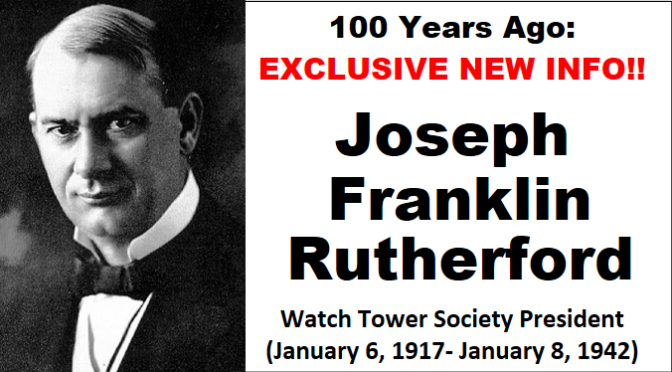
100 Years Ago: Presidential Debates – Watchtower Style

The Watch Tower Society found that debates were a fairly good way of “marketing” so that this very small religious group could make a big splash.

Russell, as president of the Watch Tower Society, had gained attention especially through the Eaton-Russell debate in 1903 and then White-Russell debate in 1908. He said that he believed the Lord’s providence had opened up the way for those two debates.

So why did Russell put the report about about the Rutherford-Troy debate in the very back as the last article of the May 1, 1915 Watch Tower? And, more importantly, why was the first article in this same issue all about downplaying the value of debates?

Some have guessed that Russell was a bit concerned about Rutherford’s brash and bombastic style, and that it probably did not represent the same style Russell himself had carefully cultivated for the Watch Tower. Russell’s emphasis was on the “high calling” in order to be part of the exclusive “Bride of Christ” and on Christian “character development.” A truly demure “Bride of Christ” would not be found “debating.” Rutherford, on the other hand, had been an experienced political speaker (working for the campaign of William Jennings Bryan). And some would conclude that his legal background as an attorney made him a professional “arguer.”

So the argument goes that Russell was becoming leery of Rutherford’s rise to power in 1915. As Russell’s attorney, he “knew where the bodies were buried” as the expression goes. (For the record, this is just an expression. I am sure there weren’t any real scandals involving dead or buried bodies in Russell’s past. Russell’s act of sending Rose Ball to Australia a few months before she might have been called upon to testify against Russell at his divorce hearing isn’t the same thing. Nor is the fact that Rose Ball’s younger brother died while working in the same house where the claimed hanky-panky with sister, Rose, had occurred.)

Rutherford was indeed becoming much more prominent in 1915, but I don’t really think that there is direct evidence of Russell having a falling out with him, or getting too worried about his rise to power and control.

Still, the general tenor of the first article was quite negative about debates in general. Here several excerpts from the first article below. Notice how the “marketing value” of the debates is the primary concern: “valuable chiefly as entering-wedges for the newspaper work.” [I’ve highlighted some of the negatives in red, and marketing advantages in blue.]

ADVANTAGES AND DISADVANTAGES OF DEBATES

Although the Lord’s providence did seem to open up the way for the “Eaton-Russell Debate” and later, for the “White-Russell Debate,” and through these Debates led the way on to the publication of the Sermons in hundreds of newspapers throughout the world, nevertheless the Editor is not, and never was, much of a believer in the advantages of debating. The Debates mentioned were valuable chiefly as entering-wedges for the newspaper work. . . . a debate . . . is also an excellent method of presenting the error to the public. . . .

An audience hearing a debate have the same difficulty that a jury has when hearing the opposing attorneys discussing the merits of a case. Each speaker has certain talent and ability, and each makes a certain amount of impression. . . .

Added to this is the fact that the debates in general are in the nature of a war of words, the disputants each seeking to undo the other’s arguments and to prove his own. In such a war of words the Truth is at a disadvantage. . . . . .our opponents seem to have no restrictions nor restraints. . . .Thus our opponents always have the advantage, not because they are intellectually brighter, but because they can and do use means to bamboozle the minds of the hearers and readers. . . .

So far as the Editor is concerned, he has no desire for further debates. He does not favor debating, believing that it rarely accomplishes good and often arouses anger, malice, bitterness, etc., in both speakers and hearers. . . .

This should not be understood to mean that the Editor would never again engage in a public debate, but merely that in order to induce him to debate, his opponent would need to be a person of so great prominence as to bring the matter to the attention of everybody. Only such a consideration would be a proper offset to the wide presentation of error thus accomplished. . . .

It’s actually a bit odd that Russell spoke out against them and then said he would do it anyway if he thought the “marketing” opportunity was worth it.

Whether Russell had noticed any dangers in Rutherford methods is hard to say. Rutherford had successfully defended Russell in court through his divorce and he had worked on mitigating other scandals. It seems likely to me that Russell was backing off of the debate scene for the same reasons that he distanced himself from the booklet “Great Battle in the Ecclesiastical Heavens.” He knew that these particular debates had to be very biased, just as the “Great Battle” booklet had to be very biased.

I am proposing that Russell realized that the debate was intended as part of  Russell’s defense campaign. These debates were designed to promote some positive publicity at a time when Russell’s scandals were becoming more and more publicized. Russell knew that these debates had been set up in a biased manner to help mask the scandals. How do we know that?

THE BIASED RULES OF THE DEBATES

Rutherford’s report was, as we pointed out, the last article in the same 1915 Watchtower. Even here, Russell repeats his negative view of debates after Rutherford’s report:

[We rejoice greatly that the blessing of the Lord was so richly with our dear Brother Rutherford on the occasion of the debates referred to above. Apparently the Lord guided these debates and blessed the outcome. However, we still feel a prejudice against public debates of religious questions, and have elsewhere expressed our reasons.]

Rutherford’s report was in the form of a letter. Below are some excerpts. Notice the methods that were enacted to “bias” the debate:

DEAR BROTHER RUSSELL:–

The debates are past history now–ending last evening. Every night the auditorium was packed, with probably more turned away than got in. . . . Certainly the Lord’s favor was with us, and the prayers of the many friends were answered. . . . The friends are all happy. . . . If the debates have accomplished no other good, I feel sure they have greatly strengthened the saints here, many testifying that the striking contrast between Truth and error has given them new zeal for service.

I must tell you how the Adversary did not succeed for once. My opponent was well prepared to assault you personally. I judged so from the interviews he had given the press two days before the debate. I said nothing then, but waited my time. About three minutes before we went on the platform for the first night’s discussion I called Brother Troy, my opponent, and two of his friends and two of our friends into a side room. You will recall that we had entered into a thousand-dollar obligation, with securities, that we would refrain from personalities. I then said: “Brother Troy, I desire to be absolutely frank with you and therefore I say this to you before we go on the platform. From your interviews with the press I judge that you intend to assault Pastor Russell from the platform. Of course, you can pursue that course if you wish, but the first time you attempt it I am going to have your bond forfeited.”

His reply was, “May I not mention his name?” “No,” I said, “not one time. I signed this agreement with you to discuss the Bible, and by that contract I am going to abide, and I shall expect you to do the same.” He said, “All right; I am ready.” We went on the platform. Not once did he mention your name throughout the four nights, but it was an awfully bitter pill for him to refrain therefrom. Having prepared along that line and being taken down so suddenly he was much disturbed and labored under much stress, as I could observe, during his first argument. I am confident the Lord directed this matter, and thus saved the debate from being an occasion for personal assault upon you.

. . .

Quite a large number of cards were turned in on each night. I have not the total here just now. I received a real blessing in the whole matter and am indeed grateful to the Lord that He has been pleased to give me this opportunity to bear witness to His great Plan.

This (Sunday) afternoon at the Shrine Auditorium we had a very good public meeting. The friends say there were about 3500 in attendance, 992 of whom turned in their addresses. This afternoon my subject was, “Babylon Before the Great Court”; and I took occasion to tell the people about the assaults the ministers were making against you personally. Several preachers were in the audience, and I stated that I would be glad to furnish a printed reply to each one of such charges. Sorry we did not have the booklet ready, but we will get it to many here when it does arrive. I hope that by the time you come the people will be more anxious to hear you than ever before. I think there are still some of the Lord’s people in this place.

I must take this occasion to say that the success of the publicity for the debates and meetings following here is due to the untiring and faithful work of our dear Brother Page Noll. He made himself very agreeable to the reporters “covering” the debates, and they were favorable to us in every way they could be. A full report of each day’s debate was published by the Express and the Tribune, and I am advised that about 75,000 extra copies were mailed out each day by the newspaper company to various parts of the world. The paper printed cards and distributed them all over the city, calling the attention of the people to the fact that verbatim copies of the debate would be in certain issues of the paper; and doubtless this sold many papers. Brother Noll had gone after the matter in a systematic manner, and the Lord surely blessed his efforts and his faithfulness. If a copy of the debates comes to your notice you will see that more space is given to my argument than to my opponent’s. That is due to the fact that I spoke with much more rapidity than did my opponent. Profiting by your experience at Cincinnati, I crowded in all that I could.

I enclose a clipping from one of the morning papers, wherein you will see that at yesterday’s meeting I spoke of the booklet I am getting out answering the slanderous charges against you. Quite a number are anxious to have these pamphlets, and I hope they may be ready soon.

Never before have I realized so fully the blessed privilege the Lord’s dear children have of praying for each other. I am sure that the prayers of the dear friends throughout the world had much to do with the success of these debates. . . . Brother Woodworth suggested that there must be great interest in Heaven in this debate. The Lord be praised for it all. I am thankful indeed that He was pleased to use me to glorify His dear name in any manner. Brothers Woodworth and MacMillan sat with me on the platform as counsel, and my son was by my side to take anything quickly that I desired and to prepare the copy for me without delay. . . . The Lord arranged it all. . . .

Please express my love to all the dear Bethel family, reserving a large portion for yourself. Please continue to remember me at the Throne of Heavenly Grace.

Yours in the service of the dear Redeemer,

J. F. RUTHERFORD.

There are quite a few lines in his report that appear to sound “self-serving.” Rutherford makes a case that he “won” the debates without question. But, of course, this has been questioned since then. The actual debate is available in several places online:

http://watchtowerdocuments.org/documents/1915_Rutherford_Troy_Debate.pdf

https://archive.org/details/RutherfordTroyDebate

The Watch Tower articles quoted above can be easily found in several places online, including:

http://www.agsconsulting.com/htdbv5/zwt0216.htm

Some interesting comments about the debate are found here:

Edmond C Gruss (Apostles of Denial, p.23)

and from a poster called “Athanasius” on JWN:

Regarding the Rutherford-Troy Debate, you might find it helpful to read the entire script. Bill Cetnar made it available in TROY DEBATES RUTHERFORD (privately published). I think that you can still order a copy from:

Cetnar

Route 3 Weir Lake Road

Kunkletown, PA 18058

The late Bill Cetnar assembled the information from the Los Angeles Express which covered the debate in great detail. Bill Cetnar makes this interesting observation in the book’s forward: “At a Bethel meeting I sat next to John Adam Baeurlein a former International Director and Officer of the Watchtower Society. He mentioned he had attended the Rutherford-Troy debates. I asked him why the Society refused to debate today. He answered: ‘Because Rutherford lost his shirt in debate with Troy.‘ . . . These remarks from this old man who spent 50 years at Watchtower Headquarters were a shock to me.”

Also, we happen to have an example of the type of agreement that Rutherford would enter into to keep the opponent from mentioning any scandals that Russell was involved in. If we read it carefully, the debater could not even quote from any Watch Tower publications. Even this would have been considered too damaging. The following is a portion of one of those “bonds” that Rutherford referred to in the Watchtower. This one comes from a debate that would have happened a few years later, if Rutherford had not created these impossible terms:

From B. H. Shadduck’s Seven Thunders of Millenial Dawn, 1928 ( https://archive.org/details/ThesevenThundersOfMillennialDawn ) we find a portion of one of these agreements:

shadduckrules

If it’s hard to read it says, in part, that Dr. Shadduck would follow certain rules, such as:

  1. … furnish a bond of $500.00 as a guarantee that he will not slander Pastor Russell during the debate, or refer to any quotation contained in any periodical or book published by the International Bible Students Association and if the Rev. B. H. Shadduck shall slander Pastor Russell or refer to any quotation or book published by the IBSA he shall at once pay the sum of $500.00 to his opponents in the debate.
  1. That it be understood that to slander means: To circulate a malicious report.

Shadduck believed these rules were meant to make it impossible to frame an argument clearly. It was clearly meant to produce the kind of legal intimidation that would become part of Rutherford’s signature style.